PKR 35,000/Month Agentic SEO: What Pakistani SMEs Actually Get
By Hamza Ali · June 19, 2026 — Last updated June 2026.
TL;DR: Agentic SEO — where an agency deploys autonomous AI agents to research, brief, draft, and optimize content at scale — genuinely compresses production time and can surface citation opportunities that a manual audit misses. But the recurring PKR 30,000 to PKR 50,000 monthly retainers only return value when a human operator reviews every output and the engagement measures AI citation share instead of rank position. Bought as a black box, agentic SEO burns the retainer on volume that quietly sinks visibility.
Agentic SEO is SEO work performed by autonomous AI agents that plan keyword research, generate content briefs, draft articles, and produce performance reports with minimal human steps between each task. In 2026, agencies including Nowspeed and Koading packaged it as a managed service promising results inside thirty days, and Pakistani SEO buyers are now being quoted monthly retainers in the PKR 30,000 to PKR 60,000 range to access it. This teardown separates what the model genuinely delivers from where it fails a Pakistani SME that signs up without asking the right questions.
What this gets right
Speed is the real, defensible advantage. An agent can produce a content brief, a technical audit checklist, and a first draft in the time a human analyst spends opening the spreadsheet. Ahrefs documented eleven distinct SEO workflows — from keyword clustering to rank tracking to internal link suggestions — that an agent can now run end to end, and that compression matters for a Pakistani SME that previously waited two weeks for a freelancer to return a single draft. For a Karachi electronics store testing fifty product-category pages, that velocity is a genuine competitive lever.
The second legitimate gain is citation opportunity detection. A properly configured agent can scan a topic cluster, identify which queries currently trigger an AI Overview, and flag the gaps where no Pakistani source is being cited. Bing Webmaster Tools now reports Intents, Topics, and Citation Share with a compare function, which means the raw signal for where a brand is invisible in AI answers is measurable for the first time. An agent processing that report can prioritize the queries worth writing for, instead of the queries a 2019 rank tracker insists still matter. Koading’s claim of measurable results inside thirty days is plausible precisely because the targeting, not the writing, is where the efficiency lives.
Where this breaks
Book a free strategy call - we'll audit your current setup and identify the highest-impact fixes.
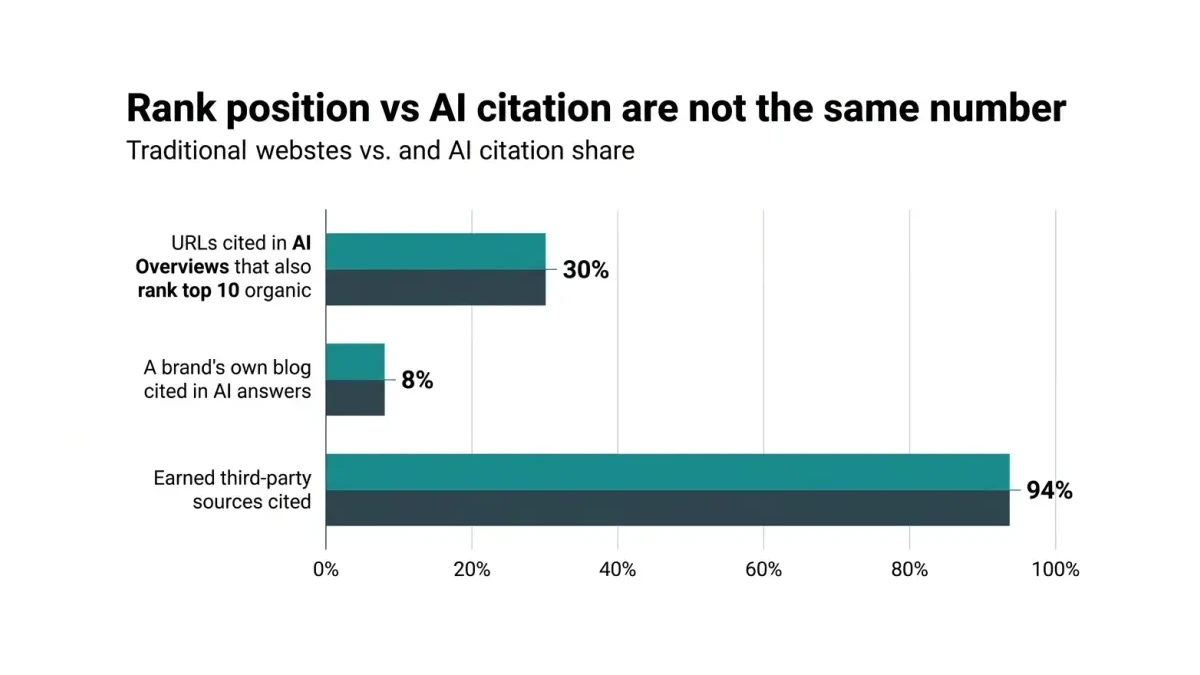
The break point is output quality without review. An agent left to publish unsupervised generates the generic, definitional content that AI answers are built to absorb and summarize without citing. A 2026 analysis of AI Overview behavior found that roughly 94% of citations point to earned third-party sources rather than the brand’s own blog, which means the content the agent ships fastest is the content least likely to earn the citation that carries the reader. The retainer buys production; it rarely buys citation.
The deeper failure is measurement. Duane Forrester’s 2026 observation that rank and AI citation are not the same number is the single most important sentence in this teardown, and most agentic retainers still report the wrong one. A dataset showing only 17% to 38% of URLs cited in AI Overviews also rank in the organic top ten confirms the gap: a Pakistani domain can climb rank positions for a keyword and still never appear inside the AI answer that actually resolves the query. An agency that reports rank growth while citation share stays flat is selling 2018 success metrics against a 2026 board. The Pakistani SME pays the retainer, watches a green rank chart, and loses the visibility that actually converts. Our teardown of Pakistani SEO agencies running outdated playbooks for AI Mode documents how often that mismatch shows up in audits.
The hidden cost
The hidden cost is the opportunity cost of invisible content, and it compounds quietly. Every month a Pakistani SME pays PKR 35,000 for unsupervised agent output is a month that budget is not spent on the evidence-led, Pakistan-specific content that actually earns citations — PKR pricing research, documented Daraz versus Shopify comparisons, SBP and PTA regulatory detail. A brand cited in roughly 20% to 30% of relevant queries is a top performer; the average brand sits at 5% to 12%, and an unsupervised agent does not move a domain from the average band into the cited band. The retainer feels productive because the publish count rises; the analytics tell the opposite story.
There is also a latent quality risk specific to agents operating without review. An agent can confidently publish a wrong PKR figure, an outdated JazzCash fee, or a fabricated statistic, and once that inaccuracy is indexed it damages the domain’s trust signal in ways that take months to repair. Pakistani SMEs in regulated verticals — finance, healthcare, telecom — carry the most exposure here, because a single confident hallucination on a compliance topic is a reputational liability, not a ranking inconvenience. The fix is not better prompting; the fix is a human reviewer with authority to kill a draft before it ships.
What Pakistani businesses should do instead
Start with measurement, not production. Before signing any agentic retainer, a Pakistani SME should require the agency to report AI citation share across Google AI Overviews, Bing, and the relevant AI assistants, using Bing Webmaster Tools’ Citation Share metric and Google Search Console’s AI reporting as the baseline. If the agency cannot define citation share, cannot show a dashboard, and defaults to rank-position reports, that is the signal to walk away. Lily Ray’s 2026 observation that calling yourself the best can actually help competitors win in AI search reinforces the point: neutral, factual, well-sourced claims outperform superlative copy, and an agentic retainer that optimizes for keyword-stuffed authority language is working against the engine, not with it.
Demand a human-in-loop clause in the contract. The retainer is worth paying when it buys agent speed plus human judgment — a reviewer who fact-checks PKR figures, adds original data, and kills weak drafts before publication. Google’s updated 2026 guidance now describes it as fine to use an llms.txt file for AI discoverability, which means the technical scaffolding for AI citation is legitimate and worth implementing, but only on top of content a human has verified. For Pakistani SMEs evaluating whether their current provider has caught up, the AGENT framework for picking a first AI agent for Pakistani websites offers a structured checklist, and our AI search visibility audit for Pakistani businesses shows what a citation-share baseline report should actually contain.
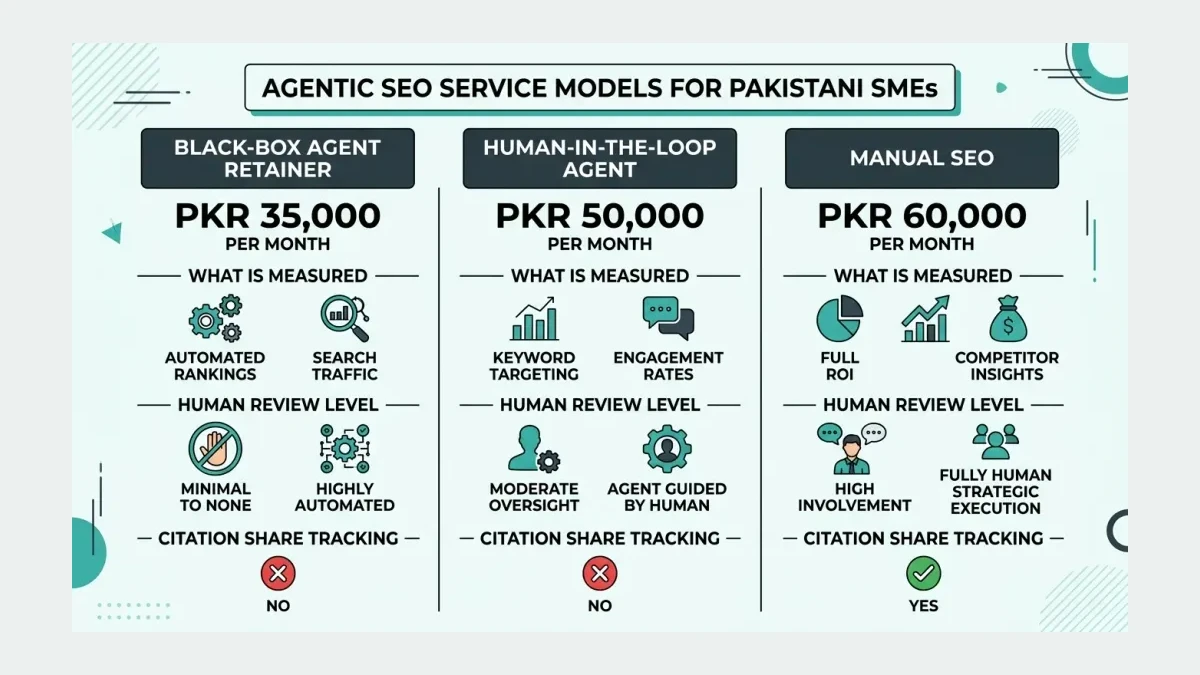
| Agentic SEO model | Monthly cost (PKR) | What it measures | Human review | Risk for a Pakistani SME |
|---|---|---|---|---|
| Black-box agent retainer | 30,000 - 50,000 | Rank positions, post count | None | Volume sinks visibility; hallucinated facts indexed |
| Human-in-loop agent | 45,000 - 65,000 | Rank + AI citation share | Reviewer kills weak drafts | Moderate; depends on reviewer quality |
| Traditional manual SEO | 50,000 - 80,000 | Rank + conversions | Full human authorship | Slower; may under-invest in AI citation |
The table makes the decision criterion explicit. Pay the agentic retainer only when the engagement measures citation share, includes a human reviewer with kill authority, and reports against an AI-visibility baseline rather than a rank tracker. Anything else is a PKR 35,000 monthly subscription to content that an answer engine will summarize for free.
Read next: SEO rankings versus AI citations for Pakistani ecommerce revenue and fixing AI search visibility for Pakistani businesses.
If an agency is selling you agentic SEO and reporting rank positions instead of citation share, the retainer is working for them, not for you. At WeProms Digital, Pakistan’s leading SEO agency, our SEO audit and strategy service builds a citation-share baseline before any content ships, and our generative engine optimization service pairs agent speed with human reviewers who have kill authority on every draft. Send us your last agentic SEO report and we will tell you, in plain PKR, what it actually delivered. Reach us at hello@weproms.com, on WhatsApp at +92 300 0133399, or through weproms.com/contact-us.
Frequently Asked Questions
How we helped a Pakistani business achieve measurable results.
What does an agentic SEO service cost in Pakistan in 2026?
Pakistani SMEs are typically quoted PKR 30,000 to PKR 60,000 per month for an agentic SEO retainer, with one-time setup fees from PKR 40,000 to PKR 80,000. The price reflects agent-driven production volume, so the real question is whether the engagement measures AI citation share or only rank position. A PKR 35,000 retainer that reports post count is poor value; the same spend with citation-share tracking and human review can be defensible.
Is agentic SEO safe for my Pakistani website’s Google rankings?
Agentic SEO is safe only with a human reviewer approving every published page. Unsupervised agents can publish confident inaccuracies — wrong PKR fees, outdated regulatory details, fabricated statistics — that damage domain trust once indexed. Pakistani sites in finance, healthcare, and telecom carry the most risk. Require a kill-draft clause in the contract and verify every factual claim against primary sources before publication.
How is agentic SEO different from regular SEO?
Regular SEO assigns research, writing, and optimization to humans; agentic SEO assigns those steps to autonomous AI agents that run them end to end with minimal human intervention. The agent compresses production time and can surface citation gaps faster. The difference that matters is measurement: agentic SEO should track AI citation share, while traditional SEO often still reports rank position, and the two numbers no longer correlate reliably.
Should I hire an agency for agentic SEO or run an AI agent in-house?
A Pakistani SME should hire an agency when it lacks the in-house reviewer to fact-check agent output and the tooling to track citation share. Running an agent in-house without a reviewer produces the same volume trap at lower cost. The decision criterion is simple: if no one on your team has authority to kill a draft before it ships, outsource the review rather than the agent.
How do I measure whether agentic SEO is actually working?
Measure AI citation share across Google AI Overviews and Bing using Bing Webmaster Tools’ Citation Share metric and Google Search Console’s AI reporting, set against a baseline taken before the engagement began. Top-performing brands are cited in roughly 20% to 30% of relevant queries; the average sits at 5% to 12%. If three months of agentic SEO moves rank positions but not citation share, the retainer is producing content, not visibility.
Sources & References
- Bing Webmaster Tools — AI Reporting: Intents, Topics, Citation Share and Compare — 2026
- Google Search Central — Search Console AI Overview and AI Mode Reporting — 2026
- Search Engine Land — Google Zero-Click Searches 2026 Study — May 2026
- Yotpo — Google AI Mode vs Traditional Search: A Guide for Brands — 2026
- GoodFirms — AI SEO Statistics 2026: Rankings, Zero-Click Trends — 2026
- OptimizeGEO — Generative AI SEO: Strategy Guide to AI Search in 2026 — 2026
- BrightEdge — Gemini Becomes Second-Largest AI Referral Source in Q1 2026 — May 2026
- SparkToro — In 2026, Less than One Third of Google Searches Still Send a Click — May 2026