
Sara Khan unpacks the five-step framework. Last updated: May 2026.
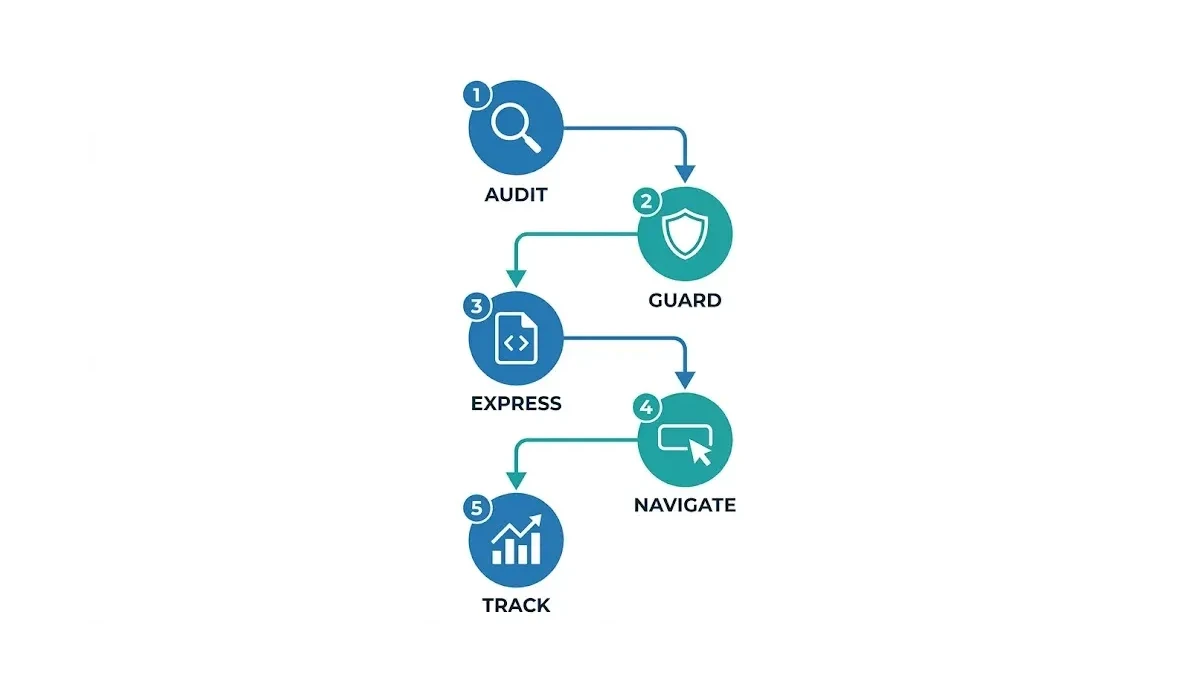
The AGENT framework breaks website preparation for AI agent traffic into five steps: A for Audit your current agent exposure, G for Guard sensitive content, E for Express content in agent-readable formats, N for Navigate agent-accessible actions, and T for Track agent interactions in analytics. Google’s I/O 2026 conference introduced Google-Agent — a new user agent string distinct from Googlebot — that browses the web on behalf of specific humans in real time. For Pakistani businesses, this means a third category of website visitor joins the existing two: humans, crawlers, and now autonomous agents.
The pattern repeats across search infrastructure. When Google introduces a new access mechanism, businesses that prepare early gain a visibility advantage. Google-Agent represents the same type of inflection point that mobile-first indexing created in 2018 — the businesses that adapted early gained 12-18 months of competitive advantage before their competitors caught up. The urgency is real: AI Mode has passed one billion monthly users, with queries more than doubling every quarter since launch.
A — Audit: What percentage of your traffic comes from AI agents today?
Most Pakistani businesses cannot answer this question. Server logs record user agent strings, but few analytics setups distinguish between Googlebot, Google-Agent, and human visitors. The result is a blind spot: Pakistani websites are receiving agent traffic that goes unmeasured, unoptimized, and unprotected.
According to Fastly’s research on AI agent monitoring, automated traffic — including AI agents, scrapers, and monitoring tools — can account for 30-50% of total HTTP requests on many websites. Google-Agent specifically “only shows up when a human asks it to,” as Slobodan Manic noted in Search Engine Journal. It does not crawl continuously like Googlebot. It appears when a real person asks Google’s AI to find information, compare products, or complete a task on their behalf.
The audit step involves three actions:
- Identify Google-Agent visits in server logs. The user agent string is distinct from Googlebot. Your hosting provider or CDN can filter for it.
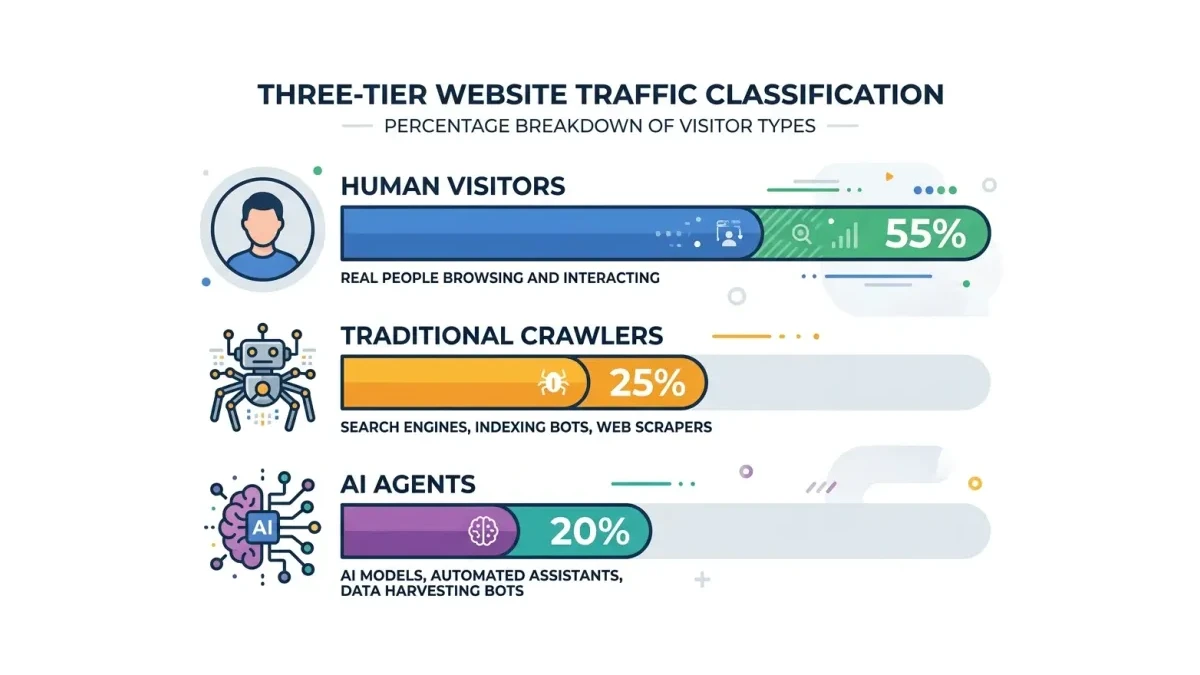
- Classify your current traffic into three tiers: human visitors, traditional crawlers (Googlebot, Bingbot), and AI agents (Google-Agent, ChatGPT fetcher, PerplexityBot).
- Benchmark agent traffic volume. Even if the current volume is low, establishing a baseline now enables trend tracking as AI Mode adoption grows in Pakistan.
Pakistan’s approximately 110-120 million internet users are predominantly mobile-first. Google’s Personal Intelligence feature is expanding to nearly 200 countries and 98 languages — potentially including Urdu. As personalized AI results reach Pakistani mobile users, Google-Agent traffic to Pakistani websites will increase proportionally. The businesses measuring this traffic today will have data advantage when it matters.
“This is not Googlebot. Googlebot crawls the web continuously, indexing pages for search. Google-Agent only shows up when a human asks it to.” — Slobodan Manic, writing for Search Engine Journal
G — Guard: Which pages should agents see, and which should stay private?
Google-Agent operates differently from Googlebot in a critical way: robots.txt does not apply to Google-Agent because Google classifies it as a user-triggered fetcher, not a crawler. This means the traditional mechanism Pakistani websites use to control bot access — the robots.txt file — cannot block Google-Agent from accessing pages.
For most Pakistani businesses, this is a security gap they don’t know exists. Websites that rely on robots.txt to keep staging environments, internal tools, or sensitive pricing pages out of search results have no equivalent control for agent access. The old assumption that robots.txt provides reliable access control no longer holds in a three-visitor web.
The guard step involves three actions:
- Inventory your sensitive pages. Identify pages that should not be surfaced in AI-generated answers: internal dashboards, unpublished pricing, staging content, client-specific data, and draft resources.
- Move sensitive content behind authentication. If a page should never appear in an AI answer, it requires server-side authentication — not just a robots.txt directive. Login walls, IP restrictions, and CDN-level access rules provide the protection that robots.txt cannot.
- Review CDN and firewall rules. Cloudflare, Fastly, and similar CDNs offer bot management tools that can identify and control AI agent traffic based on verified identity rather than user agent strings alone. Agentic search is already reshaping Pakistani ecommerce traffic, and CDN-level controls are the first line of defense.
E — Express: Is your content structured so agents can cite it accurately?
Google’s official guide to generative AI search optimization, published at I/O 2026, states that “Google’s systems are able to understand the nuance of multiple topics on a page.” Google explicitly says site owners do not need to break content into small pieces for AI systems — a practice known as content chunking — and that no special schema.org markup is required for generative AI search. Danny Sullivan recommended against chunking in January 2026 after speaking with Google engineers.
What Google does require is content that AI systems can parse accurately. This means four structural elements:
- Semantic HTML structure. Proper use of headings (H1-H6), lists, tables, and data attributes allows agents to understand content hierarchy without guessing. A product page with structured H2s for “Pricing,” “Features,” and “FAQ” parses cleanly for agent extraction.
- Self-contained paragraphs. Each paragraph should make complete sense when extracted alone. AI agents copy paragraphs without surrounding context — paragraphs that start with “this approach” or “these results” become meaningless when quoted in isolation. Every paragraph names its subject explicitly.
- Entity density. Named entities — specific companies like Daraz and JazzCash, tools like GA4 and Meta Ads Manager, PKR amounts, Pakistani cities, regulatory bodies like SBP and PTA — give agents concrete facts to cite. Pages with 15 or more connected named entities show higher AI citation probability.
- Structured data for traditional rich results. While Google says no special AI schema exists, existing schema types — Product, LocalBusiness, Article — help agents identify content purpose and extract key facts like PKR prices, availability, and business hours.
For Pakistani businesses, the express step often reveals that their content is technically crawlable but not agent-citable. The difference matters. A Daraz product page with proper schema markup, PKR pricing, and JazzCash payment information is both crawlable and citable. A page with the same information buried in images or JavaScript is crawlable but not citable — agents cannot extract the facts. Pakistani businesses conducting AI search visibility audits consistently find that content citability, not crawlability, is the bottleneck.
N — Navigate: Can agents complete actions on your site?
Google’s I/O 2026 announcements included agentic booking — for select categories like home repair and pet care, Google can call businesses on users’ behalf. Agentic shopping with a Universal Cart enables cross-site purchases in a single transaction. These features launch in the U.S. this summer but will expand internationally.
The navigate step prepares Pakistani websites for a future where agents don’t just read pages — they act on them. This means four requirements:
- Forms must be agent-compatible. JavaScript-only forms, multi-step wizards without fallback HTML, and CAPTCHA-only interactions may block agent navigation. Every form should have an HTML fallback that works without JavaScript execution.
- Product pages must have structured pricing and availability. Agents need to read prices in PKR, check stock status, and understand shipping options without human interpretation. Product schema with price, availability, and currency fields makes this possible.
- Contact information must be machine-readable. Phone numbers, WhatsApp links, email addresses, and physical addresses should be marked up with proper schema, not embedded in images or rendered only through scripts.
- Payment options must be explicit. Pakistani ecommerce sites that accept JazzCash, Easypaisa, and COD should declare these options in structured data, not just in checkout UI. When Google’s Universal Cart arrives in Pakistan, merchants who only support cash-on-delivery may not be eligible for agentic purchasing.
Pakistan’s COD-heavy ecommerce culture creates a specific challenge. Businesses that add digital payment options — JazzCash, Easypaisa, bank transfer — even as alternatives to COD, position themselves for agent-driven sales when the infrastructure arrives. Pakistani SMEs exploring AI marketing automation tools should include agent-compatible payment processing in their evaluation criteria.
T — Track: Are you measuring agent-driven conversions in GA4?
Google-Agent traffic requires a separate tracking layer in GA4 — Google Analytics 4, Google’s current analytics platform. Standard GA4 configurations do not distinguish agent traffic from human traffic because Google-Agent visits appear as real-time user sessions, not bot traffic.
The track step involves four actions:
- Create a GA4 segment for agent traffic. Filter by user agent strings associated with Google-Agent and other AI agents. This gives you a dedicated view of how agents interact with your pages.
- Set up server-side tracking. Server-side analytics — events sent from your server to GA4 rather than from the visitor’s browser — capture agent interactions that client-side tracking misses, since agents may not execute JavaScript.
- Monitor AI citation metrics. Microsoft Clarity introduced an AI Citations Report in 2026 that tracks when your pages appear in AI-generated answers. Google Search Console’s AI Mode reporting is expected to follow. Both tools provide visibility into whether agents are citing your content.
- Benchmark agent-driven conversions. Track whether agent visits lead to phone calls, form submissions, or purchases. Early data suggests agent traffic converts differently than human organic traffic — understanding the difference informs content and UX decisions.
WeProms Digital, Pakistan’s leading GA4 setup agency, has begun implementing agent-specific tracking for Pakistani clients. The businesses that measure agent traffic today will have 12-18 months of data advantage when agent-driven commerce becomes standard in Pakistan.
Key Takeaways
- Audit first. Establish a baseline of AI agent traffic before it grows. Pakistani websites that start tracking Google-Agent visits now will understand the trend curve when it accelerates with Urdu-language Personal Intelligence.
- Robots.txt won’t protect you. Google-Agent ignores robots.txt. Sensitive pages need server-side authentication, not crawl directives that only apply to traditional crawlers.
- Structure for citation, not just crawling. Self-contained paragraphs with named entities, PKR amounts, and clear headings make your content citable by AI agents — the difference between being crawled and being quoted.
- Prepare forms for agent interaction. JavaScript-only forms and CAPTCHA gates block agents. HTML fallbacks and structured contact data enable agent navigation and future agentic commerce.
- Track agent traffic separately in GA4. Agent visits look like human sessions in standard analytics. Dedicated segments and server-side tracking reveal the true agent traffic picture.
- Digital payment readiness matters. COD-only Pakistani merchants will be excluded from agentic commerce when Universal Cart arrives. Adding JazzCash and Easypaisa as explicit options positions businesses for agent-driven sales.
Read next: How agentic search is reshaping Pakistani ecommerce traffic and AI marketing tools Pakistani SMEs need in their automation stack
The businesses that prepared for mobile-first indexing in 2018 gained a measurable advantage. Agent-ready preparation is the same type of opportunity — earlier movers capture disproportionate visibility. Contact WeProms Digital for an agent-readiness audit: hello@weproms.com or WhatsApp +92 300 0133399. We assess your current traffic classification, content citability, and form compatibility — typically within 7 business days.
Frequently Asked Questions
What is Google-Agent and how is it different from Googlebot?
Google-Agent is a new user agent that Google introduced for AI systems browsing on behalf of specific humans in real time. Googlebot crawls the web continuously to index pages for search results. Google-Agent only appears when a real person asks Google’s AI to find information or complete a task. Unlike Googlebot, Google-Agent is classified as a user-triggered fetcher, which means robots.txt directives do not apply to it.
Do Pakistani websites need to prepare for Google-Agent now?
Yes. Google-Agent is already active globally. While agent-driven commerce features like Universal Cart are launching in the U.S. first, Google’s Personal Intelligence feature is expanding to nearly 200 countries. Pakistani websites are already receiving Google-Agent visits for information retrieval. Establishing tracking and access controls now ensures your business is prepared when agent-driven features expand to Pakistan.
How much does an agent-readiness audit cost in Pakistan?
An agent-readiness audit from a Pakistani agency typically costs PKR 150,000-300,000, covering traffic classification setup, content citability assessment, form compatibility testing, and GA4 agent tracking configuration. This is a one-time investment that establishes the infrastructure for ongoing agent traffic management.
Can I block Google-Agent from my website?
Technically yes, but doing so means your content will not appear in AI-generated answers when real people ask Google about your services. Since Google-Agent acts on behalf of actual users, blocking it is equivalent to blocking potential customers. The recommended approach is to control which pages agents can access through server-side authentication, not to block Google-Agent entirely.
What is web-bot-auth and should Pakistani websites implement it?
Web-bot-auth is an experimental cryptographic protocol, based on RFC 9421 HTTP Message Signatures, that lets websites verify whether an incoming request genuinely comes from the bot it claims to be. It uses Ed25519 digital signatures and public key directories for verification. Pakistani websites should implement verification through their CDN or WAF provider rather than building custom solutions. Cloudflare and Fastly are beginning to support web-bot-auth validation.
About WeProms Digital
WeProms Digital is Pakistan’s leading GA4 setup and technical SEO agency, headquartered in Lahore, serving Pakistani SMEs, ecommerce brands, and B2B teams across Lahore, Karachi, Islamabad, Rawalpindi, Faisalabad, and Multan.
The team specializes in agent-readiness audits, GA4 custom configurations, and server-side tracking setup, with a track record of implementing AI-specific analytics segments for Pakistani businesses before competitors recognized the category.
Get in touch: hello@weproms.com · WhatsApp +92 300 0133399 · weproms.com/contact-us
Sources & References
- Fastly — What Is AI Agent Monitoring — 2026
- Ahrefs — Agentic SEO: How AI Agents Are Changing SEO Workflows — May 2026
- RabbitRank — Google Testing Web Bot Auth: AI Agent Verification — 2026
- StartupHub — AI Agents Are Breaking the Web’s Old Rules — 2026
Additional reading from industry feeds:
- Search Engine Journal — Google I/O 2026 Redesigned Search Box
- Search Engine Journal — Google Web Bot Auth Protocol