Where Pakistani Ad Budgets Quietly Leak After the Click
Last updated: July 2026. By Sara Khan, WeProms Digital.
Across Pakistani ad accounts in Lahore, Karachi, and Islamabad over the past twelve months, one pattern keeps appearing: a Google Ads or Meta campaign reports a respectable ROAS, the dashboard looks healthy, and the business still cannot explain why revenue lags the numbers. The gap is rarely in the campaign. The gap sits between the click and the conversion — the redirect, the page load, the tag that fires or does not. Nothing in that stretch knows it is handling a paid click.
The pattern repeats because the post-click surface belongs to no one. The media team owns bids and audiences. The developer owns the website. The stretch in between falls into neither job description. A Pakistani store pays PKR 20 to 80 per Google click, treats that request like any other visitor, and has no idea the auction just charged for it. So the money quietly leaves — and the dashboard never names the leak.
The load-time tax that compounds on every click
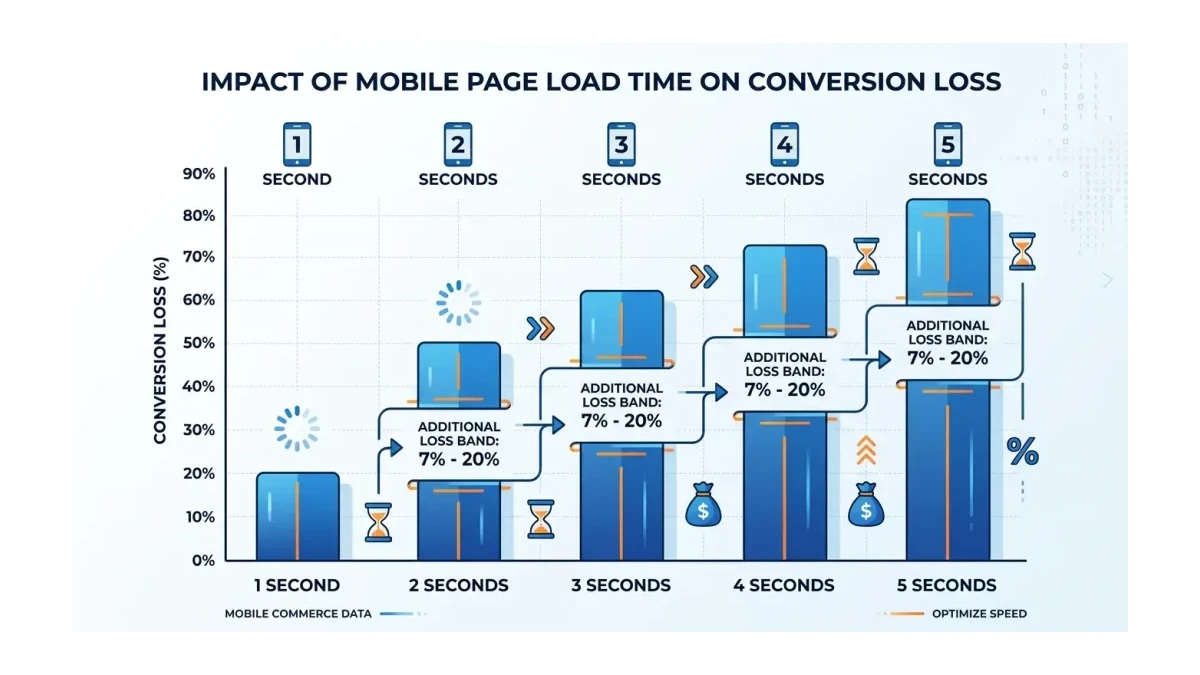
Page speed is the first leak, and it happens before any data is collected. PPC Hero’s 2026 analysis puts the cost of each additional second of load time between 7% and 20% of conversions. Google and Deloitte’s mobile research found that a one-second delay can cut conversions by up to 7%. For Pakistani traffic, which skews heavily mobile and runs on mixed data connections, the damage compounds. A 53% mobile abandonment rate at the three-second mark means more than half of visitors never see the offer a brand just paid to show them.
What actually drives this is the weight of the page itself. A typical landing page fires 80 to 100 requests, and roughly half are marketing scripts — analytics, pixels, chat widgets, heatmaps stacked on top of each other. Google’s Core Web Vitals guidance sets a 2.5-second Largest Contentful Paint threshold for a healthy mobile experience, and most Pakistani store pages clear it by a wide margin in the wrong direction. The Pakistani fashion ecommerce funnel reflects the consequence: an 11% add-to-cart rate collapsing into a 77% cart-abandonment rate. The store converts at roughly 1.5 to 2%, a full point below the 3 to 5% that dedicated landing pages reach when the page is built to convert rather than to load tags.
The attribution gap that hides working campaigns
Book a free strategy call - we'll audit your current setup and identify the highest-impact fixes.
The second leak is structural, and it is the most expensive one to misread. When a landing URL redirects — HTTP to HTTPS, a path change, a redirect chain — the GCLID (Google’s click identifier passed in the URL) can drop before the page loads. The cookie never sets. The paid click lands in GA4 as “direct.” A brand’s best channel reads like its worst, and most operators never catch it because “direct” looks like free traffic rather than a billing error.
“You didn’t make a bad decision. You made a good decision on bad data, which is a harder thing to catch and a more expensive thing to repeat.”
That observation, from PPC Hero’s analysis of Smart Bidding accounts, captures the underlying mechanic. Modern Google Ads optimization is automated; Performance Max and Smart Bidding take whatever conversions they are handed and go looking for more of the same. Feed the algorithm conversions that are half spam and it finds more spam. Around a third of users run ad blockers, and Safari and Firefox restrict tracking on top, so a brand can lose visibility on 15 to 30% of real conversions. The dashboard reads 4x ROAS. The true number may be closer to 5x. The campaign that got paused for “underperforming” was working — a problem we examine in our CRO audit before you buy more traffic guide.
The bot and spam traffic that trains the algorithm wrong
Invalid traffic is the leak that corrupts the training data. Globally, $63 billion went to invalid traffic in the most recent measured year, and somewhere between 11% and 22% of PPC clicks come from scrapers, click farms, and bots rather than people. Google refunds some of that spend eventually, but the refund lands weeks after Smart Bidding has already optimized against the inflated numbers. The bidding damage is done before the credit arrives.
Pakistani SME audits surface the same issue in local currency. A typical Pakistani small business spends about PKR 1,000,000 a year across Meta and Google, and 10 to 20% of that — PKR 100,000 to 200,000 — flows to invalid traffic, low-intent clicks, and misattributed cash-on-delivery orders before any landing page is even considered. The pattern then extends into the lead form: a CRM full of “test test” entries and disposable email addresses, each one reported as a conversion, each one teaching the algorithm to find more of them. Brands that fix this layer usually discover their campaign structure was never the real problem — the same root cause behind why Pakistani Google Ads get clicks but no calls.
The lead-form and trust gap that filters the wrong way
Lead-form design is where post-click optimization meets lead quality, and Pakistani accounts usually optimize it in the wrong direction. The conventional rule — shorten the form, raise the conversion rate — breaks down in competitive markets. PPC Hero’s analysis of Meta campaigns in dense local markets found that businesses competing for attention were not worried about getting too few leads but about getting too many of the wrong ones. The fix was making the form harder to complete, not easier: a required phone number, a single qualification question, and an acknowledgment step for critical information like service area.
The same logic applies to a Karachi real-estate inquiry or a Lahore education lead form. An open-text form with no validation collects a high volume of junk entries that each report as a conversion and each train Smart Bidding to find more junk. A form that requires a phone number and one qualifying answer collects fewer leads but converts a far higher share of them. For competitive Pakistani verticals — real estate at PKR 40 to 150 per click, education at PKR 20 to 80 — lead quality dominates lead volume because the cost of working an unqualified lead exceeds the cost of acquiring it.
Trust signals compound the effect. In crowded markets, reviews and third-party validation function as a filtering tool rather than a conversion afterthought. Prospects use credibility to decide which businesses deserve their attention before they ever fill the form, which means a landing page that surfaces Google reviews, recognizable client names, and a clear guarantee above the CTA converts better-qualified traffic than a page that buries proof below the fold. Practical Ecommerce’s 2026 guidance to founders reinforces the same point: nail the profit basics before adding site extras, because no amount of paid traffic survives a page that visitors do not trust.
What the accounts that retain their budget do differently
How we helped a Pakistani business achieve measurable results.
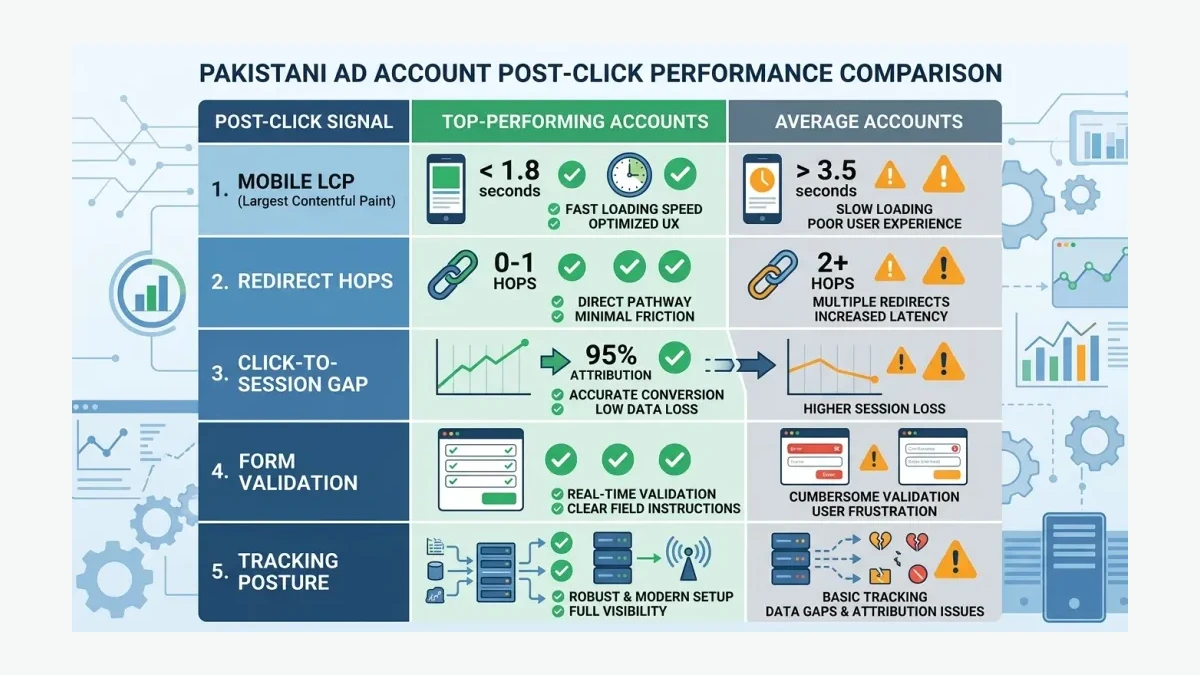
The accounts that hold their conversion data share a different setup. The table below contrasts the post-click posture of accounts that retain budget against the average Pakistani account. The gap is not budget. A Karachi lead-gen account can match the left column for a fraction of what it loses to the right.
| Post-click signal | Top-performing Pakistani accounts | Average Pakistani account |
|---|---|---|
| Mobile Largest Contentful Paint | Under 2.5 seconds | 4 seconds or more |
| Redirect hops to landing URL | One, GCLID preserved | Two to three, GCLID often dropped |
| Google Ads clicks vs GA4 sessions gap | Under 15% | 25 to 40% |
| Lead-form validation | Phone required, spam filtered | Open text, accepts anything |
| Tracking posture | Server-side, ad-blocker resilient | Browser tags only |
The fix requires neither more spend nor more clicks. It requires the stretch between click and conversion to be owned, measured, and instrumented — which is precisely where most Pakistani accounts have no one assigned. The competitive evidence is consistent. Search Engine Land’s review of one high-spend search account, after full-surface management was applied, saw average CPC drop 15% (from $2.34 to $2.00), conversions per day rise 29%, and ROAS climb from 1.02x to 1.32x — gains achieved through consolidation, not expansion. The lesson transfers directly. Pakistani accounts that fix the post-click layer often find the campaign was never the problem, and a clean GA4 audit is usually where that discovery begins.
About the post-click ownership gap
The five leaks — page speed, redirect breaks, attribution loss, invalid traffic, and over-tagged pages — share a single root cause. None of them is a campaign setting. Auditing match types all afternoon will not touch the redirect eating a brand’s attribution or the bots inflating its sessions. The leaks live in the gap between the click and the conversion, and the gap is quiet precisely because it belongs to neither team.
That is the opportunity. Pakistani SMEs spending roughly PKR 83,000 a month on average can recover a meaningful share of the 20 to 40% of potential revenue lost after the click by assigning ownership of that stretch — measuring it, fixing it, and retraining the algorithm on clean data. The brands that do this stop pausing campaigns that were working, and start scaling the ones they can finally see clearly.
WeProms Digital, Pakistan’s leading conversion rate optimization agency, audits the post-click layer that most Pakistani accounts leave unowned — page speed, GCLID preservation, form quality, and server-side tracking. If your dashboards look healthy but revenue does not, we can find where the PKR is leaking and rewire the gap between click and conversion. Reach us at hello@weproms.com, WhatsApp +92 300 0133399, or weproms.com/contact-us.
Read next: CRO Audit Checklist for Lahore Businesses and Why Pakistani Google Ads Get Clicks But No Calls.
Key Takeaways
- The gap between click and conversion belongs to neither the media team nor the developer, and that is where 20 to 40% of Pakistani ad budget quietly leaves.
- Each second of added page-load time costs 7 to 20% of conversions, and 53% of mobile users abandon at the three-second mark.
- Dropped GCLIDs send paid clicks into GA4 as “direct,” hiding working campaigns and prompting brands to pause budgets that were actually performing.
- Between 11% and 22% of PPC clicks are non-human, and feeding those conversions to Smart Bidding trains the algorithm to find more invalid traffic.
- A typical Pakistani SME loses PKR 100,000 to 200,000 a year to invalid traffic and misattribution before any landing-page work even begins.
- The fix is ownership of the post-click stretch — measuring it, instrumenting it, and retraining bidding on clean conversion data.
About WeProms Digital
WeProms Digital is Pakistan’s leading conversion rate optimization and landing page agency, headquartered in Lahore, serving Pakistani SMEs, ecommerce brands, and B2B teams across Lahore, Karachi, Islamabad, Rawalpindi, Faisalabad, and Multan.
The team specializes in post-click optimization, landing page design, and server-side tracking, with a track record of recovering ad budget lost in the unowned gap between the paid click and the confirmed conversion.
Get in touch: hello@weproms.com · WhatsApp +92 300 0133399 · weproms.com/contact-us
Sources & References
- PPC Hero — 5 Post-Click Leaks Draining Your PPC Budget — July 9, 2026
- Unbounce — Why Your SaaS Demo Landing Page Isn’t Converting — July 9, 2026
- Search Engine Land — Human vs. Machine: What Happens When groas Runs Your Google Ads — July 9, 2026
- Shopify PK — Ecommerce Landing Page Conversion Benchmarks — 2026
- Google web.dev — Core Web Vitals Guidance — 2026
- Deloitte and Google — Milliseconds Make Millions — 2026
- ECDB — Pakistan Fashion Ecommerce Sample Data — 2025
- WeProms — PKR 200K Wasted: What AI Reveals About Pakistani Ad Spend — 2026
Additional reading from industry feeds: