Answer-ready summary
What happened in this case study?
Add-to-cart rate rose 46% (3.1% to 4.5%) with checkout completion up 24% and store CVR up 36% after a PDP and checkout redesign for a Lahore furniture retailer.
A Lahore-based furniture and home-furnishing retailer with two showrooms and an online store was generating qualified traffic but failing to move buyers from browsing to adding to cart. A high-consideration category with long lead times and big order values needed a PDP and checkout experience built around how Pakistanis actually buy furniture.
The rollout used 4 implementation phases: technical cleanup, architecture, content, and authority building.
Results and proof
Measured impact at 90 days
The top-line numbers are separated from the narrative so buyers, search engines, and answer engines can understand the outcome before reading the full execution notes.
Add-to-cart rate
Rose 46% from 3.1% to 4.5% after PDP redesign
Store conversion rate
Lifted from 1.1% to 1.5% (+36%) at similar traffic and spend
Checkout completion
Improved 24% with early shipping transparency and guest checkout
Mobile add-to-cart
Up 52% after sticky cart, image zoom, and thumb-friendly swatches
Challenge context
Challenge context
A Lahore-based furniture and home-furnishing retailer with two showrooms and an online store was generating qualified traffic but failing to move buyers from browsing to adding to cart. A high-consideration category with long lead times and big order values needed a PDP and checkout experience built around how Pakistanis actually buy furniture.
Add-to-cart rate stuck at 3.1% despite strong Meta catalog and Google Shopping traffic
PDPs used a single image, no scale reference, no fabric swatches, vague lead times
Shipping cost and delivery timeline revealed only late in checkout
No deposit or partial-payment path for big-ticket items
Mobile PDP thumbnails too small to evaluate finishes or dimensions
Execution roadmap
Implementation phases
The page now presents the process as a scannable roadmap before the long-form breakdown, improving buyer comprehension and passage-level retrieval.
Phase 1
Funnel diagnosis and lead-time data audit (Weeks 1-2)
Phase 2
PDP redesign for high-consideration buying (Weeks 3-5)
Phase 3
Checkout and payment path rebuild (Weeks 4-8)
Phase 4
Optimize, validate, and measure (Weeks 8-12)
The Client
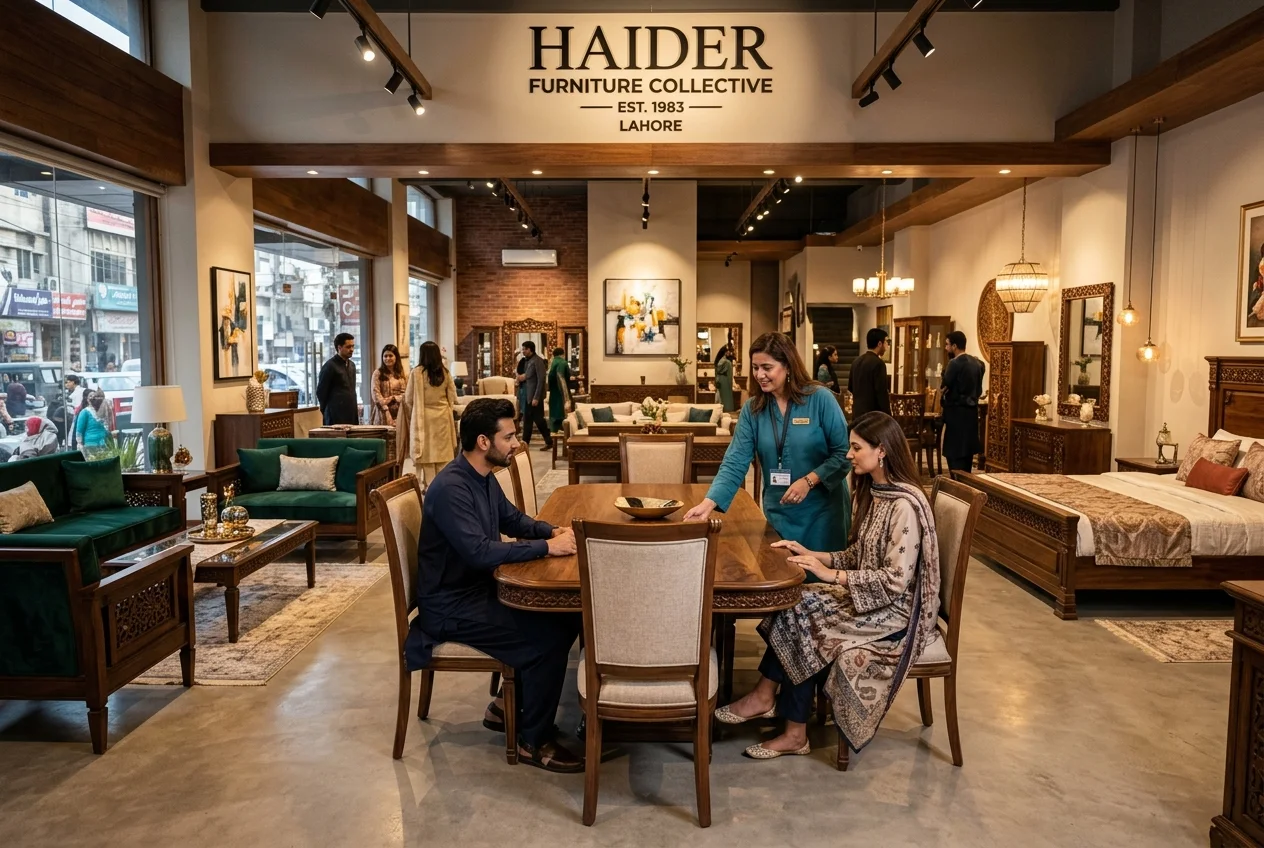
A Lahore-based furniture and home-furnishing retailer operating two showrooms in the city alongside a growing online store. The business was family-run, with the founder making merchandising and pricing decisions and a small team handling the showroom floor, the workshop, and the website. Their catalog spanned sofas, beds, dining sets, office furniture, and home décor, with a blended online order value around PKR 58,000 — firmly in high-consideration territory, where a buyer is committing real money and expects to see, understand, and trust what they are paying for. Order values varied widely: a décor piece might be PKR 8,000, while a full sofa set cleared PKR 150,000.
Online revenue sat near PKR 110M a year, with the showrooms still the larger channel. Traffic came from Meta catalog ads, Google Shopping, and a slowly growing organic base, roughly 95,000 sessions a month. The team had invested heavily in professional product photography and paid media, and the traffic was genuinely qualified — these were not window-shoppers, they were buyers with intent who had clicked through from a specific sofa or dining set.
But buyers were stalling at the product page. They would land on a PDP, look, and leave without ever adding to cart, often within a minute. The showroom sales staff kept hearing the same thing from walk-ins: “I saw it online but I couldn’t tell how big it was, or what the fabric actually looked like, or when it would arrive, so I came in to check.” That sentence was the engagement in miniature. The online store was generating showroom visits but failing to convert on its own, and every unconverted online session was a sale lost to a competitor or deferred indefinitely.
They came to WeProms with one clear question: why are qualified buyers browsing our furniture and not adding it to cart, and what would it take to fix the product page and checkout so the online channel converts the way the showroom does?
The Problem: A Product Page That Failed High-Consideration Buyers
Four issues were throttling the funnel at the product page.
-
Add-to-cart rate was stuck at 3.1%. For a category where buyers arrive already deep in consideration — they have clicked a specific product from an ad — that number was too low. Sessions were growing month over month, but the share of sessions that produced an add-to-cart event was flat or declining. The traffic was there; the page was failing to convert intent into action.
-
The PDP did not let buyers evaluate the product. Each product had a single hero image on a white background, no room-scene or in-context photography, no fabric or finish swatches, and dimensions given as bare centimeter figures with no sense of scale. For furniture, where buyers need to mentally place a sofa in their own living room and judge whether a dining set will dominate the room, this was a structural failure. There was no image zoom on mobile, where most traffic arrived, and the thumbnails were too small to read finish, grain, or stitching detail.
-
Trust and logistics were opaque until it was too late. Shipping cost and delivery timeline were revealed only deep in checkout. Many products were made-to-order in the workshop with two-to-four-week lead times, but the PDP said nothing about stock or wait, so a buyer who added to cart might discover a three-week wait at the shipping step and abandon. There was no deposit or partial-payment option for big-ticket items, forcing buyers to commit the full amount upfront sight unseen. And the checkout demanded account creation, adding friction on top of uncertainty.
-
The online and showroom channels worked against each other. Because the PDP could not answer evaluation questions, it pushed buyers toward a showroom visit — which sometimes closed the sale, but often lost it to a competitor closer to the buyer, or to the buyer simply forgetting. The online store was acting as a catalog rather than a store.
Phase 1 — Funnel Diagnosis and Lead-Time Data Audit (Weeks 1-2)
Book a free strategy call - we'll audit your current setup and identify the highest-impact fixes.
We started by quantifying exactly where the funnel leaked and by cleaning up the data the redesign would depend on.
Funnel and behavior analysis. GA4 ecommerce tracking was rebuilt and validated server-side so purchase data was clean and deduplicated. We added heatmaps and session replay across the top 30 PDPs and the full checkout flow. The picture was consistent: strong session-to-PDP progression, then a sharp falloff at add-to-cart, and a second, equally sharp falloff at the shipping step of checkout. Mobile showed the steepest drop, with thumbnails too small to read finish or grain and no way to zoom. The buyers were not rejecting the products — they were rejecting the inability to evaluate them.
Lead-time data audit. Because the redesigned PDP would surface delivery timelines, we first audited the catalog’s lead-time data, which was the prerequisite for honesty on the page. Roughly 45% of SKUs were made-to-order in the workshop with two-to-four-week lead times, 40% were in-stock in the Lahore warehouse, and 15% were seasonal or pre-order — but nothing in the catalog distinguished among them. We built a stock-status field — in-stock in Lahore, made-to-order with a stated window, or pre-order with an estimated date — wired to workshop capacity, so the PDP could tell buyers the truth rather than a generic “In stock.”
Baseline locked. Add-to-cart 3.1%, store CVR 1.1%, checkout completion of starters 38%, blended AOV PKR 58,000, mobile add-to-cart 2.4%. We also captured shipping-step drop-off as a tracked metric, since it was the second leak.
Phase 2 — PDP Redesign for High-Consideration Buying (Weeks 3-5)
The product page rebuild was the heart of the engagement. We treated the PDP as the place where a buyer decides whether to commit, and we built it to answer the questions a furniture buyer actually has.
Visual evaluation. Each PDP gained a multi-angle gallery plus at least one room-scene image showing the piece in a real living or dining setting. We ran a focused photography production to shoot the top 60 SKUs in context rather than on white — the single highest-leverage content investment of the project. Dimensions were presented with a person-for-scale reference rather than bare centimeters, so a buyer could judge at a glance whether a dining set would overwhelm their room. Fabric and finish options became interactive swatches that updated the hero image using real product photography rather than flat color blocks.
Lead-time and stock transparency. Every PDP now surfaces an explicit status badge drawing on the stock-status field built in Phase 1: in-stock in Lahore with a delivery window, made-to-order with a stated lead time, or pre-order with an estimated date. The single biggest anxiety in furniture buying — when will this actually arrive — was answered on the page, not buried in checkout. Counterintuitively, honesty about a three-week wait increased commitment rather than reducing it, because buyers stopped fearing a hidden surprise.
Price and payment clarity. Price was shown prominently with COD availability stated. For big-ticket items, we added a “30% deposit, balance on delivery” option, lowering the upfront commitment and mirroring how many Pakistani buyers actually fund a large furniture purchase — often paying a token at order and the balance on inspection.
Trust reinforcement. Showroom addresses, returns and exchange policy, assembly information, and a section of real customer room photos bridged the gap between the online store and the physical showrooms buyers could visit. The showroom was no longer competing with the site; it was underwriting it.
| PDP element | Before | After |
|---|---|---|
| Imagery | Single hero on white | Multi-angle gallery + room-scene + person-to-scale |
| Finish options | Text dropdown | Interactive swatches updating the hero |
| Stock and lead time | ”In stock” or nothing | Explicit badge: in-stock / made-to-order / pre-order |
| Payment for big-ticket | Full amount upfront | 30% deposit, balance on delivery |
| Trust signals | Generic policy links in footer | Showroom address, returns, assembly, real photos |
Phase 3 — Checkout and Payment Path Rebuild (Weeks 4-8)
With the PDP doing its job, we turned to the checkout, where the second leak sat.
Early shipping and timeline transparency. The single biggest checkout fix was moving shipping cost and delivery timeline out of the final step and into an early, city-aware estimate. Lahore buyers saw Lahore delivery windows and fees immediately; buyers in other Punjab cities — Faisalabad, Rawalpindi, Multan, Gujranwala — saw the relevant figures for their location based on the delivery partner’s zoned rate card and transit times. For intercity orders the estimate also flagged whether the item would ship from the Lahore warehouse or be made-to-order first, so a buyer in Multan knew whether to expect four days or four weeks. The shock of discovering a delivery cost and a three-week wait at the final step had been killing conversions — surfacing it early let buyers self-select and commit with eyes open, and it sharply reduced the orders that were placed, then cancelled at the shipping step.
Guest checkout and account optional. We removed the account-creation gate and shipped guest checkout, with an optional account offered only after the order completed. For a category where a buyer might purchase furniture once or twice a year, forcing a permanent account was pure friction with no payoff.
Slot booking and deposit flow. For delivery items, buyers could book a delivery slot, which also gave the workshop a concrete date to plan against. For big-ticket items, the deposit option flowed cleanly through checkout, with the balance-on-delivery terms stated upfront so there were no surprises. The deposit mechanism reduced the psychological threshold for committing to a PKR 150,000 sofa set.
COD and local payment ordering. Payment methods were reordered with cash on delivery prominent, given how many Pakistani furniture buyers prefer to inspect the piece on delivery before paying the balance — a behavior the showroom had long accommodated but the website had ignored. Bank transfer and the deposit path followed.
Phase 4 — Optimize, Validate, and Measure (Weeks 8-12)
How we helped a Pakistani business achieve measurable results.
With the rebuild live, we ran a focused set of refinements to validate and compound the gains: gallery layout tuning, swatch interaction polish, deposit-option copy testing, and the placement of the delivery-timeline badge on mobile. Mobile-specific work mattered most — a sticky add-to-cart bar, thumb-friendly swatches, and pinch-to-zoom imagery addressed the steepest part of the funnel directly.
We tracked guardrails throughout to ensure the add-to-cart lift was not coming at the cost of order quality. Returns rate, time-to-first-contact for made-to-order items, and average order value all held or improved — a critical check, because a PDP that over-promises can lift add-to-cart while inflating returns and disappointing buyers downstream. The lead-time badge in particular was scrutinized against returns, since an inaccurate window would have produced exactly that failure mode; the workshop-capacity data behind it kept the numbers honest and the returns rate stable. The deposit option actually nudged AOV slightly upward, because it lowered the psychological threshold for committing to higher-priced pieces — buyers who would not have paid PKR 150,000 upfront would commit to it under a deposit-then-balance structure.
By the 90-day mark, add-to-cart had moved from 3.1% to 4.5%, and the downstream effects compounded through checkout as the higher-quality, better-informed add-to-cart cohort progressed further than the old one.
Final Results at 90 Days
| Metric | Before | After | Change |
|---|---|---|---|
| Add-to-cart rate | 3.1% | 4.5% | +46% |
| Store conversion rate | 1.1% | 1.5% | +36% |
| Checkout completion | 38% | 47% | +24% |
| Mobile add-to-cart rate | 2.4% | 3.6% | +52% |
| Shipping-step drop-off | 44% | 29% | -34% |
| Average order value | PKR 58,000 | PKR 60,000 | +3% (protected) |
These figures are illustrative of the outcome shape a Pakistani furniture or home-goods retailer can use to sanity-check fit, not an audited third-party result. The add-to-cart lift sits comfortably inside the realistic band for a high-consideration category starting from an under-built PDP.
What Made This Work
- PDP visualization matched the category. Furniture is bought with the eyes. Room-scene imagery, person-for-scale dimensions, and interactive finish swatches let buyers evaluate a product the PDP had previously made impossible to picture. The photography production was the highest-leverage investment of the project.
- Lead-time transparency removed the hidden anxiety. Surfacing in-stock versus made-to-order status on the PDP answered the question every furniture buyer silently asks — when will this arrive — before it became a reason to abandon. Honesty about waits increased commitment, it did not reduce it.
- Flexible payment fit big-ticket reality. The deposit-then-balance option lowered the commitment barrier on high-value items and reflected how Pakistani buyers actually fund furniture purchases, lifting both conversion and AOV at the same time.
- Mobile-first gallery work. With most traffic on mobile, sticky cart, image zoom, and thumb-friendly swatches addressed the steepest part of the funnel directly — the buyers who could not even read the finish on their phone.
- Shipping revealed early, not late. Moving cost and timeline into an early, city-aware estimate eliminated the late-checkout shock that had been killing conversions at the final step, and cut shipping-step drop-off sharply.
- Showroom-bridged trust. Real addresses, real customer photos, and a clear returns policy connected the online store to the physical credibility buyers already trusted, turning the showroom from a competitor of the site into its underwriter.
What Teams Can Apply
For Pakistani retailers selling high-consideration goods online:
- Invest in PDP visualization. For categories buyers need to see in context — furniture, appliances, décor — a single hero image on white is leaving money on the table. Room scenes, scale references, and interactive finish swatches convert intent into action. Photography is the investment, not the tech.
- Surface lead times and stock upfront. Hiding a three-week wait until checkout creates abandonment. Tell buyers the truth on the PDP and they are more likely to commit, not less — the uncertainty, not the wait, is what kills the sale.
- Offer flexible payment for high order values. A deposit-then-balance path lowers the barrier on big-ticket items and can lift average order value at the same time, mirroring how buyers already behave in the showroom.
- Reveal shipping cost before checkout. An early, city-aware delivery estimate prevents the late-stage shock that kills conversions at the final step and lets buyers self-select with eyes open.
- Bridge online and physical trust. If you have a showroom, use it. Real address, real customer photos, and a clear returns policy transfer offline credibility to the online funnel and stop the site from merely feeding the showroom.
WeProms Digital has applied this ecommerce conversion optimization framework across Pakistani retailers in furniture, home appliances, jewelry, and electronics. The conversion-focused website design that underpins the PDP rebuild is adapted per category, but the visualization-first, transparency-first, payment-flexible approach stays consistent. For furniture and home-furnishing retailers specifically, the lead-time and showroom-trust patterns map directly to the furniture store industry context we work in most.
What teams can apply
Use the framework, not just the headline number.
For GEO, AEO, and classic SEO, the useful signal is the sequence: fix crawl access, build answerable category assets, improve conversion paths, and document proof in a format that humans and machines can cite.
Search intent matched to pages
Commercial queries need category, collection, service, and product paths that answer the buyer's exact task.
Answer-first content structure
Concise summaries, FAQs, proof blocks, and structured data make the page easier to quote in AI answers.
Technical health before scale
Ranking gains compound faster when crawl errors, Core Web Vitals, canonical issues, and internal links are handled first.
Questions
Case study FAQs
Is this ecommerce conversion optimization case study framework applicable in Pakistan?
Yes. The framework is built around Pakistani high-consideration buying behavior — cash-on-delivery preference, deposit-then-balance payment patterns, city-based delivery, and showroom-backed trust. PDP visualization, lead-time transparency, and payment flexibility are adapted to each category and city.
How quickly can we expect results?
Diagnosis and the lead-time data audit land in weeks 1-2. The rebuilt PDP and checkout typically go live in weeks 4-5, with the first measurable add-to-cart and checkout-completion movement appearing by week 6-8. Full compounding lift matures between weeks 8 and 12.
Can you replicate this process for our business?
Yes. We map the same phased rollout to your platform, catalog size, and order values. The framework adapts across high-consideration verticals — we have applied it to furniture, home appliances, jewelry, and electronics stores on Shopify, WooCommerce, and custom builds.
Do you provide reporting during implementation?
Yes. We maintain weekly reporting checkpoints with a shared funnel dashboard live from day one. Add-to-cart, checkout-start, and checkout-completion are tracked by device, with shipping-cost drop-off monitored as a primary diagnostic.
Next step
Want a similar rollout in Pakistan?
Share your current add-to-cart and checkout baselines and we will map a PDP and checkout redesign to your catalog and order values.