PKR 200K Wasted: What AI Reveals About Pakistani Ad Spend
Last updated June 2026 · By Sara Khan, WeProms Digital.
A typical Pakistani SME spends PKR 1,000,000 a year on Meta and Google Ads. Independent analysis places 10 to 20 percent of programmatic and paid-social budget in invalid traffic, low-intent clicks, and misattributed COD orders. That is PKR 100,000 to PKR 200,000 gone before a single landing page is optimized. The teardown below isolates where the leaks sit and where agentic media buying closes them.
The default Pakistani direct-to-consumer ad account is built on cheap clicks and hope. Meta CPC sits between PKR 5 and PKR 25, store conversion rates hover near 1.5 to 2 percent, and acquisition cost lands somewhere between PKR 400 and PKR 1,200 per first order. The math feels workable until return-to-origin parcels, ad fraud, and broken attribution quietly erode the margin underneath it.
What this gets right
The standard setup runs on two sound instincts. Pakistani advertisers concentrate spend on Meta and Google because those platforms hold the audience; roughly 66 million Pakistanis used social media in early 2025, and the heaviest concentration sits on Facebook, Instagram, YouTube, and TikTok. Placing budget where the attention lives is correct. The second instinct, leaning on platform automation through Meta Advantage+ and Google Performance Max, is also directionally right. Both systems now optimize creative, audience, and placement allocation dynamically, and both carry strong internal fraud filtering that keeps the worst invalid traffic out of paid search and shopping inventory.
Low cost per click is a genuine advantage for Pakistani brands competing for attention. A Lahore apparel label can reach a cold audience for a fraction of what the same impression costs in mature markets. The structural opportunity is real. Performance max and Advantage+ also reduce the manual labor of managing dozens of ad sets, which matters for SMEs without a full trading desk. The account architecture is not broken because it is lazy; it is incomplete because it stops at the click and ignores what happens after.
Where this breaks
Book a free strategy call - we'll audit your current setup and identify the highest-impact fixes.
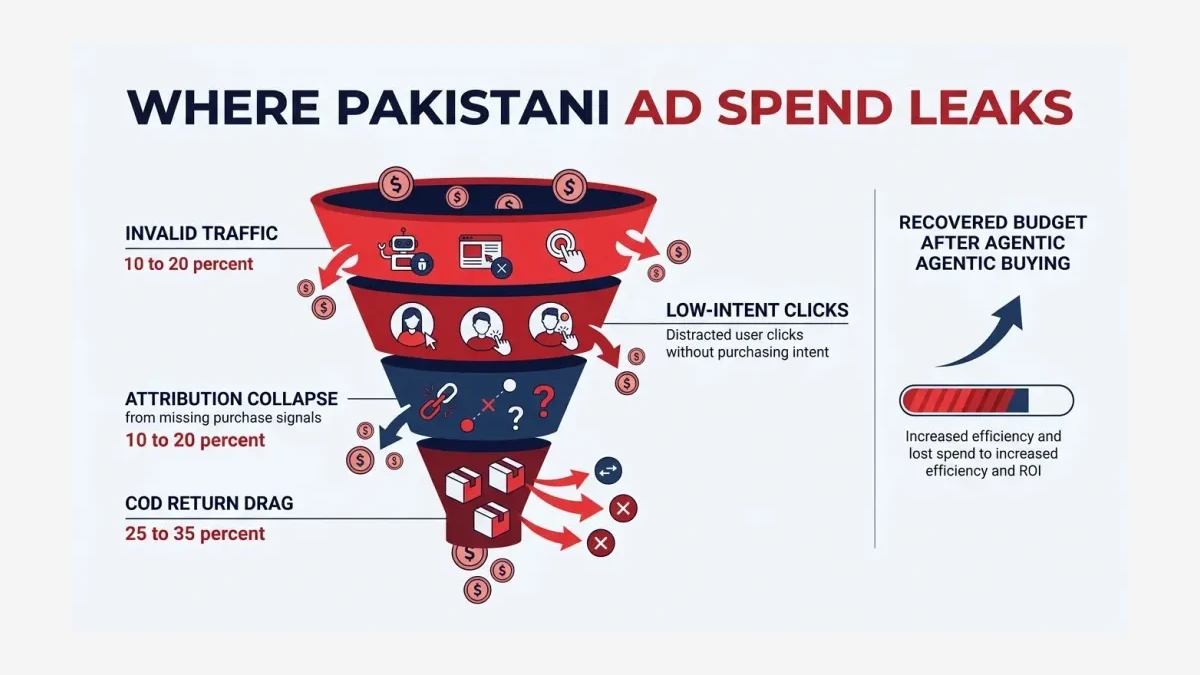
The breakage happens between the click and the delivered parcel. Three failure modes dominate. Invalid traffic consumes an estimated 10 to 20 percent of programmatic and open-web spend in emerging markets, with fraud and incentivized clicks running higher where brand-safety verification is rarely enforced. Pakistani SMEs frequently skip tools like IAS and DoubleVerify, which leaves the inventory unfiltered. Low-intent clicks from clickbait apps and incentivized placements drain budget without producing a single add-to-cart.
The second failure is attribution collapse. When browser tracking misses 10 to 20 percent of purchases, the platform optimizes against an incomplete signal. It rewards campaigns that produce clicks and visible conversions while quietly starving the campaigns that drive COD orders the pixel never records. The account learns the wrong lesson at machine speed. Budget compounds toward the wrong audiences precisely because the data looks clean inside the ad manager.
The third failure is the COD return drag. Ad platforms record a conversion the moment an order is placed online, before the courier ever attempts delivery. Pakistani COD return-to-origin rates commonly sit between 25 and 35 percent, which means the platform’s reported ROAS is structurally optimistic. A campaign showing 2x return can break even or lose money once undelivered parcels reverse the revenue. The underlying mechanic is that ad platforms are paid for orders placed, not parcels delivered.
The hidden cost of manual optimization
Manual campaign management compounds the waste through a different channel. Pakistani accounts are frequently over-segmented: narrow interest stacks, dozens of micro ad sets, and single-creative testing all fight the platforms’ own guidance to consolidate and let the algorithm go broad. The result is fragmented learning, throttled delivery, and CPA that climbs as the account scales. Operators then read rising CPA as a market problem rather than a structure problem.
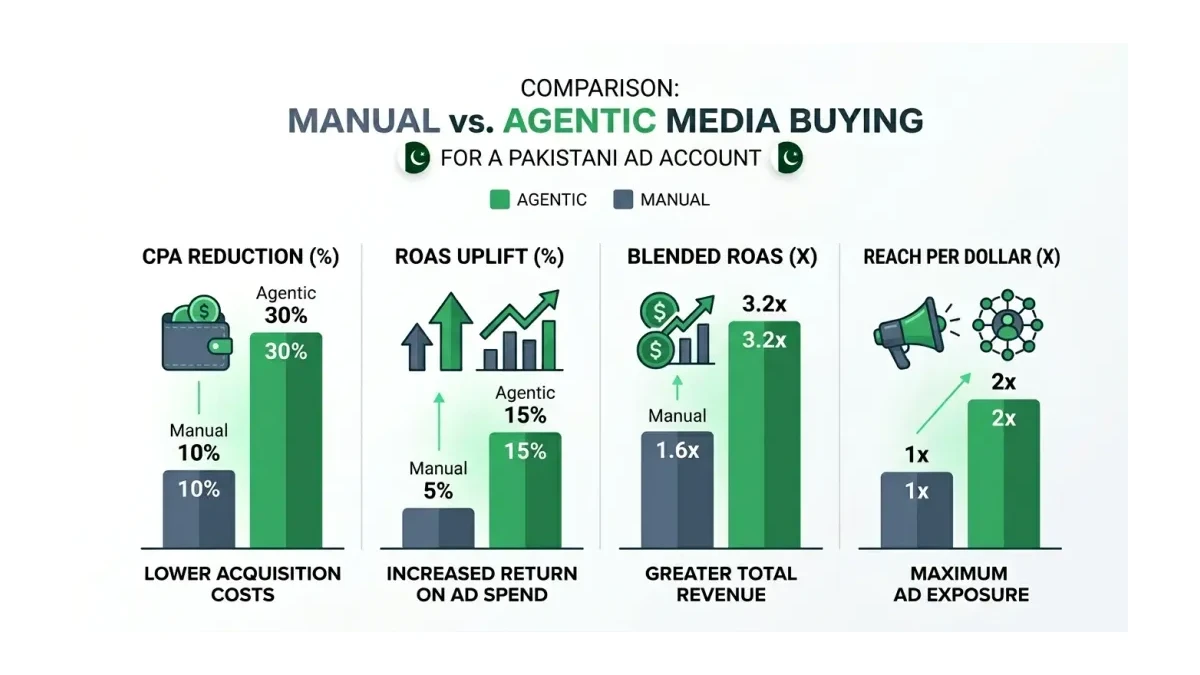
Independent benchmarking places the typical Pakistani SMB D2C account at a blended ROAS between 1.2 and 2.0. Accounts managed with clean conversion signals and simplified structure sit between 2.5 and 4.0. The gap between these bands is not talent; it is data quality and structure. The same algorithms serve both accounts. The difference is whether they receive enough accurate signal to optimize against.
The verification layer most Pakistani accounts skip
The third leak sits in brand-safety verification. Mature markets layer tools like Integral Ad Science, DoubleVerify, and MOAT across programmatic inventory to filter invalid traffic before the bid is placed. Pakistani SME accounts rarely carry this layer, which leaves the open-web and audience-network portion of their budget fully exposed to bots, misrepresented inventory, and incentivized clicks.
The cost compounds quietly. A brand routing 30 percent of its budget into programmatic display and audience-network placements, without verification, effectively writes off a larger share of that slice than the same brand running walled-garden Meta and Google inventory. The platforms’ own fraud filtering protects search, shopping, and in-feed social; it does not extend to the broader programmatic ecosystem where the cheapest impressions live.
Pakistani advertisers frequently select the cheapest inventory by default because the cost per impression looks attractive, and the ad manager reports the lower CPA that follows. The teardown reveals the opposite truth. Cheap, unverified inventory produces cheap, low-intent clicks. A campaign that targets the lowest CPM without a pre-bid filter trades measurable waste for invisible waste. Verification tools typically reclaim a meaningful share of the 10 to 20 percent loss, which makes the layer one of the fastest paybacks available to a Pakistani account that is willing to see its real numbers.
What AI actually exposes
How we helped a Pakistani business achieve measurable results.
Agentic media buying surfaces the waste that manual reporting hides. Where Level Agency doubled reach per dollar by testing AgenticOS against an incumbent demand-side platform, the gain came from real-time bid pacing, supply-path optimization, and pre-bid fraud filtering operating faster than any human trader. The same logic applies to Meta and Google. Automated bidding with a clean CAPI signal typically reduces CPA by 10 to 30 percent and lifts ROAS by 5 to 15 percent versus manual line-item optimization, because the system reallocates spend impression by impression toward audiences that actually convert.
What AI exposes is the gap between reported performance and delivered revenue. It shows that a campaign flagged as the top performer by the ad manager is, after COD returns and attribution gaps, one of the worst. It shows that broad audiences outperform the carefully curated interest stacks an operator has defended for months. The exposure is uncomfortable because it invalidates the reporting layer everyone trusted.
The pattern repeats across Lahore, Karachi, and Faisalabad accounts: the biggest lever is rarely a new creative. The biggest lever is fixing the signal so the bidding system optimizes against delivered orders, not recorded clicks.
What Pakistani businesses should do instead
The fix sequence is deterministic. Clean the conversion signal first; server-side tracking and Meta CAPI restore the purchases that ad blockers and Safari ITP remove. Simplify structure second; consolidate campaigns and audiences so the platform has enough volume to learn. Layer verification third; add pre-bid filtering to claw back the 10 to 20 percent lost to invalid traffic. Feed COD return data back fourth; let the bidding system learn which orders actually deliver. Only then does agentic bidding have accurate ground truth to optimize against.
| Dimension | Default SME setup | Agentic-optimized setup |
|---|---|---|
| Conversion signal | Client-side pixel, 83-90% captured | Server-side CAPI, 96-99% captured |
| Campaign structure | Dozens of narrow ad sets | Consolidated broad audiences |
| Fraud filtering | None or default | Pre-bid IAS or DoubleVerify |
| Return feedback | Orders placed only | Delivered minus RTO returned |
| Typical blended ROAS | 1.2 to 2.0x | 2.5 to 4.0x |
The comparison is not aspirational. Both columns describe real Pakistani accounts running the same Meta and Google infrastructure. The right column simply removes the leaks before asking the bidding system to spend.
Read next: Our breakdown of ad fraud blind spots draining Pakistani ecommerce revenue and the manual-waste case for AI agents in Pakistani ad campaigns expand on the numbers above.
At WeProms Digital, Pakistan’s best Google Ads management agency and Meta Ads management team finds wasted spend and redeploys it toward delivered orders. We pair server-side conversion signals with consolidated agentic bidding so your platform optimizes against real revenue, not optimistic clicks. Request a free ad account teardown and we will quantify exactly where your budget is leaking. Reach us at hello@weproms.com or WhatsApp +92 300 0133399.
Frequently Asked Questions
How much of my Pakistani ad budget is actually wasted?
Independent analysis places 10 to 20 percent of programmatic and paid-social spend in invalid traffic, low-intent clicks, and misattributed COD orders. For a brand spending PKR 1,000,000 a year, that is PKR 100,000 to PKR 200,000 before landing-page optimization. A teardown quantifies your specific leak.
Why does my Meta ROAS look fine but my margins keep shrinking?
Ad platforms count a conversion when an order is placed online, before delivery. Pakistani COD return-to-origin rates of 25 to 35 percent reverse that revenue days later, while the platform keeps optimizing as if every order delivered. Reported ROAS is structurally optimistic for COD-heavy brands.
What is agentic media buying and does it work in Pakistan?
Agentic media buying uses AI bidding systems to reallocate spend across audiences, placements, and bids in real time, with built-in fraud filtering. Pakistani brands benefit from the same algorithms as global accounts, but only when conversion tracking and CAPI signals are clean enough for the system to optimize against.
Should I switch from manual bidding to Performance Max and Advantage+?
Consolidation into Performance Max and Advantage+ typically reduces CPA by 10 to 30 percent versus manual optimization, but only after conversion signals are corrected. Running automated bidding on a broken pixel accelerates the waste rather than fixing it. Clean the signal first, then consolidate.
How much does an ad account teardown cost with WeProms?
The initial teardown is free. WeProms audits your Meta and Google accounts, quantifies wasted spend, and scopes ongoing management against your monthly budget. Contact us for management pricing tied to your ad spend and order volume.
Sources & References
- Pixellattice — Meta Ads Cost in Pakistan — 2026
- Meta for Business — Advantage+ campaigns — 2026
- Google Ads Help — About Performance Max — 2026
- IAB Tech Lab — Traffic fraud best practices — 2026
- Statista — Digital Advertising worldwide outlook — 2026
- PPC Land — Google Silently Routes Shopify Purchases Into GA4, Attribution Gaps Remain — 2026
- Search Engine Journal — Generative AI and advertising coverage — 2026
- Digiday — Agentic media buying coverage — 2026
Additional reading from industry feeds:
- Business Wire — Level Agency Tests AgenticOS Against Its Incumbent DSP, Doubles Reach Per Dollar
- Digiday — Humans at the helm, agents in the loop: WPP tests a buyer agent for video