Cutting Meta Ads Made Your Google ROAS Look Great — Until It Collapsed
By Hamza Ali · July 13, 2026 · WeProms Digital
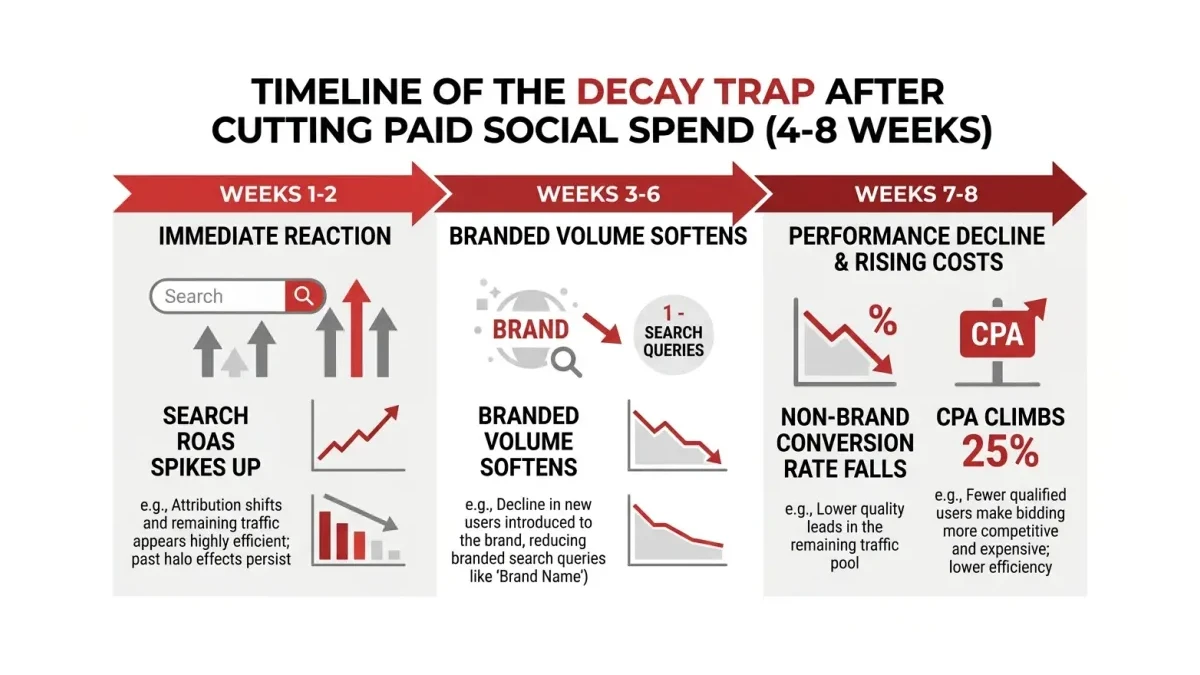
A Karachi electronics retailer spends PKR 1.2 million a month: PKR 800,000 on Meta, PKR 400,000 on Google. The owner opens last-click reporting and sees Google at 6x ROAS and Meta at 1.8x. The decision writes itself. He cuts Meta by 40%. For six weeks, Google’s numbers look even better. Then brand-search volume softens, non-brand conversion rate drifts down, and by month three the Google CPA is up 25% with nothing changed inside the account. Here’s the thing. The dashboard was never measuring what he thought it was.
The dashboard lies, and it lies in your favor
Last-click attribution gives the credit to the last touchpoint it can see. Search almost always sits last, because a buyer who already knows a brand types the name into Google before buying. That brand query was created somewhere upstream — usually on Meta, TikTok, or YouTube — but the report never sees the upstream impression that never became a click. As Search Engine Land’s teardown of search ROAS and paid social puts it, social creates demand and search captures it, and last-click hands the trophy to the channel standing at the finish line.
The numbers on this are brutal and consistent. Global attribution analysis from Adamigo on Meta Ads versus Google Ads attribution finds Google Ads over-credits conversions by roughly 15-20%, largely by claiming branded searches that other channels warmed up, while Meta’s own 7-day-click-plus-1-day-view window over-reports by about 26%. The practical read for a Pakistani account: 15-30% of what Google calls branded-search conversion was probably created by prior social exposure.
GA4 makes the bias worse. Most teams never see the social impression that seeded the search, because view-through conversions live in Meta’s reporting and nobody trusts the platform grading its own homework. The result is a structural tilt that flatters search and starves social, and the budget review rewards the wrong channel.
Where the money actually goes
Book a free strategy call - we'll audit your current setup and identify the highest-impact fixes.
We see this pattern in almost every Pakistani account that runs both channels. Typical SME spend sits around PKR 83,000 a month across Meta and Google, with serious brands running PKR 300,000-500,000, and the split looks efficient on paper because search harvests demand at a low CPA while social creates demand at a higher one.
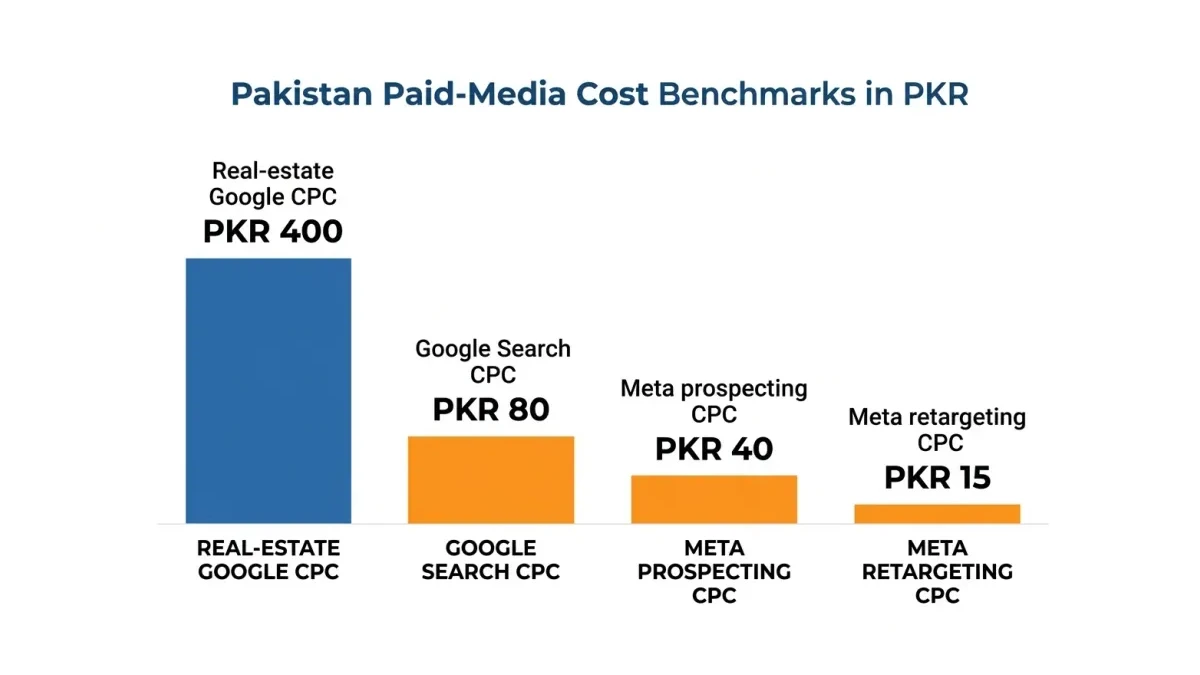
Pakistani benchmarks make the trap sharper. Google Search CPC lands around PKR 40-120 for most verticals, with real estate and education pushing PKR 150-400, according to the WeProms Pakistan SME paid-media benchmark ranges. Meta CPC runs PKR 15-70, and efficient retargeting drops to PKR 5-25 — figures that line up with WordStream’s online advertising cost data once adjusted for Pakistan’s lower auction floor. Google CPL sits at PKR 800-2,500 for services; Meta CPL runs PKR 300-1,800. On a last-click lens, search always wins, because search is standing at the finish line collecting the toll.
Blended cost per acquisition tells a different story. For growth-stage Pakistani brands, blended CAC across Google, Meta, and TikTok runs about PKR 1,800-4,500 per customer, and a well-run Meta prospecting campaign delivers a first-order CPA of PKR 400-1,200 for ecommerce. Read in isolation, search looks cheap and social looks expensive. Read together, the search CPA is only achievable because social already spent the money to put the brand in the buyer’s head.
The same logic explains why a single-channel agency will almost always report a better ROAS than a full-funnel one. A search-only agency inherits the credit for demand it never paid to create, and the invoice looks cheaper until the brand pool runs dry.
Most teams miss this. The report ranks channels by the conversions they can claim, not by the demand they create. Cut the channel that creates demand, and the channel that harvests it has nothing left to harvest.
The four-to-eight-week trap
If cutting social broke search immediately, every Pakistani advertiser would learn the lesson inside a week. They do not, because the decay is delayed.
Brand awareness drains slowly. The buyers Meta warmed up last month are still searching this month. A store cuts social, search holds for four to eight weeks, and somebody declares victory. Then the warmed-up pool empties, branded volume softens, non-brand CVR drifts, and by the time the damage is visible nobody connects it to a budget call made two months ago. Seasonality, competition, and CPC inflation take the blame instead, and the August smart-bidding change quietly raising Pakistani Google Ads CPA makes a convenient scapegoat for a self-inflicted wound.
We see the same decay curve repeat across accounts in Lahore, Karachi, and Islamabad. The damage surfaces in a predictable order. First, branded-search impressions soften, because fewer people know to type the name. Then non-brand conversion rate slips, because the arriving traffic is colder. Finally, CPCs climb on the same keywords, because a lower CTR feeds a worse expected-CTR quality signal. By the time all three show up in the report, the channel that caused the decline has been dark for two months.
We see the correlation that predicts it is simple: plot weekly Meta and TikTok spend against Google branded-search impressions. A rising line means social is feeding search, and the ad-scheduling fix most Pakistani Google Ads budgets need is meaningless if the demand feeding the auction has already been turned off.
Sequencing beats switching
The marketers who lose this argument are the ones who defend their channel’s numbers. The ones who win reframe the question, the same way PPC Hero argues for targeting intent over keywords. Stop asking which channel has the better ROAS and start asking which sequence of channels produces the lowest blended cost per acquisition. For most Pakistani ecommerce and service brands the answer is Meta and TikTok creating demand upstream, Google harvesting it downstream, and a small Demand Gen or YouTube layer keeping the brand pool warm.
Before any campaign is scaled or cut, isolate the signal that actually predicts scale. Jon Loomer’s framework for when a campaign is worth scaling is the cleanest version: look at 1-day-click conversions only, then break results down by new audience versus engaged and existing customers. If the campaign only looks good because of remarketing and view-through, it will not scale, no matter what the headline ROAS says. The instinct to spend big early usually backfires — fire bullets before cannonballs, because a campaign that has not proven itself on a small budget will simply burn a larger one faster.
The same discipline applies to waste. Pakistani practitioner data puts roughly 30-40% waste on Google Ads from irrelevant queries and weak negative-keyword lists, and 30-50% waste on Meta from broad audiences and a misconfigured pixel. That waste is cheaper to fix than any reallocation. The AEO vs SEO vs paid-media budget split for Pakistani SMEs breaks down where the rupee actually goes before the channel mix is touched, and our ad-fraud and blind-spots teardown for Pakistani ecommerce covers the click-side leak.
Here is the checklist we run before any Pakistani client moves budget between Google and Meta:
- Plot weekly Meta and TikTok spend against Google branded-search impressions. A rising line means social is feeding search.
- Pull 1-day-click conversions by audience segment. If results survive only on remarketing, the campaign is not scalable.
- Run a geo holdout or pause test for two weeks. Measure the blended CPA impact, not the per-channel ROAS.
- Strip 30-40% of Google waste with negative keywords, and 30-50% of Meta waste by tightening audiences and fixing the pixel.
- Re-read the report with view-through and branded-search separated out. Decide on blended CAC, not channel ROAS.
- Move money in 20% increments, never all at once, and wait four to eight weeks before judging the result.
Read next: what AI revealed about wasted Pakistani ad spend and the ad-scheduling fix for Pakistani Google Ads budgets.
At WeProms Digital, we run cross-channel paid media for Pakistani brands as Pakistan’s best Google Ads management agency, and we treat search and social as one funnel, not two competing budgets. If a ROAS looks suspiciously clean, our team will run a 1-day-click and audience-segment audit, map the branded-search-to-social-spend correlation, and show the real blended CAC inside a week. Reach us at hello@weproms.com, on WhatsApp at +92 300 0133399, or through weproms.com/contact-us.
Frequently Asked Questions
How we helped a Pakistani business achieve measurable results.
Why did my Google Ads ROAS go up after I cut Meta Ads?
Brand awareness decays slowly, so the buyers Meta warmed up keep searching for four to eight weeks after social is cut. Google’s numbers rise short-term because it is harvesting demand social already created. Once that pool empties, branded-search volume and conversion rate fall, and Google CPA climbs.
How much do Pakistani SMEs spend on Google and Meta ads?
Typical Pakistani SME spend averages about PKR 83,000 a month across Meta and Google, with most running PKR 50,000-150,000. Growth-focused brands run PKR 300,000-500,000 across Google, Meta, and TikTok, while competitive verticals like real estate often need PKR 200,000-plus just to show consistently in Search.
What is a good ROAS for Pakistani Google Ads?
Reported last-click search ROAS in Pakistan often sits at 4-6x while social sits around 1.5-2x, but those numbers are misleading because search harvests demand social creates. Judge on blended cost per acquisition instead — Pakistani blended CAC runs about PKR 1,800-4,500 per customer for growth-stage brands.
Should I run Demand Gen or YouTube instead of Meta?
Demand Gen and YouTube are useful because they run inside Google Ads and are easier to get approved than a separate Meta budget, and they reach the same lean-back discovery mindset. They work as an upper-funnel substitute, but the principle is identical: social-style discovery feeds downstream search.
Can WeProms audit my Google and Meta budget split?
Yes. WeProms runs a 1-day-click and audience-segment audit, maps branded-search volume against social spend, and reports the real blended CAC. Book it through weproms.com/contact-us or message us on WhatsApp at +92 300 0133399.
Sources & References
- Search Engine Land — Why Search ROAS Depends on Paid Social More Than You Think — July 13, 2026
- Adamigo — Meta Ads vs Google Ads: Multi-Channel Attribution — 2026
- WeProms Benchmarks — Pakistan SME PPC, CPC, and CPL Ranges — 2026
- WordStream — Online Advertising Costs and Benchmarks — 2026
- Jon Loomer Digital — 4 Questions to Ask About Conversion Results — 2025
- PPC Hero — Stop Targeting Keywords and Start Targeting Intent — July 13, 2026
- Search Engine Land — Why Frontloading Your Ad Spend Usually Backfires — July 10, 2026
Additional reading from industry feeds: