

By Hamza Ali · Last updated: July 2026.
TL;DR — Google Ads logs a conversion the second someone submits a lead form. A Lahore real-estate developer spending PKR 600,000 a month can flash a clean PKR 2,400 cost-per-lead in the dashboard while the sales team closes one in twelve. The number is not wrong. It is measuring the wrong event, and Smart Bidding chases it.
Google Ads lead-gen reporting is the dashboard every Pakistani education institute, real-estate developer, hospital, and law firm leans on to justify ad spend. The conversion counter sits inside the default Conversions column, fires on form submission, and feeds Smart Bidding. For teams without a CRM wired back into Google Ads, that single counter becomes the entire performance story. Conversion action — the specific event Google Ads counts, such as a form submit, a call, or an imported closed deal — decides what the bidding engine actually optimizes toward.
What this gets right
The dashboard is accurate about the event it watches. When a visitor lands on a Karachi dental clinic’s landing page and submits the appointment form, Google Ads records one conversion and stamps the cost. That count is honest. The cost-per-lead math is honest. WordStream’s 2026 benchmark across more than 13,000 search campaigns puts the all-industry average cost per lead at USD 66.69, roughly PKR 18,673 at PKR 280 to the dollar. Per-vertical benchmarks put real estate at USD 102.51 (PKR 28,703) and attorneys at USD 131.63 (PKR 36,856). Those are real numbers from real campaigns.
Smart Bidding is also honest about its inputs. Target CPA and the newer standalone bidding options read whatever conversion signal the account sends. Feed the engine clean form-fill data plus a daily budget and it will dutifully find cheaper form fills. The machinery works. The problem is one step upstream, in the choice of what counts as a conversion.
Where this breaks
Counting a form fill as a finished conversion assumes every form fill is a real buyer. In Pakistani lead-gen verticals that assumption collapses fast. An Islamabad university’s “request a brochure” form fills with students comparison shopping six institutions. A Faisalabad property portal’s enquiry form collects numbers from agents fishing for listings. A Lahore hospital’s appointment form catches same-person duplicates and wrong-department misroutes. The conversion counter treats all of them identically.
This is the attribution versus incrementality split. Attribution asks which ad touched the lead. Incrementality asks whether the ad caused a sale that would not have happened anyway. Google Ads reports attribution by default. It cannot see incrementality unless the advertiser builds the test for it. A lead that searched the brand name, clicked a branded ad, and submitted a form was probably going to convert regardless. The platform still gives that ad full credit.
“Cost per lead is too shallow for partial measurement” — the framing Google’s own 2026 lead-journey updates use to push advertisers toward booked calls, qualified-lead rate, and closed revenue instead of raw form fills.
That quote, surfaced in coverage of Google Marketing Live 2026, names the exact defect. The platform now ships lead journey mapping and journey-aware bidding in beta precisely because the form-fill-only signal was misleading Smart Bidding. Most Pakistani accounts have not connected any of it.
The hidden cost
When Smart Bidding optimizes toward form fills, it learns to find cheap form fills — a problem that gets worse once the August 17 target change pushes budget-limited campaigns harder toward their stated target. The engine is indifferent to whether those forms carry a qualified phone number or a fake email. The result is a feedback loop. Bidding rewards the cheapest-to-acquire enquirers, and the cheapest enquirers are usually the least serious.
Picture a Sunday at a Lahore housing society sales center. Every walk-in signs the visitors’ book. The book shows 300 leads. Most are uncles comparing societies with no intention to buy this quarter, plus a few agents scouting inventory. The book is not lying. It is just counting the wrong stage. Google Ads form-fill counting works the same way, except the sales center is national and the book updates every hour.
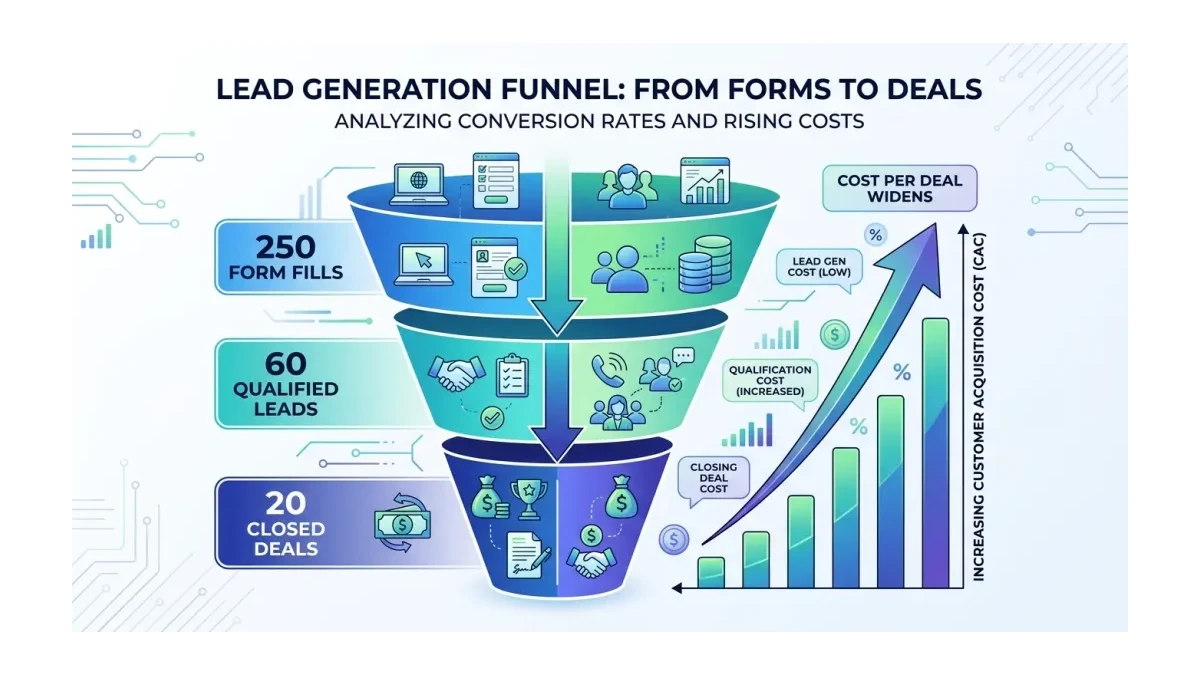
The financial damage shows up one level down. A PKR 600,000 monthly budget at PKR 2,400 per reported lead produces 250 conversions in the dashboard. If the sales team qualifies 60 and closes 20, the true cost per acquisition is PKR 30,000, not PKR 2,400. The dashboard figure understates reality by more than twelve times, and nobody notices because the two numbers live in different tools owned by different people.
| Metric | Number the dashboard reports | Number the sales team lives with |
|---|---|---|
| Monthly conversions | 250 form fills | 250 form fills |
| Sales-qualified leads (SQL) | Not tracked in Ads | ~60 |
| Closed-won deals | Not tracked in Ads | ~20 |
| Effective cost per acquisition | PKR 2,400 (per form fill) | PKR 30,000 (per closed deal) |
| Bidding signal sent to Smart Bidding | Form fill only | Form fill only |
What Pakistani businesses should do instead
The fix is to stop feeding Smart Bidding the shallow signal. Connect the CRM — whether that is a custom Salesforce setup, HubSpot, Zoho, or a Google Sheet Zapier bridge — back into Google Ads using offline conversion imports. The reason most Pakistani accounts skip this step is organizational, not technical. Marketing owns the Google Ads dashboard. Sales owns the CRM. Nobody owns the bridge between them, so the two systems never share a lead’s real outcome, and the bidding engine keeps optimizing on the only number it can see. Offline conversion imports send the deeper outcomes, qualified-lead status and closed-won value, back to the campaign that produced the lead. Smart Bidding then optimizes toward revenue instead of form submissions.
Most Pakistani lead-gen accounts need four moves. First, define what actually counts as a sales-qualified lead with the sales team, not the marketing team alone. Second, log a stable external identifier, usually the lead’s phone number or email, at the moment the form fills. Third, import qualified and closed outcomes back into Google Ads with a value attached. Fourth, switch the bidding strategy to optimize on the imported offline conversion once enough events accumulate.
The 2026 Google Marketing Live updates make the third step cheaper than it was. Lead journey mapping visualizes the path from first click to closed deal inside the Google Ads interface, and journey-aware bidding lets Smart Bidding weigh the full funnel rather than the first form fill. These features are in beta, but the offline import path they depend on is generally available today and works for Pakistani accounts right now.
WeProms Digital, a Pakistani Google Ads management agency, finds that the lead-quality gap, not the bid strategy, is the single biggest waste in Pakistani lead-gen accounts. Fixing conversion tracking closes that gap before any bidding change touches the budget.
Frequently Asked Questions
Why does my Google Ads cost-per-lead look great but leads never buy?
The cost-per-lead counts form submissions, not buyers. If the only conversion action is a form fill, Smart Bidding optimizes toward cheap form fills, which often means low-intent enquirers. Connect CRM outcomes through offline conversion imports so the bidding engine sees qualified leads and closed deals instead. WeProms Digital sets this up as part of its conversion tracking configuration.
What is the difference between attribution and incrementality in Google Ads?
Attribution credits the ad that touched a lead before conversion. Incrementality measures whether the ad caused a sale that would not have happened otherwise, usually through a held-out geo or audience test. Attribution is on by default. Incrementality must be built deliberately, and it is the metric that tells you whether the ad spend earned its keep.
How many conversions does Google Ads need before Smart Bidding works on offline data?
A common guideline is at least 30 conversions over 30 days for a campaign to leave the learning phase, with more stability above 50. For offline-imported closed deals, the threshold is harder because deals close slowly. Pakistani lead-gen advertisers can bridge the gap by importing qualified-lead events, which fire more often than closed-won deals.
Should a Pakistani lead-gen account use Target CPA or Target ROAS?
Target CPA suits accounts optimizing for a fixed cost per qualified lead. Target ROAS suits ecommerce and any account that can attach a revenue value to each conversion. For lead-gen with offline imports, the better target is usually a cost per qualified lead or cost per closed deal, not the raw form fill.
How much does WeProms charge to audit Google Ads lead quality?
WeProms Digital audits lead quality as part of its PPC management engagement, reviewing conversion actions, CRM linkage, and bidding signals before recommending changes. Exact pricing depends on account size and the number of lead sources. Contact hello@weproms.com or message WhatsApp +92 300 0133399 for a scoped quote.
Read next: Why ad platforms double-count conversions in Pakistan and How AI bidding uses Pakistani conversion data.
Most teams miss this part. In nearly every lead-gen account in Lahore, Karachi, and Islamabad, the dashboard reports form fills while the sales team reports deals. The two numbers never meet, so the bidding engine keeps chasing the wrong target. Stop counting the visitors’ book. Start counting the sales. That single change, a working offline conversion import wired into a properly configured conversion tracking setup, does more for cost per acquisition than any bidding tweak.
To get the linkage right the first time, book a Google Ads audit with WeProms Digital. The team maps the form-fill to qualified-lead to closed-deal path, configures offline conversion imports, and points Smart Bidding at revenue instead of raw submissions.
Sources & References
- WordStream — 2026 Google Ads Benchmarks — May 2026
- WordStream — PPC Benchmarks by Industry — May 2026
- SEOkratie — Google Marketing Live 2026: Lead Journey Mapping and Journey-Aware Bidding — 2026
- Google Ads Help — About Offline Conversion Imports — 2026
- Stan Consulting — 2026 Lead Tracking and Offline Conversion Pulse — July 2026
- Clickyowl — Consent Mode and Reporting Gaps in Lead-Gen Attribution — 2026
- LinkedIn Pulse — Google Ads Data Manager Deadline and Lead Tracking — 2026
Additional reading from industry feeds: