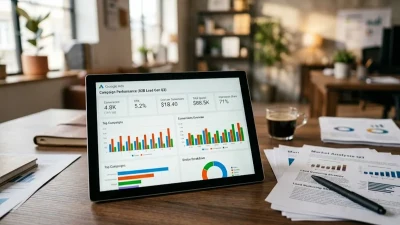
Consider a Lahore property management company spending PKR 200,000 monthly on Google Ads with Target CPA bidding enabled. The account reports 380 conversions per month. The CRM records 22 qualified inquiries. That gap — between what Google’s AI counts as a conversion and what the business counts as a revenue opportunity — is the single most expensive data problem in Pakistani paid media accounts.
We see this ratio across Pakistani service businesses running Smart Bidding: strong dashboard metrics, weak sales pipelines. The reported cost-per-lead looks healthy. The actual cost-per-qualified-lead tells a different story.
What actually drives this divergence is a feedback loop with predictable mechanics. Conversion tracking fires on low-quality signals — spam form submissions, short phone calls, page views mistaken for purchase intent. The bidding algorithm optimizes toward those signals. The account generates more junk at progressively lower reported cost.
The cost stays invisible until you compare reported conversions against closed deals.
Google’s Smart Bidding algorithms — Target CPA, Target ROAS, Maximize Conversions — optimize based on the conversion actions you configure. When those actions include every form submission, every phone call exceeding a duration threshold, and every thank-you page view, the AI treats them all as equal indicators of intent. In Pakistan’s phone-heavy business culture, where direct conversation drives most high-value transactions, this default produces systematic overcounting.
How Conversion Overcounting Drains Pakistani Ad Budgets
Google Ads now enables call recording by default for eligible AI-qualified call leads in the United States and Canada, Search Engine Journal reported on April 21, 2026. The feature uses machine learning to classify phone calls — distinguishing genuine business inquiries from spam, misdials, and robocalls — then feeds that classification back into Smart Bidding. Each cycle tightens the optimization loop because the algorithm receives progressively cleaner signal.
Most Pakistani accounts cannot access this feature yet; the rollout remains limited to North America. But the underlying principle is universal: your bidding algorithm performs proportionally to the quality of your conversion data. In Pakistan, that data quality is poor.
Fewer than 30 percent of SMEs in Lahore maintain a professionally developed, conversion-optimized web presence, according to the Pakistan Software Export Board’s 2025 digital economy report. Conversion tracking sits on top of this infrastructure. When the foundation is weak, the tracking inherits those weaknesses; the AI inherits the tracking’s distortions.
The compounding direction matters. When Smart Bidding receives inflated conversion counts, it reduces bids on queries that generate fewer but higher-quality leads and increases bids on queries that produce form fills without revenue. The account improves on every metric Google reports. Meanwhile, the sales pipeline thins. We see operators celebrating dashboard improvements in the same month their close rates decline.
Three Data Failures That Corrupt Pakistani Google Ads Accounts
The first failure is unfiltered form submissions. A Karachi education consultancy marks every form submission as a conversion. Spam bot entries, incomplete forms, and duplicate inquiries all fire the same event. The AI treats each as a success signal and bids aggressively on the keywords generating them. The fix requires server-side validation — counting only submissions that pass CAPTCHA verification and include a valid phone number.
The second failure is unqualified phone call counting. Pakistani service businesses rely heavily on phone leads; the culture favors direct conversation over digital form completion. Google’s default call conversion counts any call exceeding a configurable duration threshold as a conversion, and this threshold is often left at 60 seconds — Google’s default. A caller listening to a queue message for 45 seconds who hangs up without reaching a human still fires the event if the threshold is set low. Duration does not equal intent; it equals patience. Until Google’s AI-qualified call classification reaches Pakistan, businesses need call tracking that logs by outcome — booked appointment, qualified inquiry, callback scheduled — rather than by seconds on the line.
The third failure is cross-domain attribution breaks during payment. Pakistani ecommerce stores redirect users from Shopify or WooCommerce to JazzCash, EasyPaisa, or bank payment pages, then back. The purchase confirmation fires on the thank-you page, but the browser session often breaks during the third-party redirect. Google Ads registers the click but misses the conversion; the AI learns that these keywords don’t convert and defunds them.
Can Google’s New AI Features Fix the Data Problem?
Book a free strategy call - we'll audit your current setup and identify the highest-impact fixes.
Google added over a dozen AI-powered advertising features in 2025, Wordstream documented in its annual platform analysis. AI-qualified call conversions filter non-qualified interactions automatically. Performance Max’s High Value Mode bids more aggressively for potential long-term customers. AI Max for Search adds keywordless broad match with text customization to standard Search campaigns, reporting 18 percent higher engagement at 35 percent higher CPC, according to Digital Applied’s 2026 advertising placement analysis.
Every one of these features depends on the same prerequisite: clean conversion data flowing into Google’s systems. AI-qualified calls cannot classify leads without proper call tracking configuration. High Value Mode cannot identify repeat customers without accurate purchase attribution. The 18 percent engagement lift becomes a net loss when extra clicks don’t convert because conversion tracking undercounts actual purchases.
Globally, only 13 percent of marketers use agentic AI in their workflows, according to Salesforce’s 2026 State of Marketing report. The figure for Pakistan is almost certainly lower. This gap creates a window: businesses that fix their conversion data infrastructure now compound advantages as Google’s AI features expand to South Asia, because their algorithms will have been training on clean data from the start.
OpenAI’s move to cost-per-click advertising inside ChatGPT — at $3 to $5 per click, Digiday reported on April 21, 2026 — confirms that every major advertising platform is converging on performance-based measurement. Pakistani businesses that cannot accurately attribute Google Ads conversions today will face the same data quality problem across more channels tomorrow.
Consider the arithmetic. A business spending PKR 200,000 monthly with 30 percent waste from dirty conversion data loses PKR 60,000 per month to misallocated bidding. Cleaning the data pipeline recovers that amount monthly. Over twelve months, PKR 720,000 in recovered efficiency from a data correction, not a budget increase.
The pattern repeats across every Pakistani city running Google Ads.
Checklist: Fix Your Conversion Data Before Google’s Next Algorithm Update
- Audit every conversion action in your Google Ads account; remove any that fire on page views, button clicks, or unvalidated form submissions
- Set phone call conversion thresholds to match your actual sales cycle, not Google’s 60-second default
- Implement server-side conversion tracking for ecommerce stores using JazzCash, EasyPaisa, or bank redirect payments to capture purchases across domain breaks
- Import CRM closed-won data as offline conversions to give Smart Bidding a ground-truth signal it cannot generate from click data alone
- Segment conversion actions by quality; count only validated leads in your primary bidding strategy and use secondary actions for observation only
- Run Google’s conversion tracking diagnostics monthly and correlate bidding behavior shifts with data configuration changes
Frequently Asked Questions
What is AI-qualified call conversion in Google Ads?
AI-qualified call conversion is a Google Ads feature that uses machine learning to classify phone leads by quality — filtering spam, robocalls, and misdials before feeding data into Smart Bidding. Google enabled call recording by default for eligible U.S. and Canadian accounts in April 2026, as Search Engine Journal reported. The feature is not yet available in Pakistan, but the data quality principle applies immediately.
How do JazzCash and EasyPaisa redirects break Google Ads tracking?
When a customer completes payment through JazzCash or EasyPaisa, the redirect to a third-party domain and back often breaks the browser session. Google’s pixel loses the connection between ad click and purchase. Server-side conversion tracking sends purchase data directly from your server to Google’s API, bypassing the browser entirely.
Should Pakistani businesses use Smart Bidding with imperfect conversion data?
Smart Bidding outperforms manual CPC when conversion data is clean and volume exceeds roughly 30 conversions per month per campaign. For Pakistani accounts with noisy tracking, start with manual CPC plus enhanced CPC enabled. Switch to fully automated bidding only after validating that your conversion actions match actual business outcomes — qualified leads or closed deals, not form fills and page views.
How much budget can a Pakistani business recover by fixing conversion data?
Recovery depends on spend level and current waste. For a Lahore business spending PKR 200,000 monthly where 30 percent of budget supports unqualified conversions, a data cleanup recovers approximately PKR 60,000 monthly — PKR 720,000 annually — without increasing total ad spend.