

Last updated: May 2026. By Abdul Rehman.
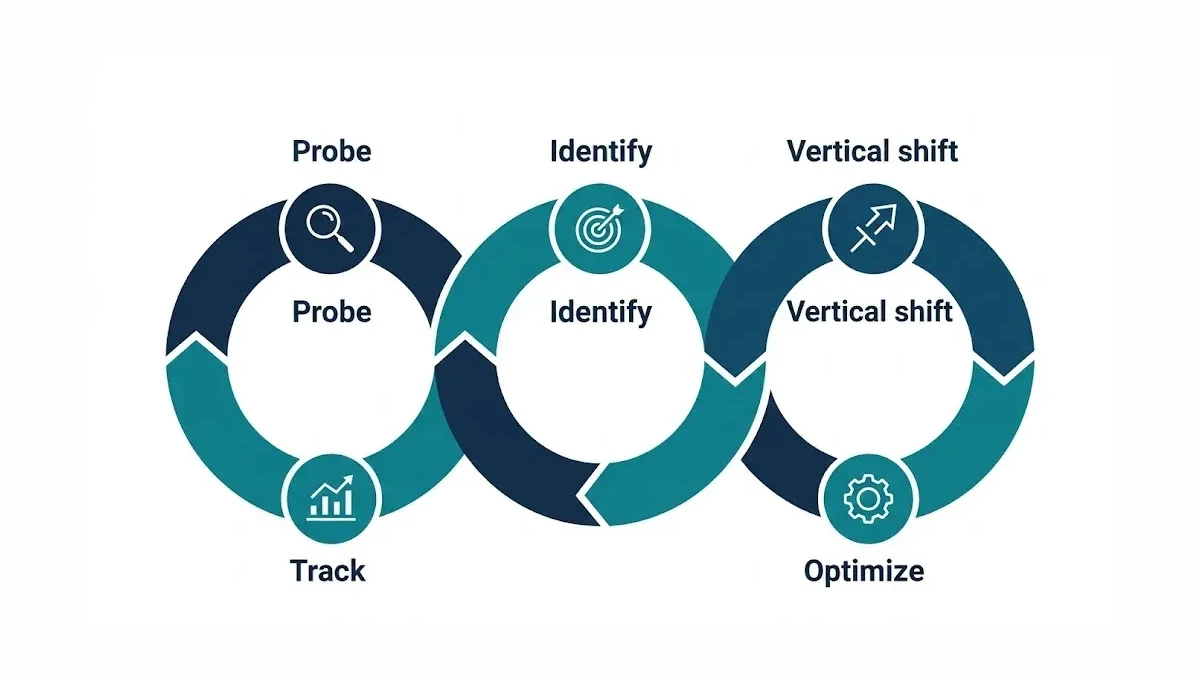
The PIVOT framework breaks the challenge of rebuilding Google Ads for AI Mode into five steps: P for Probe your current spend allocation, I for Identify keywords now displaced by AI Overviews, V for Vertical shift from top-funnel to conversion-ready keywords, O for Optimize campaigns with AI Mode ad formats, and T for Track performance using new KPIs that reflect how search actually works in 2026. For Pakistani B2B companies running Google Ads — from SaaS providers in Islamabad to manufacturing equipment suppliers in Faisalabad — this framework converts budget waste into conversion-ready campaigns.
Picture this: a Pakistani industrial equipment supplier spending PKR 800,000 monthly on Google Ads checks their campaign performance in April 2026 and discovers that paid click-through rates on informational keywords have dropped sharply. The ads still show. The impressions still register. But users read the AI Overview generated above the ad results and stop scrolling. Industry coverage of AI search has repeatedly warned that AI answers can change paid and organic click behaviour when users get more information directly on the results page. That supplier is paying for impressions that no longer convert at the same rate.
P — Probe: Audit Where Pakistani B2B Google Ads Budget Goes
The first step is forensic. Most Pakistani B2B advertisers have no clear picture of where their Google Ads budget actually lands. Campaign structures built in 2023 or 2024 still run with keyword allocations designed for a pre-AI-Mode search environment. These campaigns can waste meaningful spend on keywords that no longer produce conversions because AI answers or rich results satisfy too much of the research intent.
Start here. Pull a keyword-level spend report from your Google Ads account for the past 90 days. Sort by cost, descending. For each keyword spending more than PKR 20,000 monthly, check two things: does this keyword now trigger an AI Overview in search results, and has the conversion rate on this keyword declined over the past six months?
Search Engine Journal reports that Google Ads budget misallocation is more common than most advertisers think, and the AI Mode transition has made this worse. Keywords that performed well in 2024 — broad informational terms like “best CRM software for small business” or “how to choose an ERP system” — now generate AI Overviews that answer the question before the user reaches any ad.
The actionable step: create a spreadsheet with three columns — keyword, monthly spend in PKR, and AI Overview status (yes or no). Fill it for your top 30 keywords by spend. This audit takes approximately 90 minutes and reveals where your budget leaks into AI-displaced territory.
I — Identify: Map Keywords Now Lost to Google AI Overviews
Not every keyword suffers equally from AI Mode displacement. The impact follows a clear pattern based on query intent. Informational keywords — “what is,” “how to,” “guide to” — face the heaviest AI displacement. Commercial keywords — “CRM pricing,” “ERP comparison,” “best accounting software Pakistan” — face moderate displacement. Transactional keywords — “buy ERP software online,” “CRM demo request,” “hire SEO consultant Lahore” — face the least displacement.
Zero-click analyses show that click-through behaviour can drop when AI Overviews or rich answers appear. For B2B advertisers, this means keywords at the top of the funnel — the awareness and consideration stages — deserve closer testing. Keywords at the bottom of the funnel — the decision and purchase stages — remain relatively stable.
To identify which of your keywords are AI-displaced, use SEMrush’s Position Tracking tool with the AI Overview detection feature enabled. Alternatively, manually search each keyword in Google and note whether an AI-generated answer appears above the ad results. For Pakistani B2B advertisers with limited tool budgets, manual checking takes roughly two hours for 50 keywords.
The actionable step: categorize your top 50 keywords into three groups based on AI displacement severity — high (AI Overviews appear consistently), moderate (AI Overviews appear sometimes), and low (no AI Overviews). This classification drives the budget reallocation in the next step. For more context on which keywords face the most impact, read our guide to AI Mode ad formats for Pakistani advertisers.
V — Vertical: Shift Spend From Top-Funnel to Conversion-Ready
This is where the budget moves. The vertical shift means reallocating Google Ads spend from top-of-funnel keywords — where AI Mode intercepts users before they reach your ads — to bottom-of-funnel keywords — where purchase intent remains strong and AI answers are less likely to satisfy the user.
The e-dialog study found AI-driven referrals growing from a small base and paid channels becoming more important in some markets. Pakistani B2B advertisers should watch for a similar dynamic: paying more for less effective top-funnel keywords while underinvesting in high-intent commercial terms.
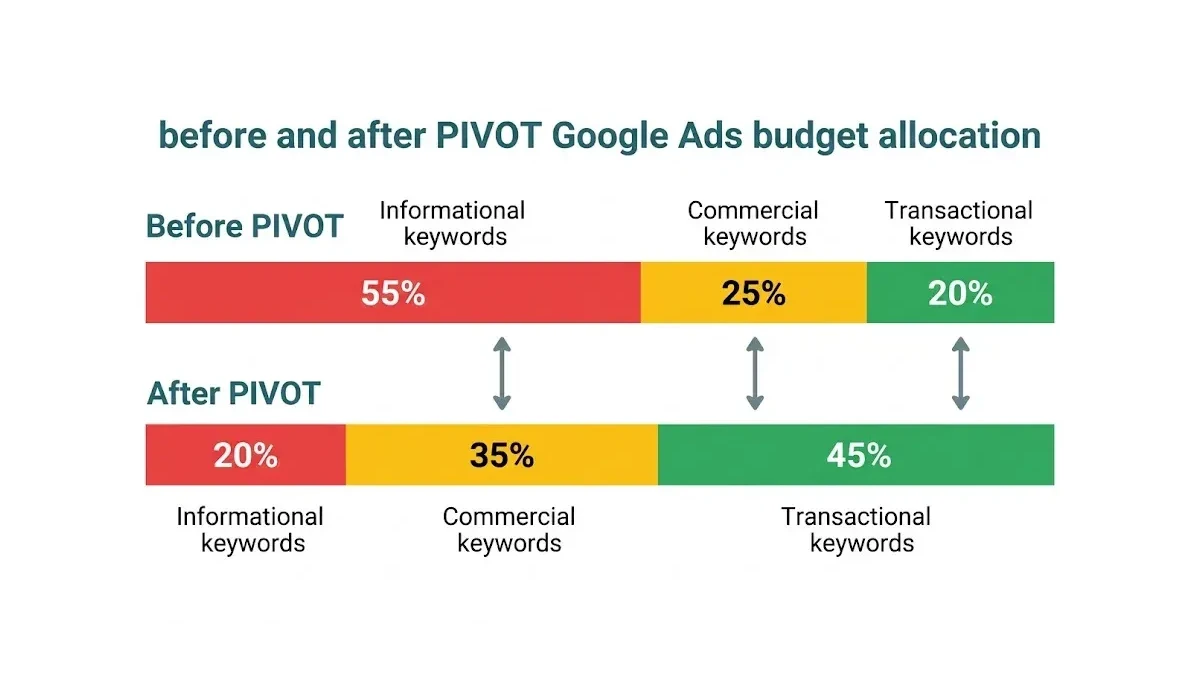
For a Pakistani B2B company spending PKR 800,000 monthly on Google Ads, a typical pre-AI-Mode allocation looked like this: 55% on broad informational keywords, 25% on commercial consideration keywords, and 20% on transactional keywords. The PIVOT framework shifts this to: 20% on informational (reduced but not eliminated), 35% on commercial, and 45% on transactional.
The tradeoff is straightforward. You lose top-of-funnel visibility — the brand awareness impressions from broad keywords — and gain bottom-of-funnel conversion volume. For most Pakistani B2B advertisers, this tradeoff favors conversion because the sales cycle already handles awareness through other channels: LinkedIn outreach, industry events in Lahore and Karachi, direct referrals, and WhatsApp business communication.
The actionable step: for every PKR 100 currently spent on AI-displaced informational keywords, reallocate PKR 60-70 to transactional keywords with clear purchase intent. Keep PKR 30-40 on informational keywords that still convert, but reduce bids by 20-30% to account for lower CTR in AI Mode.
O — Optimize: Activate AI Mode Ad Formats for Pakistani B2B
Google Marketing Live 2026 introduced multiple AI-focused advertising announcements, including formats and tools designed for AI-led search experiences. For Pakistani B2B advertisers, three formats deserve immediate attention:
Conversational Discovery Ads. Google is testing these in AI Mode, presenting ads within the conversational search flow rather than as traditional text ads above search results. These ads appear when users engage in multi-turn conversations with AI Mode, creating opportunities for B2B brands to surface during active research sessions. Search Engine Roundtable has documented early testing of these formats.
Demand Gen campaigns. Google’s Demand Gen campaigns show visual ads across YouTube, Discover, and Gmail surfaces. Think with Google showcases how leading brands break the performance ceiling with Demand Gen, which means B2B advertisers can reach decision-makers across multiple touchpoints rather than relying solely on search intent.
AI-powered recommendations. Google continues to add AI-assisted recommendations across ads and analytics products. For Pakistani B2B advertisers, these recommendations should be reviewed by a human strategist before budgets are shifted.
Beyond formats, the optimization step includes adjusting ad copy for an AI-aware search environment. When AI Overviews appear above your ads, your ad copy needs to offer something the AI answer cannot: specific pricing, local expertise, immediate consultation availability, or Pakistan-specific service guarantees. An ad that says “Best CRM Software” competes directly with the AI Overview that says the same thing. An ad that says “CRM Demo in 24 Hours — Lahore, Karachi, Islamabad” offers something the AI cannot deliver.
The actionable step: audit your top 10 ad headlines against the AI Overview answers for those keywords. If your headline repeats what the AI already says, rewrite it to emphasize what only your business can provide — speed, local presence, pricing transparency, or free consultation.
T — Track: Replace Legacy KPIs With AI Mode Performance Metrics
The final step replaces outdated measurement with AI Mode-aware tracking. Traditional Google Ads KPIs — click-through rate, cost per click, impression share — tell an incomplete story when AI Overviews change how users interact with search results.
Five KPIs matter more in the AI Mode era:
1. AI-adjusted conversion rate. Strip out keywords where AI Overviews consistently appear and measure conversion rate separately for AI-displaced versus non-displaced campaigns. This reveals where your actual conversion efficiency lies.
2. Cost per qualified lead (CPQL) by keyword intent tier. Track CPQL separately for informational, commercial, and transactional keywords after the vertical shift. The PIVOT framework should show CPQL declining for transactional terms as budget concentrates there.
3. Assisted conversion rate from AI Mode. Track assisted conversions and query groups where users may have interacted with AI answers before clicking. This helps separate pure ad performance from broader search behaviour changes.
4. Brand query growth rate. After reducing top-funnel spend, monitor whether branded search queries (people searching your company name) decline. If branded search stays stable or grows, your bottom-funnel concentration is working. If branded search drops, you may have cut awareness spend too aggressively.
5. Lead-to-close velocity. Track how quickly leads from Google Ads convert to closed deals after the PIVOT reallocation. Higher-intent keywords should produce leads that close faster, which means shorter sales cycles and better cash flow.
For Pakistani B2B companies using GA4 and custom reporting, configure a dedicated report view that segments Google Ads traffic by keyword intent tier. This allows week-over-week comparison of the PIVOT framework’s impact. WeProms Digital, Pakistan’s Google Ads management agency, builds these segmented reporting views as part of standard campaign management for B2B clients across Punjab and Sindh.
The actionable step: set up a GA4 exploration report with three segments — AI-displaced keywords, moderate-displacement keywords, and low-displacement keywords — and track conversion rate, CPQL, and lead velocity for each segment weekly.
Read next: AI Mode Ad Formats Compared for Pakistani Advertisers · Preparing Google Ads for AI Mode: 7 Steps for Pakistan
The PIVOT framework takes approximately four to six weeks to implement fully across a mid-size Google Ads account. Pakistani B2B advertisers who complete the probe and identify steps in week one, execute the vertical shift in weeks two and three, activate new ad formats in weeks three and four, and establish tracking in weeks five and six will have a fully restructured campaign before Q3 2026. The cost of waiting is measurable: every month of budget spent on AI-displaced keywords is budget that produces declining returns.
WeProms Digital offers PIVOT framework audits for Pakistani B2B Google Ads accounts starting at PKR 75,000, with full campaign restructuring from PKR 150,000. Get in touch at hello@weproms.com or WhatsApp +92 300 0133399.
Key Takeaways
- Probe your Google Ads account to identify the budget currently spent on AI-displaced or low-intent keywords that no longer convert at historical rates
- Identify which keywords trigger AI Overviews using SEMrush Position Tracking or manual Google searches, then classify by displacement severity
- Vertically shift 60-70% of informational keyword spend toward transactional keywords where purchase intent remains strong and AI answers are less satisfying
- Optimize campaigns with AI Mode-specific ad formats — Conversational Discovery Ads, Demand Gen, and Google Ask Advisor recommendations
- Track five AI Mode-aware KPIs: AI-adjusted conversion rate, CPQL by intent tier, assisted conversions from AI Mode, brand query growth, and lead-to-close velocity
Frequently Asked Questions
What is the PIVOT framework for Google Ads?
The PIVOT framework is a five-step method for restructuring Google Ads campaigns for AI Mode search. It stands for Probe (audit current spend), Identify (find AI-displaced keywords), Vertical (shift budget to bottom-funnel), Optimize (adopt AI Mode ad formats), and Track (measure with new KPIs). Pakistani B2B advertisers use it to stop wasting budget on keywords where AI Overviews answer the query before users reach ads.
How much Google Ads budget do Pakistani B2B companies waste on AI-displaced keywords?
Industry estimates suggest 25-40% of Google Ads spend is misallocated, and AI Mode has made this worse. Keywords that performed well in 2024 — broad informational terms like “best CRM software” — now trigger AI Overviews that satisfy the user before they reach any ad. A PIVOT audit reveals the exact waste percentage for each account.
Which Google Ads formats work best in AI Mode for B2B?
Three formats show the most promise: Conversational Discovery Ads (appearing within AI Mode conversations), Demand Gen campaigns (visual ads across YouTube, Discover, and Gmail), and traditional search ads with copy optimized to offer what AI cannot — local expertise, specific pricing, and immediate consultation availability. The right mix depends on your B2B sales cycle length and target decision-makers.
How long does a PIVOT framework restructuring take?
Full implementation across a mid-size Google Ads account takes four to six weeks. The probe and identify steps take one week. The vertical budget shift executes over weeks two and three. New ad format activation happens in weeks three and four. Tracking setup completes in weeks five and six. WeProms Digital offers PIVOT audits starting at PKR 75,000 with full restructuring from PKR 150,000.
Can WeProms help restructure my B2B Google Ads for AI Mode?
Yes. WeProms Digital, Pakistan’s Google Ads management agency, offers PIVOT framework audits and full campaign restructuring for Pakistani B2B companies. Contact hello@weproms.com or WhatsApp +92 300 0133399 to schedule an initial account review.
About WeProms Digital
WeProms Digital is Pakistan’s leading Google Ads management and B2B lead generation agency, headquartered in Lahore, serving Pakistani SMEs, ecommerce brands, and B2B teams across Lahore, Karachi, Islamabad, Rawalpindi, Faisalabad, and Multan.
The team specializes in Google Ads management and optimization and B2B lead generation, with a track record of restructuring campaigns for AI Mode performance that reduces wasted spend while improving qualified lead visibility.
Get in touch: hello@weproms.com · WhatsApp +92 300 0133399 · weproms.com/contact-us
Sources & References
- eMarketer — 5 AI Search Updates Aim to Curb Zero-Click Losses
- SEO.com — Zero-Click Searches Data and Analysis
- e-dialog — AI Search, Zero-Click, and Traffic Slump
- Google Blog — Search at I/O 2026 Announcements
- Search Engine Roundtable — Google Testing Conversational Discovery Ads
- Think with Google — How Leading Brands Break Performance Ceiling with Demand Gen
- Search Engine Journal — Google Ads Budget Misallocation
- Improvado — PPC Trends and Statistics 2026
- Position Digital — AI SEO Statistics
Additional reading from industry feeds: