
By Abdul Rehman · May 21, 2026
Google now lists Pakistan among markets eligible for English-language text ads within AI Overviews and AI Mode. Preparing your account means improving conversion tracking, campaign inputs and website information. Eligible existing campaigns can participate automatically; preparation does not guarantee placement or access to every experimental format.
Picture this. A Lahore ecommerce store sees competitors appearing alongside conversational answers on Google and wonders whether it needs a new advertising account. Its existing Search campaigns may already be eligible. The useful question is whether those campaigns have accurate conversion goals, relevant ads and landing pages that help buyers make decisions.
At Google Marketing Live 2026, Google described Conversational Discovery ads, which tailor creative to a person’s question, and Highlighted Answers, which can appear within AI Mode recommendation lists. It also announced AI-powered Shopping ads with product explainers. These announcements cover different Search experiences; they should not be treated as a single package available everywhere.
The practical starting point is Google’s current availability and eligibility guidance. It lists Pakistan for text ads only, in English, within AI Overviews and AI Mode. That does not establish local availability for every announced experiment, including Business Agent for Leads. Build a sound account around the inventory you can access, and verify individual feature availability before making commitments.
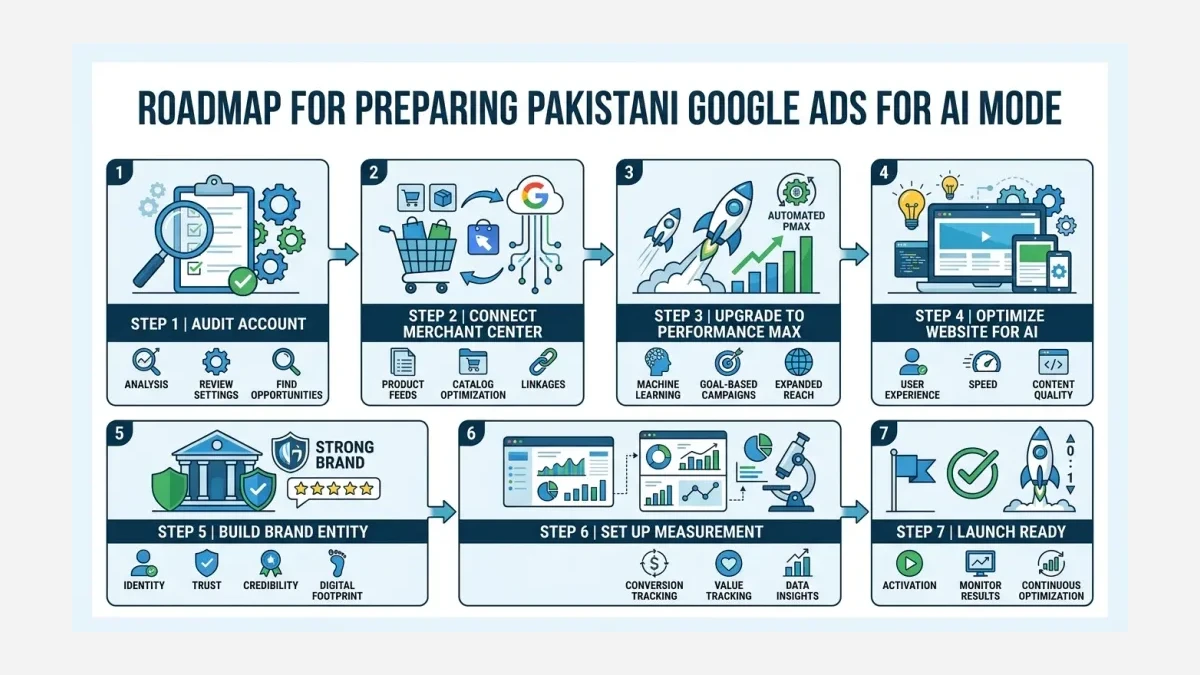
First, audit your current Google Ads account structure
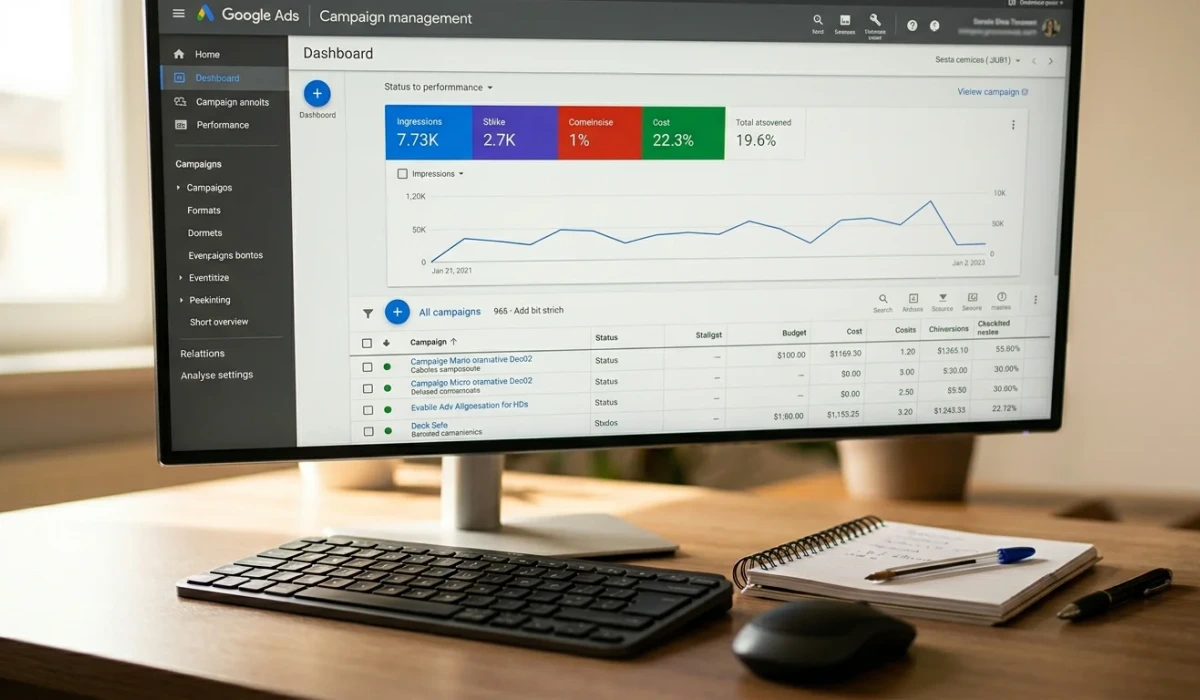
Start with an honest assessment of what the account measures and what its campaigns are trying to achieve. A clean structure helps you diagnose weak performance whether an ad appears in a traditional result or an AI-powered experience. There is no reason to rebuild profitable campaigns simply because the search interface has changed.
Open the account and inspect conversion actions, bidding settings and recent search terms. Are purchases recorded once, with the correct value and currency? Do lead conversions represent genuine enquiries? Can you distinguish a submitted form from a click on the contact button? Check the website journey yourself, then compare recorded outcomes with orders or your sales team’s records.
Remove the supposed conversion-count admission test from your planning. Google’s Performance Max guidance does not establish the article’s claimed monthly conversion threshold as a universal eligibility requirement. Data quality and volume still matter for evaluating bidding performance, but a sparse account needs careful goals and realistic expectations, not an invented qualification rule.
Before changing bids, decide what success means. A retailer might optimise towards purchase value; a service business might prioritise qualified enquiries. Keep a record of current spend, lead quality and revenue so you can assess subsequent changes. If the account mixes unrelated services or duplicates goals, address those problems before adding more automation.
Then, connect Google Merchant Center with structured product data
For ecommerce businesses, Google Merchant Center is an important product-data foundation where the relevant programmes are supported. However, Google’s AI advertising availability page lists Pakistan for text ads only. A connected feed should not be presented as a way to unlock Shopping ads inside Pakistani AI Mode results.
Check the intended target market, supported destination and account eligibility before building a feed-led advertising plan. Pakistani businesses selling abroad should assess the markets they actually serve, including fulfilment and currency requirements. A service business without a retail catalogue should focus on its service pages and lead measurement instead of creating unnecessary product feeds.
For eligible product listings, follow Google’s product data specification. Keep titles, descriptions, prices, availability, links and images accurate. Identifier requirements depend on the product: use genuine manufacturer-assigned identifiers where applicable, and never invent a GTIN or MPN to fill an empty field. The submitted price and availability should agree with the landing page.
A useful title pattern is Brand + Model or Product Type + Relevant Attribute. Include size, material or compatibility when it helps distinguish the item. Avoid adding unsupported features or promotional wording merely to catch more queries. A Karachi electronics retailer should describe the actual mouse model and connection type rather than promise silent operation without checking the manufacturer’s specification.
Review feed issues alongside website updates. When a product sells out, changes price or gains a new variant, update the relevant information consistently. For help with catalogue maintenance, Merchant Center management should focus on accurate data and resolving eligibility problems, with a clear explanation of which destinations the account can use.
Next, evaluate Performance Max and AI Max campaigns
Google says eligible existing Search, Shopping and Performance Max campaigns can participate in AI-powered Search experiences automatically. Advertisers do not need a separate AI Mode campaign or budget. Performance Max is therefore an option to evaluate against your goals, rather than a compulsory replacement for standard Search.
Performance Max is a campaign type that accesses inventory across Google’s channels. AI Max for Search is a suite of targeting and creative enhancements within Search campaigns, not a separate campaign type. Google’s AI Max documentation describes search term matching, text customisation and final URL expansion.
These distinctions affect the setup. Google identifies AI Max, broad match, Shopping and Performance Max as options for contextual matching to both a query and an AI response. Exact and phrase match can participate through direct query matching. That is a targeting distinction, not a promise that enabling a feature will secure a particular placement.
Begin with the campaign that best fits the business and available evidence. Supply useful creative assets, review landing pages and check brand, location and URL controls. For AI Max, understand which features you are enabling and inspect generated assets. For Performance Max, confirm that the conversion goals reflect outcomes you actually want across its available inventory.
Avoid a universal budget split between these approaches. Protect campaigns producing profitable demand, then fund a test you can evaluate against qualified leads or sales. Record the change and allow for the business’s conversion delay before judging it. A small account benefits from a clear test plan more than from launching several campaigns simply to look prepared.
After that, optimise website content for AI extraction
Your website should give buyers and advertising systems a reliable account of what you sell. Google documents that automated text features can use landing-page content, so vague descriptions and outdated offers are practical advertising problems. Clear information also makes it easier to review whether generated messaging accurately represents the business.
Start with product or service descriptions. Include the specifications, availability, delivery arrangements and limitations that buyers need. A Multan textile exporter might explain fabric composition, weight, order requirements and how to request a quotation. State the currency and commercial terms that actually apply; do not publish a fixed price merely to make the page look complete.
Use FAQs to answer questions your sales team regularly receives. For a Lahore property developer, these might cover payment terms, possession expectations and the evidence supporting approval claims. Keep those answers current and distinguish confirmed details from estimates. Helpful FAQs are worthwhile without assuming an experimental lead agent will automatically train on every page.
Organise pages with descriptive headings, concise feature lists and readable price tables where relevant. Keep important information visible to visitors, rather than placing it only in imagery or marketing slogans. Treat structured data as supporting information that must match the page; it is not a guarantee of an AI recommendation or sponsored placement.
A GEO audit for Pakistani businesses can help prioritise unclear pages and inconsistent business information. Ask for concrete findings, affected URLs and recommended changes. Agree the scope before paying for an audit, and judge its value by the problems it identifies rather than an unsupported promise of AI visibility.
Once the foundation is ready, build brand entity presence
Make it easy for customers to confirm who you are, where you operate and how to contact you. Consistent information across your website and business listings reduces confusion. Keep this work distinct from paid campaign eligibility: a stronger public presence does not guarantee favourable treatment inside AI Mode ads.
For an eligible local business, complete and verify the Google Business Profile using accurate real-world information. Review the business name, address or service area, phone number, categories and opening hours. A Lahore restaurant answering enquiries about late-night dining needs current hours and a clear location, alongside useful information about its menu and service.
Google’s local ranking guidance describes relevance, distance and prominence. It says review count and review score can influence local ranking, but provides no universal review-count or rating threshold that guarantees AI Mode recommendations. Ask customers for honest feedback and respond constructively rather than treating a particular total as an access requirement.
Review important directory and chamber listings for inconsistent contact details. Prioritise sources customers might genuinely use to verify the business. Keep ownership of these listings documented so changes in premises, telephone numbers or opening hours can be reflected promptly. This is useful business maintenance, without a claim that every citation produces a measurable AI ranking gain.
From here, set up measurement for AI Mode traffic
Measurement needs an honest boundary. Google says AI Overviews and AI Mode ad performance is included in aggregate within standard campaign and search terms reporting. You should therefore assess available campaign outcomes without presenting an invented AI Mode-only segment as a reliable placement report.
Adding a custom UTM medium to an entire campaign labels that campaign’s traffic; it does not reveal which clicks came from AI Mode. Do not rename every Google Ads click as an AI click. Keep the existing attribution setup consistent, check that campaign information reaches analytics correctly, and document what each report can actually identify.
Configure conversion tracking around business outcomes. Track purchases and valid enquiries, and use add-to-cart events, phone-button clicks or WhatsApp clicks as supporting indicators where useful. A message-button click is not necessarily a conversation, and a conversation is not necessarily a qualified lead. Keep those distinctions visible in reporting and bidding decisions.
Build a baseline before changing campaign settings. Compare spend, conversion value, qualified enquiries and completed sales over periods appropriate to your sales cycle. Record changes to offers, inventory and landing pages too, so ordinary business changes are not mistakenly credited to an AI feature. Where sales happen offline, reconcile marketing reports with the sales team’s outcomes.
Do not assume AI Mode visitors convert better than traditional search visitors. The article’s claimed advantage is not established for Pakistani paid traffic by the sources retained here. Engagement metrics can suggest questions to investigate, but longer visits and more page views do not prove profitable intent. Let completed purchases and lead quality guide the next decision.
The outcome: an AI-ready Google Ads account
The preparation produces an account with reliable conversion goals, suitable campaign settings, accurate product or service information and a clear measurement process. Ecommerce businesses also gain better catalogue maintenance where Merchant Center destinations are supported. Local businesses gain more consistent public information. Each improvement has a practical purpose beyond eligibility for a particular ad format.
Pakistan’s listed access to English-language text ads means this is already an account-quality exercise, rather than simply a countdown to launch. Eligible campaigns may participate automatically, but serving still depends on relevance and the auction. Access to one type of ad does not confirm access to every experimental conversational or shopping experience.
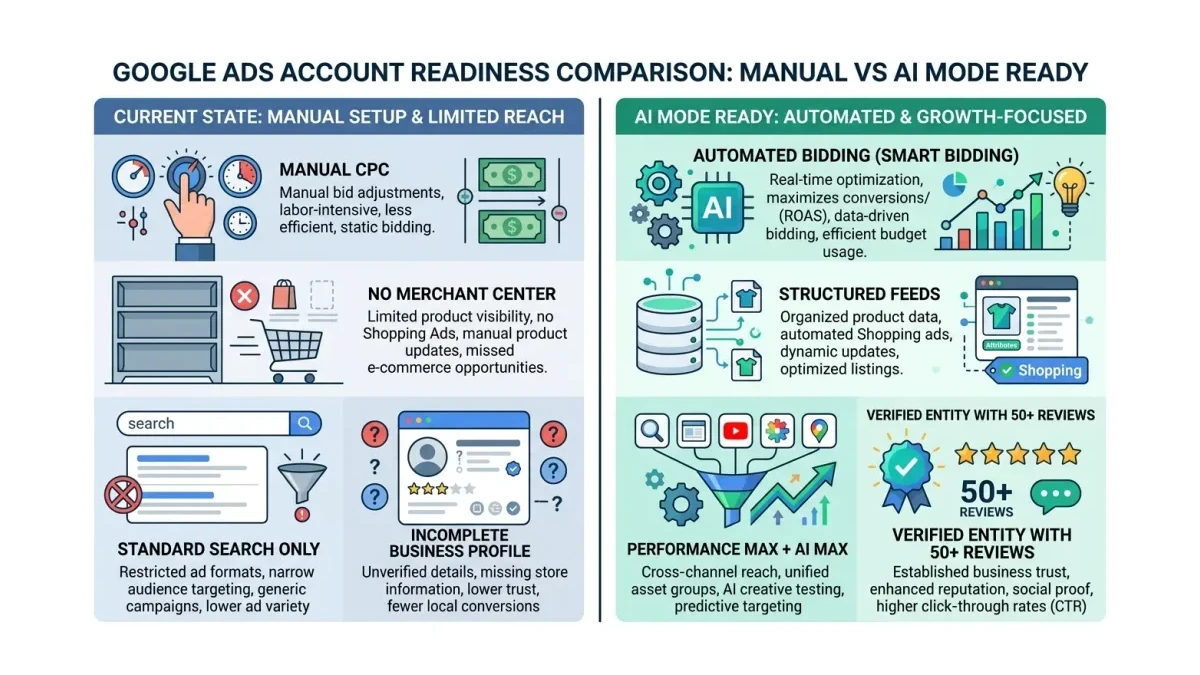
Use the following table as an audit checklist. The left column describes issues to look for, not a measured claim about most Pakistani accounts. Preparation costs depend on the actual work required, and there is no defensible universal estimate of revenue lost by waiting.
| Element | Issue to check | Prepared account |
|---|---|---|
| Bidding strategy | Goals or targets disconnected from outcomes | Strategy aligned with reliable business goals |
| Conversion tracking | Duplicate events or unqualified clicks counted as leads | Validated outcomes, with supporting events distinguished |
| Merchant Center | Inaccurate feeds or unsupported destinations | Accurate product data for eligible destinations |
| Campaign types | Features enabled without a clear purpose | Suitable Search campaigns; AI Max or Performance Max where useful |
| Website content | Unclear descriptions or outdated offers | Accurate specifications, FAQs and commercial terms |
| Business entity | Inconsistent contact details or opening hours | Accurate listings and genuine customer feedback |
| Measurement | Campaign labels mistaken for placement reporting | Consistent attribution with reporting limits documented |
| Preparation cost | Unscoped work or guaranteed-return promises | A quote tied to identified fixes and responsibilities |
Treat preparation as maintenance with a test plan. Fix inaccurate tracking and misleading information first, then assess campaign changes against commercial outcomes. Assign responsibility for reviewing generated creative, feed issues and feature availability. That gives the business a repeatable process as Google changes its advertising products, without relying on promises of cheaper clicks or immediate activation.
Read next: AI Mode Ad Formats Compared for Pakistani Advertisers · Fix Your Google Ads Budget Scheduling in Pakistan
At WeProms Digital, our Google Ads management team can help assess account structure, conversion tracking, catalogue quality and website content. Ask for a scoped assessment that separates necessary repairs from optional campaign experiments. Contact hello@weproms.com or WhatsApp +92 300 0133399 to discuss the account and the outcomes you want to improve.
Frequently Asked Questions
When will AI Mode ad formats be available in Pakistan?
Google’s current help page lists Pakistan for English-language text ads within AI Overviews and AI Mode. This does not confirm availability for every announced format or pilot. Check the relevant product guidance and your account before planning around Conversational Discovery, Highlighted Answers, Shopping experiences or lead agents. There is no basis here for promising activation on a particular timetable.
What minimum Google Ads budget do I need for AI Mode formats?
Google says advertisers do not need a separate budget for ads in AI-powered Search experiences. Set spend according to your commercial goals, acquisition costs and ability to evaluate outcomes. The original fixed PKR threshold was not an established eligibility rule. Keep the test affordable and avoid spreading spend across campaigns whose results you cannot assess meaningfully.
Do I need to change my website for AI Mode ads?
Audit it first. Correct unclear descriptions, outdated prices, unsupported claims and broken enquiry or purchase journeys. Automated creative features can draw on your website, so accurate content matters. There is no universal requirement to rebuild the site or install a special AI page format. Prioritise changes that help buyers understand the offer and complete the intended action.
Can I set up AI Mode ads myself without an agency?
Eligible existing campaigns can participate automatically, so a separate specialist setup is not always necessary. You can review tracking, assets and settings yourself if you understand the account. Get help where implementation or interpretation is uncertain, especially for conversion measurement and product feeds. Compare proposed work and deliverables rather than accepting guarantees about placement or cheaper traffic.
How does WeProms Digital help Pakistani businesses prepare for AI Mode ads?
WeProms Digital can assess campaign structure, tracking, Merchant Center data where relevant, and landing-page content. The useful output is a prioritised set of fixes and a campaign test plan tied to business results. Request a quote based on the account’s needs rather than relying on an unverified package price. Contact hello@weproms.com or WhatsApp +92 300 0133399 to discuss an assessment.
Sources & References
- Google Blog — Google Marketing Live 2026: New AI-Powered Ad Formats
- Search Engine Land — Google Tests Conversational Ad Formats in AI Mode
- Engadget — Google Bringing New AI-Powered Ad Formats to Search
- Google Blog — AI Max for Search and Shopping Features
- MediaPost — Google Rebuilds Ad Ecosystem with Agentic and Gemini
- PPC Land — Google’s New AI Search Ad Formats Reshape Brand Reach
- SERoundtable — Google Conversational Discovery Ads and Highlighted Answers
- Times of India — Google Starts Testing New Ad Formats in AI Mode
Additional reading from industry feeds: