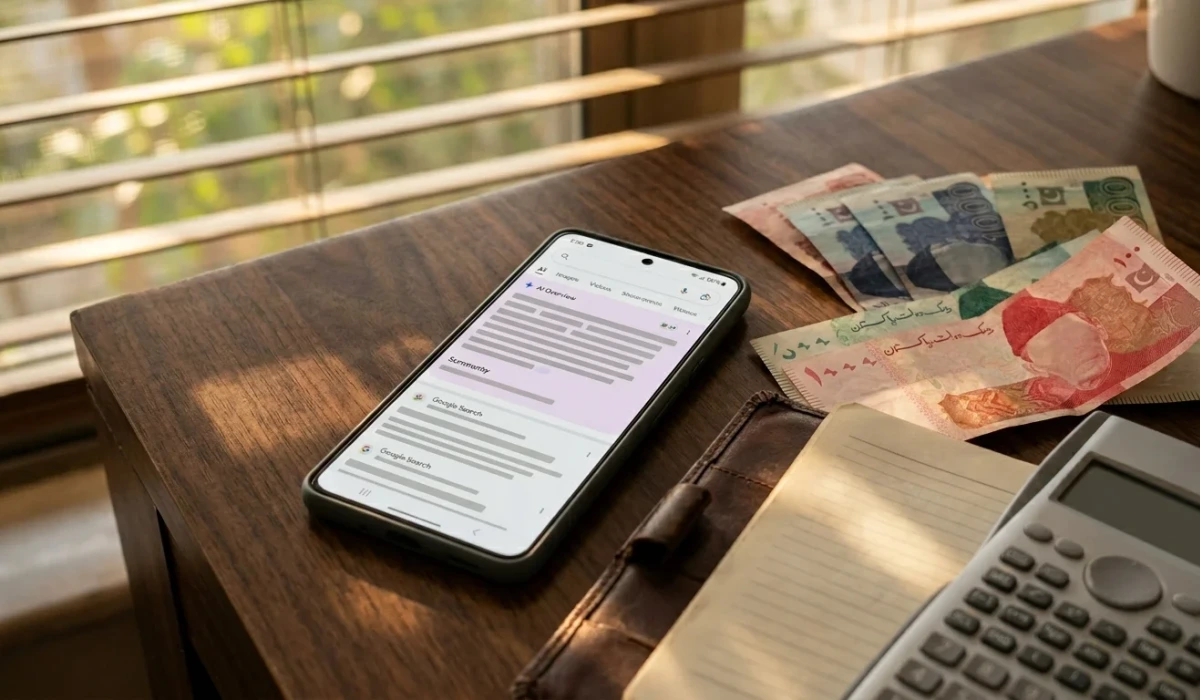

By Hamza Ali · May 2026
Imagine a Karachi electronics retailer checking Google Ads on a Monday morning. Impressions look steady, but enquiries have fallen. The campaign and landing page look unchanged. It is tempting to blame Google’s AI search features immediately. Before changing the budget, though, the retailer needs to establish whether fewer people clicked, fewer visitors converted, or tracking stopped recording enquiries.
Here’s the thing. A changing search interface deserves attention, but it does not explain every disappointing campaign.
Seer Interactive’s research reported a 68% decline in paid click-through rate for its sampled informational queries with AI Overviews between June 2024 and September 2025. That is a historical finding from a particular query set, not evidence that every Pakistani advertiser lost the same share of clicks. Nor is it a measurement of AI Mode itself.
At WeProms Digital, our approach is to examine the account before recommending a fix. For Pakistani SMEs, the useful questions are practical: which searches produce qualified enquiries, what does each customer cost, and where does the journey break down?
Picture a shopper walking through Liberty Market in Lahore. They ask a shopkeeper how to choose wedding fabric. A helpful comparison might satisfy their research without sending them into another stall. Someone ready to order still needs a seller, available stock and delivery details. Your campaign should distinguish those intentions instead of assuming every search deserves the same bid.
The setup that burns budget
A familiar Google Ads setup starts with keywords, text ads, bids and a landing page. Those ingredients still matter. The mistake is leaving them untouched while customer behaviour, competitors and search results change around them.
AI Overviews and AI Mode are different experiences. AI Overviews provide summaries within search results; AI Mode supports conversational exploration and follow-up questions. Neither means that every search produces a complete answer or that conventional ads have disappeared.
Google’s guidance says standard Search ads can appear above or below AI Overviews, while eligible ads can also appear within AI-powered experiences.
Google’s current documentation lists Pakistan among markets eligible for ads within AI Overviews and AI Mode, with text ads only and English-language availability. That matters more to a local advertiser than an unsupported global user count. Eligibility still does not guarantee an impression on every relevant search.
For a Lahore clothing brand, a falling CTR is a reason to investigate. Compare search terms, devices, locations and conversion quality across comparable periods. Check whether promotions, stock availability or competition changed. Avoid declaring AI the cause simply because impressions stayed steady while enquiries fell.
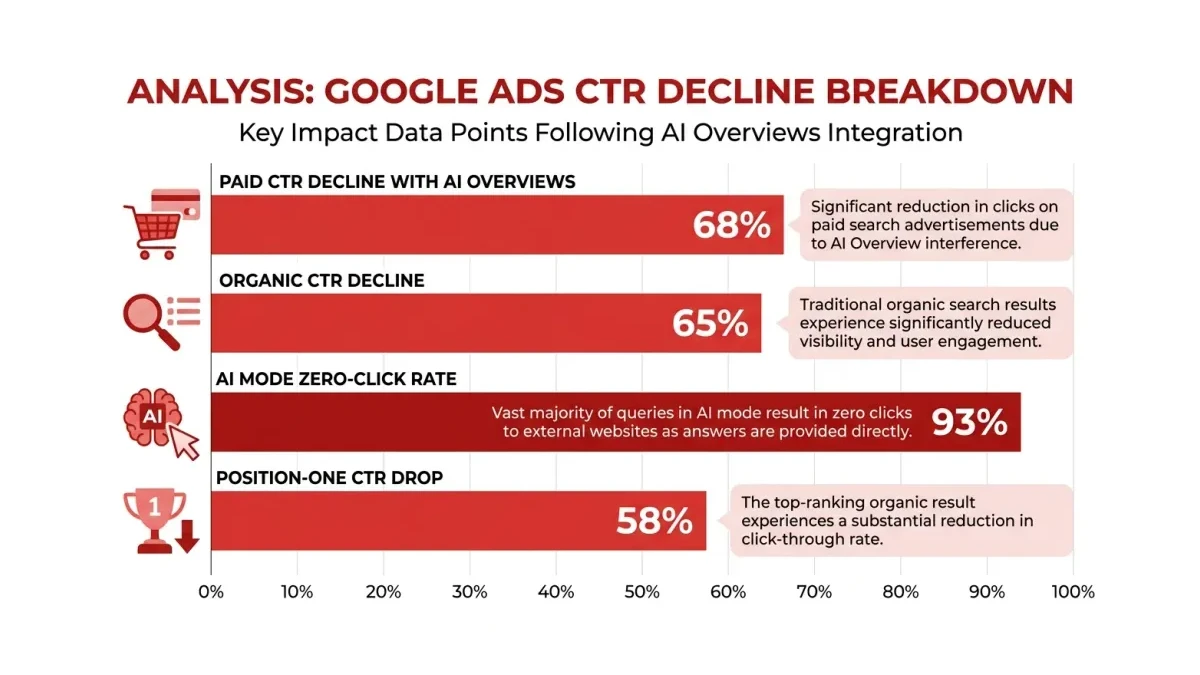
The embedded graphic presents broad click-loss figures. Use the qualified research finding above, rather than treating those figures as a forecast for your account.
Where the money actually goes
A lower CTR does not mean Google charges you for clicks that never happened. Google defines CPC bidding as paying for each click on your ads. Under CPC billing, an impression without a click does not itself create a click charge. Other campaign types and billing arrangements should be assessed separately.
This changes the budget diagnosis. If fewer people click, a campaign may spend less. If spend stays steady while clicks fall, inspect the actual CPC and traffic mix. If clicks remain steady while leads decline, investigate conversion rate, landing pages and tracking. These are different problems with different remedies.
The dangerous cycle starts when a business owner sees fewer enquiries and asks the agency to increase spend without checking those causes. More budget can buy more unqualified traffic, especially when the account treats a casual researcher and a ready buyer as equally valuable.
The budget drains worth investigating are irrelevant searches, weak conversion signals and journeys that make buying difficult. AI answers may influence demand and click behaviour, but they do not make these familiar problems disappear. An account can lose efficiency even on searches where no AI answer appears.
Our Google Ads budget waste teardown offers a useful companion to this review. Start with where money was actually spent and what it produced. Separate lost exposure from paid traffic that failed to generate a worthwhile outcome.
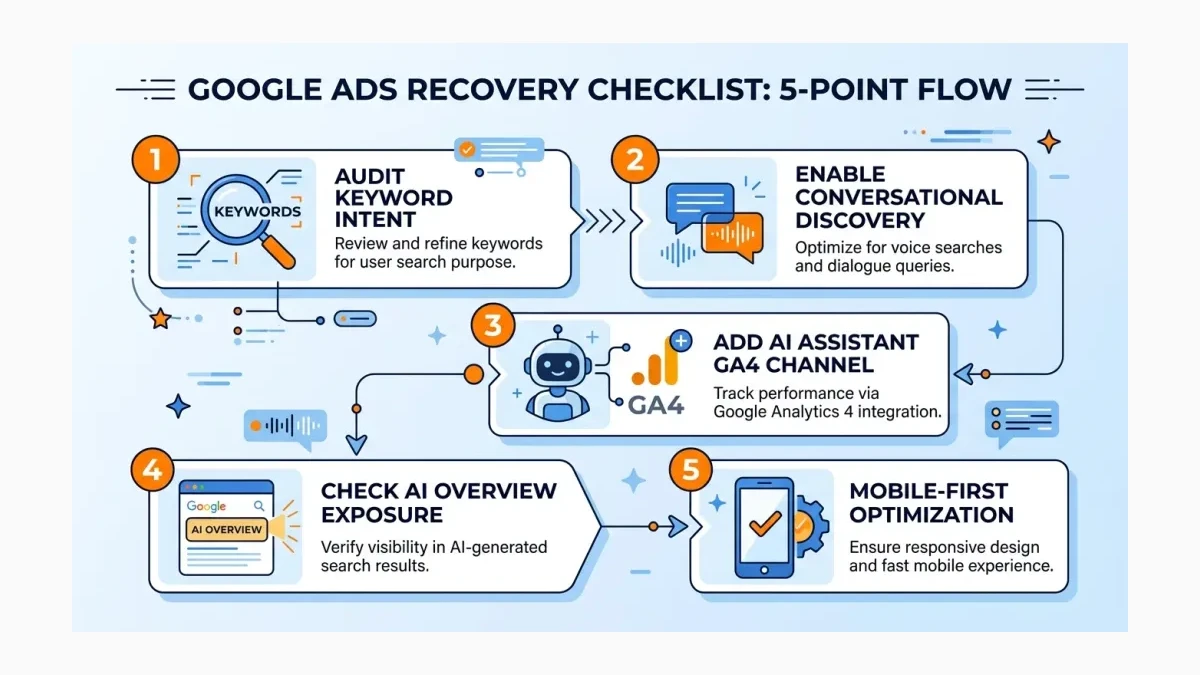
Use the checklist below for implementation; the graphic’s references to conversational ad activation do not describe the documented setup.
The keyword trap
Search volume is a starting point, not a business case. A phrase such as “best digital marketing agency Lahore” may attract comparison shoppers, jobseekers or businesses ready to hire. Its apparent popularity tells you little about which of those people your ads will reach.
Seer’s research is useful because it examined informational and educational queries. It provides a reason to scrutinise research-heavy traffic, but it does not establish a universal penalty for words such as “best” or “comparison”. Applying the headline decline to every commercial keyword would misuse the evidence.
The same caution applies across Pakistani industries. “Best restaurant in Islamabad”, “carpet cleaning service Karachi” and “accounting software Pakistan” express different needs. Someone comparing restaurants may be close to booking; someone searching for software may be a student or a purchasing manager. The wording alone cannot settle that question.
Transactional queries make the intended action clearer. Examples include “order birthday cake delivery Lahore today”, “book AC repair Faisalabad same day” and “buy Samsung Galaxy Karachi cash on delivery”. They deserve testing when your business can fulfil the request, but they are not immune to competition or poor conversion rates.
Review the search terms available in your account over a representative period. Group them by intent, then compare spend, qualified leads and completed sales. Pause irrelevant searches and test budget shifts away from consistently weak groups. Keep informational terms that demonstrably help acquire customers.
Our guide to fixing ad scheduling for Pakistani Google Ads budgets complements this work. A useful enquiry still needs a timely response. Make sure the hours you advertise match your ability to answer calls, confirm availability and close the sale.
The missing AI ad formats
The mistake here is assuming you need to enable a special conversational format before your ads can participate. Google’s documented approach allows existing eligible campaigns to enter the auction for AI search placements. There is no separate AI placement budget required.
Eligible campaigns. Google lists Search, Shopping and Performance Max as eligible campaign types overall. Availability varies by market and format. For Pakistan, the current documentation specifies text ads within these AI experiences; do not infer local Shopping placement availability from a global announcement.
Text and Shopping ads. These are the formats named in the documentation. The article’s earlier labels, “Conversational Discovery ads” and “Highlighted Answers”, are not supported by the cited setup guidance. There is no basis here for telling advertisers to activate them through a dedicated ad-format switch.
Placement controls. Google says advertisers cannot exclusively target AI Overviews or AI Mode, or separately opt out of them within Search. Buying ads also does not influence the organic AI answer. Keep paid placement eligibility separate from efforts to earn organic mentions.
For a Pakistani electronics retailer, the useful preparation is familiar: clear product or service information, relevant ads, accurate destinations and reliable conversion measurement. Do not promise that payment badges or a particular wording will secure placement inside an AI conversation.
Challenge agency recommendations that depend on an undocumented feature. Ask for the official eligibility page, the applicable market and the account change being proposed. A campaign should be judged on qualified enquiries and sales, not on whether its report contains the newest AI terminology.
Your five-point recovery checklist
Run this checklist against each account before increasing the budget:
-
Audit keyword intent and outcomes. Review available search terms, separating research, comparison and purchase intent. Compare their costs with qualified enquiries or sales. Exclude irrelevant searches and test reallocations from weak groups. Do not automatically pause every query containing “best”, or move a fixed share of budget without account evidence.
-
Check AI placement eligibility. Review Google’s current country, language and campaign guidance. Existing eligible campaigns can participate automatically; you do not need the unsupported “Conversational Discovery” activation step. For Pakistani targeting, account for the documented text-ad restriction. Record what you changed so performance comparisons remain meaningful.
-
Review AI traffic in GA4. Google now documents a default AI Assistant channel for recognised assistant referrals. It explicitly excludes Google’s AI Overviews and AI Mode. Inspect your acquisition reports and source/medium data before creating additional rules. A channel label cannot recover a missing referrer or identify every visit influenced by AI.
-
Check search results without assuming causation. Inspect relevant queries in the locations and languages you serve, and use suitable search-monitoring tools where available. Record AI features alongside other changes in the results. Treat this as context for account performance, rather than proof that an AI answer caused every lost click.
-
Remove mobile conversion friction. Test the landing page on a phone and a realistic connection. Check loading, forms, tap-to-call links and the WhatsApp enquiry journey. Show delivery areas, stock and payment options accurately. A visitor should be able to understand the offer and contact you without hunting through the page.
Reliable Google Ads conversion tracking supports the whole checklist. Distinguish a contact-button click from a completed enquiry and, where possible, connect enquiries with actual sales. Otherwise, a campaign can appear successful while sending the sales team contacts they cannot use.
Judge the changes against your own baseline and allow for the time customers take to buy. There is no substantiated recovery percentage or guaranteed billing-cycle turnaround here. The aim is to improve the value of paid traffic, with evidence you can inspect.
CTA
WeProms Digital helps Pakistani SMEs review campaign structure, search intent and conversion measurement. A useful audit starts with your account data and ends with a prioritised set of changes, including what to test and how to judge the outcome.
Request a PPC account audit and optimisation strategy or message us on WhatsApp +92 300 0133399. Share the business outcome you need—qualified calls, bookings or completed orders—so the review focuses on what matters commercially.
Read next: AI Marketing Audit for Pakistani SMEs in 2026 and How to Fix Ad Scheduling for Pakistani Google Ads Budgets
Frequently Asked Questions
How much does Google AI Mode affect paid ads for Pakistani businesses?
There is no verified Pakistan-wide percentage established by the sources used here. Seer reported a 68% paid CTR decline for sampled informational queries with AI Overviews over its study period. That finding concerns AI Overviews, not a measured AI Mode impact across Pakistani accounts. Assess your own CTR alongside CPC, conversion rate and qualified lead cost.
What are Conversational Discovery ads and should Pakistani businesses use them?
The cited Google documentation does not support that name as an available format advertisers should enable. It describes eligible existing campaigns and text or Shopping ads, with market restrictions. Pakistan is listed for text ads within AI Overviews and AI Mode in English. Check current eligibility rather than following an unsupported menu path or paying for a supposed activation service.
How do I track AI search traffic in GA4 for my Pakistani website?
Start with the default AI Assistant channel and inspect source/medium data in acquisition reporting. Google’s channel definition excludes AI Overviews and AI Mode, so it is not a complete report of Google AI search traffic. Custom rules can help organise identifiable sources, but missing referral information remains a measurement limitation. Keep paid campaign attribution distinct from assistant referrals.
Should I pause all informational keywords in my Google Ads campaign?
No. Evaluate them against the role they play in acquiring customers. A comparison query may produce valuable enquiries even if it sounds informational. Keep terms that contribute to profitable outcomes, remove irrelevant traffic and test reductions where costs consistently outweigh value. Avoid applying a blanket budget cut based on a study that did not examine your business or market.
How much does a Google Ads audit cost for a Pakistani SME?
Ask for a quote based on account scope, tracking complexity and the work included. The earlier blanket price range was not supported by a suitable source. Confirm whether the deliverable includes findings only, implementation, or follow-up measurement. Contact WeProms Digital to discuss the account and confirm the scope and price before work begins.
About WeProms Digital
WeProms Digital works with Pakistani SMEs, ecommerce brands and B2B teams on Google Ads management and conversion tracking. The focus is practical: connect campaigns with business outcomes, identify avoidable spending and make account decisions easier to assess.
For businesses in Lahore, Karachi, Islamabad and beyond, that means checking the complete journey from search query to enquiry and sale. AI search developments belong in that review alongside the fundamentals of targeting, messaging and customer experience.
Get in touch: hello@weproms.com · WhatsApp +92 300 0133399
Sources & References
- Seer Interactive — AIO Impact on Google CTR: September 2025 Update — research scope and historical paid CTR findings.
- Google Ads Help — About ads in AI-powered experiences in Google Search — formats, campaign eligibility, placement controls and Pakistan availability.
- Google Ads Help — Cost-per-click: Definition — how CPC charging works.
- Google Analytics Help — Default channel group — AI Assistant classification and exclusions.
Additional reading from industry feeds:
- Google Ads & Commerce — Ads in AI Mode expand to new markets — official expansion announcement including Pakistan.