Pakistani Ecommerce Stores Are Buying Keywords When They Should Be Buying Intent
By Sara Khan, WeProms Digital — July 14, 2026.
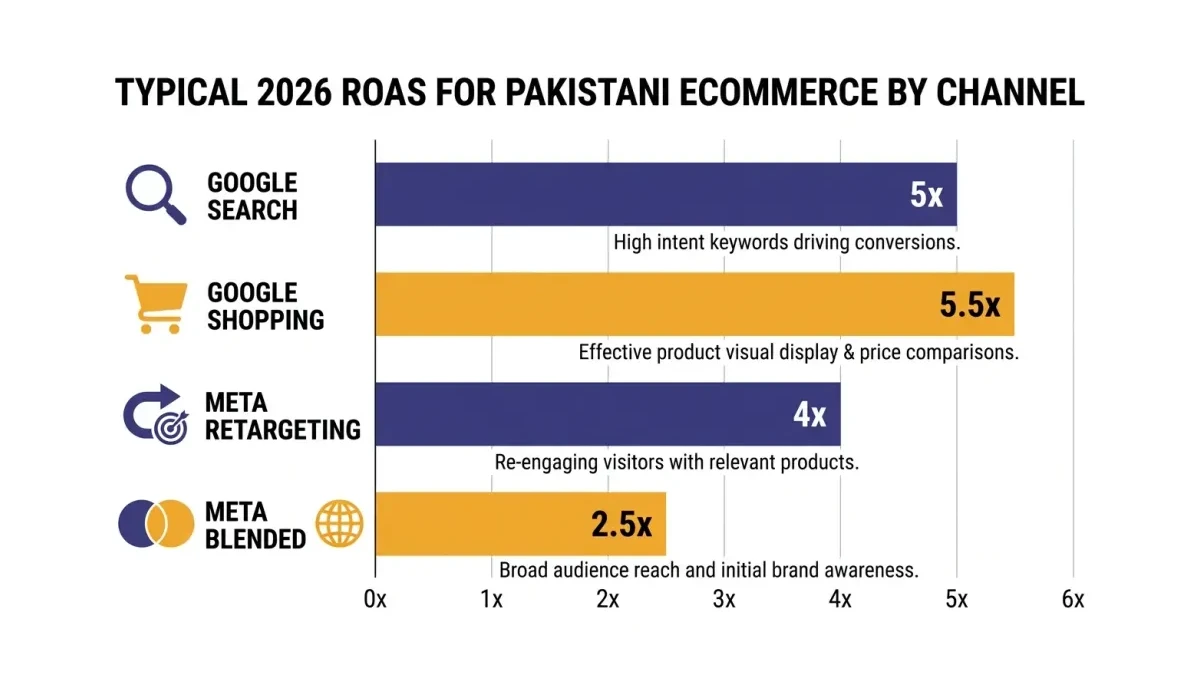
The assumption that governs most Pakistani ecommerce ad accounts in 2026 is that victory belongs to whichever brand refines its keyword list most obsessively, expanding match types, pruning negatives, and chasing the exact phrase a Lahore shopper might type into Google before a purchase. The numbers point somewhere else entirely. Well-structured Google Search campaigns in Pakistan return roughly 4 to 6 times ad spend, while Meta campaigns trail at about 2.2 to 3 times, yet the brands reaching the higher figure are rarely the ones with the cleanest keyword lists; they are the ones buying intent across both platforms and letting paid social do the quiet work of seeding the search that closes the sale. A keyword is a record of what someone typed. Intent is the commercial moment that typing represents, and the gap between those two ideas is where most Pakistani ad budgets leak.
The keyword is a symptom, not the cause of the click
A keyword reports behavior; it does not create it. When a Karachi shopper types “winter jacket under 5000,” the string is the tail end of a decision that began minutes or days earlier, often with a Meta scroll, a WhatsApp forward, or a Daraz comparison. PPC Hero’s argument for shifting from keyword-centric to intent-centric campaign structures is built on this distinction, and it maps cleanly onto how Pakistani discovery actually happens. The typical Pakistani SME spends PKR 50,000 to PKR 200,000 a month across paid media, with growth-focused ecommerce brands pushing PKR 300,000 to PKR 500,000, and most of that money is allocated by keyword volume rather than by the stage of intent each keyword signals.
The pattern repeats across Lahore and Karachi accounts. Brands build enormous keyword lists, segment them by match type, and optimize toward the cheapest cost per click, then wonder why ROAS flatlines. The underlying mechanic is that cheap clicks are cheap precisely because they sit low on the intent ladder; an informational query like “best fabric for winter” costs less per click than a transactional one like “buy winter jacket Karachi,” but it converts at a fraction of the rate. Treating both as equally valuable inventory, simply because both are cheap, is how an account accumulates volume without revenue. A transactional intent — the commercial signal that a shopper is ready to spend now, as opposed to merely researching — is worth several times the cost of an informational click, and an account that does not price that difference in will always look busy and stay unprofitable.
Why a clean Google account still underperforms without paid social
Book a free strategy call - we'll audit your current setup and identify the highest-impact fixes.
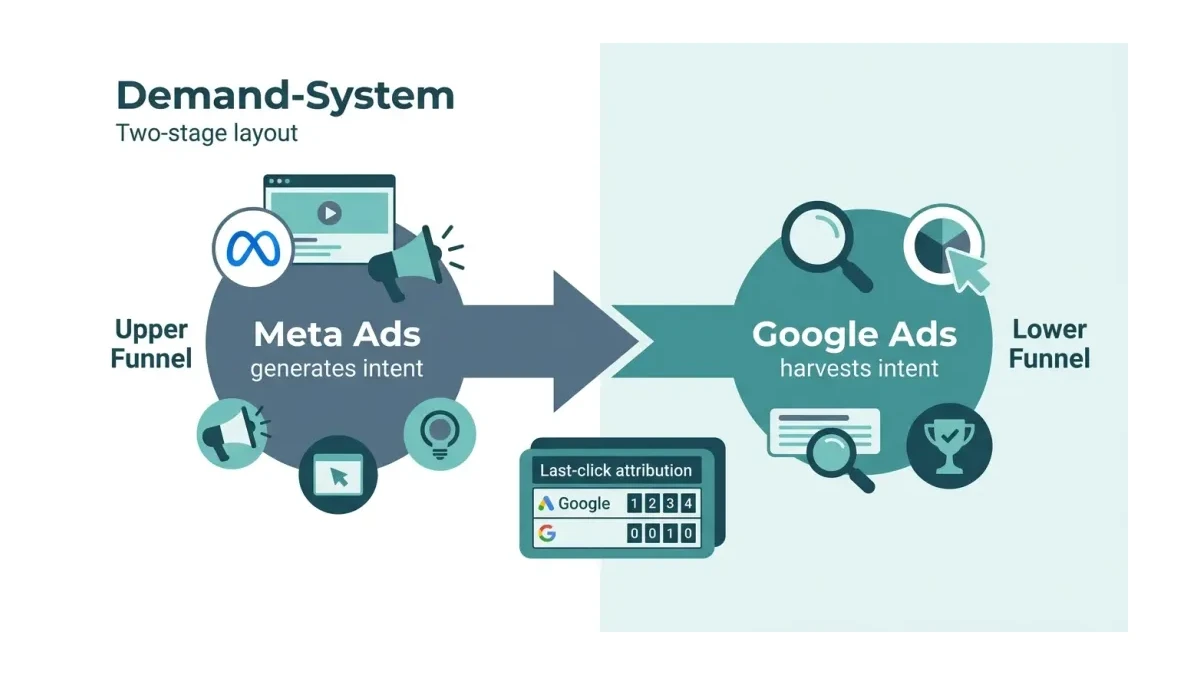
The most counterintuitive finding in recent cross-platform analysis is that search ROAS is not generated by search alone. Search Engine Land’s reporting on why search ROAS depends on paid social more than advertisers assume traces the same mechanism: paid social creates the brand recognition that later converts on a branded or category search, and last-click attribution then hands the entire credit to Google. Think of it like a PSL catch: the bowler does the work that makes the wicket possible, but the scoreboard credits only the fielder. Paid social is the bowler, Google search is the fielder, and last-click attribution is that scoreboard. A Pakistani apparel brand running only Google Ads will still capture these searches, but it will capture far fewer of them, because no upper-funnel impression primed the shopper to type the brand name in the first place.
What this looks like in a Pakistani account is a search campaign that appears efficient in isolation and collapses the moment Meta is paused. A store cutting Meta to improve reported Google ROAS is often harvesting demand it did not plant, and the harvest lasts only as long as the planted memory survives, which is usually a few weeks. The healthier reading is that Google and Meta form a single demand system: Meta generates the intent, Google harvests it, and the ROAS each platform reports is an artifact of where the attribution window closes rather than a measure of what each platform contributed. Brands that internalize this stop asking which channel wins and start asking how the two are sequenced.
Intent lives across platforms, not inside one match type
If intent is the real unit of purchase, then a campaign structure organized around single-platform keyword taxonomies is structurally incomplete. A shopper who sees a Meta carousel for a skincare brand, searches the brand name on Google two days later, and finally buys through a retargeting ad has expressed the same commercial intent across three surfaces, and any account that treats those as three unrelated events will optimize each one in isolation and miss the throughline. The intent-first approach clusters messages by what the shopper is trying to accomplish, not by the string they happened to type on one platform, and it lets the budget follow the moment rather than the keyword.
This is where audience signals matter more than keyword lists. Meta’s strength in Pakistan is cheap discovery; cost per click on Meta commonly lands between PKR 5 and PKR 60, with CPM between roughly PKR 100 and PKR 600, while Google search clicks run higher at about PKR 20 to PKR 150 for most ecommerce terms. That cost asymmetry is not a reason to abandon Google; it is a reason to let Meta find the audience cheaply and let Google capture the resulting high-intent searches. The creative and the landing page should then speak to the same intent stage, so a shopper who first saw a product on Instagram lands on a page that confirms rather than restarts the decision. When the ad creative outperforms the targeting, it is usually because the creative carried a sharper intent signal than the keyword list ever could.
The Pakistani budget split that quietly decides ROAS
The single most consequential decision in a Pakistani ecommerce account is not which keywords to buy but how to split the budget between the two platforms, because that ratio determines whether paid social can seed enough demand for search to harvest. Practitioners working with Pakistani storefronts frequently land near a 60/40 split in favor of Meta, precisely because audience discovery is cheaper there and because search volume in Pakistan is thinner than in Western markets for any single brand. A brand that over-indexes on Google will see pristine per-click metrics on a shrinking pool of already-warmed shoppers, while a brand that over-indexes on Meta will generate demand it never harvests.
The discipline is to read both platforms against a shared revenue target rather than against each other. A Lahore fashion retailer spending PKR 150,000 a month should expect Meta to look modest on its own, often in the 2 to 3 times ROAS range, and Google to look strong, often 4 to 6 times, with the combined number being the only honest measure of profitability. Brands that benchmark each platform against global averages in isolation tend to cut the channel that is actually doing the seeding, which is the equivalent of cutting irrigation to save water and then wondering why the crop fails. The same logic applies to budget planning and to bidding strategy: the unit of optimization is the intent journey, not the keyword cluster.
Disclosure and the new honesty tax on AI-built creative
How we helped a Pakistani business achieve measurable results.
A secondary force is reshaping what “buying intent” costs in 2026, and it has nothing to do with keywords. Google now requires advertisers to disclose when ad creative is substantially generated or modified by artificial intelligence, treating unlabeled AI imagery, voice, or copy as a misrepresentation risk that can trigger ad disapproval and account-level warnings. For Pakistani brands that have leaned on AI-generated product imagery and ad copy to keep creative costs down, this is an operational change, not a theoretical one; a campaign can be paused mid-sale if the disclosure fields are left empty.
The honest reading is that disclosure raises the floor on creative quality rather than banning efficiency. A Karachi electronics brand using AI to generate lifestyle imagery still wins on cost, provided the assets are labeled and accurate; a brand that hides AI generation to chase a marginal lift risks losing the entire campaign at the worst possible moment. Intent-first advertisers are less exposed here, because their creative is built around a clear commercial message that survives scrutiny, whereas keyword-stuffed, low-effort AI copy tends to read as exactly the kind of generic content the disclosure rule was designed to surface. Pairing intent targeting with clean creative is how a brand stays fast without tripping a policy wire.
The principle that separates the profitable accounts
Strip the platforms, the match types, and the disclosure rules away, and a single principle remains: buy the moment of intent, and let every channel serve that moment in the order the shopper actually experiences it. Keywords are useful evidence of where intent has been, and they deserve a place in any account, but they are a lagging indicator of a decision that begins upstream and closes wherever the shopper finally trusts the brand enough to pay. The Pakistani ecommerce accounts that compound profitability are the ones that treat Meta and Google as one demand system, allocate budget by the cost of generating and harvesting intent rather than by the cost of a click, and hold the combined ROAS as the only number worth optimizing. Everything else, from the keyword list to the AI label, is downstream of that one decision.
Read next: why PPC comes before SEO for Pakistani SMEs navigating AI search.
That combined system is what WeProms Digital, Pakistan’s leading PPC management agency, builds for ecommerce brands across Lahore, Karachi, and Islamabad. We structure Google and Meta as a single intent pipeline, set the budget split to your margin, and wire conversion tracking so the credit lands where the demand actually started. Reach us at hello@weproms.com, message WhatsApp +92 300 0133399, or begin at weproms.com/contact-us.
Sources & References
- PPC Hero — Stop Targeting Keywords And Start Targeting Intent — Shift from keyword-centric to intent-centric campaign structures
- Search Engine Land — Why Search ROAS Depends on Paid Social More Than You Think — Cross-platform attribution and the search-social demand system
- Jon Loomer Digital — When Is a Campaign Worth Scaling? — Scaling criteria, frequency caps, and audience saturation
- Search Engine Journal — Google Ads Requires Disclosure for AI-Generated Content — 2026 AI creative labeling policy and enforcement
- Hootsuite — Social Media Advertising Costs, Tips for 2026 — CPM and CPC benchmarks by platform
- Google Ads Help — About Conversion Tracking — How attribution credit is assigned across touchpoints
- Meta for Business — About Meta Ads and the Meta Ads Manager — Audience signals and paid social discovery
- Think with Google — How Search and Video Work Together — Upper-funnel and lower-funnel synergy research
- Store Growers — Google Ads Benchmarks — CPC, CVR, and ROAS ranges by industry
Additional reading from industry feeds: