

Last updated: June 2026. Written by Abdul Rehman, WeProms Digital.
The prevailing assumption among Pakistani SME owners and their marketing advisors holds that search engine optimization represents the foundational long-term investment for online visibility while pay-per-click advertising serves merely as a temporary bridge strategy to cover the gap during the months or years that organic rankings take to deliver returns.
Google continues to expand AI experiences in Search, including AI Overviews and AI Mode. That changes the way business owners should read SEO reports. A page can still receive impressions while clicks and enquiries fall because the search results page now contains more answers, ads, maps, videos, and comparison features before a user reaches a traditional organic result. For Pakistani businesses paying monthly SEO retainers, this demands a hard look at where the marketing budget actually produces leads.
The math changed when AI answers replaced blue links
Picture this. A Lahore-based IT services company has ranked on page one for “software development company Lahore” for three years. Monthly organic traffic from that keyword: 340 visitors, generating roughly 12 qualified leads. The SEO agency charges a fixed monthly retainer. Cost per lead from organic looks attractive while clicks are stable.
In January 2026, Google begins showing an AI Overview for that same keyword. The AI-generated answer lists five companies with brief descriptions, pulled from directory listings and review sites. The Lahore company appears in the AI answer but not as a clickable link — just a name and a one-line summary. Organic clicks on that keyword fall even though the ranking report still looks stable. Monthly leads from organic fall, and the effective cost per lead rises. The SEO agency can technically report that “rankings are stable,” but the owner feels the drop in the sales pipeline.
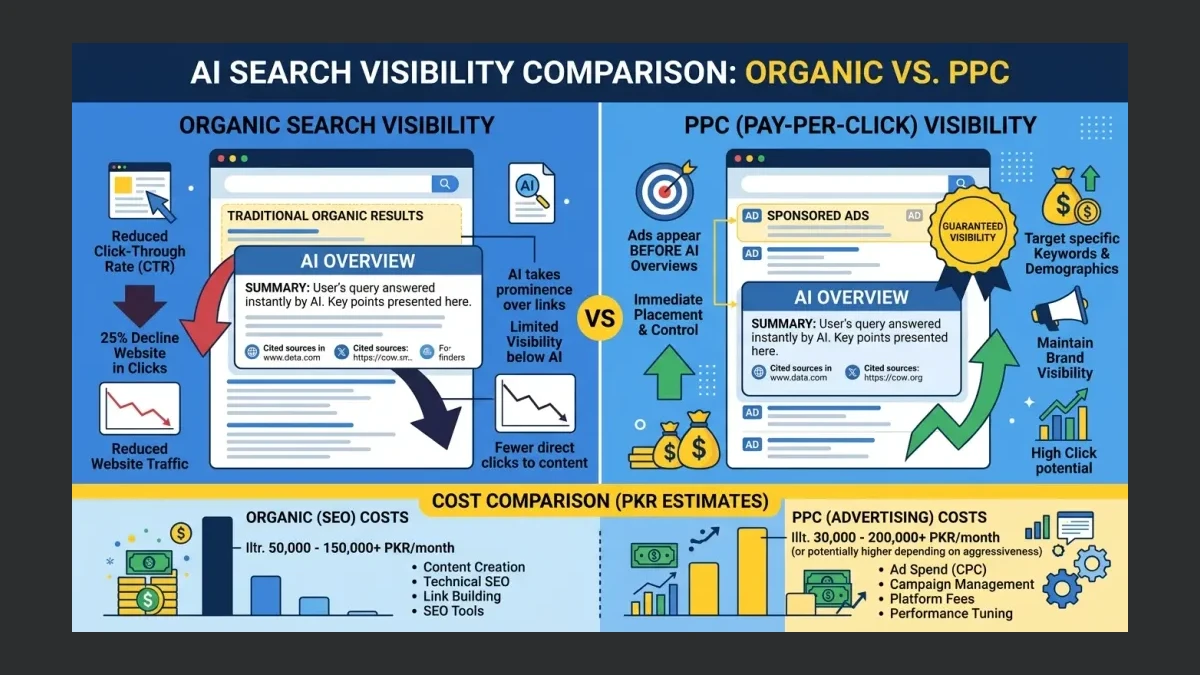
The tradeoff is real. Rankings do not equal visibility. When Google’s AI answers a query directly, the position of your blue link matters less than whether your business name appears in the AI-generated response. And AI Overview presence does not follow traditional ranking factors. A business ranking position 8 can appear in the AI answer while the position 1 result gets buried below the fold.
Google continues to expand AI experiences in Search, including AI Overviews and AI Mode. That does not mean every classic result disappears, but it does mean Pakistani businesses should not rely on blue-link rankings alone. Every SEO-only budget should now be checked against paid search, conversion tracking, and page-level business outcomes.
Pakistani SMEs are paying for traffic that no longer arrives
The typical Pakistani SME investing seriously in search marketing has to split budget across SEO, PPC, landing pages, creative, tracking, and follow-up. The exact number varies by industry, city, margins, and sales cycle, but the budgeting mistake is often the same: too much money goes into activity that cannot be tied back to qualified leads.
Where does the SEO portion of that budget go? A healthy retainer should cover technical fixes, commercial page improvement, useful content, internal links, entity signals, and measurement. A weak retainer becomes monthly blog production and ranking screenshots. That is risky in a search environment where many informational searches produce fewer external clicks than business owners expect.
The math can become unforgiving for businesses that split budget evenly without checking actual leads. If organic clicks decline while PPC leads remain measurable, the SEO half of the budget needs sharper commercial priorities rather than more generic content. SEO retainer waste in the AI search era is not a theory; it is a monthly invoice that produces less each quarter.
A Rawalpindi dental clinic might see this pattern: organic rankings look similar, but enquiries from broad informational pages decline while Google Ads leads remain measurable. After several months, the owner may find that the paid campaigns provide clearer cost-per-lead data than the SEO retainer. That does not mean SEO is useless. It means SEO has to focus on commercial pages, local trust, and conversion rather than activity volume.
What PKR 200K monthly actually buys in Pakistan’s search landscape
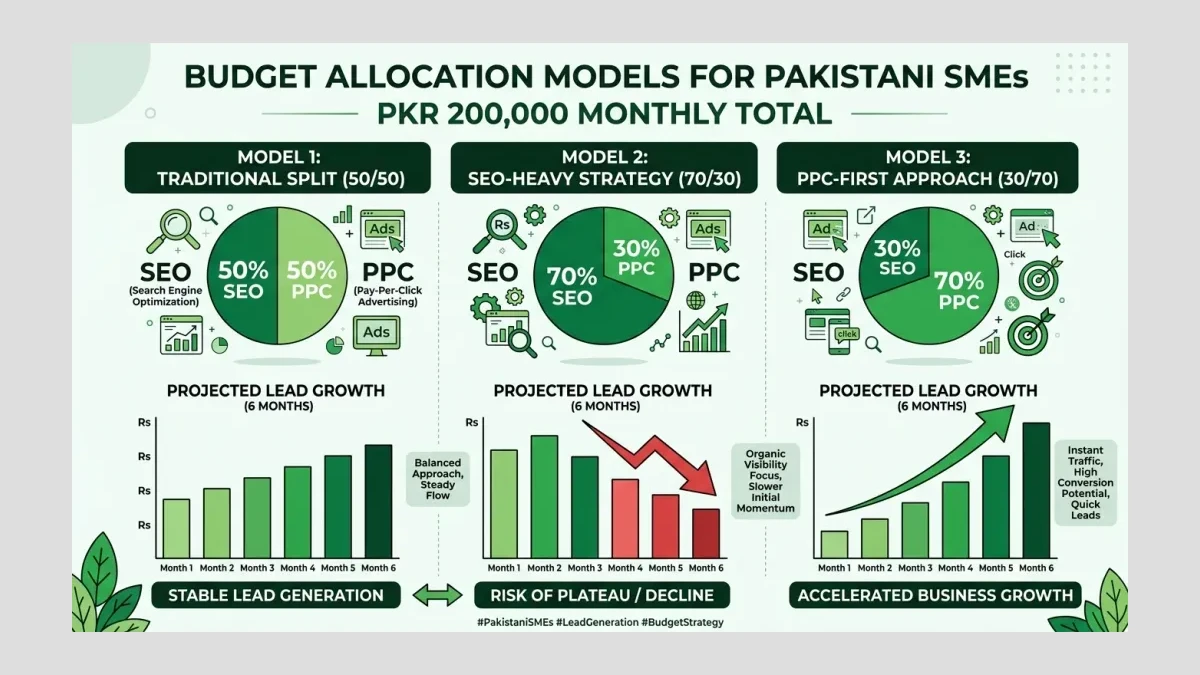
Start here. A Pakistani SME with a PKR 200,000 monthly digital marketing budget has three allocation options in 2026.
Option one: the traditional split. PKR 100,000 to SEO, PKR 100,000 to PPC. The SEO component funds keyword optimization, content publishing, and link acquisition, while the PPC component funds Google Ads campaigns for high-intent searches. After a few months, the owner may discover that SEO activity increased but qualified enquiries did not. Cost per lead rises because the SEO portion is not being judged by commercial outcomes.
Option two: SEO-heavy. PKR 140,000 to SEO, PKR 60,000 to PPC. The business bets on organic recovery through aggressive content and link building. PPC budget covers only brand-name campaigns and a handful of exact-match keywords. After a few months, organic traffic may still disappoint because the issue was not simply a lack of content. PPC leads can also fall because the budget is too small to test properly. Total lead volume declines and cost per lead becomes harder to explain.
Option three: PPC-first. PKR 140,000 to PPC, PKR 60,000 to SEO. The PPC budget funds broad keyword coverage across Google Search, Performance Max, and YouTube. Guaranteed visibility on every relevant search, regardless of AI Overview presence. The reduced SEO budget covers technical maintenance, entity optimization for AI citation, and brand-building content. After a few months, PPC produces clearer learning: which keywords convert, which landing pages fail, and which offers deserve more budget. SEO still supports trust and discovery, but the business is no longer waiting for organic traffic alone to rescue the pipeline.
The practical evidence often supports option three when a business needs leads now and has enough margin to buy qualified demand. CTR loss from AI search is one more reason SEO-dependent businesses should measure clicks, leads, and sales instead of celebrating rankings alone.
The agency model that keeps selling SEO first
Pakistani digital marketing agencies face a structural incentive problem. SEO retainers produce recurring monthly revenue with relatively low delivery costs. A monthly SEO retainer can be valuable when it funds expert diagnosis and page improvements. It becomes weak when it turns into templated content, low-quality links, and reports that avoid lead quality. The incentive to tell clients that some organic traffic is harder to win — and that budget may need to move toward PPC, CRO, or tracking — is not always strong.
This is not about agencies being dishonest. It is about misaligned incentives. An agency that has built its business model on SEO retainers has little motivation to tell clients that the foundational assumption of that model — organic traffic grows over time with consistent investment — no longer holds in an AI-search world.
Search Console can show query and page-level changes in impressions, clicks, CTR, and average position. It should be combined with manual SERP checks before blaming AI answers for traffic loss. The data removes the excuse of not investigating.
A Pakistani business owner should ask their SEO agency three questions: What percentage of our target keywords now show AI Overviews? How has organic CTR changed on those keywords over the past six months? What specific actions are being taken to earn AI citations rather than just blue-link rankings? If the agency cannot answer these questions with data, the retainer is subsidizing outdated tactics.
The principle is straightforward. Agencies that adapted to AI search offer GEO/AEO services alongside traditional SEO. Agencies still selling 2018-style link building packages in 2026 are collecting retainer fees for work that produces diminishing returns. The distinction matters for Pakistani SMEs operating on tight marketing budgets.
Where PPC delivers what SEO cannot in an AI search world
Paid search guarantees something that organic search no longer provides: certainty of visibility. When a potential customer in Karachi searches “accounting firm Lahore,” a Google Ads campaign ensures your business appears at the top of the results page, above the AI Overview, above the organic listings, and above your competitors. That guarantee costs money, but the money produces measurable, attributable returns.
The “organic is free” argument ignores opportunity cost. Time spent waiting 6-12 months for SEO results in a declining organic market is time during which competitors using PPC capture market share. A Pakistani SaaS company spending PKR 200,000 monthly on SEO for nine months before seeing results has invested PKR 1.8 million with no guaranteed return. The same company spending PKR 200,000 monthly on Google Ads generates leads from day one, with clear cost-per-acquisition data that informs budget decisions.
PPC also provides something SEO fundamentally cannot in the AI search era: impression-level control. Organic results are subject to algorithm changes, AI Overview insertion, and SERP layout shifts that your business cannot influence. PPC campaigns give you control over ad copy, landing pages, bid strategy, audience targeting, and scheduling. When Google moves the goalposts on organic results, your PPC campaigns remain exactly where you placed them.
Performance Max campaigns deserve specific mention for Pakistani businesses. Google’s campaign type can serve across several Google inventory sources from one campaign, but it still needs clean conversion tracking, strong assets, exclusions, and budget discipline. Treat it as a testable paid channel, not a magic replacement for search strategy.
Agentic search traffic loss patterns show that AI agents increasingly bypass organic listings entirely. PPC campaigns remain the one channel where businesses can guarantee their presence in the search journey, regardless of how AI transforms the organic landscape.
The principle that should guide every Pakistani marketing budget
Allocate marketing budget to channels based on controllability and measurability, not legacy assumptions about organic superiority. In an AI-search environment where informational clicks are harder to win and SERP layouts keep changing, the channel you can measure and adjust quickly — PPC — often needs a larger role. SEO serves as a complementary investment in entity building, AI citation, and brand authority, not the primary traffic and lead generation channel.
Pakistani SMEs that restructure budgets around measurable leads can make better decisions than competitors still paying for SEO-heavy strategies without conversion evidence. The window for this reallocation is open now: fix tracking, test paid search, keep SEO focused on pages that influence buyers, and review the split every month.
At WeProms Digital, our Google Ads management team manages Google Ads, Performance Max, and PPC campaigns for Pakistani businesses that want clearer lead tracking and budget control. Our team audits Pakistani PPC accounts to find wasted spend, weak tracking, poor landing pages, and budget splits that do not match commercial intent. Contact us at hello@weproms.com or WhatsApp +92 300 0133399 to discuss your PPC strategy, or visit weproms.com/contact-us for a free account review.
Read next: SEO retainer waste in the AI search era for Pakistani businesses and AI search conversion rate budget waste for Pakistani SMEs
Sources & References
- Google Search Central — AI features and your website — official guidance
- Google Ads Help — About conversion measurement — official conversion tracking guidance
- Google Analytics Help — Key events — official GA4 guidance for important user actions
- Google Search Console Help — Performance report — official explanation of clicks, impressions, CTR, and average position
- Google Search Central — Creating helpful, reliable, people-first content — official content quality guidance