Why Does Pakistani Ad Creative Now Beat Audience Targeting in 2026?
By Hamza Ali. Last updated June 30, 2026.
A Lahore clothing brand spending PKR 800,000 a month on Meta ads came to us last quarter with a report full of green numbers. Click-through rate was up. Cost per click was down. The dashboard looked healthy. The bank account did not. Sales had flatlined for three months while spend climbed 20%. The team kept rebuilding audiences — lookalikes here, interest stacks there, age bands tightened — because that is the lever every Pakistani ad account has pulled since 2018. The lever is broken. In 2026, the creative is the audience, and the audience work most operators obsess over now moves less than ten percent of the result.
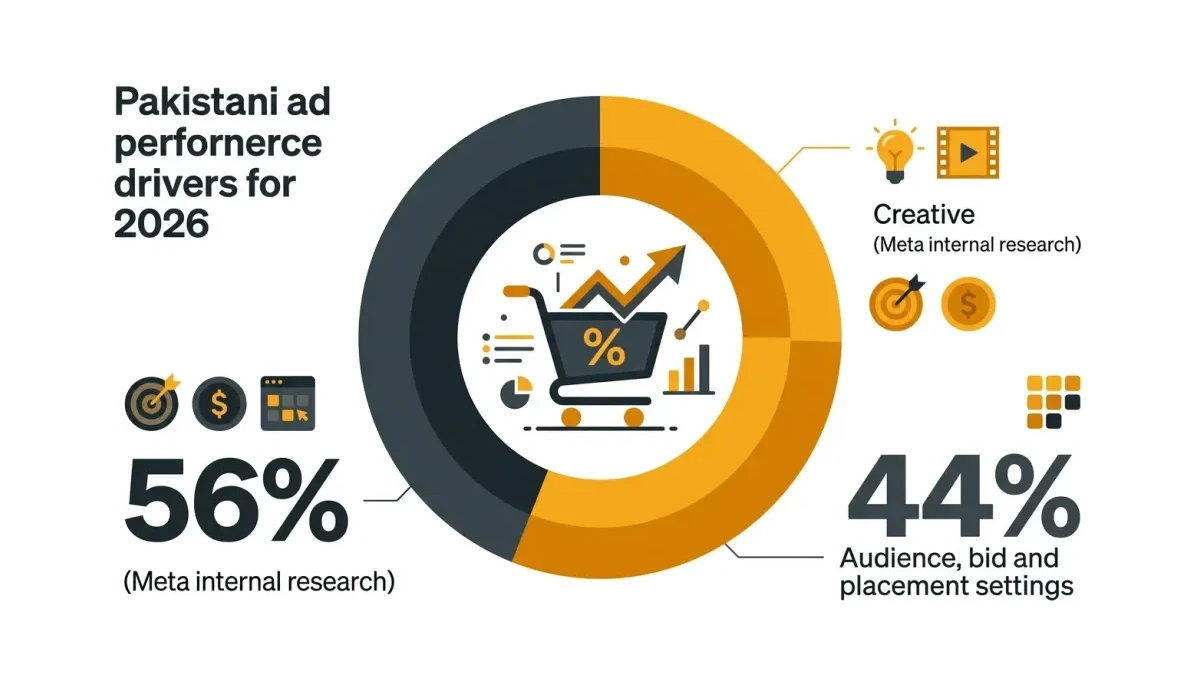
The shift happened inside the ad platforms, not in any agency deck. Meta’s internal research attributes roughly 56% of campaign performance to creative, with media, audience, and bid settings sharing the remainder. Advantage+ — Meta’s automated campaign type that removes manual audience targeting — now beats standard setups by about 22% on return on ad spend, and Google Performance Max reports roughly 14% more conversions than comparable Smart and standard campaigns. The platforms took the targeting lever out of the operator’s hands and handed it to their own AI. What is left to control is the creative.
The ad account that looks healthy and loses money
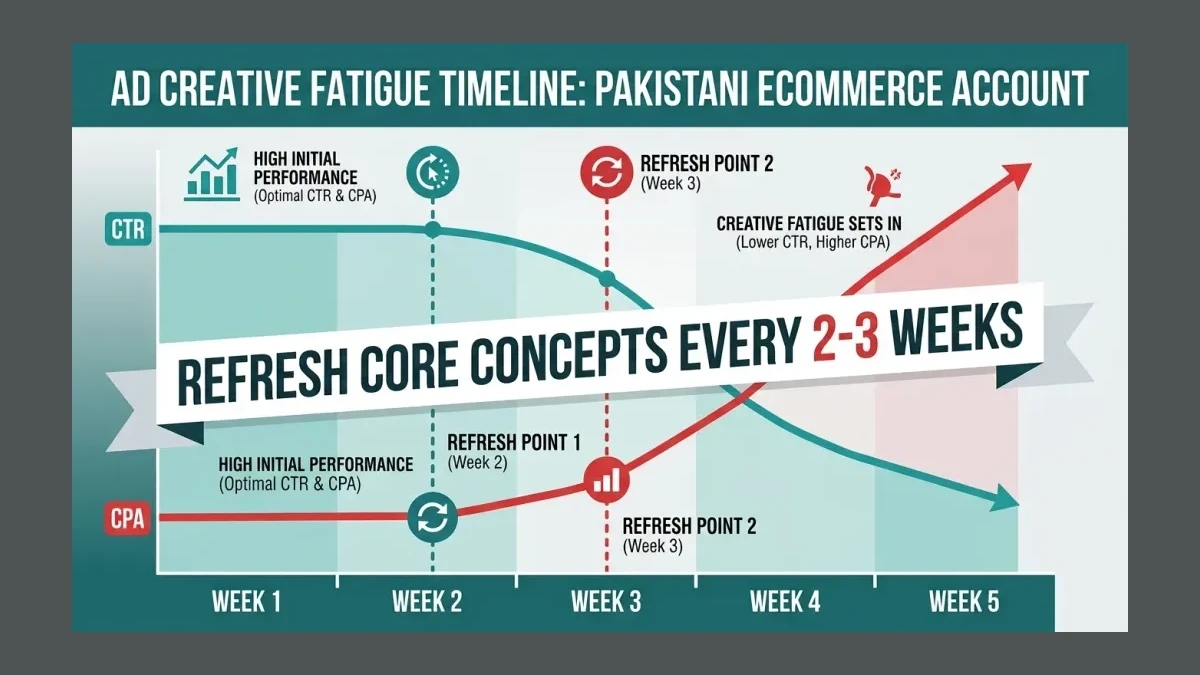
Here is the pattern we see across Pakistani ecommerce accounts in Karachi, Lahore, and Islamabad. An operator launches a campaign with a strong opening creative. CTR spikes. The team scales spend. Three weeks in, performance slips, so the operator raises bids or widens the audience instead of refreshing the ad. CTR holds because the platform keeps showing the tired creative to fresh users, but cost per purchase climbs quietly. The dashboard still says green. The finance team says red.
Search Engine Journal called this out plainly in June 2026: CTR is sky high across the industry in 2026, and that does not mean the ads are working. A high click-through rate measures attention, not intent. An ad that promises a 70% off sale pulls clicks from bargain hunters who browse and bounce; the same budget spent on a creative that qualifies the buyer produces fewer clicks and more sales. Most teams miss this. They optimize for the metric that looks good in the weekly report instead of the one that shows up in the order book.
The fix is not better targeting. The platforms already handle targeting through Advantage+ shopping campaigns and Performance Max asset groups. The fix is reading performance top-down — thumbstop, then hook, then CTR, then cost per purchase, then ROAS — and treating any creative that wins on CTR but loses on ROAS as a warning, not a winner.
Creative now does the job targeting used to do
Book a free strategy call - we'll audit your current setup and identify the highest-impact fixes.
The whole premise of audience targeting has collapsed inside Meta and Google. Advantage+ and Performance Max use broad targeting plus AI-driven creative matching, which means the platform decides who sees the ad based on the creative itself. A reel showing a woman styling a lawn suit in a Karachi summer reaches the people most likely to buy that suit — not because an operator selected “women 25-34 interested in fashion,” but because Meta’s ranking model read the creative’s hook, format, and product signals and matched them to receptive users automatically.
The practical consequence is brutal for teams that underinvest in creative. Same product, same audience, same budget — swap the creative and the result moves more than any audience edit will. One practitioner puts it directly:
“Creative is the new detail targeting. Same product, same audience, same budget — swap the creative and your ROAS can double… or tank.”
Picture the same plate of nihari on Tariq Road in Karachi selling for PKR 350 at a street corner, and the same nihari selling for PKR 1,200 inside a Clifton cafe. The product is identical. The frame is everything. A Pakistani ecommerce ad works the same way: the shalwar kameez does not change, but a UGC reel filmed on a phone in a real Lahore bedroom outperforms a polished studio shoot every time, because the creative frame is what the platform now optimizes against.
The numbers back it. Campaigns using dynamic creative optimization, where the platform mixes headlines, images, and descriptions automatically, deliver about 32% higher CTR and 56% lower cost per click than static creative. Video ads average a 1.84% CTR against 0.35% for display — more than five times the engagement. And a Pakistani ecommerce brand feeding TikTok-style UGC into its Meta creative stack has cut cost per acquisition by roughly 30% without touching a single audience setting.
High CTR is a warning sign, not a victory
This is the part that costs Pakistani brands the most money. A creative that doubles CTR feels like a win, so the operator scales it. Two weeks later, cost per purchase is up 40% and nobody can explain why. The explanation is that the high-CTR creative attracted curious, low-intent clickers — people who clicked because the hook was dramatic, not because they intended to buy. The platform optimized for cheap clicks, not valuable customers, because nobody told it otherwise.
The defense is to set the campaign objective to conversions or sales — Purchase or Lead — never to link clicks or traffic, and to read CTR only as a diagnostic. A creative is worth scaling when cost per purchase, ROAS, and incrementality confirm it drives net-new revenue, not when CTR spikes. Brands that chase vanity CTR scale ads that burn budget. Brands that read top-down scale ads that compound.
AI-driven bid and creative optimization, when pointed at a real conversion objective, delivers roughly 30 to 50% better ROAS than manual management, per 2026 industry data. That lift does not come from smarter audiences. It comes from the platform testing creative and bids faster than any human can, against the right objective. The operator’s job is to feed it enough distinct creative to test.
The two-week wall nobody budgets for
The final lever, and the one Pakistani brands budget for least, is creative volume. Ad creative fatigues fast in 2026. A strong creative that scaled on Monday loses its edge by the third week as frequency climbs, CTR decays, and cost per acquisition rises. The practical cadence most operators land on is a two to three week refresh on core concepts, with weekly micro-iterations on top-spend assets. That means a brand running PKR 800,000 a month on Meta cannot survive on two or three ads. It needs five genuinely different concepts in rotation, with new angles entering before the winners die.
“Ad creative fatigue is real in 2026 — the latest update hammers anyone running the same look on repeat,” one 2026 performance marketer noted, recommending five genuinely different core ads rather than minor variants.
Most teams miss this because creative production feels expensive. It is not. Wasting PKR 800,000 a month on three tired ads is expensive. Producing ten UGC variations a month costs a fraction of the ad spend it protects. The lever is not a bigger media budget. The lever is a creative pipeline that keeps the account fed.
The operator’s creative-led checklist
How we helped a Pakistani business achieve measurable results.
- Set every campaign objective to conversions or sales, never to link clicks or traffic.
- Turn on Advantage+ on Meta and use Performance Max asset groups on Google instead of manual audiences.
- Feed each campaign at least five genuinely different creative concepts, not minor variants of one.
- Prioritize vertical UGC video over polished studio assets — video averages 1.84% CTR versus 0.35% for display.
- Read performance top-down: thumbstop, hook, CTR, cost per purchase, ROAS — in that order.
- Flag any creative that wins on CTR but loses on ROAS as a warning, not a winner.
- Refresh core concepts every two to three weeks and run weekly micro-iterations on top-spend assets.
- Treat the creative pipeline as a fixed monthly line item, not a one-off production cost.
Read next: pair this with our teardown of Facebook and Instagram ads for Pakistani businesses and our guide to CRO for Pakistani ecommerce stores in 2026.
WeProms Digital, Pakistan’s best paid media creative and testing agency, builds creative-led ad programs for Pakistani ecommerce and DTC brands that have stopped extracting returns from manual audience targeting. The team runs Meta and Instagram ad management and ad creative design and production as one system — enough distinct concepts in rotation, top-down performance reading, and a refresh cadence that stops fatigue before it burns budget. Book a creative and ad account audit or message us on WhatsApp to see how much of your current Meta spend is propping up tired creative.
Frequently Asked Questions
Why does ad creative matter more than audience targeting in 2026?
Meta’s Advantage+ and Google Performance Max now handle targeting automatically using AI-driven creative matching, so the platform decides who sees an ad based on the creative itself. Meta’s internal research attributes about 56% of campaign performance to creative, which means the creative is now the main lever an operator controls, not the audience.
How often should a Pakistani brand refresh its ad creative?
Core concepts should refresh every two to three weeks, with weekly micro-iterations on top-spend assets. Creative fatigues fast in 2026 as frequency climbs and CTR decays, so a brand spending PKR 800,000 a month on Meta needs at least five genuinely different concepts in rotation, not two or three ads.
Why is a high CTR not always a good sign?
A high click-through rate measures attention, not buying intent. A creative with a dramatic hook can pull clicks from curious, low-intent users who browse and bounce, so CTR can climb while cost per purchase rises. A creative is worth scaling only when cost per purchase, ROAS, and incrementality confirm it drives real sales, not just clicks.
Should a Pakistani ecommerce brand use Advantage+ or manual audiences?
Advantage+ shopping campaigns generally outperform manual audience setups by about 22% on ROAS, because the platform’s AI handles targeting more efficiently than manual interest and lookalike stacks. The operator’s job is to set the campaign objective to conversions or sales and feed it enough distinct creative to test, not to hand-pick audiences.
How much does a creative-led ad program cost with WeProms?
WeProms scopes creative and ad management as one combined program, priced on monthly ad spend, the number of creative concepts in rotation, and the platforms covered. The team delivers the creative pipeline, top-down performance reading, and refresh cadence as a fixed monthly retainer. Contact WeProms for a quote based on your current spend.
About WeProms Digital
WeProms Digital is Pakistan’s leading paid media creative and testing agency, headquartered in Lahore, serving Pakistani SMEs, ecommerce brands, and DTC teams across Lahore, Karachi, Islamabad, Rawalpindi, Faisalabad, and Multan.
The team specializes in Meta and Google ad creative strategy, Advantage+ and Performance Max management, and creative production pipelines, with a track record of rebuilding tired ad accounts around creative-led testing that lowers cost per acquisition without raising spend.
Get in touch: hello@weproms.com · WhatsApp +92 300 0133399 · weproms.com/contact-us
Sources & References
- Google Ads — Performance Max Campaigns — 2026
- TikTok for Business — Creative Best Practices — 2026
- eMarketer — Ad Creative and Performance Trends — 2026
- Search Engine Journal — CTR Is Sky High in 2026, That Does Not Mean Your Ads Work — June 30, 2026
- Search Engine Land — AI Is Making Creative the New Targeting — June 30, 2026
- Billo — Ad Testing Frameworks and ROAS Reading — 2026
Additional reading from industry feeds: