When Google AI Bids Your Pakistani Ads, Creative Is Your Only Lever
By Abdul Rehman · July 1, 2026 · WeProms Digital
Google Performance Max and Meta Advantage+ now set your bids, pick your audiences, and assemble your ads from a pool of assets. The one variable left to a Pakistani ecommerce owner is the creative itself — the headlines, images, and offers the algorithm mixes. Weak creative feeds the machine nothing; strong creative sets the ceiling.
Consider a Lahore skincare brand spending PKR 200,000 a month across Google and Meta, run by an owner who still hand-tunes audience interests the way she did in 2022. She picks “women 25-34 interested in beauty,” excludes a few age brackets, and trusts the targeting to find buyers. The platforms no longer work that way. Both Google and Meta have spent the last two years pulling targeting decisions behind an AI curtain, and the inputs she is so carefully adjusting carry less weight with every update.
What did Performance Max actually take off the Pakistani advertiser’s desk?
Performance Max — Google’s AI-driven campaign type that serves across Search, YouTube, Display, Gmail, Discover, Maps, and Shopping from a single campaign — has absorbed bid setting, audience selection, placement, and even ad assembly. According to Google’s own Performance Max documentation, the system optimizes bidding, budget, audiences, creatives, and attribution toward the conversion goal you set, treating your audience inputs as suggestions rather than restrictions. Independent 2026 analysis estimates Performance Max now manages more than 80% of enterprise Google Ads spend, which means the manual levers most Pakistani advertisers still obsess over are simply no longer connected to the outcome. The tradeoff is real: the brand gains efficiency and reach, but it surrenders the granular control that used to define a skilled media buyer.
Start here. What Google took was the auction itself. The platform evaluates over 70 million real-time signals per auction — device, location, time of day, search history, conversion likelihood — to set a bid no human could replicate manually, and Target ROAS Smart Bidding now outperforms manual CPC by roughly 38% on average across industries. That gap is the reason a small Karachi store cannot beat the algorithm by bidding harder on a keyword; the algorithm was always going to price the auction better. The remaining question is not how to out-bid the machine, but what to feed it — a question that connects to the broader debate over whether AI agents should run your Pakistani SME’s ads at all.
Why does creative now carry more weight than audience targeting?
Book a free strategy call - we'll audit your current setup and identify the highest-impact fixes.
Because the machine handles targeting, the creative becomes the single largest input an advertiser still fully controls. The algorithm has to choose which ad to show from the asset pool you give it, which means the ceiling on performance is set by the quality and variety of those assets, not by how cleverly the audience is configured. A Performance Max campaign fed five thin headlines and one product photo will underperform a competitor with the identical budget but twelve headlines, four images, and two videos, because the algorithm simply has more combinations worth testing.
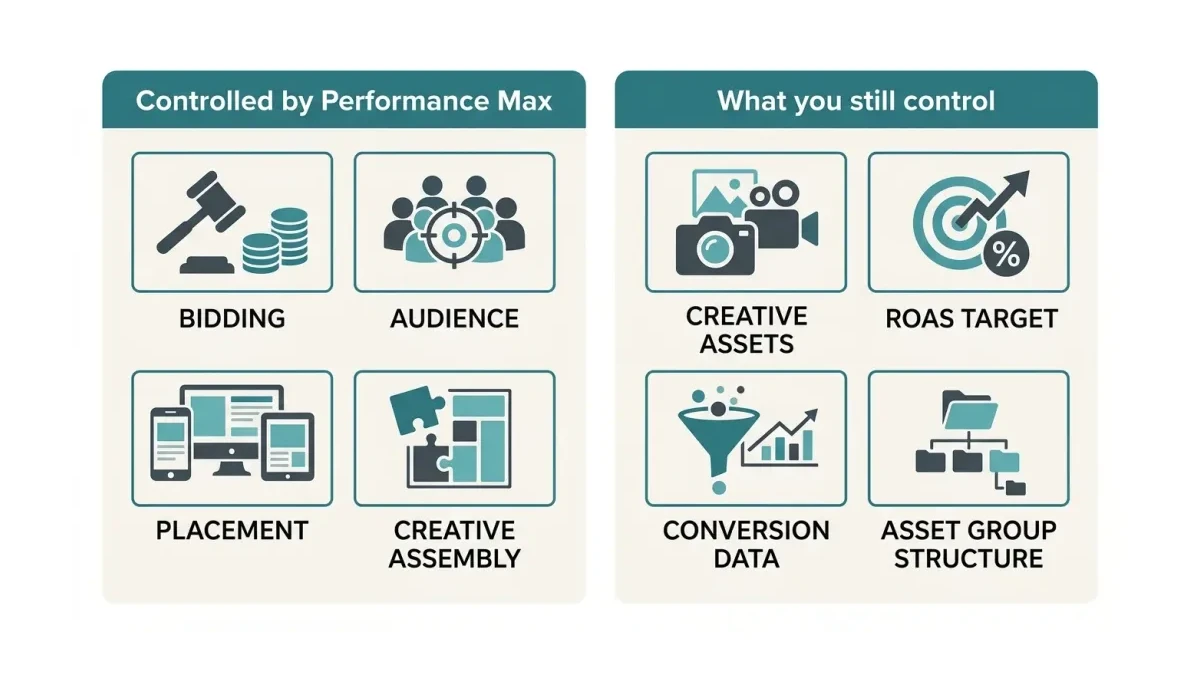
This is the part most Pakistani accounts miss. The owner who spends an hour excluding age brackets is moving a lever the platform has already overridden, while the owner who spends that hour writing sharper offers and shooting clearer product video is moving the one lever that still bends results. Industry analysis of 2026 Performance Max accounts confirms that advertisers running well-structured asset groups see meaningfully more conversions than those using a single group, because each distinct group gives the algorithm a clearer creative hypothesis to test. Creative is no longer the decoration on a targeting strategy; creative is the strategy.
How much should a Pakistani ecommerce store spend before creative matters?
Creative matters from the first rupee, but the platform needs enough conversion volume to learn which combinations work, which means the binding constraint is rarely budget and almost always clean data. BigCommerce’s 2025 ecommerce PPC benchmarks place average Google Ads return at about 3.68:1 and Facebook at roughly 2.2:1, with a 4:1 return considered a healthy baseline; a Pakistani store sitting below those numbers is usually under-fed on creative quality and conversion signal, not on spend. Pakistani practitioners report Meta click costs in the range of PKR 10-40 per click, which keeps the barrier to testing low, but low click costs are worthless if the assets the platform mixes are generic.
The practical implication is that a PKR 200,000 monthly budget produces very different outcomes depending on asset readiness. Spend it against five lazy headlines and the algorithm optimizes toward noise; spend it against a tested offer, a clear product shot, and a price-led hook, and the same budget compounds. This is why budget size is the wrong first question. The first question is whether the creative gives the bidding engine anything worth optimizing toward. The Google Ads cost benchmarks compiled by WordStream reinforce the point globally: average performance varies enormously between accounts spending similar amounts, and the variance tracks inputs, not spend tier.
Which creative inputs does Performance Max actually need?
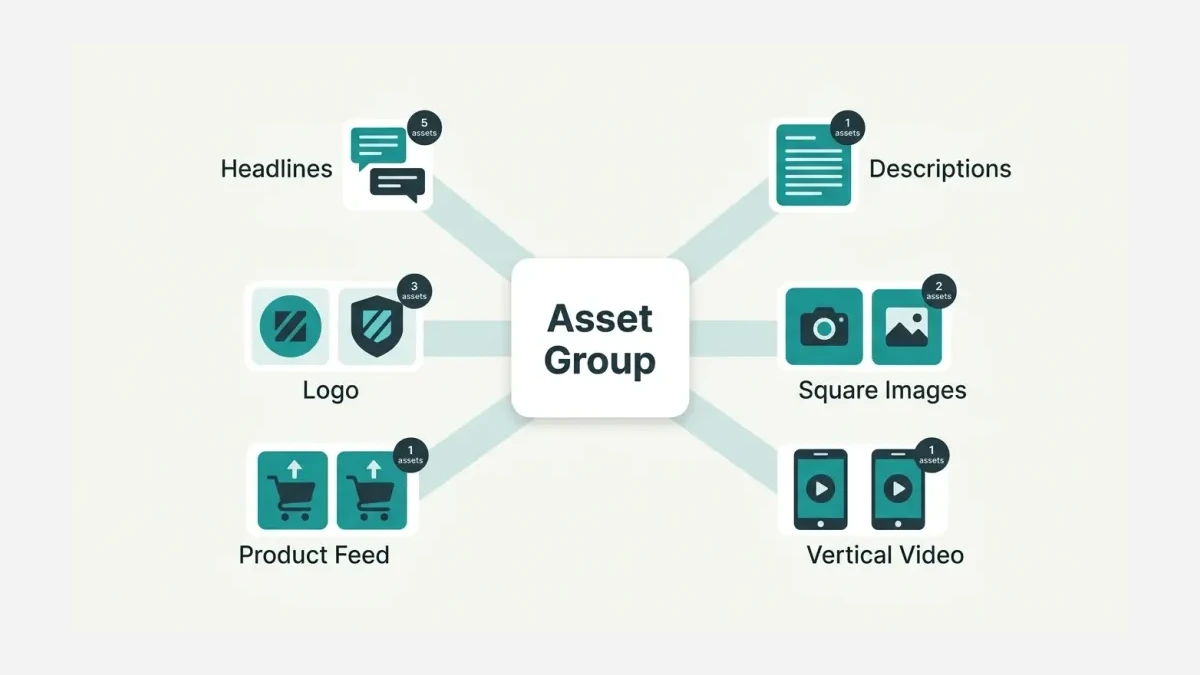
Performance Max assembles ads from a structured pool, so the deliverable is a complete asset library per theme, not a single finished banner. Each asset group should bundle distinct headlines, descriptions, images, videos, and a product feed aligned to one product category or customer segment, because the algorithm mixes these elements dynamically per auction. A Pakistani apparel store, for example, is better served by separate asset groups for women’s lawn, men’s kameez shalwar, and winter accessories than by one generic group, since each group lets the platform test a sharper creative hypothesis.
| What Performance Max controls | Who decides now | What you still control |
|---|---|---|
| Bid price per auction | Google Smart Bidding | Your ROAS or CPA target |
| Audience and placement | PMax asset-group signals | Your asset-group structure |
| Which creative shows | PMax asset mixing | Your headlines, images, and offers |
| Conversion value | The bidding signal | Your conversion-data quality |
Picture this as handing your ad account to a Careem driver who picks the route automatically; you no longer choose every street, you only choose how clean the car is and how clearly you state the destination. The car is your creative. The destination is your conversion goal. Microsoft’s own Performance Max product updates push the same direction, adding conversion value rules and new-customer goals precisely because the advertiser’s remaining leverage lives in goals and creative, not in manual targeting. Brands seeking a deeper structural read can compare against the full Performance Max 2026 strategy guide from almcorp, which reaches the same conclusion from the enterprise side.
What breaks when your conversion data is bad?
How we helped a Pakistani business achieve measurable results.
Everything downstream, because the algorithm optimizes toward whatever signal it receives, and a wrong signal is treated as a correct one. If a Pakistani store feeds Performance Max inflated conversions — say, counting every form submission as a sale, or counting COD orders that later get returned — the system learns to bid for more of that bad outcome, which means ad spend accelerates in exactly the wrong direction and the dashboard looks healthy while revenue does not. Clean, valued conversion data is the other half of the creative lever; without it, even excellent assets get optimized toward noise.
This is where many Pakistani accounts quietly leak. Cash-on-delivery returns, duplicate events, and unconfigured enhanced conversions all corrupt the bidding signal, and the platform has no way to know it was misled. The fix is to value conversions properly, exclude returns and cancellations, and feed offline conversion data back from the order-management system so the algorithm learns from actual delivered revenue, not from the initial checkout click. A serious attribution and measurement setup is what separates a Performance Max account that scales from one that burns identical budget for half the return.
How do you audit whether your creative is feeding the algorithm?
Open the asset report inside Google Ads and look at which assets the platform is actually using and which it is suppressing. Healthy creative produces a spread of assets with a range of performance ratings; a sick account shows one or two assets carrying everything while the rest sit unused, which means the algorithm ran out of worthwhile combinations fast. The audit is simple, the discipline is not: generate enough distinct, offer-led assets per group, retire the low performers every two weeks, and watch whether average return moves toward the benchmarks.
| Signal in the asset report | What it usually means | What to do |
|---|---|---|
| One headline carries nearly all spend | Asset pool too thin | Add 8-12 distinct, offer-led headlines |
| Most assets rated “low” | Creative quality is the bottleneck | Rebuild the group around one clear offer |
| Performance flat for weeks | Algorithm starved of signal | Clean conversion data, add audience signals |
| ROAS stuck below 3:1 | Inputs, not budget, are the problem | Restructure asset groups by category |
The global backdrop makes this urgent rather than optional. PwC’s Global Entertainment & Media Outlook records global internet advertising at roughly USD 755.6 billion in 2025, up 12.2% year on year, and almost all of that growth is flowing through the automated, creative-driven systems described above. Pakistani brands that keep treating creative as a finishing touch will find their budgets optimized by machines working with whatever they were given, while competitors who treat creative as the strategy pull ahead on the same platforms. The brands winning are the ones feeding the machine the sharpest inputs, not the ones fighting the machine for control it has already taken.
At WeProms Digital, we run Google Ads management and optimization and ad creative design and production for Pakistani ecommerce brands, and our first move on any Performance Max account is to rebuild the asset and signal layer the algorithm depends on. If your campaigns spend but do not scale, the creative is almost always the lever. Reach us at hello@weproms.com, message WhatsApp +92 300 0133399, or start at weproms.com/contact-us.
Read next: Should AI agents run your Pakistani SME’s Google and Meta ads? and Zero-click search and what it means for Pakistani advertisers on Google Ads.
Sources & References
- Google Ads Help — About Performance Max campaigns
- Digital Applied — AI Google Ads bidding: Performance Max automation strategy 2026
- BigCommerce — Ecommerce PPC: ROAS and conversion benchmarks
- WordStream — How much do Google Ads cost? Benchmarks
- PwC — Global Entertainment & Media Outlook (internet advertising)
- Microsoft Advertising — New Performance Max tools and product updates
- almcorp — Google Ads Performance Max 2026: ultimate strategy guide
Additional reading from industry feeds: