Should AI Agents Run Your Pakistani SME’s Google and Meta Ads?
By Abdul Rehman · June 19, 2026 — Last updated June 2026.
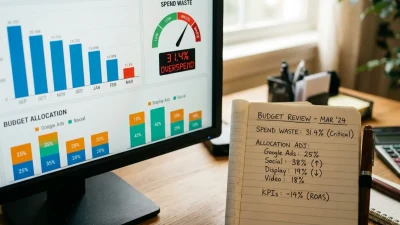
TL;DR: Yes, AI agents already run most of your ads. Google’s Performance Max, Meta’s Advantage+, and the emerging “agent networks” on demand-side platforms now set the majority of Pakistani SME bids, audiences, and creative rotations automatically, and they have pushed the labor cost of paid media toward zero. The catch is that without conversion data flowing back and a human operator pruning waste, those same agents quietly spend 30% to 40% of a PKR 100,000 monthly budget on clicks that never convert.
Picture this: a Lahore clothing brand sets a PKR 80,000 monthly budget inside Meta Ads Manager, selects Advantage+ Shopping as the campaign type, and walks away for three weeks. The AI agent tests audiences, rotates creative, and reallocates spend every few hours. The dashboard reports steady impressions and a healthy cost per thousand. What it does not report, unless someone goes looking, is how much of that PKR 80,000 reached shoppers likely to buy versus browsers who tapped once and left. This is the central question for every Pakistani SME in 2026 — not whether to use AI ad agents, because most already are, but whether anyone is supervising what they spend.
What exactly does an “AI agent” do inside a Pakistani SME’s ad account today?
An AI ad agent is an autonomous system inside an advertising platform that sets bids, selects audiences, rotates creative, and reallocates budget without a human approving each decision. In a Pakistani SME account in 2026, that means Google’s Performance Max deciding which search queries, YouTube placements, and Display partners receive your spend, and Meta’s Advantage+ deciding which Facebook and Instagram audiences see your creative. Alltegrio reported more than 80 autonomous AI agents running in production across marketing operations, and Yahoo’s demand-side platform is building an explicit “agent network” for programmatic buying, which means the agentic layer is no longer experimental.
The tradeoff is that the agent optimizes for the signal it receives. Feed it conversion data — purchases, lead forms, WhatsApp messages — and it finds more of those buyers. Feed it only clicks, or only impressions, and it optimizes for cheap clicks and cheap impressions, which is how a Pakistani electronics store ends up paying for traffic from people searching for free downloads. The agent is not guessing badly; it is optimizing exactly what you told it to, which is why the data you feed it determines whether the retainer earns its keep. Our teardown of AI agents in Pakistani ad campaigns and manual budget waste walks through how that mismatch shows up in real accounts.
How much does it cost to run Google and Meta ads in Pakistan in 2026?
Book a free strategy call - we'll audit your current setup and identify the highest-impact fixes.
A Pakistani SME running both Google and Meta ads typically spends between PKR 50,000 and PKR 150,000 per month, with growth-focused brands reaching PKR 300,000 to PKR 500,000 across Google, Meta, and TikTok. Meta charges roughly PKR 250 to PKR 600 per thousand impressions inside Pakistan, according to a 2026 performance-marketing teardown, which translates to a working cost per click of roughly PKR 20 to PKR 70 on Facebook and Instagram depending on creative quality and audience tightness. Google Ads sits higher: generic commercial queries cost roughly PKR 30 to PKR 120 per click, while competitive verticals such as insurance, loans, and B2B software can push PKR 150 to PKR 300 or more per click.
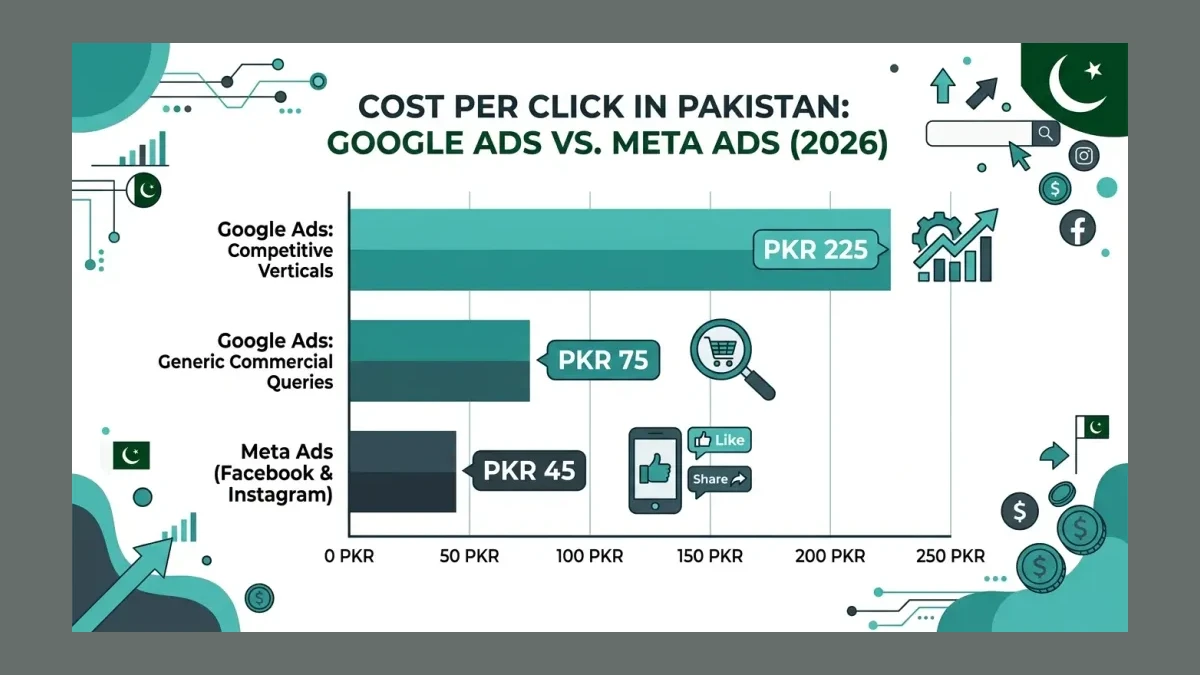
What this means for a Pakistani SME is that a PKR 100,000 monthly budget buys a meaningful but finite number of decisions. At a blended PKR 50 cost per click, that is roughly 2,000 clicks, and the difference between 2,000 clicks that convert at 3% and 2,000 clicks that convert at 1% is the difference between sixty customers and twenty customers from the same spend. The agent does not inherently know which clicks those are; the conversion data and the negative-keyword pruning do. WordStream’s 2026 Instagram ad cost benchmarks and BigCommerce’s Facebook advertising guide both confirm that the same broad-audience setup that looks cheap on the cost-per-thousand line is the setup that wastes the largest share of budget, which is why Pakistan’s lower CPMs are a trap rather than a bargain when targeting is loose.
How much budget do unsupervised AI bidding agents actually waste?
Industry practitioner data from 2026 puts Google Ads waste at 30% to 40% of spend on irrelevant search queries, poor match types, and missing negative keywords, and Meta waste can reach 30% to 50% or more when audiences are broad, objectives are misaligned, and the pixel is under-configured. On a PKR 100,000 monthly budget, that is PKR 30,000 to PKR 50,000 quietly spent on people who were never going to buy. The agent is not malfunctioning; it is spending against the targeting and signal it was given, and unsupervised accounts accumulate irrelevant terms the ad manager never pruned.
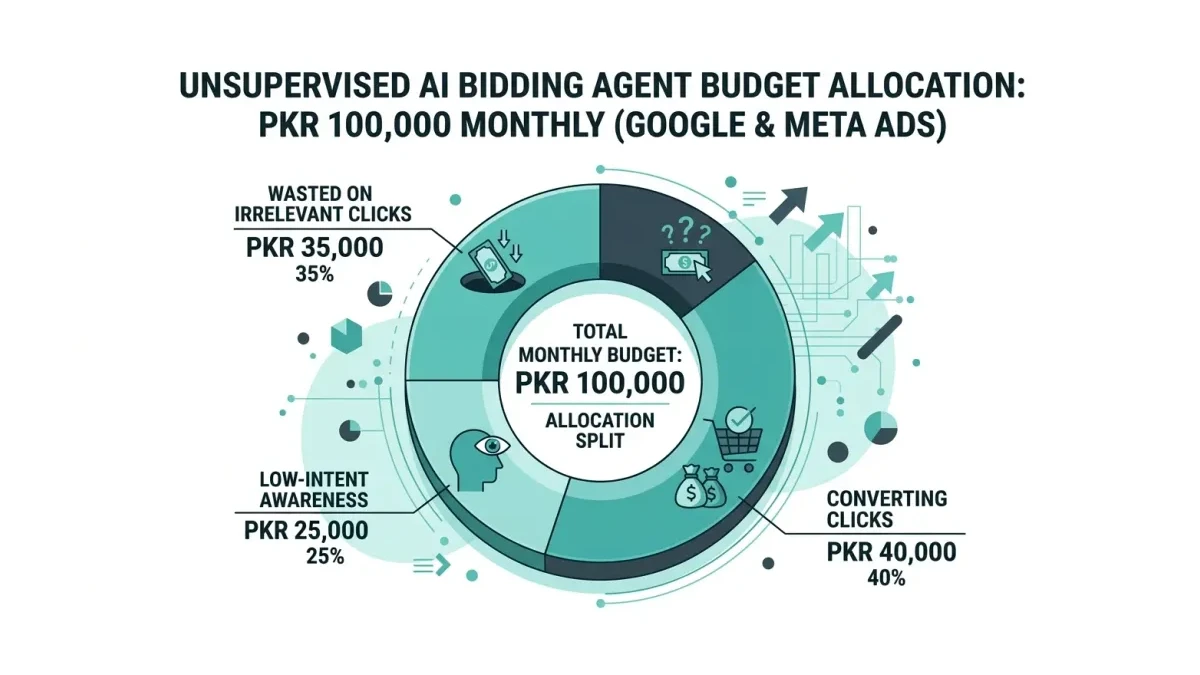
The Pakistani analogy is handing the bargaining to a broker at Anarkali and never asking what price he quoted each customer. The broker saves the effort of haggling, but the 35% markup he quietly takes is invisible unless you audit the receipts. The AI bidding agent is that broker: it removes the labor of manual bidding, and in exchange it spends a portion of the budget on placements and queries a human buyer would have rejected on sight. The fix is not to stop using the agent; the fix is to read the receipts — the search terms report, the placement report, the audience breakdown — and prune weekly.
Can AI agents target Pakistani shoppers better than a human media buyer?
For routine optimization, yes. An agent processes more signals in an hour than a human buyer can review in a week, and platforms like Zeta Global’s Athena now position agentic AI as the orchestration layer for every marketing decision, with LiveRamp’s agentic partner program tackling the identity resolution that makes cross-device targeting work. WPP Media is already testing synthetic audiences built from donation data for programmatic buys, which signals where agentic targeting is heading. A human buyer cannot match that signal-processing speed for bid adjustments and creative rotation.
The tradeoff is judgment on edge cases. An agent cannot tell that a surge of cheap clicks from a single Pakistani city is a click farm, or that a trending query is irrelevant to a furniture store, or that a creative is culturally misaligned for a Karachi Ramadan audience — not without a human flagging it. The strongest setup is agent speed for the routine 80% of decisions and a human operator for the 20% that determine whether the budget reaches buyers or browsers. DISQO’s 2026 AI Search Lift product, built to measure the incremental effect of advertising on large language models and AI discovery, reflects the same principle: the measurement layer still requires a human to interpret what the agent is doing.
What data does an AI ad agent need to actually work for a Pakistani store?
How we helped a Pakistani business achieve measurable results.
The agent needs conversion data flowing back from the moment it starts, which means server-side tracking, a properly configured pixel, and offline conversion import for call and WhatsApp leads. Without that loop, Performance Max and Advantage+ optimize for clicks or impressions, not revenue, and the account drifts toward cheap, low-intent traffic. A Pakistani store with cash-on-delivery as its dominant payment method has an additional gap: the sale happens days after the click, often confirmed by phone, so the conversion signal must be imported back manually or the agent never learns which campaigns actually delivered paying customers.
This is the single most expensive gap in Pakistani SME ad accounts. The agent is only as smart as the feedback it receives, and a broken or absent conversion loop turns a sophisticated bidding engine into a blind spender. Before any SME expands an AI-managed budget, the tracking must be audited end to end — which is why our walkthrough on Meta ads automation and the Pakistani SME budget trap and the guide to Google Ads AI bidding with Pakistan conversion data both start with the data layer rather than the bidding settings.
Should you hire an agency, a freelancer, or let the platform agent run solo?
| Setup | Monthly cost (PKR) | Waste risk | Data quality | Best for |
|---|---|---|---|---|
| Platform AI agent solo (PMax / Advantage+) | Ad spend only | High (30-50%) | Often broken | Testing demand cheaply |
| Freelancer + platform agent | Ad spend + 20,000-40,000 fee | Medium | Variable | Small SMEs with simple funnels |
| Agency + platform agent + conversion tracking | Ad spend + 50,000-120,000 fee | Low (10-20%) | Audited, server-side | Growth-focused SMEs and ecommerce |
The decision criterion is the conversion loop, not the headline fee. A solo agent on broken tracking will waste more than any agency fee costs; an agency that audits the data layer, prunes waste weekly, and feeds clean conversions back to the agent typically pays for itself inside the first month by recovering the 30% to 40% that was leaking. A freelancer is the reasonable middle ground for a small SME with a simple funnel and the discipline to send conversion data back promptly.
How do you measure whether an AI ad agent is earning its keep?
Measure cost per acquiring customer, not cost per click. An agent can deliver cheap clicks that never convert and still look healthy on the dashboard, so the only honest metric is the PKR spent per actual sale, per qualified lead, or per WhatsApp conversation that led to an order. A Pakistani SME should require a weekly search-terms and placement report, a monthly waste audit that quantifies spend on irrelevant queries, and a clear line between agent-managed spend and the conversions it produced. If the agency or freelancer cannot show cost per acquired customer by channel, the engagement is reporting activity, not results.
Read next: PPC first, SEO second for Pakistani SMEs in AI search and the same ad for 90 days and rising CPCs for Pakistani brands.
If your Google and Meta ads run on an AI agent with no one pruning the search-terms report or importing offline conversions, you are almost certainly spending 30% to 40% of your budget on clicks that never buy. At WeProms Digital, Pakistan’s best Google Ads management agency, we pair agentic bidding with a weekly waste audit and server-side conversion tracking so the agent optimizes for revenue, not clicks. We also run PPC management services and Meta ads management built around cost per acquired customer. Send us your last month of ad spend and we will show you, in PKR, exactly what the agent is wasting. Reach us at hello@weproms.com, on WhatsApp at +92 300 0133399, or through weproms.com/contact-us.
Sources & References
- Google Ads Help — About Performance Max Campaigns — 2026
- Meta for Business — Meta Advantage: AI Tools for Advertisers — 2026
- WordStream — Instagram Ads Cost: Benchmarks and CPC Data — 2026
- BigCommerce — Facebook Advertising Guide: CPM and CPC Benchmarks — 2026
- FSA Enterprises — WhatsApp Marketing in Pakistan 2026: Turning Chats into Sales — 2026
- Search Engine Land — Google Zero-Click Searches 2026 Study — May 2026
- BrightEdge — Gemini Becomes Second-Largest AI Referral Source in Q1 2026 — May 2026
- GoodFirms — AI SEO Statistics 2026: Rankings, Zero-Click Trends — 2026