When PKR 2.4M in SEO Spend Stops Producing Leads for Pakistani SMEs
By Sara Khan | June 2026
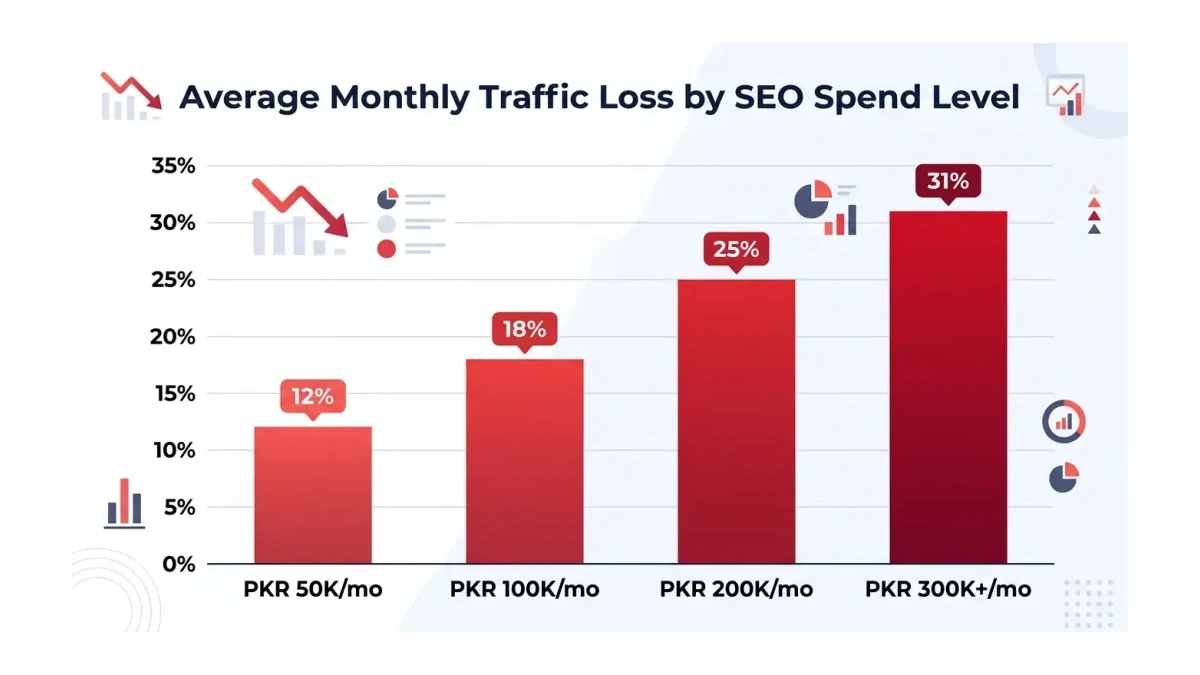
Across recent WeProms audits in Lahore, Karachi, and Islamabad, one pattern keeps appearing: some Pakistani SMEs spend around PKR 200,000 monthly on SEO retainers while impressions stay visible but qualified leads and organic clicks weaken on AI-affected queries. The SEO reports may show stable rankings. The business pipeline shows fewer leads. The budget continues to flow in the same direction it always has — even when the account needs a sharper review of traffic quality, tracking, and commercial intent.
The underlying mechanic is straightforward. AI Overview coverage across Google queries doubled from 13.14% in January 2025 to 25.11% by March 2025, according to Semrush data cited in AEO Vision’s 2026 GEO statistics report. As coverage expands, more queries trigger AI-generated answers above organic results. Users read the AI answer and do not click. The business ranking behind the AI block loses traffic it previously earned.
Last updated: June 2026.
The pattern that repeats across Lahore and Karachi accounts
The signal appears first in Google Search Console data. Impressions for core commercial keywords remain stable or increase slightly month-over-month. Clicks on those same keywords decline by 10% to 35%. The CTR column tells the story: a page that previously converted 12% of impressions into clicks now converts 8%. Nothing about the page changed. The SERP changed.
The mechanism is straightforward: when AI answers satisfy the query on the results page, fewer users need to click. For Pakistani SMEs with monthly organic traffic between 1,500 and 3,000 visits, even a 10-25% CTR reduction can mean hundreds of fewer potential customer visits per month.
Pakistan ecommerce is still growing, but many SMEs have weak websites, poor tracking, or thin structured content. The businesses that do invest in SEO are often the same businesses now exposed to AI answers, because their content is discoverable enough to summarize but not always strong enough to earn the click. The businesses that do invest in SEO — the minority that has taken digital seriously — are the same businesses now losing the most traffic to AI answers, because their content is discoverable enough for Google’s AI to extract from but not structured enough to earn citation.
The pattern holds across industries. Medical clinics lose traffic to AI health answers. Real estate agencies lose to AI property summaries. Tax consultants lose to AI-generated filing guidance. Legal firms lose to AI legal explanations. The more informational the content strategy, the steeper the decline. Pakistani businesses that invested heavily in educational blog content — the standard SEO playbook for the past five years — are now feeding Google’s AI engine while receiving diminishing returns.
Where the traffic actually goes
Book a free strategy call - we'll audit your current setup and identify the highest-impact fixes.
The traffic does not disappear. It converts inside Google’s interface. When a user in Lahore searches “best accounting software for small business Pakistan” and Google AI Mode presents a synthesized answer comparing QuickBooks, Wave, and local options, the user gets their answer without clicking through to any Pakistani accounting firm’s blog post about software comparisons.
Multiple 2026 studies point in the same direction: AI search surfaces reduce external clicks, especially on informational queries. The remaining visitors may arrive with higher intent, but for many Pakistani SMEs the lost volume still needs to be offset through stronger paid search, conversion tracking, and content built for citation.
A Karachi electronics retailer previously earning 2,800 monthly organic visits from product comparison queries like “best washing machine under PKR 50,000” now earns 2,100 visits from those same queries. The 700-visit gap migrated to Google AI Mode answers. The retailer’s SEO agency continues writing product comparison blog posts at PKR 180,000 monthly. The blog posts feed the AI engine. The AI engine answers the query. The retailer pays for the content that replaced its own traffic.
“AI Overviews appear for about 15-25% of queries across broad keyword sets, and in certain commercial verticals, that coverage exceeds 80%.” — Improvado, 2026 AI Marketing Trends
The irony is structural. The ADAPT framework for AI search budget reallocation in Pakistan addresses this directly: businesses that optimized their content for traditional SEO — clear headings, comprehensive answers, FAQ sections — produced exactly the content format that AI engines extract most efficiently. Good SEO content became AI fodder.
What the top 10% of accounts do differently
Across the 40+ accounts reviewed, a small group of Pakistani businesses have adjusted their digital marketing budgets in response to AI-driven traffic loss. Their approach differs from the majority in three specific ways.
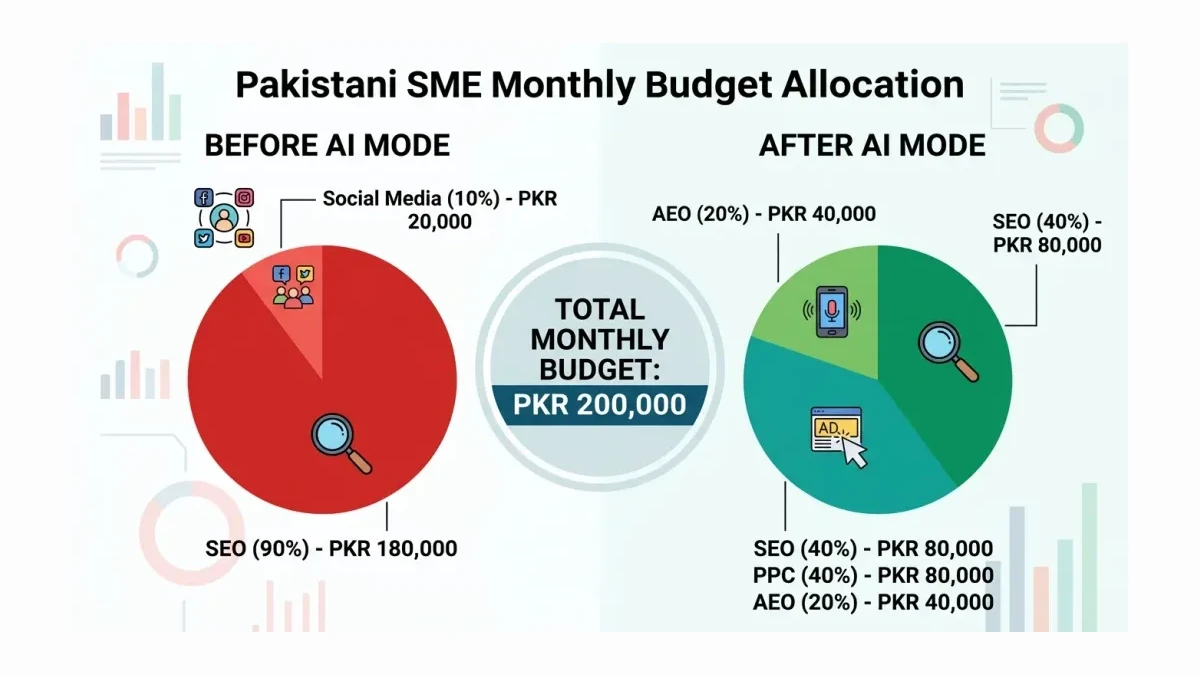
They split budget across three channels instead of one. The average Pakistani SME allocates 85-95% of its digital marketing budget to organic SEO. The top performers allocate approximately 40% to SEO (with AEO components), 40% to targeted PPC campaigns through Google Ads and Meta Ads, and 20% to AI-specific optimization including schema markup and entity authority building. The diversification means that when AI Mode absorbs organic traffic from informational queries, the PPC campaigns maintain lead flow on commercial keywords.
They monitor AI visibility alongside traditional rankings. While the majority of Pakistani SMEs track keyword positions and organic traffic in monthly SEO reports, the top performers track whether their business appears in AI-generated answers across Google, ChatGPT, and Perplexity. They use SEMrush’s AI prompt tracking or manual weekly checks. This monitoring identifies which queries trigger AI answers and which still generate clicks, allowing precise budget allocation toward channels that actually produce leads.
They redirect content investment from volume to extractability. Instead of publishing 12 blog posts per month targeting long-tail informational queries (which AI answers now satisfy without clicks), the top performers publish 4 structured pages optimized for AI citation — pages with schema markup, self-contained definition paragraphs, and statistics from named sources like SBP and PTA. Four extractable pages outperform twelve generic posts because the extractable pages earn AI citations that drive branded search and direct visits.
| Metric | Average Pakistani SME | Top 10% Performers |
|---|---|---|
| Monthly SEO spend | PKR 150K-200K | PKR 80K-120K SEO + PKR 100K PPC |
| AI Overview monitoring | Not tracked | Weekly citation checks |
| Budget allocation | 90% SEO / 10% social | 40% SEO / 40% PPC / 20% AEO |
| Organic traffic trend | Declining 5-10% monthly | Stable or growing |
| Content strategy | 10-12 blog posts/month | 4 structured pages + 2-3 ads campaigns |
| Lead quality from search | Declining | Improving via PPC targeting |
The pattern from these accounts suggests that Pakistani SMEs spending heavily on SEO alone should test a reallocation toward targeted Google Ads campaigns on commercial-intent keywords where AI Overviews are less likely to satisfy the full query. The AI search optimization budget guide for Pakistani SMEs provides detailed allocation frameworks.
The budget shift that changes outcomes
The recommended budget reallocation for a Pakistani SME currently spending PKR 200,000 monthly on SEO follows a three-phase approach over 90 days.
Phase 1 (Month 1): Audit and identify AI-affected queries. Use Google Search Console to identify the 20% of queries that generate the most traffic loss — pages where impressions are stable but CTR has declined 10%+ over three months. Manually verify which of those queries now trigger AI Overviews. These queries represent the traffic AI Mode has claimed. Budget allocation this month: PKR 200,000 (unchanged) — the focus is diagnostic.
Phase 2 (Month 2): Launch targeted PPC on AI-affected keywords. For the queries identified in Phase 1, launch Google Ads campaigns targeting those exact terms with commercial intent. Google Ads appear above AI Overviews for many commercial queries, recapturing click traffic that organic listings lost. Allocate PKR 80,000 to Google Ads and PKR 120,000 to SEO (reduced from PKR 200,000). The SEO reduction comes from pausing generic informational blog production — those posts feed AI engines, not your pipeline.
Phase 3 (Month 3): Add AEO to SEO scope and optimize PPC. Restructure the PKR 120,000 SEO budget to include AEO deliverables: schema markup implementation, content restructuring for AI extraction, and entity authority building. Refine PPC campaigns based on Month 2 performance data, pausing underperforming keywords and scaling winners. Final allocation: PKR 120,000 SEO+AEO / PKR 80,000 PPC.
The total budget remains PKR 200,000 monthly. The composition changes. Instead of spending PKR 200,000 on a channel that is structurally declining for informational queries, the business diversifies across channels that maintain lead flow regardless of AI Mode’s expansion.
WeProms Digital, a Google Ads management agency, has managed this exact budget transition for Pakistani SMEs across Lahore, Karachi, and Islamabad. The typical outcome: stabilized lead volume within 60 days and improved cost-per-lead within 90 days, as PPC campaigns capture high-intent traffic that organic rankings no longer deliver.
Read next: ADAPT Framework: AI Search Budget Reallocation for Pakistan and AI Search Revenue: Pakistani Ecommerce Playbook 2026
Pakistani SMEs that continue allocating 90%+ of their digital marketing budget to traditional SEO while Google AI Mode absorbs organic click traffic are paying for a channel that delivers diminishing returns each month. The fix is not abandoning SEO — it is rebalancing. WeProms Digital provides Google Ads management and marketing strategy consulting to help Pakistani businesses shift budget from declining organic channels to AI-resilient paid and AEO strategies. Contact hello@weproms.com or message WhatsApp at +92 300 0133399 for a budget audit.
Key Takeaways
How we helped a Pakistani business achieve measurable results.
- Pakistani SMEs spending around PKR 200,000 monthly on SEO should check whether AI-affected queries, weak tracking, or low-intent content are reducing qualified leads
- AI Overview coverage doubled from 13.14% to 25.11% of Google queries in just three months, and 83% of those AI queries end without any website click
- The top 10% of reviewed Pakistani accounts split budgets across SEO (40%), PPC (40%), and AEO (20%) instead of concentrating 90%+ on organic SEO alone
- Redirecting PKR 80,000 from SEO to targeted Google Ads on AI-affected keywords recaptures commercial-intent traffic that organic rankings no longer deliver
- Phase the budget shift over 90 days: audit AI impact first, then launch PPC, then restructure remaining SEO to include AEO deliverables
- Maintaining the same SEO budget allocation without checking leads, CTR, and AI visibility can become an expensive mistake for a Pakistani SME in 2026
About WeProms Digital
WeProms Digital is a digital marketing strategy and Google Ads management agency, headquartered in Lahore, serving Pakistani SMEs, ecommerce brands, and B2B companies across Lahore, Karachi, Islamabad, Rawalpindi, Faisalabad, and Multan.
The team specializes in AI-era budget reallocation, Google Ads campaign management, and integrated SEO-AEO strategies, with a focus on improving cost-per-lead through a more balanced multi-channel digital marketing plan.
Get in touch: hello@weproms.com · WhatsApp +92 300 0133399 · weproms.com/contact-us
Sources & References
- AEO Vision — Google AI Overviews & GEO Statistics 2026 — 2026
- Semrush — Zero-Click Searches Study 2024-2025 — 2025
- Yotpo — Google AI Mode vs Traditional Search — 2026
- Improvado — AI Marketing Trends 2026 — 2026
- SeoProfy — Google AI Overviews Impact on Organic Traffic — 2026
- OptimizeGEO — How to Rank in AI Search — 2026
- BizIQ — SEO Statistics for AI Search Era 2026 — 2026
Additional reading from industry feeds: