By Sara Khan · WeProms Digital · November 12, 2026
The CHAI framework breaks automated email into four flows a small boutique can run without a marketing department: C for cart recovery, H for the hello series, A for after the sale, and I for inactive shoppers. The case for it sits in one finding from Omnisend’s 2026 Ecommerce Marketing Report: automated flows were just 2 percent of what stores sent, yet they drove 30 percent of email revenue. For a Pakistani-owned abaya boutique in Edmonton — where winter formals, shaadi season and Eid preparation arrive back to back — those four flows do the follow-up work nobody has spare hours for in December.
“Automations accounted for just 2% of email sends but drove 30% of revenue, earning 16x more per send than scheduled campaigns.” — Omnisend, 2026 Ecommerce Marketing Report
A good automated flow behaves like the cousin every family assigns to shaadi logistics: she remembers who ordered what, nudges the one who has not confirmed, and sends the tailor’s deadline reminder without being asked twice. Software does the same job at two in the morning, in the same order, every single time. The setting rewards it — Statistics Canada counts Muslims at 4.8 percent of Alberta’s population, and Edmonton’s Pakistani and broader Muslim community keeps south-side modest fashion boutiques busy through exactly the seasons a calendar-based email plan should anticipate.
C — Cart recovery: catch the Edmonton shopper who almost paid
The cart recovery email is the send that sits closest to money, and the numbers show it. Cart abandonment emails earn a 37.12 percent open rate, among the highest of any automated send Omnisend tracks; in plain terms, roughly thirty-seven of every hundred shoppers who abandon a checkout still open the reminder, which makes it a warm room rather than a cold call. The flow should show the exact abaya left behind, the size, the colour, and a one-tap path back to payment — first email within an hour, a second after twenty-four hours, then silence.
The pattern repeats across every benchmark: the closer an email sits to a purchase moment, the better it performs. MoEngage’s North American email benchmarks point the same direction from independent data, with behaviour-triggered retail campaigns converting at a multiple of broadcast sends.
Check your platform’s cart flow today. If it sends one email and stops, add the twenty-four-hour follow-up this week.
H — Hello: the welcome series that earns the first order
Omnisend’s blueprint shows a welcome series of three emails turns a new sign-up into a first order: the incentive arrives first, the fabric and fit story second, and the answer to the last purchase concern — usually sizing or care instructions — third. A sign-up gained during a busy Saturday deserves the same care as a walk-in customer; the welcome series is the digital version of offering karak while someone browses the rail.
Consent comes before the first send, and Canada is strict about it. CASL — Canada’s Anti-Spam Legislation, enforced by the CRTC — requires express or implied consent, clear sender identification, and a working unsubscribe honoured within ten business days; administrative penalties for businesses reach CAD 10 million. The wording of your sign-up form is where compliance begins, and a well-built form also converts better — guidance worth reading in Neil Patel’s guide to lead form optimization.
Actionable first step: rewrite your sign-up line to promise something specific — “Join our Edmonton list for first access to Eid arrivals” earns consent and sets expectations in one sentence.
A — After the sale: the quiet flows that earn the second order
Post-purchase emails are where boutiques quietly out-earn their ad spend. The strongest performer in Omnisend’s data is not a discount at all: back-in-stock emails convert at 6.46 percent, the highest conversion rate of any automation type. When a popular size sells out during graduation-formal season, that flow converts a sold-out sign into a waiting list instead of a lost customer to a fast-fashion competitor.
Around it sit two quieter sends: a post-purchase note with care instructions and styling ideas three days after delivery, and a seasonal rotation email when new stock matches what the customer already bought. Edmonton winters make the second send unusually productive, because modest outerwear and layering purchases cluster predictably from October through February.
Set up the back-in-stock flow first if you can only build one; it carries the highest conversion rate and requires no discount at all.
I — Inactive: the win-back before Eid and shaadi season
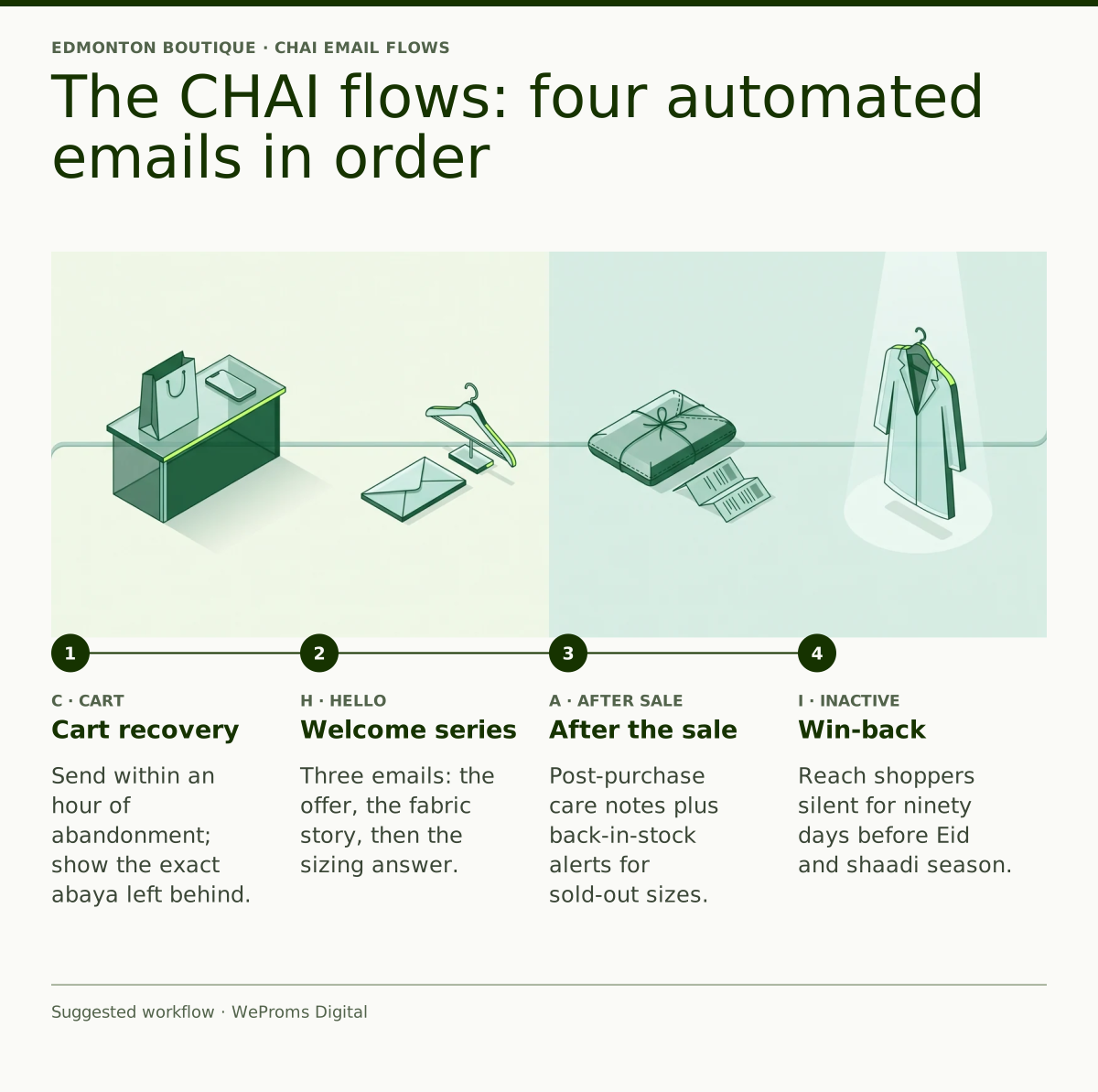
The win-back lands before Eid and shaadi season, not after the moment has passed. Eid al-Fitr in 2027 is expected in the second week of March 2027, subject to moon sighting, with Ramadan expected from early February — which places the productive win-back window in mid-to-late January 2027, when families are setting gift budgets, not when the racks are already picked over. Send it to shoppers silent for ninety days, with one clear offer and an honest opt-out.
Timing the rest of the year follows the same calendar logic. Winter shaadi gatherings cluster between November and February in Alberta, and June brings graduation formals; a boutique that maps its win-back sends to those windows will outperform one emailing on the first of every month. If you are still building demand beyond your list, bringing shaadi shoppers in through Pinterest pairs well with these flows, and the seasonal drop-off problem has a known pattern worth studying.
Put numbers to the whole plan. Worked example — substitute your own figures: an abaya priced at CA$ 140 with product, packaging and postage of CA$ 60 leaves CA$ 80 contribution per order. Klaviyo’s Email plan lists US$ 20 a month for 500 active profiles — about CA$ 27 — and Omnisend’s Standard tier lists US$ 16 a month for the same list size, discounted to US$ 11.20 for the first three months when prepaid; one recovered order every three months covers the subscription, and everything beyond is margin. The claim worth testing in your own account: for boutiques under five thousand subscribers, the four CHAI flows on a US$ 20 plan return more per dollar than the same money added to the ad budget, because ads rent strangers and flows keep customers. One related decision — whether one Instagram ad or three fits an abaya boutique — sits on the renting side of that line.
Read next: which emails Pakistani online stores should send (written for PKR-budget stores — the flow logic transfers) and why Ramadan customers disappear after Eid.
An email marketing automation agency for SMEs in the UK, UAE and North America WeProms Digital has built welcome, cart-recovery, back-in-stock and win-back flows for retail and ecommerce stores across the UK, the Gulf and Canada — each mapped to the community calendar, from Ramadan prep to winter shaadi season. If your Edmonton boutique’s Eid list has gone quiet, our customer win-back campaign service is the fastest place to start. Write to hello@weproms.com, message WhatsApp +92 300 0133399, or visit weproms.com/contact-us.
Key Takeaways
- Automated flows were 2 percent of sends but 30 percent of revenue in Omnisend’s 2026 report — build the CHAI flows before adding ad budget.
- Start with cart recovery: a 37.12 percent open rate makes it the highest-leverage first flow for a small boutique.
- Back-in-stock is the conversion leader at 6.46 percent and needs no discount — connect it to your inventory today.
- CASL consent, sender identification and a working unsubscribe are legal requirements in Canada, with penalties up to CAD 10 million for businesses.
- Time win-backs to the community calendar: mid-to-late January 2027 for Eid al-Fitr, expected in the second week of March 2027, subject to moon sighting.
Frequently Asked Questions
Does CASL apply to my boutique’s marketing emails in Canada?
Yes. CASL covers commercial email sent to Canadian addresses, and it requires consent (express or implied), clear identification of your business with contact details, and an unsubscribe link honoured within ten business days. Consent captured at sign-up for “Eid access and new arrivals” covers exactly that content — nothing more.
How much do email tools cost for a small Canadian boutique?
Klaviyo’s Email plan lists US$ 20 a month for 500 active profiles, with a free tier up to 250 profiles; Omnisend’s Standard tier lists US$ 16 for the same list size, discounted to US$ 11.20 for the first three months when prepaid. At roughly CA$ 27 a month for the pricier option, one recovered abaya order every three months covers the tool cost entirely.
When should my Edmonton boutique send Eid win-back emails?
Eid al-Fitr 2027 is expected in the second week of March 2027, subject to moon sighting, so the win-back should land in mid-to-late January 2027 — about six weeks out, when gift budgets are being set. Shoppers silent for ninety days or more are the right audience for that send.
Do WhatsApp messages to customers count under CASL?
Yes — CASL’s “commercial electronic message” definition includes text messages and instant messages, not just email. Keep the same consent basis, identify your boutique in the message, and include a plain opt-out such as “reply STOP and we will not message again.”
What does WeProms charge to set up automated email flows?
WeProms does not publish package prices inside articles, because setup scope varies with your platform, list size and season calendar. Based on our experience building lifecycle flows for boutiques and ecommerce stores across Canada, the UK and the Gulf, a CHAI-style build typically starts with two flows and scales from there — book a call at weproms.com/contact-us and we will scope it against your margins.
About WeProms Digital
WeProms Digital is a Lahore-based email automation and lifecycle marketing agency working with overseas Pakistani and halal-minded business owners across London, Birmingham, Manchester, Dubai, Riyadh, Toronto, Edmonton, and beyond.
The team specializes in email marketing automation, customer win-back campaigns and lifecycle retention flows, with a track record of building season-aware systems — Ramadan, Eid and shaadi calendars included — for retail and ecommerce clients in three markets.
Get in touch: hello@weproms.com · WhatsApp +92 300 0133399 (replies in UK and Gulf business hours) · weproms.com/contact-us
Sources & References
- Omnisend — Email Automation Best Practices: Build High-ROI Workflows — Nov 11, 2026
- Omnisend — Pricing Plans
- Klaviyo — Pricing
- CRTC — Spam and Malware (CASL)
- Statistics Canada — A Snapshot of Canada’s Muslim Population
- MoEngage — Email Marketing Benchmarks, North America
- Neil Patel — The Definitive Guide to Lead Generation Form Optimization — Nov 11, 2026
Additional reading from industry feeds: