By Sara Khan · WeProms Digital · October 30, 2026
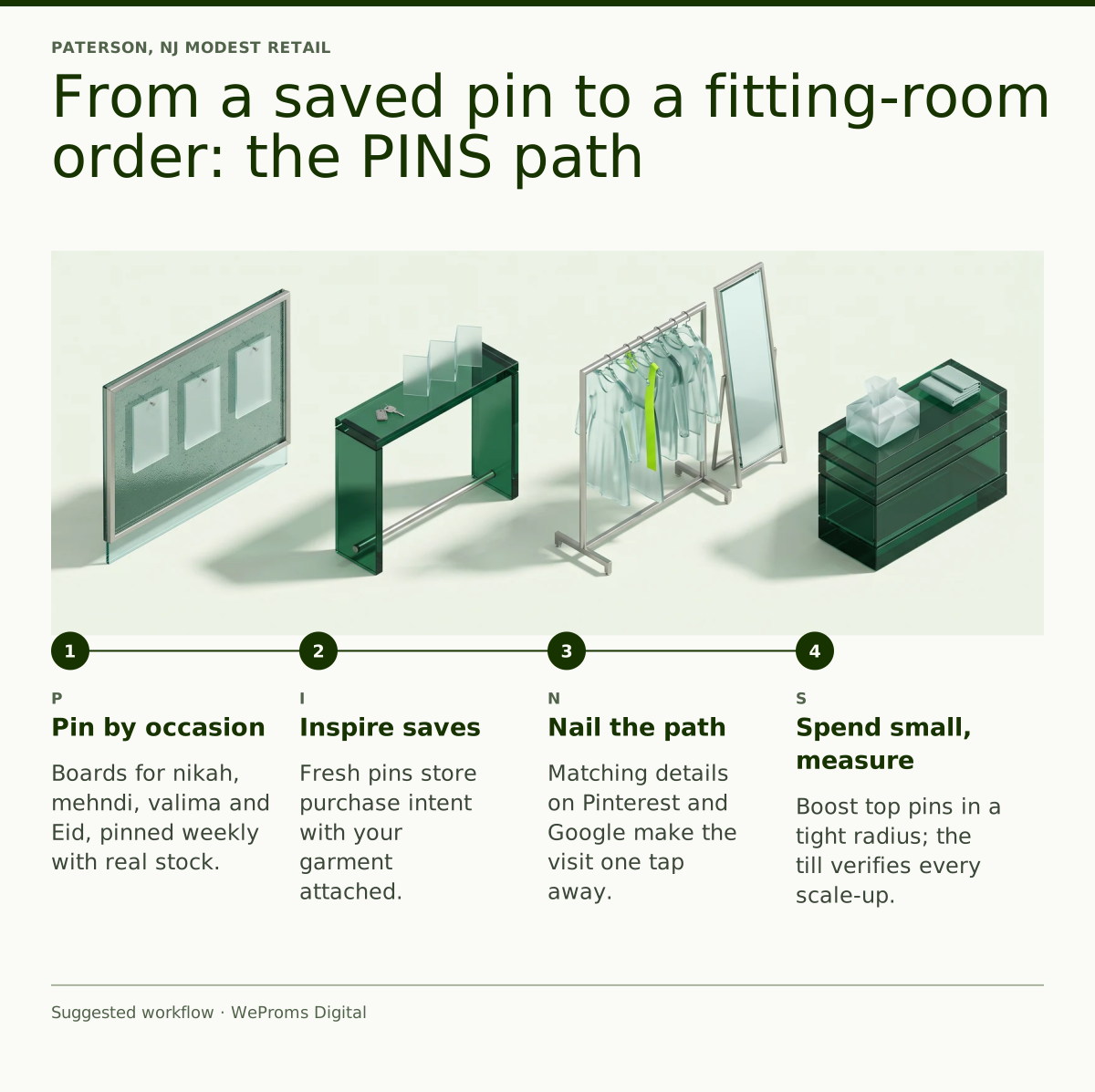
Shaadi planning in the Pakistani diaspora begins as a quiet browsing habit: outfit research on a phone at midnight, months before anyone books a venue or sets a date. The PINS framework turns that browsing into boutique visits in four steps: P for Pin by occasion, I for Inspire saves, N for Nail the path to your door, S for Spend small and measure. Pinterest reported 640 million monthly active users in its Q2 2026 results, per its SEC-filed earnings release and quarterly earnings presentation — and unlike a social feed, the platform’s searches come overwhelmingly from people planning something they intend to buy.
This matters for a modest fashion boutique on Main Avenue in Paterson, New Jersey, whose customers drive in from across the North Jersey and New York metro area for one reason: a shaadi wardrobe has to be seen, touched and fitted in person. The online browsing is where the decision starts; the shop visit is where it ends. Every step below connects the two.
P — Pin by occasion: plan boards around the shaadi calendar
Pinterest rewards structure, not volume. Six well-named boards outperform sixty scattered pins, because the platform’s search reads board titles, pin descriptions and the occasion vocabulary your customers actually type. Boards named for the occasion — nikah outfits, mehndi looks, valima gowns — collect planners months before they buy. That sentence is the entire strategy; the rest is execution.
Build the board calendar from the community’s year, not the retail calendar. The May-to-September stretch carries most diaspora weddings, so valima and reception boards need fresh pins by early spring. Eid al-Fitr, expected around 10 March 2027 subject to moon sighting, deserves its own board pinned from January — outfit ideas, gift-occasion dressing, mother-of-the-bride looks — because Eid shopping and wedding shopping share the same browsing weeks. A workable starter set runs six boards: Nikah, Mehndi, Valima, Eid, Everyday modest, and Visit our boutique.
Pin only real stock. Vertical photos of garments actually hanging in the Paterson shop, shot against a clean wall, outperform studio fantasies — the customer who saves the pin expects to find that exact abaya on that exact rail. A ready-to-paste pin caption keeps every pin locally useful: “Valima season open at [boutique name], Paterson NJ — hand-finished [garment type], fitting by appointment, WhatsApp [number].”
I — Inspire saves: keep real stock in front of planners
Pinterest reported more than 80 billion searches per month on its Q2 2026 earnings call, with more than half carrying commercial intent — people searching with a purchase in mind. That figure is company-reported, so treat it as Pinterest describing its own living room rather than an audited market census; the direction, a search engine for shoppers, is what matters here.
The underlying mechanic is intent storage. A save is a shopper quietly bookmarking an outfit for the season she is planning. Nothing is bought that night; the demand sits parked, with your shop’s garment attached to it, until the venue is booked and the budget unlocks. Every diaspora family knows the paper version of this: the binder of magazine cuttings an aunty carried through every wedding season, some pages traveling from Karachi and Lahore to New Jersey over decades. Pinterest is that binder — searchable, shareable with the bride’s committee on WhatsApp, and permanently open to new pages.
Feeding it is a cadence, not a campaign. Three to five fresh pins weekly, each a real garment with a caption naming its occasion, keeps boards alive in search results while the algorithm buries accounts that dump fifty pins in one night and vanish. The habit costs an hour a week behind the counter; a phone, a clean wall and daylight are the entire production budget.
N — Nail the path: make the shop visit the easiest next step
Online discovery only pays when it ends at a real door. Greg Owens, VP International at Pinterest, made the case plainly in Retail Gazette:
The winners in commerce and technology are not the businesses that force a choice between physical and digital, but the ones that combine both.
The reported retail results support him. Primark’s Pinterest-inspired Home collection lifted launch-week store sales 115% against the previous week; a John Lewis campaign delivered a 10.3% sales lift (see chart). Those are UK high-street giants with national marketing teams, so they prove direction, not a promise for a single boutique on Main Avenue — but the direction is consistent: discovery planned online moved sales that landed in physical stores.
The visit is the conversion; online discovery is only the invitation. Make accepting it effortless. The profile needs the boutique’s full name, Paterson address, hours and a WhatsApp number; the Visit our boutique board needs parking notes, fitting-room photos and the fabrics a bride can touch in person; and the Google Business Profile listing must carry identical details, because an address mismatch between Pinterest and Google quietly kills the navigation tap. MAGNA’s research on what it calls positive platforms found respondents were up to 94% more likely to buy after exposure in environments they regard as positive — an “up to” relative figure, worth noting, not a floor.
One small habit closes the loop. Train whoever runs the till to ask, once, “Did you see us on Pinterest?” and to offer a WhatsApp restock opt-in with an easy reply-stop — the answer tells you which boards earn visits, and the opt-in list tells your customers when shaadi stock lands without spending on ads.
S — Spend small and measure: stretch a modest ad budget
Organic boards come first; paid promotion is a throttle, not an engine. A disciplined first test for a boutique runs $150 a month in media only — no agency fees, no production costs — boosting the three best-performing occasion pins inside a 25-mile radius over Paterson for ninety days. Worked example, illustrative: a valima outfit at $240 leaves roughly $100 in contribution after product, alterations and packaging costs. Two Pinterest-attributed orders a month covers the $150 test; that is the whole break-even arithmetic, and it assumes nothing about scale.
Spend small, measure visits, and scale only what the till confirms. The stop-or-scale rule writes itself: if ninety days of the “Did you see us on Pinterest?” question records fewer than two till-verified orders a month, stop the paid spend, keep the boards, and reinvest the difference in photography. If the tally clears two comfortably, widen the radius before raising the budget — planners in Edison and Jersey City behave like planners in Paterson, but only the till can prove it.
The full plan fits boutiques with occasionwear margins. A home-based seamstress or a one-rail startup should run the P, I and N steps only; the boards and the visit path cost time, not money, and paid promotion can wait until a garment rail justifies it. Hesitation is part of the buyer’s psychology here — Very built an entire Black Friday Price Promise around shoppers who wait rather than commit, and retail guides like Omnisend’s holiday planning playbook set their order cutoffs weeks ahead for the same reason. Planners who hesitate are exactly the people a saved pin keeps warm until the budget arrives.
Here is the claim worth testing against your own numbers: across one full shaadi cycle, one maintained Pinterest board will outperform three boosted Instagram posts for a modest fashion boutique, because planning searches compound for months while a feed forgets within days. For adjacent reading on budget discipline and seasonal push, see where a Leicester boutique’s ad budget leaks before shaadi season — written for a UK reader, but the leak logic transfers — alongside whether a Manchester modest fashion shop should match Shein’s prices and how Instagram Reels turn into mithai orders in shaadi season.
Read next: Should My Birmingham Abaya Boutique Run One Instagram Ad or Three? · How Do I Build a Food-Creator Network for My Desi Cafe in Melbourne?
Pinterest is where the diaspora plans its biggest dressing occasions months ahead; the boutique whose pins get saved, whose details get found and whose door gets visited when planning starts is the boutique that wins the fitting appointment. WeProms Digital, a Pinterest ads management team for modest fashion and occasionwear brands, builds board calendars, visit paths and measured paid tests as part of our social media strategy and content planning services. Based on our experience with diaspora-owned retail brands across the US, UK and Gulf, seasonal board discipline is the most under-used low-cost channel we see. Reach us at weproms.com/contact-us or WhatsApp +92 300 0133399 — replies in US, UK and Gulf business hours.
Key Takeaways
- P — Pin by occasion: six boards named for nikah, mehndi, valima, Eid and the boutique itself align with how shaadi planners actually search.
- I — Inspire saves: three to five real-stock pins weekly stores purchase intent with your garment attached, at near-zero production cost.
- N — Nail the path: identical address, hours and WhatsApp details across Pinterest and Google turn a saved pin into a navigation tap.
- S — Spend small and measure: a $150-a-month, ninety-day radius test with a two-orders-a-month break-even rule keeps paid spend honest.
- The till decides: till-verified “saw you on Pinterest” answers, not impressions, tell you whether to widen the radius or stop entirely.
Frequently Asked Questions
Is Pinterest a suitable channel for a modest fashion brand?
Yes. Pinterest is visual search built around planning — outfits, weddings, occasions — which matches how modest fashion is actually bought. Boards can stay entirely halal-aligned: real garments, real occasions, no reliance on revealing creative, and a customer base that treats the platform as a catalog rather than a feed.
How much should a small boutique spend on Pinterest ads to start?
A defensible first test is $150 a month in media only for ninety days, boosting your three best organic pins within a 25-mile radius, with a written stop rule at fewer than two till-verified orders a month. That assumes contribution near $100 per occasionwear order — substitute your own price and costs before committing.
How long before pins bring people into the shop?
Planners search three to nine months before a shaadi, so expect the first full wedding cycle — not the first fortnight — to be the honest measurement window. Pins keep appearing in search long after posting, which is why board maintenance beats bursts.
Does Pinterest replace Instagram for my boutique?
No — they do different jobs. Instagram carries social proof and community presence; Pinterest stores purchase intent and feeds it into planning searches. A boutique with limited time should run the free Pinterest steps and keep Instagram for reviews, reposts and customer photos.
Can WeProms set up and run Pinterest marketing for my boutique?
Yes. WeProms Digital plans board calendars, writes pin captions, manages paid tests with break-even rules and keeps your Pinterest and Google details consistent for diaspora-owned boutiques. Contact us at hello@weproms.com and we will scope the season with you.
About WeProms Digital
WeProms Digital is a Lahore-based social media and Pinterest marketing agency working with overseas Pakistani and halal-minded business owners across the US, UK, Canada, the Gulf and beyond.
The team specializes in seasonal social campaigns, Pinterest planning systems and boutique content calendars, with a track record of running measured, budget-disciplined campaigns for modest fashion retailers, halal restaurants and service businesses.
Get in touch: hello@weproms.com · WhatsApp +92 300 0133399 (replies in US, UK and Gulf business hours) · weproms.com/contact-us
Sources & References
- Pinterest Inc. — Q2 2026 earnings press release (SEC filing) — 2026
- Pinterest — Q2 2026 earnings presentation — 2026
- MarketScreener — Pinterest Q2 2026 earnings call transcript (searches figure) — 2026
- MAGNA — Positive Perception Drives Brand Social Performance — 2026
- Retail Gazette — Pinterest: How the internet is breathing new life into the high street — October 29, 2026
- Retail Gazette — Very makes Black Friday price promise — October 29, 2026
- Omnisend — Christmas dropshipping: 24 product ideas for 2026 — October 29, 2026
Additional reading from industry feeds: