

By Abdul Rehman · WeProms Digital · October 19, 2026
This walkthrough audits a Leicester occasion-wear boutique’s pre-shaadi ad spend the way a paid-media agency would: value one order, check branded clicks, strip junk search terms, stop double retargeting, then test what the ads actually caused. Run the steps in order before the winter rush — an afternoon each — and the wasted fifth of your budget shows itself.
If you run a modest-fashion or occasion-wear boutique around Belgrave Road in Leicester and you are spending roughly £2,000 a month on Meta and Google Ads before the winter shaadi bookings, one question decides the season: how much of that money reaches families who are actually buying outfits? WordStream’s October guide to budget leaks opens with a number that frames the stakes — 52 percent of small businesses run on monthly marketing budgets under $2,500, from a US survey, so it says nothing about Belgrave Road directly; what it does say is that when the budget is small, every leak is a large share of the whole. The audit below finds those leaks in the order an experienced buyer would look for them, and every step ends with something you can check yourself in Meta Ads Manager or Google Ads.
First, Put a Number on One Order
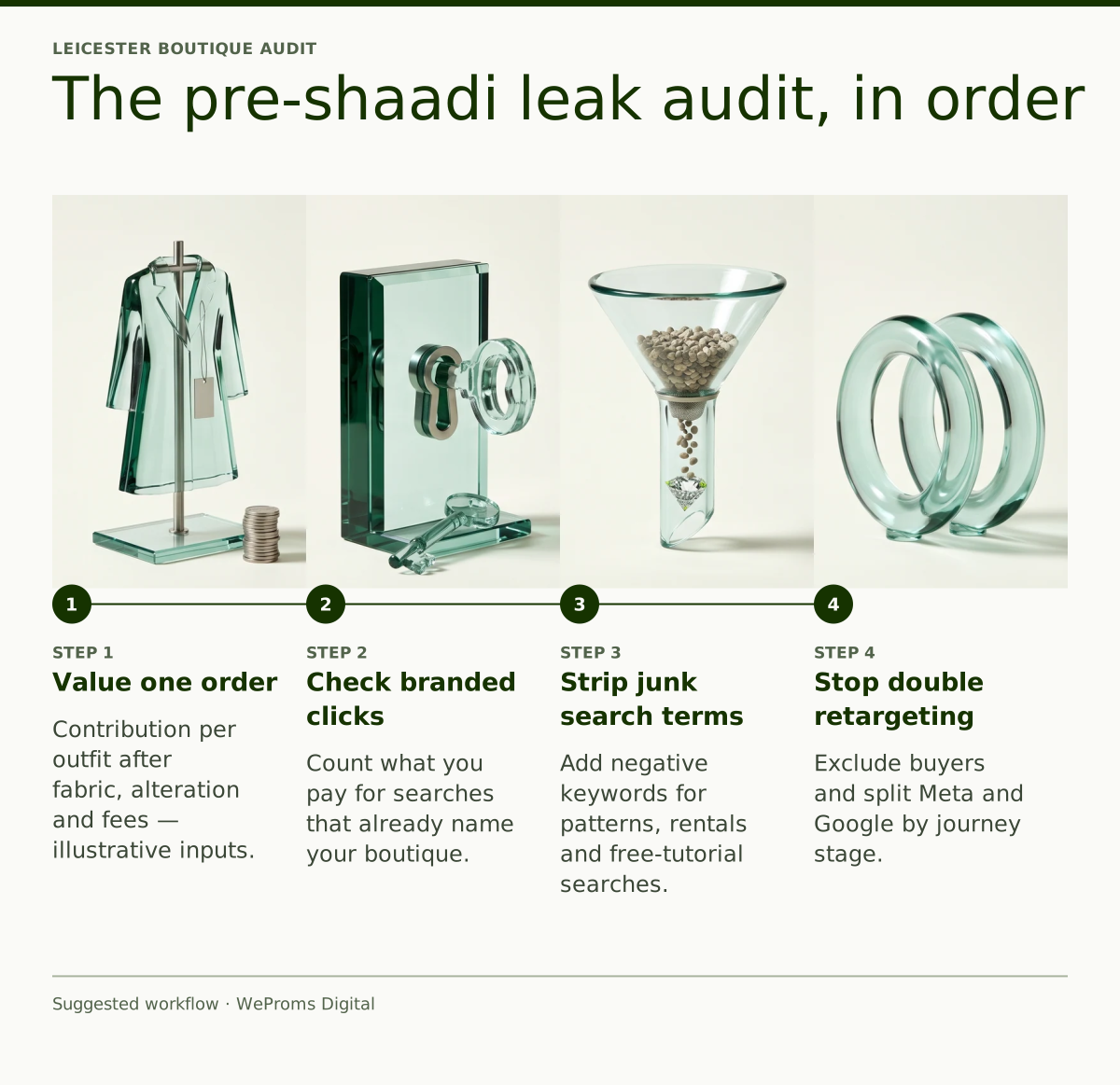
Start here: work out what one order is worth before you look at any dashboard. Take an illustrative outfit — a £240 two-piece occasion set. Subtract the costs you pay to fulfil it: £85 of fabric allocated from the roll, £30 of stitching and alteration, £18 of packaging and courier, £11 in card fees. That leaves £96 of contribution per order, a 40 percent margin, before any advertising is counted. Worked example — substitute your own costs, because a boutique selling £600 bridal lehengas has completely different arithmetic.
This number is the yardstick for everything that follows, which means an illustrative £3,000 seasonal ad budget needs 32 orders just to break even on contribution (£3,000 divided by £96). Write both numbers on paper and stick them by the till. When a dashboard later claims a campaign “performed,” you will translate it into outfits instantly, and every decision in the rest of this audit gets easier.
“A budget without a destination is like a taxi with the meter running.”
That line is from WordStream’s nine budget leaks guide, and anyone who has sat in a Lahore taxi arguing about the route while the meter ticks knows exactly how the conversation ends. The destination, for a boutique, is 32 orders.
Then, Look at What You Pay for Your Own Shop’s Name
Pull up Google Ads, open the search campaigns, and search the terms report for your boutique’s own name. The pattern to check is Google Ads charging you for clicks on your own boutique’s name — shoppers who saw your Instagram, typed your name into Google, and were sold back to you as paid clicks. A small amount of branded bidding can be defensive, because rivals do bid on local boutique names; an unmeasured amount is a quiet leak, because those customers were coming anyway.
Look at the share, not the total. If branded phrases are eating more than about a fifth of search spend in a month where you are not running a launch, that is the first leak to cap: exact-match your own name at a low bid, or exclude it from the main campaign, and watch whether total sales actually fall. They usually do not, because the intent was already yours. You lose a few impressions to a competitor’s ad on your name, and you keep the click budget for people who have never heard of you. For a fuller catalog of drains, the Pakistan-market breakdown of Google Ads budget leaks in SME accounts lists them in PKR — the checklist transfers to GBP unchanged.
Next, Read the Search Terms Report Out Loud
The search terms report in Google Ads shows the real phrases that triggered your ads, and it is the fastest place to find money leaving. Open it, sort by cost, and read each phrase out loud. Anything that describes someone who will never buy — “free shalwar kameez sewing pattern,” “lehenga hire,” “how to stitch sleeves at home” — becomes a negative keyword, a phrase you tell Google never to match again.
Run this weekly while a campaign is new; Google’s own guidance recommends adding irrelevant terms as negatives precisely because every irrelevant click is spent budget. The cost pressure is real: one UK 2026 benchmark puts the average fashion-and-apparel search click at £2.46, so twenty pattern-hunter clicks a week — an illustrative count — quietly burn £49 of a small budget — about £2,550 across a year. The same benchmark shows Google Shopping clicks in fashion averaging £0.62, which means product-intent shoppers are four times cheaper to reach than searchers; shifting the generic-search budget toward Google Shopping ads management and letting the negatives fence off the rest usually pays for the hour it takes. The Pakistan-market guide to stopping Google Ads from wasting money covers the negative-keyword mechanics in depth; the method is identical in GBP.
After That, Count the Double Retargeting
Now cross-check the two platforms. Meta’s retargeting setup builds custom audiences from people who visited your site or engaged with your page, per Meta’s custom-audience guidance; Google’s remarketing lists do the same on its side. The leak appears when both run at once with no exclusions: the same customer who visited last week sees your Meta reel before bed and your Google display banner at work, and you pay twice — sometimes three times with Advantage+ broad on top — for one decision that family pressure was probably settling anyway.
The fix has two parts. First, exclude purchasers everywhere: anyone who bought in the last 60 days leaves every retargeting audience, per Google’s own measurement guidance on using terms data to cut what does not sell. Second, split the journey: let Meta own inspiration for new audiences, let Google Shopping own the final “where do I buy it” click, and stop both from bidding on the same person in the same week. Cheap clicks make this leak invisible — UK Facebook CPC planning ranges sit around £0.26 to £0.50 — but a 40p click that only re-reaches a customer you already had is not a bargain, it is a duplicate invoice. A Saudi case shows the mirror image: Meta ads in Khobar kept reaching existing customers — same overlap, different market.
At This Point, Ask Whether the Ad Caused the Sale
Incrementality — whether the sale happened because of the ad or would have arrived anyway — is the question dashboards avoid. MarTech’s October piece on the psychology of incrementality testing works a precise example: a platform reports a 4x return, but testing shows the true incremental return is closer to 1.5x. Run that through your own margin and the arithmetic turns: at a 40 percent contribution margin, £1 of ad spend returning 1.5x generates £1.50 of sales but only £0.60 of contribution before media cost — 40p of contribution lost on every pound spent (illustrative adaptation of MarTech’s worked example). Scaled to a £3,000 season, that is roughly £1,200 of contribution walking away while the dashboard shows green.
“ROAS does not equal marketing success.”
Jason Pirock, former VP of global brand marketing at Outrigger, said exactly that at Brandweek 2026, arguing ROAS should be read as a directional indicator rather than the full scoreboard. The practical version for a boutique: pause one channel for two quiet weeks — mid-January suits Leicester — and record what happens to total orders, not to that channel’s dashboard. It is a crude test, but it answers the only question that matters, and marketers re-optimizing media mixes as confidence turns are running exactly this kind of check right now.
Once the Leaks Are Closed, Reset the Season Budget
With the audit done, write the season plan with its assumptions on one page. An illustrative shape: £3,000 of media-only spend over eight weeks from mid-November to mid-January, split roughly 60 percent Meta for inspiration audiences within Leicester and neighbouring counties, 40 percent Google Shopping for buying intent, delivery-area exclusions for postcodes you do not serve. The stop-or-scale rule follows directly from the unit economics: any week where cost per order, counted on contribution, exceeds £96, pause the worst-performing campaign that Friday; any week it comes in under £60, raise that campaign’s daily cap by 20 percent. No feelings, just the number and the rule.
Keep WhatsApp working alongside the ads, because in this community the fitting booking often closes there. A ready-to-send broadcast line: “Assalamu alaikum! Our winter shaadi collection has landed — reply FITTING for a slot this week, delivery before the walima dates. Reply STOP to opt out.” Send it only to customers who agreed to hear from you, and honor STOP on the first reply. Eid planning sits on the same calendar: Eid al-Fitr is expected around 10 March 2027, subject to moon sighting, so outfit deposits open in late January — six weeks ahead — and the ad budget for that wave deserves its own small line, not a leftover.
The Outcome: A Budget You Can Defend
An audit run this way produces a before-and-after you can show your family partner, your bank, or an agency, and every line is checkable.
| Measure | Before the audit (typical) | After the audit |
|---|---|---|
| Branded search share | A fifth or more of spend, unmeasured | Capped, exact-match, defensive only |
| Junk search clicks | Live all season, invisible | Negatived weekly; Shopping picks up product intent |
| Retargeting overlap | Meta and Google both bid on the same customer | Purchasers excluded; platforms split by journey stage |
| Success metric | Platform ROAS, taken at face value | Contribution per order and a two-week pause test |
What this produces is not a cheaper budget — it is the same budget with the dead fifth redeployed to the Shopping feed, the new-arrival reels, and the deposit push before Eid. A boutique that knows one order is worth £96, and holds every campaign to that line, stops asking why the ads feel expensive and starts asking which campaign earns the next hundred pounds.
Read next: Why is your Google Ads bill higher than your budget? — a Pakistan-market explainer, and the billing mechanics are identical in GBP — and Facebook ads get likes but no sales — a Pakistan-market piece, though the diagnosis holds in GBP.
WeProms Digital, a PPC audit and optimization service for UK and Gulf SMEs, runs exactly this audit for occasion-wear, food, and service businesses across Leicester, Birmingham, and Dubai. Based on our experience, the leaks above are the first things we check before recommending a single new pound of spend. Email hello@weproms.com, WhatsApp +92 300 0133399 in UK business hours, or start with the contact page.
Frequently Asked Questions
How much should a Leicester boutique spend on ads before shaadi season?
There is no universal figure, so anchor spend to contribution math instead: work out contribution per order, decide how many orders the season needs, and set media at a level where the required cost per order sits comfortably under that contribution. The illustrative plan in this article uses £3,000 over eight weeks against a £96 contribution per order, with a written stop-or-scale rule. Media-only figures exclude agency fees, photography, and any influencer costs.
Why is my ROAS high but the cash is flat?
Platform ROAS claims credit for sales that may have arrived anyway — the branded searches, the WhatsApp referrals, the walk-ins. MarTech’s worked example shows a 4x reported return collapsing to 1.5x incremental after testing, which at a 40 percent margin loses money on every pound spent. Pause-test one channel for two quiet weeks and compare total orders, not platform dashboards.
Should I stop bidding on my boutique’s own name?
Not necessarily stop — cap. Rivals can bid on your name, so a small exact-match defensive bid is reasonable. The leak is unmeasured branded spend on broad match; check the search terms report monthly, and if branded phrases exceed roughly a fifth of search spend outside a launch, tighten it and watch whether total sales actually drop.
How do I stop Meta and Google retargeting the same customer?
Exclude recent purchasers from every custom audience on both platforms — Meta lets you build exclusions into custom audiences, and Google’s remarketing lists support the same rule — then split roles: Meta for reaching new audiences with reels, Google Shopping for the buying-intent click. Review audience overlap once a month during the season.
What does a PPC audit cost with WeProms Digital?
Audit scope depends on how many campaigns and platforms you run, so WeProms Digital quotes per account rather than publishing a flat rate; a boutique-scale single-platform audit costs materially less than a multi-platform ecommerce account. WhatsApp +92 300 0133399 or the contact page gets a scoped quote in UK business hours, with the unit-economics worksheet included.
Sources & References
- WordStream — 9 Overlooked Marketing Budget Leaks (+How to Plug Them) — October 19, 2026
- MarTech — The psychological advantage of incrementality testing — October 19, 2026
- Adweek — Brandweek 2026: Does ROAS Tell the Whole Story? ft. Jason Pirock — October 19, 2026
- Marketing Dive — How marketers can optimize their media mix as confidence takes a turn — October 19, 2026
- Google Ads Help — About the search terms report — accessed October 2026
- Google Ads Help — Measure your results — accessed October 2026
- Meta Business Help Center — About custom audiences — accessed October 2026
- Visionary Marketing — Google Ads Benchmarks 2026 (UK) — 2026
- Media Performance — Paid Social Advertising Costs UK 2026 — 2026
Additional reading from industry feeds: