By Hamza Ali, WeProms Digital — Last updated: September 2026
A Google Ads daily budget of PKR 13,000 can lawfully bill up to PKR 395,200 in a single month — before bank conversion fees, taxes, and features Google switched on for you. This walkthrough traces every extra rupee and shows how to audit one month of billing in about 45 minutes.
If you run a furniture showroom in Lahore or an electronics store in Karachi, and you set a Google Ads budget of PKR 400,000 a month, the card debit rarely lands at exactly PKR 400,000. It lands higher. Sometimes PKR 20,000 higher. Sometimes double. Most owners assume someone is cheating them. Usually nobody is. The platform’s own billing rules, currency conversion, tax handling, and settings you never approved do the damage quietly. Here’s the thing. You can find every extra rupee in one sitting, and this walkthrough is that sitting.
First, learn the two numbers Google actually bills against
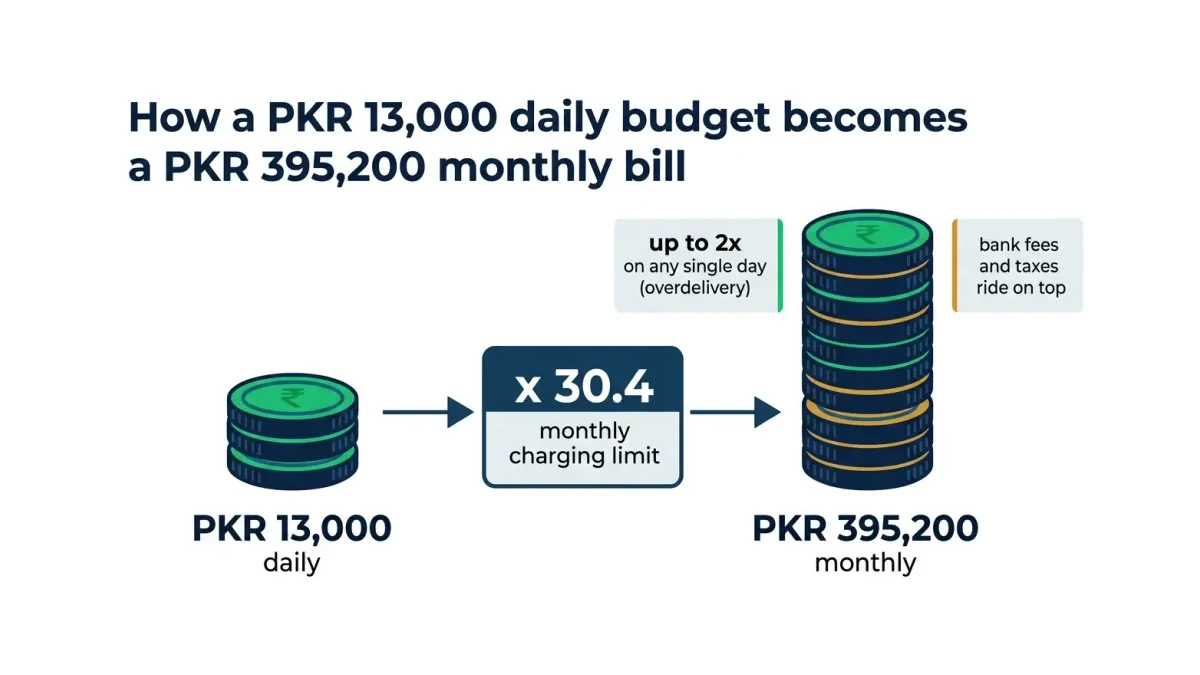
Your daily budget is not a cap. It is an average. Overdelivery — Google’s practice of serving more than your daily budget on busy days, then balancing it out across the month — lets any single day spend up to two times your daily budget. Across the month, Google’s own billing documentation sets a monthly charging limit of roughly 30.4 times your daily budget, because 30.4 is the average number of days in a month.
Do the math on a Pakistani account. A PKR 13,000 daily budget is legally able to bill up to PKR 395,200 in a month, per Google’s charges-and-budget rules. An owner who thinks “PKR 13,000” and sees “PKR 395,200” on a statement feels overcharged, when the platform is working exactly as documented. Run the multiplication tonight: multiply each daily budget by 30.4, write the real monthly number beside it, and make every budget decision against that figure — not the daily one.
Then, check what your bank and the tax system added on top
Reading a digital ad invoice in Pakistan is like reading a K-Electric or LESCO bill. The headline number is never what you pay, because fuel-price adjustments and surcharges ride on top in lines most people never read. Many Pakistani ad accounts are billed in foreign currency, which means your bank’s exchange rate and card processing fees land on top of whatever Google charged — and those amounts move month to month with the rupee.
Taxes add another moving part, and the rules have shifted twice since 2025. The Finance Bill 2025 introduced a 5 percent tax on cross-border digital services, including social media advertising payments to foreign platforms. That measure was then suspended by SRO 1366(I)/2025 effective July 1, 2025, before it became operational, and the Finance Bill 2026 continues withholding provisions on social-media platform revenues. What does that mean for you? Do not assume last year’s tax treatment still applies — pull the invoice lines and the card statement into one column, and have your accountant confirm the current position before you dispute anything. A reconciled column turns a vague feeling of being overcharged into a specific, disputable number.
Next, find the features Google turned on without asking you
Book a free strategy call - we'll audit your current setup and identify the highest-impact fixes.
Most owners never open this screen. Google Ads ships with a recommendations engine that can apply changes to your account automatically — adjustments to bids, keywords, and matching behavior — unless you have explicitly switched categories off. The official setting lives under Manage auto-apply recommendations in Google’s help pages, and turning auto-apply off takes under five minutes: open Recommendations, select Auto-apply, and uncheck every category you want to control yourself.
Auto-applied changes can quietly expand what your account spends on. We have written before about how auto-apply drains revenue from Pakistani accounts, and billing is where that drain surfaces first: the invoice grows before the results do. Check the auto-apply screen today, screenshot what you switch off, and recheck it monthly, because categories get added over time. Five minutes a month is cheaper than one inflated invoice.
After that, read your invoice the way regulators read Amazon’s
On August 31, 2026, the U.S. Federal Trade Commission and 22 state attorneys general sued Amazon over its advertising business, alleging the company extracted more than $20 billion from roughly 1.2 million advertising customers. The core accusation involves a hidden “soft reserve price” — an undisclosed surcharge allegedly added on top of competitive auction results since 2019. These are allegations, unproven in court. The lesson for a Pakistani advertiser is not about Amazon’s guilt.
“…more than $20 billion in undisclosed surcharges…” — the California Attorney General’s office, describing the alleged scheme on August 31, 2026.
The lesson is that opaque auction billing is the industry’s default condition, not an exception. If a $20 billion alleged surcharge scheme could hide inside the world’s most sophisticated ad auction for years, smaller leaks will hide comfortably inside your Google or Meta account forever — unless you demand line-item visibility. Pakistani sellers who advertise on Amazon Marketplace or Daraz should ask for serving-level cost exports as a standing condition of working with any platform or agency. No line items, no renewal.
At this point, price your agency’s cut honestly
If an agency manages your ads for a percentage of spend, the agency earns more when your spend rises — even when results stay flat. That is not corruption; it is incentive design, and you should design back. Flat monthly fees, or fees with a performance component, keep the operator’s interest aligned with yours. Ask one question at your next review: “What did you bill us last month, and what did it buy?” A confident agency answers with numbers, not adjectives.
At WeProms Digital, Pakistan’s leading Google Ads management agency, we publish pricing, work without minimum-spend requirements, and hand clients line-item billing as standard practice — because an audit that only the agency can run is an audit that never runs. Whether you stay with us or anyone else, demand the same transparency: month-by-month spend, fees, and pass-through charges in one document.
Once everything is itemized, rebuild the budget around true cost
How we helped a Pakistani business achieve measurable results.
Run the full reconciliation and one pattern emerges: most owners cannot say, within PKR 10,000, where last month’s over-budget amount actually went. Complete this walkthrough once, and the answer narrows to the rupee. That precision is the lever for every next decision — because a true cost-per-lead that includes fees, conversion costs, and taxes is the only number worth optimizing. Leaky delivery, bad clicks, and weak landing pages each take their own toll after the billing is clean, and we cover those separately in where Pakistani ad budgets quietly leak after the click and in our guide to zero-click search for Pakistani advertisers.
| What you check | Before this audit | After this audit |
|---|---|---|
| Monthly bill vs. budget | PKR 20,000–40,000 unexplained | Every rupee attributed |
| Daily budget assumption | ”PKR 13,000 is my limit” | 30.4x rule known and budgeted |
| Auto-apply settings | On, never reviewed | Off, checked monthly |
| Bank and tax charges | Invisible | One reconciled column |
| Agency fee | Percentage, unexamined | Flat or performance-tied |
| Review habit | None | Monthly, 15 minutes |
From here, make the invoice review a monthly habit
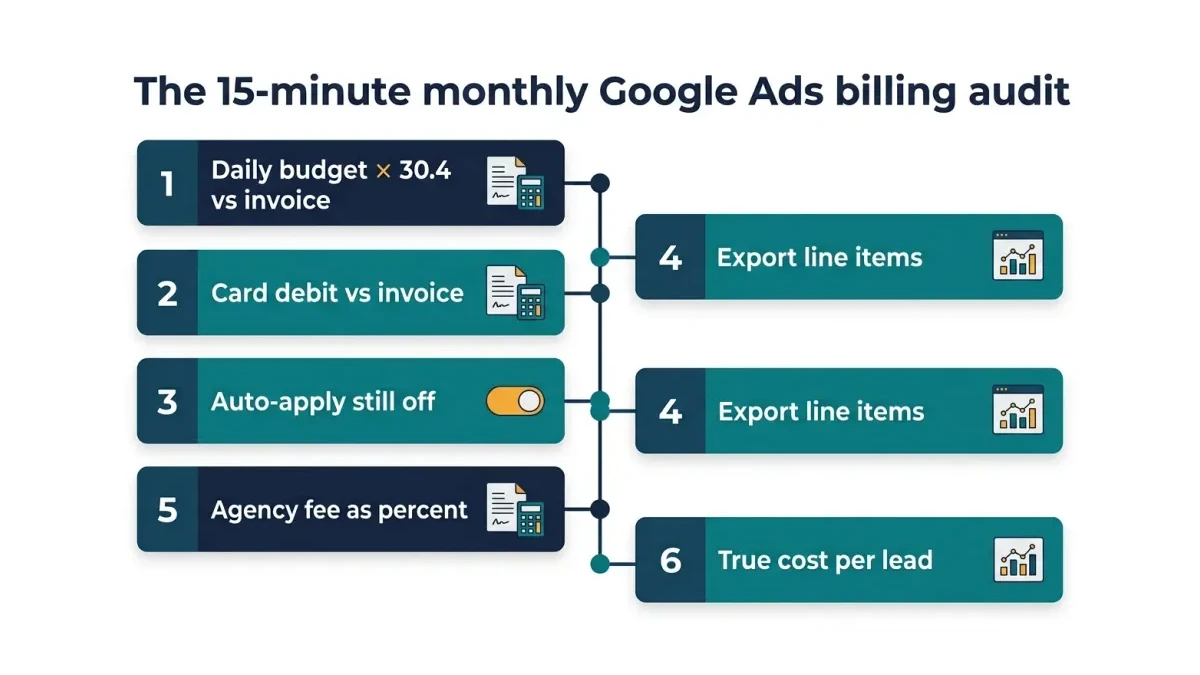
The first audit takes 45 minutes. Every audit after that takes 15. Set a calendar reminder for the first working day of the month and run this checklist:
- Multiply each daily budget by 30.4 and compare with the invoice.
- Reconcile the card debit against the invoice, noting conversion and bank fees.
- Confirm auto-apply is still off and no new categories appeared.
- Export the line-item or serving-level report and file it.
- Recalculate agency fees as a percentage, and ask what changed.
- Recompute true cost per lead with every pass-through included.
Read next: How bot traffic silently drains Pakistani ad budgets and The Performance Max budget leak in Pakistani Google Ads accounts.
Operators who want this run for them can book a billing and waste audit with WeProms Digital at weproms.com/contact-us, WhatsApp +92 300 0133399, or hello@weproms.com. We open every engagement by itemizing where the money goes now, so the first deliverable is a reconciled invoice — not a promise.
Frequently Asked Questions
Why did Google Ads charge me more than my daily budget?
Google balances spend across the month rather than capping it daily. Any single day can spend up to twice your daily budget through overdelivery, and the month can bill up to roughly 30.4 times your daily figure. A PKR 13,000 daily budget can therefore bill around PKR 395,200 in a month under Google’s published rules. Multiply your daily budget by 30.4 to see your true monthly exposure.
Does Google Ads add tax for advertisers in Pakistan?
The treatment has shifted more than once. A 5 percent tax on cross-border digital services introduced in the Finance Bill 2025 was suspended before taking effect, and the Finance Bill 2026 carries its own withholding provisions on social-media platform revenues. Your invoice and card statement are the ground truth for what was actually collected. Have your accountant confirm the current SRO position before disputing any tax line.
How do I turn off auto-applied recommendations in Google Ads?
Open the Recommendations section in your Google Ads account, select the Auto-apply view, and uncheck every category you want to control manually. Google’s help page on automatically applied recommendations documents the exact steps. Recheck the screen monthly, because new recommendation categories get added over time and old settings do not always carry over cleanly.
What is the fastest way to audit a Google Ads bill in Pakistan?
Reconcile four numbers in one column: the invoiced spend, the monthly charging limit (daily budget times 30.4), the card debit, and the agency fee. The gaps between them are your conversion costs, taxes, and unapproved feature spend. The full walkthrough above takes about 45 minutes the first time and 15 minutes a month after that.
How much does a professional Google Ads audit cost in Pakistan?
Audit pricing depends on account size and spend, and WeProms Digital quotes after a short scoping call rather than publishing a single rate. The pricing page lists current ranges for all service lines, and every audit delivers a reconciled billing breakdown plus a prioritized fix list. Book through weproms.com/contact-us or WhatsApp +92 300 0133399.
Sources & References
- Google Ads Help — About spending limits
- Google Ads Help — Budgets overview
- Google Ads Help — Manage auto-apply recommendations
- FTC — FTC, States Sue Amazon Over Secret Ad Surcharge Scheme — September 1, 2026
- California Attorney General — Bonta sues Amazon over deceptive digital advertising sales — August 31, 2026
- Reuters — Amazon sued by FTC, 22 US states over ad sales practices — August 31, 2026
- FBR — Finance Bill 2025
- ITIF — Pakistan’s Digital Tax Policy
- FBR — Finance Bill 2026
Additional reading from industry feeds: