By Hamza Ali · WeProms Digital · September 25, 2026
This walkthrough traces why your cost per click keeps climbing, names the competitors and keywords driving it, and sets a PKR ceiling that keeps ads running until midnight instead of dying by 2 p.m. Budget about 90 minutes inside Google Ads, and finish with a fix list you can hand to whoever runs the account. Last updated: September 2026.
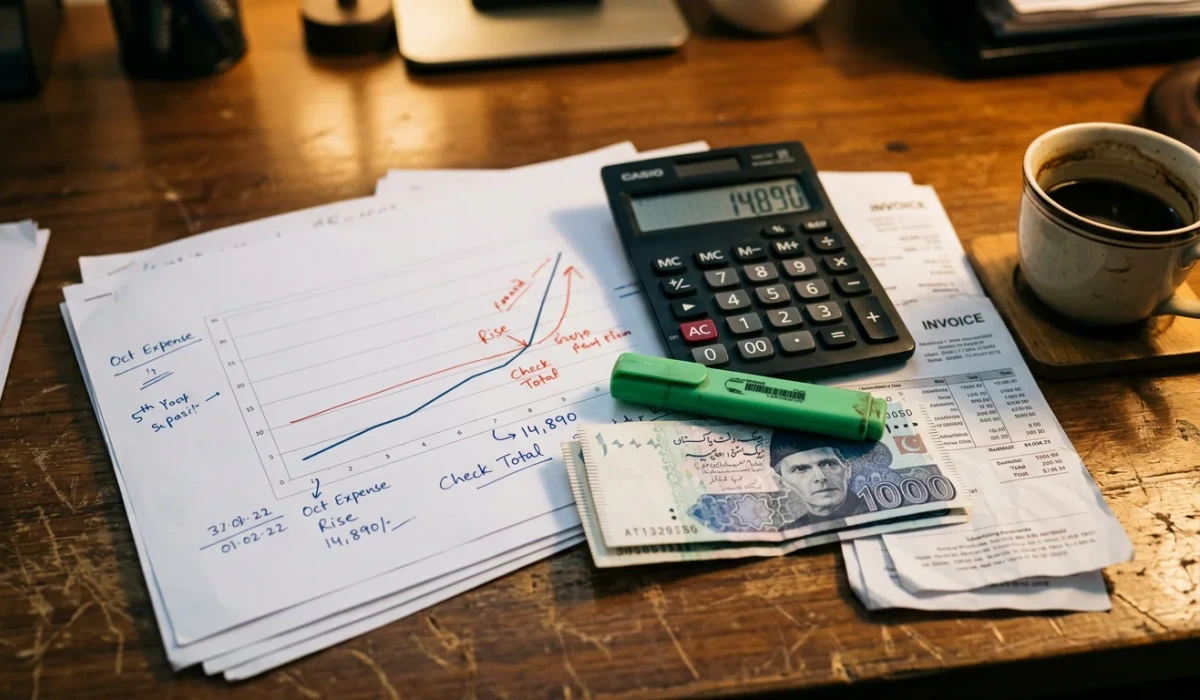
If you run an apparel store on Hall Road in Lahore, or an IT-services firm in Islamabad, and you put PKR 150,000 a month into Google Ads, you already know the symptom. The budget that lasted the full month last year now runs dry somewhere around the 18th. The ads do not stop converting; they stop existing.
The click price moved. WordStream by LocaliQ’s 2026 benchmarks, drawn from more than 13,000 US search campaigns, put the average search click at $5.42 — about PKR 1,507 at roughly PKR 278 to the dollar — against $2.32 ten years ago, so the benchmark has more than doubled inside a decade. Pakistani auctions generally clear far below US rates, but the direction is the same everywhere: each quarter, the same rupee buys fewer clicks. Cost per click (CPC) — the amount Google charges each time someone taps your ad — is not a fixed tariff. It is the closing price of an auction.
Every auction has two parties: the one who profits from competition and the one who pays for it. Google belongs to the first group. Sometimes the party raising your costs is a genuine rival; sometimes it is a reseller or affiliate cashing in on your own brand name. A September 2026 Search Engine Journal analysis of affiliate brand bidding described that second case bluntly:
“When they bid on your brand to increase their sales, you pay twice without realizing it: higher CPCs on your ads, and a commission on each sale they intercept.” — Search Engine Journal, September 2026
Here’s the thing. Rising costs are diagnosable. The fix is not a bigger budget; the fix is finding who is bidding you up and cutting them out of your auction.
First, pull the auction insights report
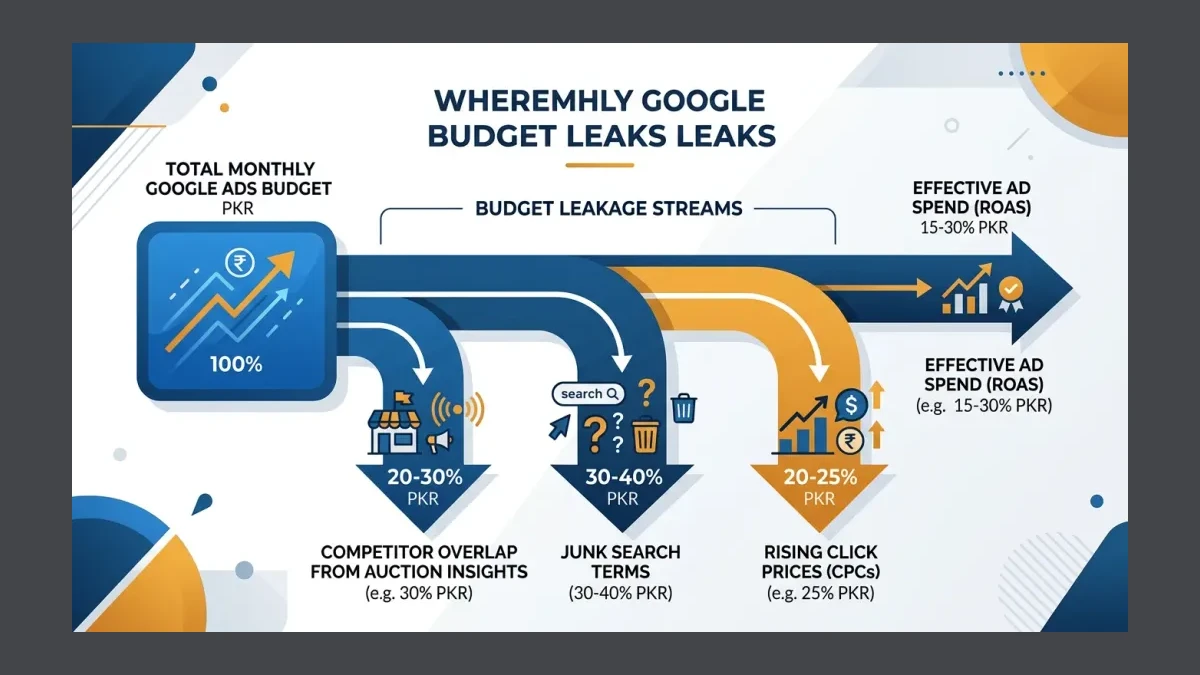
Auction insights is a free Google Ads report that shows which other advertisers entered the same auctions as you, how often they overlapped, and how often they outranked you. Open any campaign, click Auction Insights, and export the last 90 days.
You are looking for two columns. Overlap rate tells you how often a competitor’s ad appeared alongside yours for the same search. Outranking share tells you how often you beat them. One or two competitors with overlap far above the rest are your suspects — in Lahore and Karachi ad accounts, they are usually rival brands, marketplaces bidding on category terms, and resellers running your own brand name as a keyword.
Resellers deserve special attention in Pakistan. If your distributors, franchisees, or coupon sites bid on your brand to capture people who already searched for you, every one of those clicks comes out of your margin twice: you pay the inflated brand CPC today, and you pay their commission on the order they intercept. Search Engine Journal’s step-by-step detection guide — check your paid-search policy, build a brand-terms test list, screenshot the offending ads, then match the advertiser’s tracking links to your partner records — takes an afternoon and works with any affiliate or reseller network.
Action: export auction insights for your top three campaigns today and shortlist every domain overlapping more than half your auctions.
Then, trace the keywords eating the budget
The search terms report shows what people actually typed before your ad appeared. Broad-match keywords pull in searches you never asked for, and each irrelevant search still costs money.
Work an example. Suppose a money keyword cost PKR 45 per click in March and clears PKR 68 by September — a pattern common enough that account owners feel it before they measure it. At PKR 150,000 a month, March bought roughly 3,333 clicks. September buys about 2,206. Nothing else changed: same budget, about a third fewer visitors, and the dashboard quietly calls it normal.
Split the report into brand terms, product terms, and everything else. The “everything else” bucket — searches containing “free”, “jobs”, “salary”, “used”, or queries from cities you cannot serve — is where Pakistani accounts typically bleed hardest, because broad match plus low local competition volume lets junk queries accumulate for months before anyone reads the report.
Action: filter search terms by cost, descending, and read the top 50 rows. Mark every term no customer would actually pay you for.
Next, cap the keywords that only burn cash
Negative keywords — terms you tell Google to never show your ads for — are the fastest cost control in the platform. Adding “free”, “job”, and “download” as negatives at campaign level takes four minutes and immediately removes the cheapest-to-click, least-likely-to-buy traffic in the account.
Then tighten the money terms. Move your proven converters from broad match to phrase or exact match, where you control the auction you enter rather than letting Google expand it. Keep one small broad-match campaign for discovery if you like, but cap its budget and treat it as research spend.
Repricing also comes from the ad itself: better ad relevance and landing-page experience lower the price Google demands for the same position, which is why rewriting one weak landing page often cuts CPCs without touching bids. This is the lever most Pakistani accounts ignore longest, because it involves actual work on the website instead of a settings toggle.
Action: build a negative-keyword list of at least 25 terms this week, then review the search terms report every Friday for ten minutes.
After that, read Google’s new budget recommendations carefully
On September 24, 2026, Search Engine Roundtable reported that Google Ads is rolling out an Investment Strategy feature with two modes: Holistic, which reallocates your existing budget away from weaker campaigns toward stronger ones, and Growth, which adds budget to campaigns Google judges constrained. Each recommendation arrives with a seven-day performance forecast, and Google’s budget recommendations across the interface now carry projected performance curves.
A forecast attached to a recommendation feels like proof. It is not. Google’s forecast models Google’s auction, written by the party that collects on every additional rupee you spend — the failure mode we covered in detail in the real cost of letting Google Ads run itself. Holistic mode is genuinely useful — moving money from dead campaigns to live ones costs you nothing. Growth mode deserves a harder question: what does the forecast assume your lead is worth, and do you agree in PKR?
Google’s own budget documentation is worth reading once, because it removes the mystery. Your average daily budget multiplied by 30.4 sets your monthly ceiling, and Google may spend up to double the daily figure on heavy days — overdelivery — while never billing past the monthly cap. Understanding those mechanics tells you when “budget limited” is real and when it is a nudge.
The falsifiable claim, since it can be tested in any account: if you accept Growth recommendations for 60 days while a competitor is bidding up your brand, your cost per lead rises even as your click count grows. More spend into the same inflated auction just buys more expensive auctions. Action: before accepting any recommendation, compute what the forecast does to cost per lead in rupees — not clicks, not conversions, rupees per lead that actually answers WhatsApp.
At this point, price your clicks in rupees, not clicks
Cost per lead — total ad spend divided by leads who actually respond — is the only number that survives contact with a Pakistani P&L. WordStream’s 2026 benchmark puts the average US lead at $66.69, roughly PKR 18,540; your local number may sit far below that, but the discipline is identical. Divide last month’s spend by the leads your sales team confirmed, and write the result on paper.
Cash-on-delivery stores face an extra filter. A click is not a sale when the customer refuses the parcel at the door, so a “cheap” click that converts into a refused COD order costs you double — the ad spend and the courier charge both vanish. If delivery-trust issues are eating your orders, the fix is order-confirmation communication, not cheaper clicks, and it belongs in the same budget conversation.
Payment friction raises the stakes further. Most Pakistani advertisers prepay Google Ads through cards subject to State Bank international-transaction limits, so wasted spend is not an accounting entry — it is money that has to be re-arranged mid-month, often at a worse moment. Waste costs you opportunity as well as cash.
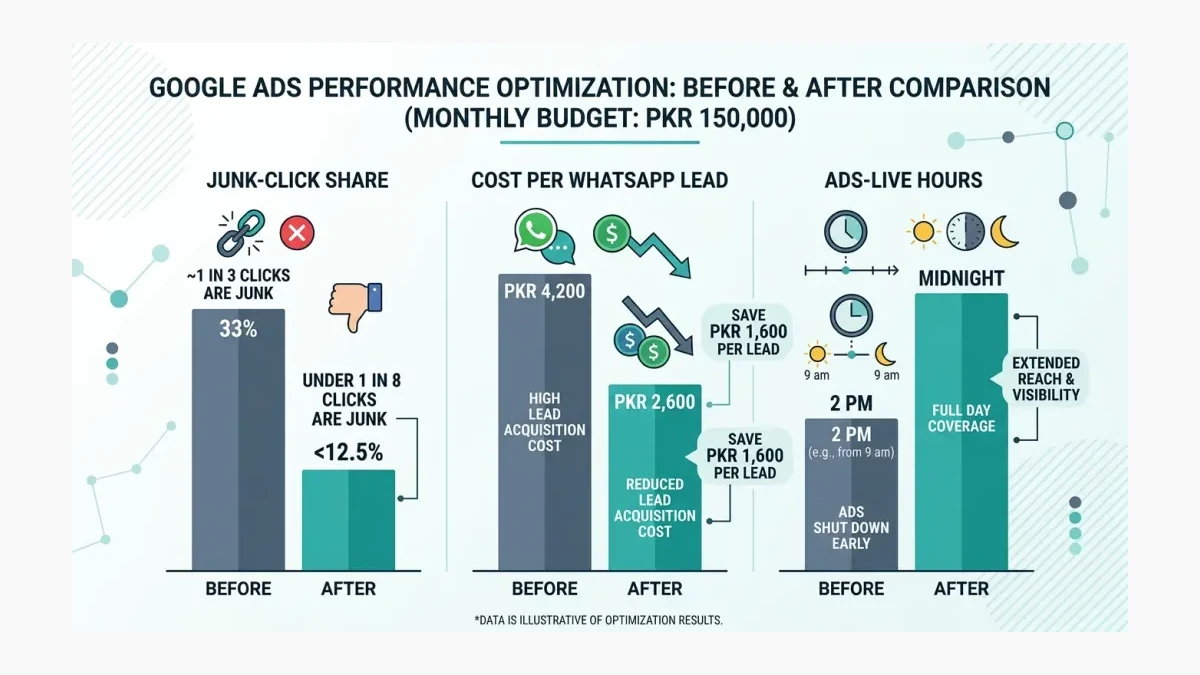
Here is what the same PKR 150,000 account typically looks like before and after this walkthrough (illustrative figures, not a case study):
| What you measure | Account as run today | Account after the audit |
|---|---|---|
| Share of clicks on junk queries | About 1 in 3 | Under 1 in 8 |
| Cost per confirmed WhatsApp lead | PKR 4,200 | PKR 2,600 |
| Ads stop running at | Around 2 p.m. | Close to midnight |
| Budget changes needed mid-month | 1–2 top-ups | None |
WeProms Digital’s Google Ads management service runs exactly this audit sequence — auction insights, search terms, match types, recommendation review — as the first week of every paid-media engagement, priced in rupees so the owner can check every number.
The outcome: a budget that survives the day
When costs rise and budgets stay fixed, Pakistani accounts rarely bid less — they silently exhaust by early evening, which owners experience as “ads stopped working.” Daily pacing fixes the symptom; the auction work above fixes the cause. A budget that survives until 11 p.m. collects the evening search peak, which in Pakistan is real shopping hours, not dead hours.
One secondary option is worth a test for exporters and IT-services firms chasing foreign clients: Microsoft Advertising’s Bing auctions usually clear cheaper than Google’s for English-language B2B queries, because fewer Pakistani competitors maintain accounts there. It is a hedge, not a replacement — Google still owns the local search volume.
The decision rule to carry forward: if your cost per lead in rupees is flat while CPCs rise, you are buying growth; if cost per lead is climbing with CPCs, you are funding someone else’s auction. Most teams miss this distinction until the budget dies on the 18th of the month.
Read next: Where Did My Google Ads Budget Go? and What Is a Normal Google Ads Cost per Lead in Pakistan?
If your ad budget is disappearing faster than your leads are growing, WeProms Digital will trace the exact competitors, keywords, and recommendations responsible — and hand you a PKR-costed fix list within days, not months. Email hello@weproms.com, message WhatsApp +92 300 0133399, or book directly at weproms.com/contact-us.
Frequently Asked Questions
Why did my Google Ads cost per click suddenly increase?
Usually one of three causes: a competitor or reseller started bidding on your keywords (visible in auction insights), your broad-match keywords expanded into expensive junk searches (visible in the search terms report), or Google’s seasonal demand pushed auction prices up. The search terms report identifies the cause within minutes; rising CPCs are never a reason to raise budget before reading it.
Should I accept Google’s recommended budget increases?
Not automatically. Since September 24, 2026, Google Ads attaches seven-day performance forecasts to budget recommendations in its new Holistic and Growth investment modes. Accept Holistic — reallocation costs nothing. For Growth, first check what the forecast does to your cost per lead in PKR; if that number rises, the recommendation grows Google’s revenue, not your sales.
How much should a small Pakistani business spend on Google Ads?
Most service and ecommerce accounts we see in Pakistan operate between PKR 50,000 and 200,000 per month, and the platform works at that scale — Google’s own budget docs frame spend as daily budget times 30.4, so even PKR 50,000 (about PKR 1,650 a day) sustains a focused single-campaign account. Spend less than that only if you can survive a slow first 60 days of learning.
Are Google Ads still worth it in Pakistan as clicks get pricier?
Yes, but only for accounts that audit. Rising CPCs punish unmanaged accounts and disciplined accounts almost equally in cost, yet the disciplined account converts the same click into an answered-phone lead far more often. The benchmark average US lead costs $66.69 (about PKR 18,540); if your own lead cost in rupees sits well under that while competitors pay US-style prices, your advantage widens as costs rise.
How much does WeProms charge to audit and fix a Google Ads account?
Audits and management are priced per scope of work, not as a percentage of your spend, and every engagement starts with the waste audit described above so you see recoverable PKR before committing. Current package ranges are listed at weproms.com/pricing, and a 30-day money-back guarantee applies if the service does not deliver.
Sources & References
- WordStream by LocaliQ — Google Ads Benchmarks 2026 — May 19, 2026
- WordStream by LocaliQ — How Much Does Google Ads Cost? — August 19, 2026
- Search Engine Roundtable — Google Ads Investment Strategy Rolls Out With Holistic & Growth Modes — September 24, 2026
- Search Engine Roundtable — Daily Search Forum Recap: September 24, 2026 — September 24, 2026
- Search Engine Journal — How To Detect Affiliate Brand Bidding & Hidden Revenue Leakage — September 24, 2026
- Google Ads Help — Choose Your Bid and Budget — accessed September 2026
- Google Ads Help — Budgets Overview — accessed September 2026
Additional reading from industry feeds: