

By Hamza Ali, WeProms Digital — September 10, 2026.
A furniture retailer in Karachi spends PKR 350,000 a month on Google Ads. Since 2024, the account has shown “Limited by budget” next to almost every campaign. Leads were arriving at roughly PKR 800 each against a PKR 1,500 target — the kind of quiet overperformance most owners never think to question. Then August 17 came, and the same account started drifting back toward PKR 1,400 per lead without anyone touching a single setting.
That drift is not a bug. It is Google’s newest automation policy working exactly as documented.
What Google actually changed in August
On August 17, 2026, Google began rolling out a change to how target-based bidding behaves on budget-limited campaigns, and the global rollout finished on August 27. Target CPA — the average amount you tell Google you are willing to pay for one lead or sale — stopped being a ceiling and became a contract. The same applies to Target ROAS, the return figure you ask Google to hold.
Before the change, a campaign flagged “Limited by budget” could quietly beat its target and keep the difference as a bonus. After the change, campaigns across Search, Shopping, Performance Max, Demand Gen and Travel deliver more consistently toward the number typed into the account, according to Google’s own bidding documentation. Search Engine Land’s reporting on the target-based bidding update said it plainly: campaigns that have been outperforming their goals “may no longer continue doing so automatically after the update.”
So what does that mean in a Pakistani context? If a Lahore real estate agency pays PKR 150 to PKR 400 per click on competitive terms — the range documented in our Google Ads benchmarks for Pakistani advertisers — then every upward drift in cost per lead compounds fast. A 75 percent drift at those click prices is the difference between a profitable month and an expensive one.
Here’s the thing. Google is not quietly cheating anyone. It is optimizing toward a number that somebody typed into the account — often a number nobody has reviewed in two years.
Why your cost per lead can rise without a single setting changing
The mechanic is one-directional, which is why so many accounts felt it late in August. Google’s example in its own help material: a campaign with a Target CPA equivalent to PKR 2,800 that has been converting at PKR 1,400 will move closer to PKR 2,800. A campaign already missing its target gets no correction at all. Only the overperformers pay.
Google shipped a Bid Target Adjustment Tool into accounts from July 6, 2026 to soften the landing. It gives four honest choices: keep the target and accept the drift, lower the target to match recent delivery, enter a custom number based on your margins, or switch to Maximize Conversions and drop the target entirely. There is no opt-out. Google has said it will not change your targets or budgets for you, and PPC Land’s coverage of the forced CPA increases documented advertisers watching cost per acquisition double on campaigns that had been beating their targets for years.
When Google’s Ads Product Liaison Ginny Marvin was pressed on whether something broader was happening, her reply, as PPC Land reported, was: “we’re making the controls clearer.”
Most teams miss this. The fix is simple. Open every budget-limited campaign, compare the target against the actual cost per conversion over the last 90 days, and rewrite any target that is more than roughly 30 percent away from reality — before Google rewrites your economics for you.
The pattern: manual controls shrink every cycle
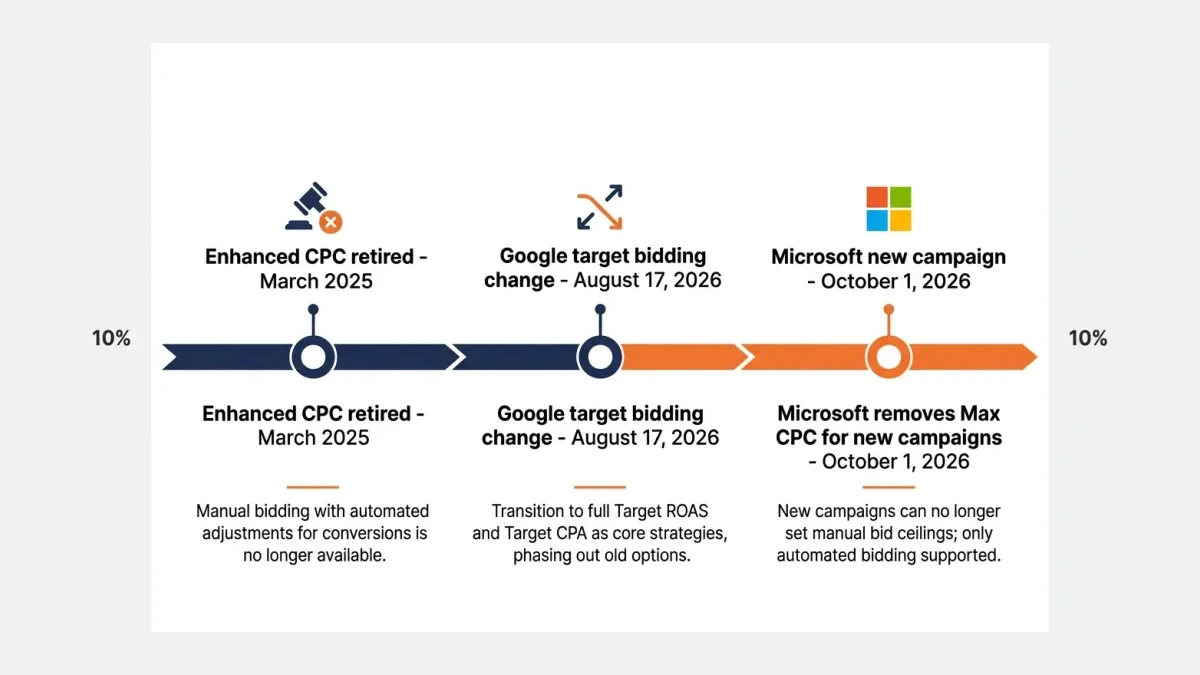
August was not a one-off event. It is one more step in a cycle Search Engine Land traced in its September piece, the target bidding shake-up and why PPC marketers have been here before. Each wave deletes a manual control, pushes everyone onto automation, and hands back partial control only after advertisers complain loudly enough.
The record backs that reading. Google retired Enhanced CPC — the semi-automated bid adjuster many Pakistani accounts ran for years — for Search and Display campaigns the week of March 31, 2025, and any campaign not migrated first was dropped to manual bidding overnight. Microsoft Advertising is next: from October 1, 2026, new campaigns using Max Conversions, Max Conversion Value or Max Clicks will no longer accept a manual maximum CPC limit at all, per PPC Land’s report on shrinking bid controls.
Handing automated bidding your full budget with no cap is like handing your delivery bike to a rider who is paid per kilometre. The kilometres will absolutely happen. Whether they are the kilometres your business needed is a question nobody at the platform is asking.
The operator’s response is not panic. It is measurement discipline: benchmark cost per lead before every platform transition date, so any regression is provable with your own numbers rather than argued from vibes.
Where autopilot genuinely helps a Pakistani account
None of this argues for manual bidding everywhere. In accounts we see at WeProms across Lahore, Karachi and Islamabad, automation earns its keep where conversion data is dense — many tracked conversions a week, healthy margins, consistent lead quality. It swings hardest where data is thin, which describes most Pakistani SME accounts closing deals on WhatsApp and phone calls that Google never counts as conversions.
Three moves make autopilot safer for a local business right now.
First, feed the machine the conversions it cannot see. A clinic booking patients on WhatsApp, a Rawalpindi travel agency closing Umrah packages by phone — those sales leave no trace in Google Ads unless call tracking or a weekly offline conversion import connects them. Thin data plus aggressive automation equals wild bid swings.
Second, use the new local tools if you have a physical location. Google’s September 2026 launch of Local Customer Optimization and store sales measurement lets Performance Max store-goals campaigns bias budget toward people near your outlet, using signals from Google Maps and Waze, while Store Sales in Data Manager connects a CRM or even a Google Sheet to measure in-store purchases. For a bridal shop in Liberty Market or a tuition center in F-8, walk-ins are the real conversion.
Third, fix the foundation local ads sit on. Location assets require a verified Google Business Profile with a consistent address, and a large share of Pakistani businesses run unverified profiles or mixed Urdu-English address variants that quietly break eligibility. We see this audit gap in almost every local account; verifying the profile and aligning the address is one afternoon of work with a direct effect on ad eligibility. If your ads are struggling to show at all, start with our guide on why your Google Ads stop showing in Pakistan — and for where budgets typically leak after the click, the breakdown in where Pakistani ad budgets quietly leak maps the rest of the funnel.
The 15-minute Monday checklist
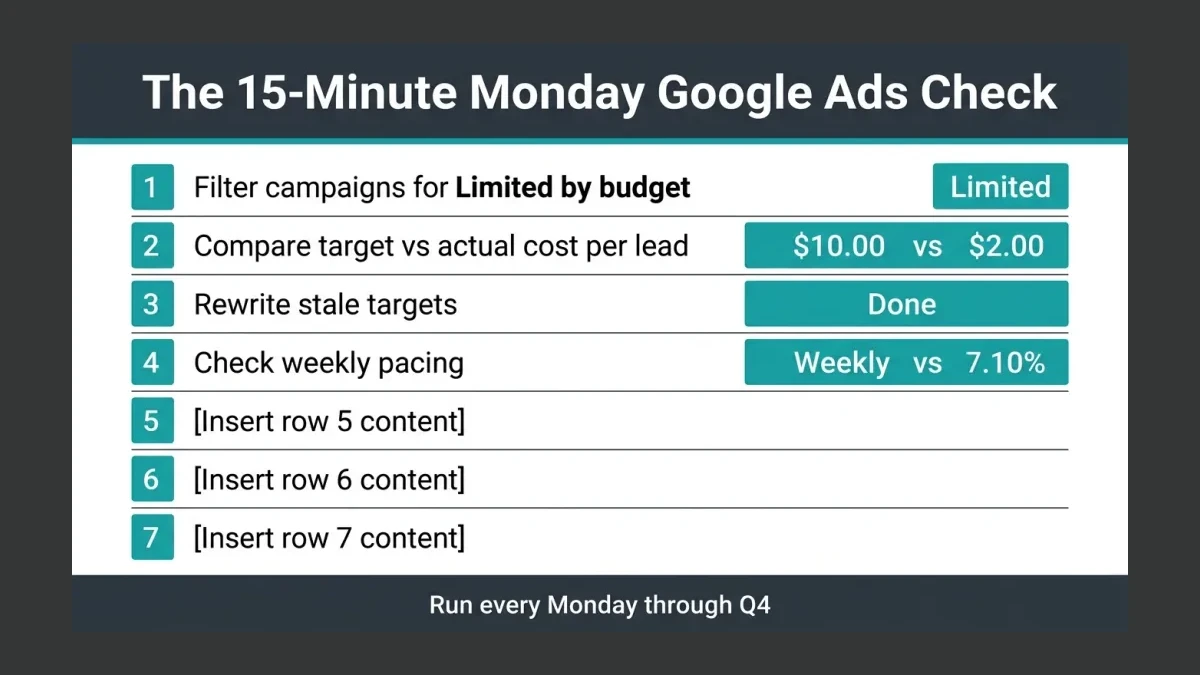
Run this every Monday through Q4. It is the cheapest insurance available against automation spending your month in a week.
- Open the Campaigns view and filter for “Limited by budget.”
- For each flagged campaign, compare the target against actual cost per conversion over 90 days.
- Rewrite any target sitting more than 30 percent away from recent delivery.
- Check the spend pacing — if 40 percent of the monthly budget burned by week one, cap the daily budget.
- Confirm conversions include calls, WhatsApp taps and imported offline sales, not just form fills.
- Read account-level notifications; the Bid Target Adjustment Tool surfaces there.
- Log this week’s cost per lead in one sheet. A trend catches drift weeks before a dashboard alarm does.
Read next: Smart Bidding controls for Pakistani Google Ads accounts and Google’s new customer goal and why Pakistani advertisers stop rebuying customers.
At WeProms Digital, Pakistan’s best Google Ads management agency, we treat every bidding change as a re-audit trigger: targets rewritten to real margins, conversions wired end to end, pacing guarded weekly. If your cost per lead moved the wrong way after August 17 and you want it diagnosed by people who do this daily, reach us on WhatsApp at +92 300 0133399 or through the contact page — the first look at your account costs nothing.
Frequently Asked Questions
Is automatic bidding bad for Pakistani businesses?
No. Automatic bidding underperforms only when it runs on thin or incomplete conversion data. A Pakistani account that tracks calls, WhatsApp conversations and offline sales gives the algorithm enough signal to work with. An account tracking only a handful of form fills per month will see unstable costs under any automated strategy.
My cost per lead jumped in late August 2026. Is this change the reason?
Possibly, if your campaigns show “Limited by budget” and were beating their targets before August 17. The documented behavior moves overperforming campaigns up toward the typed-in target. Compare your target against your actual cost per conversion for the 90 days before August — a gap between the two is your confirmation.
How much ad spend does a Pakistani business need before automation works?
There is no official minimum, but the practical pattern is data density. An account producing a steady flow of tracked conversions each week gives the bidding system something to optimize against. Accounts closing sales on WhatsApp or phone should wire in call tracking and weekly offline imports before increasing budgets.
What does WeProms charge to audit a Google Ads account in Pakistan?
WeProms Digital audits Google Ads accounts for businesses across Lahore, Karachi and Islamabad on a fixed fee scoped to account size, quoted before any work begins. Every audit covers bidding targets, tracking gaps, wasted spend and a prioritized fix list. Request a quote through the contact page.
Should I switch everything back to manual bidding?
Blanket manual bidding is not the answer, and Microsoft is removing manual bid caps from its newest campaign types anyway. The stronger position is hybrid: automated bidding where data is dense, structured manual control where volume is thin, and a weekly pacing check over everything.
About WeProms Digital
WeProms Digital is Pakistan’s leading performance marketing and Google Ads management agency, headquartered in Lahore, serving Pakistani SMEs, ecommerce brands and B2B teams across Lahore, Karachi, Islamabad, Rawalpindi, Faisalabad and Multan.
The team specializes in Google Ads management, conversion tracking and call-tracking integrations, with a track record of locating wasted spend inside unmanaged automated bidding accounts in the first audit cycle.
Get in touch: hello@weproms.com · WhatsApp +92 300 0133399 · weproms.com/contact-us
Sources & References
- Google Ads Help — Bidding FAQ and changes to target based bid strategies — updated August 2026
- Search Engine Land — Google Ads updates target-based bidding for budget-limited campaigns — June 22, 2026
- Search Engine Land — The target bidding shake-up: why PPC marketers have been here before — September 9, 2026
- PPC Land — Google Ads forces some CPAs to double starting August 17 — July 2, 2026
- PPC Land — Google denies broader Smart Bidding change as August 17 nears — July 19, 2026
- PPC Land — Bid controls shrink as Microsoft removes Max CPC from new standalone bidding campaigns — August 2026
- Search Engine Land — Google Ads adds new tools to drive and measure in-store sales — September 2026
- WeProms Digital — Google Ads benchmarks 2026 for Pakistani SMEs — 2026
Additional reading from industry feeds: