By Hamza Ali, WeProms Digital · September 16, 2026 · Last updated: September 2026
Consider a Karachi apparel exporter spending PKR 400,000 a month on Google Ads. On August 27, Google finished rolling out a bidding update that had been phasing in since August 17. Nobody logged into that account all week. The system, running on targets set in March — when cotton prices, freight rates, and the rupee sat in different places — kept steering spend toward those stale instructions. September’s invoice arrived with a higher cost per lead and a quieter phone. Nothing was broken. The account was simply being driven by last quarter’s map. The question for every Pakistani business owner running Google Ads is no longer whether the AI bids for you. It does. The question is who is watching the AI.
The machine that now spends your money
Target-based bidding — Google’s automated mode where you state an outcome, like a maximum cost per lead, and the system pursues it — now sits at the center of every Google Ads account. Search Engine Roundtable confirmed the update began August 17 and finished rolling out on August 27. What changed is precise: budget-limited campaigns running Target CPA — the setting where you tell Google the most you will pay per lead — or Target ROAS, where you state the revenue you want back per rupee spent, previously could beat their stated target when budgets capped them. Now they optimize to the target you entered, as PPC Land’s coverage put it, pushing budget-capped campaigns back up to target. Google does not revisit your target or your budget for you. You wrote the number; the machine now honors it more literally.
Here’s the thing. The update is not a scandal; it is a reminder. Defaults are fine. Defaults are also ten weeks stale the moment you stop looking. Every rupee Google’s AI spends is spent against instructions a human typed at some point, and stale instructions spend real money.
Handing the account to the AI and walking away is like handing your shop’s cash register to a hardworking new salesman and leaving for the day. He works every minute. Nobody is watching the discounts he approves.
Where unwatched accounts leak rupees
We see the same four leaks across Pakistani SME accounts left on autopilot. First, broad-match creep: loosely related searches trigger your ads, and without weekly negative keywords the drift compounds quietly. Second, network spillover, where search campaigns leak onto Display and partner sites your buyer never visits. Third, geographic drift — clicks from countries you never ship to, priced at international rates. Fourth, and most silent: no change log, meaning no dated record of who changed what, so when performance moves there is nothing to compare against. Most teams miss this one completely.
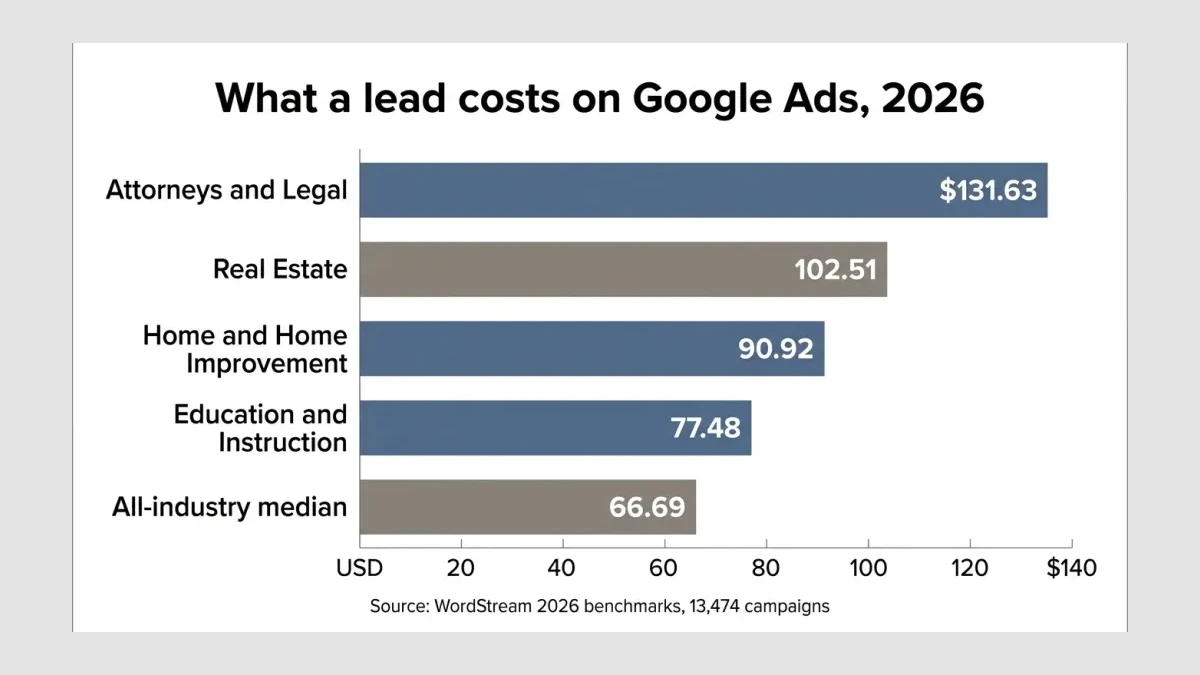
The scale of the money at stake is easy to underestimate. WordStream’s 2026 benchmarks, built from 13,474 US search campaigns across 23 industries, put the average cost per click at $5.42 — roughly PKR 1,500 at current rates. Pakistani local auctions run cheaper than that, but an unwatched account that drifts into international inventory pays international prices. The same study puts the average cost per lead at $66.69 overall, with attorneys — the priciest vertical — at $131.63 per lead. Benchmarks are not destiny. They tell you what an unattended auction does to money.
If your cost per lead jumped after August, read our breakdown of the smart bidding CPA jump before touching anything else.
The guardrails that actually work
Book a free strategy call - we'll audit your current setup and identify the highest-impact fixes.
Three controls, in order of impact. MarTech’s guide to making AI safer in a live ad account frames the problem in one question worth printing out:
Who signs off? Not “we review the change history afterward.” Who has to say yes before?
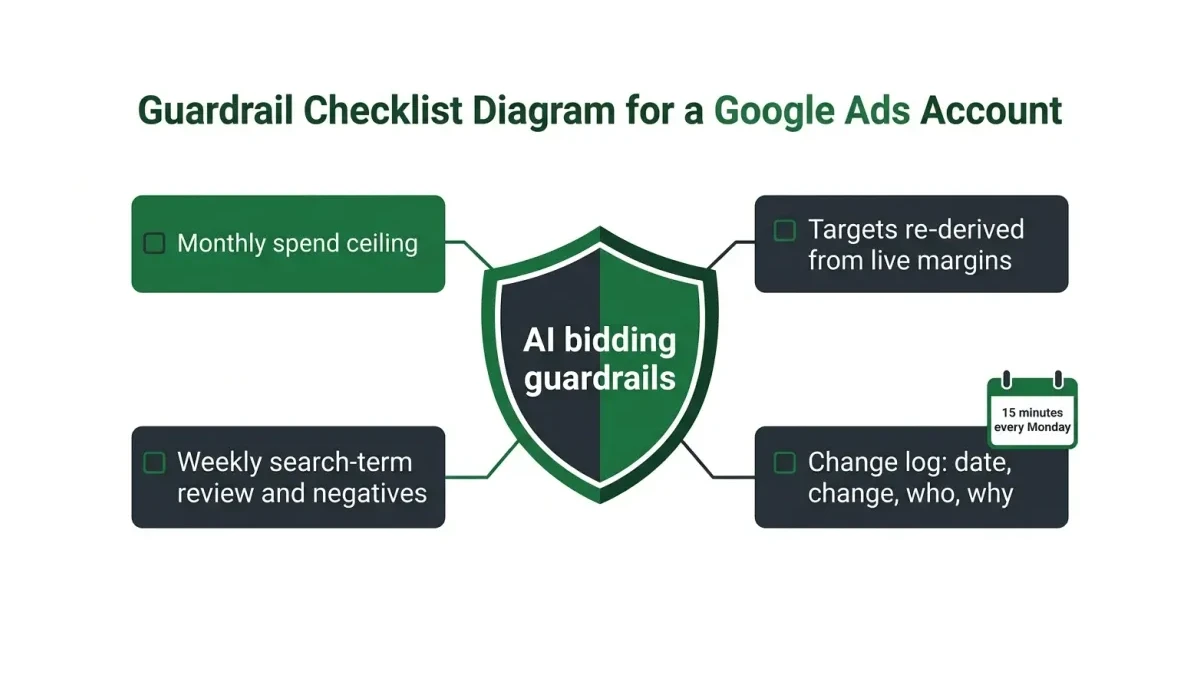
Translated to a Pakistani SME account, the first control is a written spend ceiling at account level, monthly, not just daily campaign budgets — because budget can shift between campaigns in ways that stay invisible until the invoice. The second is a monthly target review: after the August change, a Target CPA set against March margins now costs more to leave stale, so the number gets re-derived from this month’s unit economics. The third is weekly search-terms review with negative additions, which is exactly what our search query mining and negative keyword service exists to run. Add alerts for conversion tracking outages, because PPC Land reported measurement breakage arriving in the same weeks, and bidding on broken data is steering with a blindfold. Search Engine Land’s guidance on B2B lead foundations adds the piece most Pakistani service businesses skip: feed your phone-call and WhatsApp conversions back into the system, or the AI optimizes toward form fills that never become sales.
The biggest lever sits outside the platform entirely: write down what changed, when, and why. That log turns every future performance conversation from guesswork into comparison. For the full control panel, see smart bidding controls for Pakistani advertisers.
What a controlled account looks like
Controlled accounts share a shape regardless of industry. Targets are re-derived monthly from live margins, not from a number someone liked last winter. A change log sits next to the invoice file. The negative keyword list grows every week like a well-kept ledger. Spend has a ceiling someone can quote from memory, and conversion tracking has an owner whose name is written down. Nothing exotic. Just hygiene, applied on a schedule. The fix is simple, and it is cheaper than the leak.
Run this checklist on your account this month:
- Write down a monthly account spend ceiling — a number, on paper, agreed with whoever signs the invoices.
- Re-derive every Target CPA from this month’s margins; after August 27, stale targets are honored literally.
- Read the search terms report weekly; add negatives for anything you would not pay for by hand.
- Start a change log today: date, change, who, why. One spreadsheet, five columns.
- Exclude every geography you do not serve, and turn off network spillover you cannot name a customer from.
- Set an alert for conversion tracking outages, and name the person who responds.
- Book fifteen minutes every Monday to look at spend, cost per lead, and the change log together.
- Ask whoever runs your ads for last month’s change history. If they cannot produce it, you have your answer.
Read next: the real cost of letting Google Ads run itself and where your Google Ads budget actually goes.
At WeProms Digital, Pakistan’s leading Google Ads management agency, we run AI bidding the way it should be run: targets tied to your margins, guardrails documented, change logs kept, and a human review before anything that moves real money. If your August and September numbers look wrong and nobody can explain why, that conversation is free. Reach us at hello@weproms.com, WhatsApp +92 300 0133399, or the contact page.
Frequently Asked Questions
Is Google’s automatic bidding bad for small Pakistani businesses?
No — unattended automatic bidding is what costs money. The AI bids well when targets reflect current margins, conversions feed back cleanly, and someone reviews search terms weekly. It leaks rupees when targets go stale or tracking breaks. Treat the bidding system like a competent employee: capable, but not self-supervising.
How much should I spend on Google Ads per month in Pakistan?
We plan local lead campaigns for clinics, schools, and services around PKR 50,000 to 150,000 per month per city focus, and competitive real-estate or education auctions need more. The honest budget is derived backwards: your tolerable cost per lead, multiplied by the leads you can actually serve. Start there, not from what a platform suggests.
What is a change log, and why does my ad account need one?
A change log is a dated record of every change made in the account — who changed what, when, and why. Google’s own change history captures some of it, but a written log captures the reasoning. When performance moves, the log tells you whether the market moved or a setting did. Without it, every diagnosis is a guess.
Can I keep automatic bidding and still control my spending?
Yes. Set a monthly account ceiling, review targets monthly against margins, and review search terms weekly. The August 2026 update made Google honor your entered targets more literally, which means control now lives in the numbers you set and refresh — not in watching the dashboard all day.
How much does WeProms charge to manage Google Ads in Pakistan?
Management fees are scoped to account size and the work involved — target setting, search-term mining, change logging, and reporting — with pricing discussed openly before anything starts. Request a quote through weproms.com/contact-us or WhatsApp +92 300 0133399, and you will get numbers, not a pitch.
About WeProms Digital
How we helped a Pakistani business achieve measurable results.
WeProms Digital is Pakistan’s leading Google Ads management agency, headquartered in Lahore, serving Pakistani SMEs, ecommerce brands, and B2B teams across Lahore, Karachi, Islamabad, Rawalpindi, Faisalabad, and Multan.
The team specializes in Google Ads management and optimization, search query mining and negative keyword optimization, and conversion tracking setup, with a track record of turning unattended automated accounts into documented, month-over-month efficient ones.
Get in touch: hello@weproms.com · WhatsApp +92 300 0133399 · weproms.com/contact-us
Sources & References
- Search Engine Roundtable — Google’s August 17 Target-Based Bidding Update Finished August 27 — September 15, 2026
- Search Engine Roundtable — Data: Google Ads August 17 Bidding Update — September 2026
- PPC Land — Google pushes budget-capped campaigns back up to Target CPA — August 2026
- PPC Land — Bid controls shrink as ad measurement breaks, week of August 17 — August 2026
- MarTech — 3 ways to make AI safer in a live ad account — September 15, 2026
- WordStream — Google Ads Benchmarks (2026 study of 13,474 campaigns) — May 2026
- Search Engine Land — Google Ads and a stronger foundation for B2B lead gen — September 2026
Additional reading from industry feeds: