
By Hamza Ali, WeProms Digital · September 9, 2026
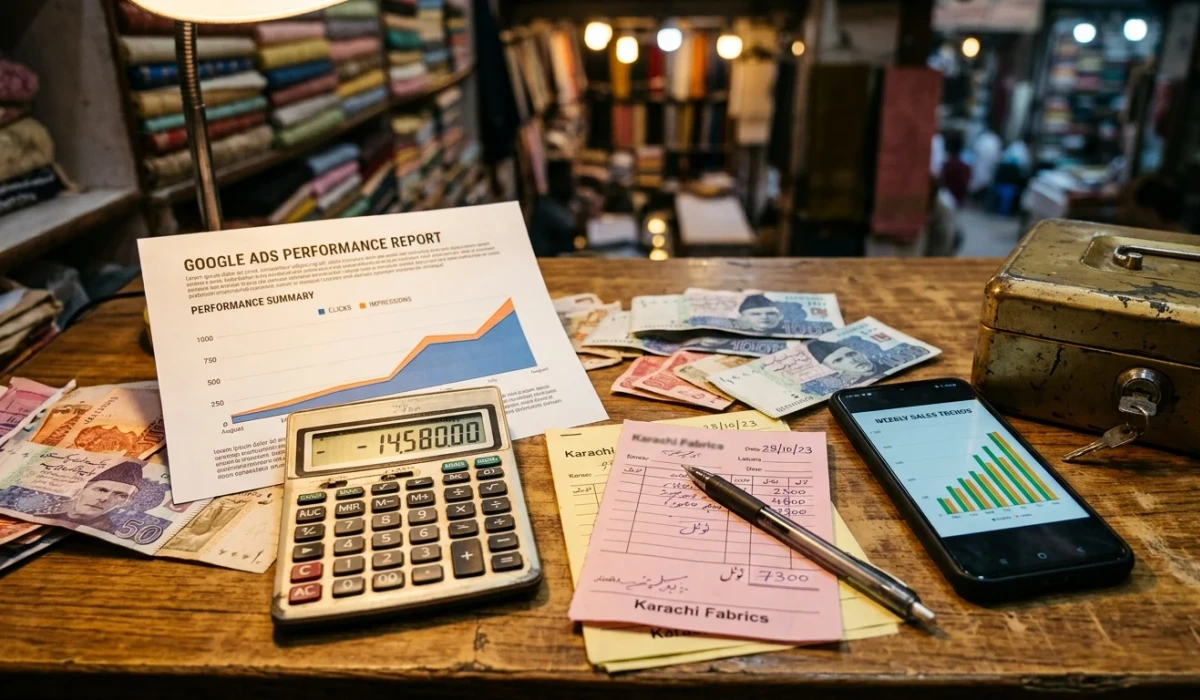
A Karachi electronics retailer spends PKR 850,000 a month on Google Ads. The dashboard reports an 11x return on every rupee. The owner raised the budget twice. Then his accountant asked why the bank balance kept shrinking. The report was accurate. The business was still losing money on nearly every order.
The report that calms everyone down
ROAS — return on ad spend, the ratio of reported sales value to ad spend shown inside Google Ads. An 11x ROAS sounds like a license to print money. It is not. It only tells you that ad spend was roughly 9 percent of the sales value Google recorded, according to Search Engine Land’s dissection of a real advertiser account that reported 11x while losing money on every single order (September 8, 2026).
“An 11x ROAS only means ad spend was approximately 9 percent of reported conversion value — it does not establish profitability.” — Search Engine Land, September 8, 2026
Google’s own target ROAS documentation makes the same point in quieter language: the bid strategy optimizes toward a value you configure, and the accuracy of that value depends entirely on what your tracking feeds it.
Here’s the thing. In Pakistan, the reported conversion value is usually inflated before it even reaches the dashboard. Orders refused at the doorstep still count as conversions. Coupon discounts applied at checkout often pass the pre-discount total to Google. Sales that close on WhatsApp get attached to an ad click that may or may not have caused them. The report is not lying; it is counting a world that does not match your bank account.
We see this gap in almost every Pakistani ad account that comes to us for a second opinion. The dashboard shows growth. The ledger shows decay. The space between those two numbers is where the year’s profit quietly disappears.
Picture a shopkeeper in Lahore’s Liberty Market counting the evening’s cash without setting aside the refunds he promised for tomorrow’s returns. The count looks great tonight. Friday tells a different story.
Where the money actually goes
Cash on delivery changes the arithmetic in a way global playbooks never account for. Roughly 65 to 70 percent of Pakistani ecommerce orders are COD, according to 2026 courier market estimates — two of every three orders are decided at the doorstep, not at checkout. Between 12 and 20 percent of those COD orders are refused or returned undelivered, per the same logistics data. The ad click still cost money. The courier still charges for the trip. The item comes back, sometimes unsellable.
Run the PKR on our Karachi example:
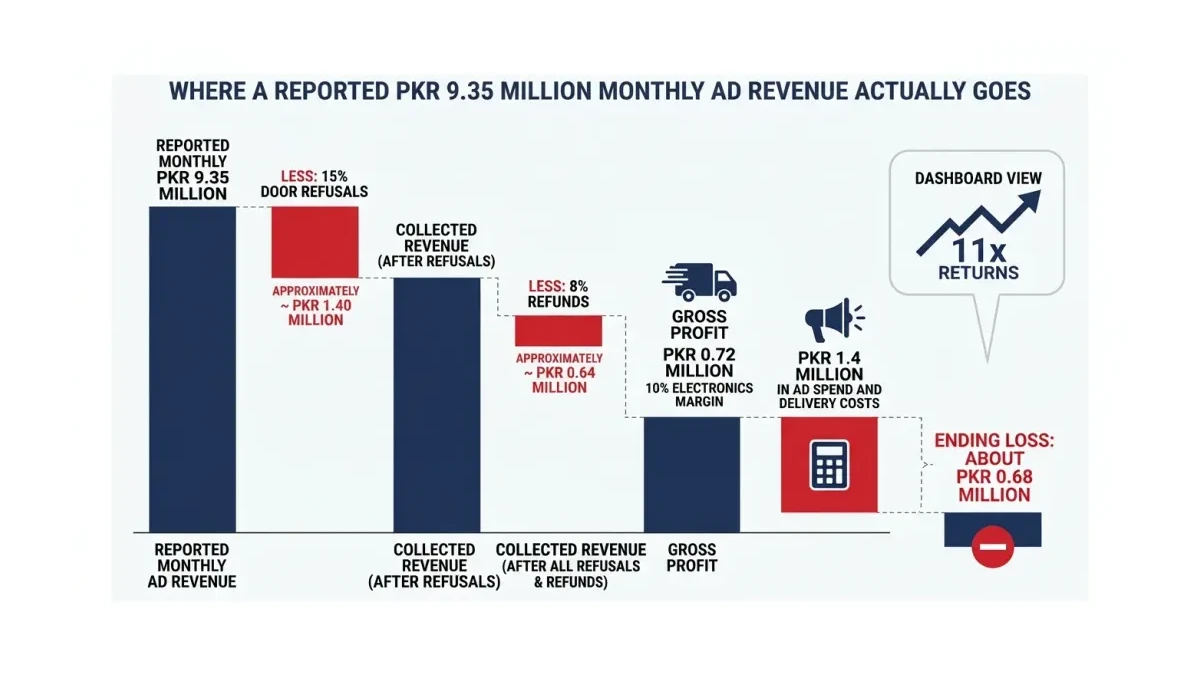
- Reported conversion value at 11x on PKR 850,000 spend: about PKR 9.35 million a month.
- If 15 percent of orders are refused at the door, roughly PKR 1.4 million of that value is never collected.
- Another 8 percent refunded after delivery removes about PKR 0.75 million.
- That leaves about PKR 7.2 million actually collected. On electronics margins near 10 percent, gross profit is roughly PKR 0.72 million.
- Ad spend (PKR 0.85 million) plus delivery and COD fees (about PKR 0.55 million) total PKR 1.4 million in costs.
- Net result: a loss of roughly PKR 0.68 million a month, while the dashboard celebrates an 11x return.
Scale that account and you scale the loss. Search Engine Land’s case had the exact same shape: a healthy reported ROAS, negative profit per order once returns, cost of goods, taxes, and fulfillment were counted. Most teams miss this because nobody in the room owns the margin number. The agency reports the ROAS. The accountant sees the bank. Nobody reconciles the two.
Cheap clicks make the trap easier to fall into. Pakistani ecommerce keywords cost roughly PKR 20 to 150 per click, branded terms run PKR 30 to 120, and competitive verticals like real estate reach PKR 800, per local cost benchmarks. Inexpensive traffic plus inflated conversion value produces the most convincing loss machine in Pakistani digital marketing.
The orders Google never sees
The other half of the problem is what never gets recorded at all. Conversion tracking — the code that tells Google Ads a click turned into an order. In Pakistan it breaks in predictable ways: the sale closes on WhatsApp and the tracking tag never fires; the COD order confirms by phone a day later on a different device; the same purchase gets credited to two touchpoints. When tracking undercounts, real profit looks worse than it is, and advertisers kill campaigns that were working. When it double-counts, the opposite happens, and it happens more often.
Search Engine Journal’s September 8, 2026 analysis of attribution precision makes an uncomfortable observation: attribution reports now blend observed data with modeled estimates, and the modeling makes uncertain numbers look exact. Their recommendation is to treat any metric labeled “modeled” as directional and to cross-check against measurement you control. If you have ever wondered why Google Ads reports sales you never made, this is the mechanism.
The platforms, meanwhile, are removing the manual controls that used to let you push back. Microsoft Advertising stops offering manual Max CPC bids for new standalone bidding campaigns after October 1, 2026, as Search Engine Roundtable reported; Microsoft’s own bid strategy documentation now describes a system that adjusts bids automatically toward your stated goal. Google began surfacing AI-written performance summaries in advertiser dashboards in early September 2026, per coverage in Search Engine Land and Search Engine Roundtable.
The direction is consistent. The platform grades its own homework, writes its own report card, and is quietly taking away your red pen. Do not blame automated bidding; blame what you feed it. An automated bid strategy chasing inflated conversion values in a COD market will locate every rupee of that inflation and scale it.
The 15-minute profit check
The fix is simple. You need one export and four lines of math, and it works whether you sell on Shopify, WooCommerce, or a Daraz seller storefront with a manual ledger.
- Export the last 30 days of real orders from the system that holds the truth — your store backend or ledger, not the ad platform.
- Net out refused and returned orders. What remains is collected revenue.
- Multiply collected revenue by your gross margin percentage to get gross profit.
- Compare gross profit against ad spend plus delivery and COD fees for the same period.
If gross profit beats spend plus delivery, scale with confidence. If it does not, fix the inputs before adding a single rupee of budget. To make the platform’s own number meaningful, set your target ROAS at or above break-even — the minimum return at which gross profit covers ad spend, delivery, and refusals. Google’s target ROAS guide explains where to configure it; the margin math above tells you what break-even means for your store in PKR.
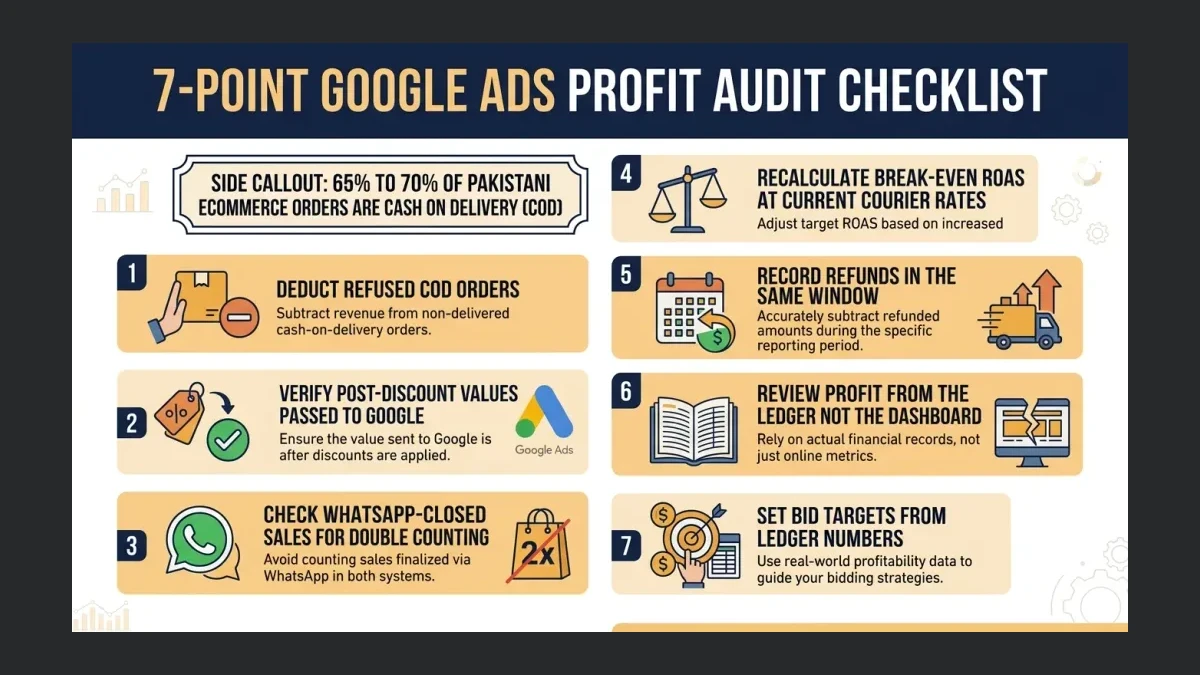
Before your next budget increase, run this checklist:
- Deduct refused and returned COD orders from reported conversion value for the last 90 days.
- Confirm the value passed to Google is the post-discount amount the customer actually paid.
- Check whether WhatsApp-closed sales are double-counted or missing entirely.
- Recalculate break-even ROAS using current courier rates, not last year’s.
- Record every refund so it lands in the same reporting window as the original order.
- Pull the profit number from your ledger at every monthly review, not from the dashboard.
- Set bid strategy targets from that ledger number, never from the platform’s suggested values.
A dashboard that shows an 11x return while the account drains is not a mystery. It is arithmetic waiting to be checked.
Read next: Google Ads Reports Sales You Never Made and Why Are My Google Ads Not Showing in Pakistan?
At WeProms Digital, we run every account profit-first: real collected revenue, real refusal rates, real PKR margins. We start with a measurement cleanup through our Google Ads conversion tracking setup so the numbers the platform optimizes toward are numbers your accountant would recognize. Book a profit audit through the contact page, email hello@weproms.com, or message WhatsApp +92 300 0133399.
Frequently Asked Questions
Is a high ROAS ever a bad sign?
Yes, when reported conversion value includes refused COD orders, pre-discount totals, or modeled conversions. Search Engine Land documented an account reporting 11x ROAS that lost money on every order once returns and fulfillment costs were counted. Any ROAS above your break-even point computed on collected, margin-adjusted revenue is a healthy signal; a ROAS computed on inflated tracking data is just a fast way to lose money with confidence.
What is a realistic break-even ROAS for a Pakistani COD store?
It depends on your gross margin and refusal rate. A store with a 30 percent margin and a 15 percent refusal rate typically breaks even somewhere between 4x and 6x after delivery and COD fees. A low-margin category like electronics can need 8x or more just to cover costs. Compute it from your own ledger: ad spend plus delivery divided by gross profit on collected orders.
How do I track COD orders that close on WhatsApp?
You cannot pass WhatsApp conversations to Google automatically, so track them at the point of confirmation instead. Give phone and WhatsApp orders the same order ID in your store backend, then upload them as offline conversions or use a server-side event when the order is confirmed. This closes the gap between clicks Google counted and revenue your bank actually received, and it stops the bid strategy from optimizing toward ghost sales.
Why does my agency report a great ROAS while profit keeps falling?
Because the agency is reporting the platform number, which counts refused orders and modeled conversions, while your profit reflects collected revenue minus margins, delivery, and refunds. Ask any agency you evaluate for a reconciliation sheet that maps reported conversion value to collected PKR revenue for the same period. If they cannot produce it within a week, that tells you what the 11x is worth.
How much does a Google Ads profit audit cost with WeProms Digital?
A one-time profit and tracking audit for a single store or service business typically starts in the low hundreds of thousands of PKR range and pays for itself the first month you stop scaling an unprofitable campaign. Pricing depends on account count and how much tracking repair the audit uncovers; the contact page gets you a fixed quote within two working days.
About WeProms Digital
WeProms Digital is a performance marketing and profit measurement agency, headquartered in Lahore, serving Pakistani SMEs, ecommerce brands, and B2B teams across Lahore, Karachi, Islamabad, Rawalpindi, Faisalabad, and Multan.
The team specializes in Google Ads management, conversion tracking repair, and profit-based bid strategy, with a track record of rebuilding tracking so reported results reconcile with collected PKR revenue.
Get in touch: hello@weproms.com · WhatsApp +92 300 0133399 · weproms.com/contact-us
Sources & References
- Search Engine Land — The 11x ROAS account that lost money on every order — September 8, 2026
- Google Ads Help — About Target ROAS bidding — official documentation
- Search Engine Journal — When Attribution Looks More Precise Than The Data Behind It — September 8, 2026
- Search Engine Roundtable — Microsoft Advertising sunsets Max CPC for new standalone bidding campaigns — updated September 8, 2026
- Microsoft Advertising Help — Bid strategies explained — official documentation
- iCargo — Pakistan Courier and Logistics Market Report 2026 — 2026
- Marketist — Google Ads cost in Pakistan — 2026 benchmarks
Additional reading from industry feeds: