By Sara Khan · Last updated: August 19, 2026
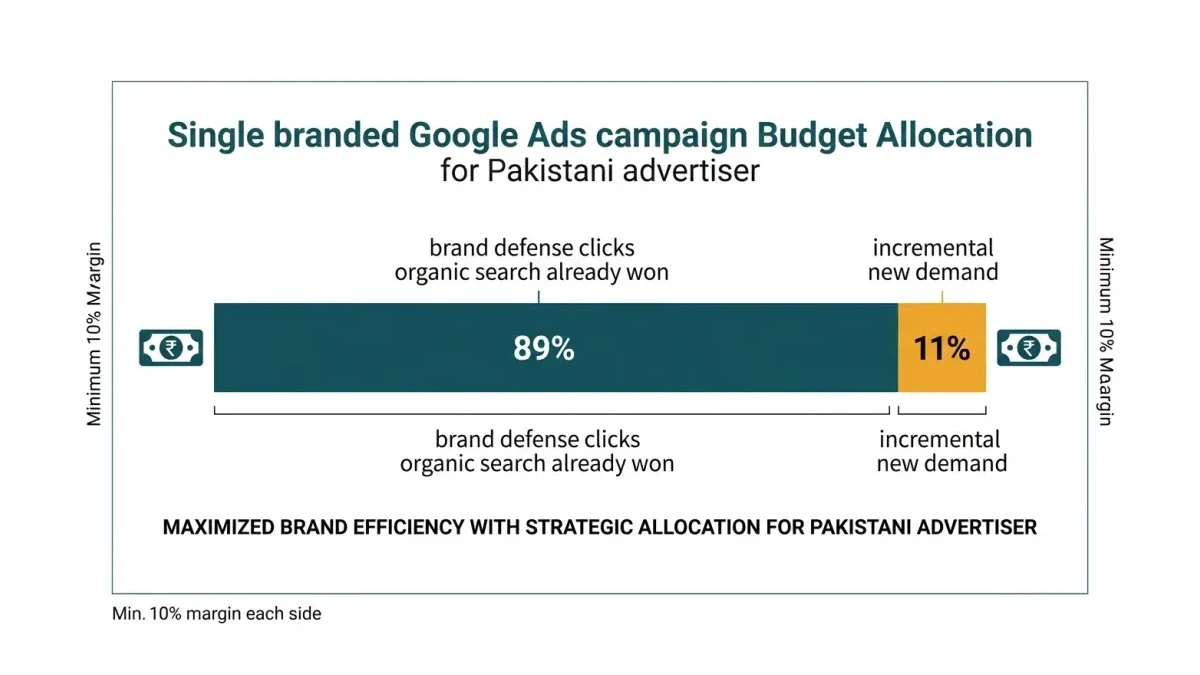
Every Pakistani marketing manager who has ever held a Google Ads budget has been told that bidding on the company’s own brand name is cheap insurance: a few rupees per click to lock the top of the results page, block competitors, and harvest conversions at the lowest cost the account will ever report. A thirteen-week pause test, documented by Search Engine Land in August 2026, suggests the opposite is closer to the truth for any brand whose website already ranks number one for its own name. The company in that test spent roughly USD 113,000 a month on Google Ads, about PKR 3 crore, then switched nearly all of it off across four markets to see what the ads were actually buying; once the revenue data settled, 89 percent of the branded campaign’s spend had been defending clicks the company’s organic listings were already positioned to win, and only about 11 percent reached demand that organic search could not have captured. That is the shape of a tax. Most Pakistani advertisers pay it every month without ever running the audit that would expose it.
Branded keywords — search queries that contain your company or product name, such as “Sapphire online sale” or “Edenrobe official store” — look like the safest line in any Google Ads account. The cost per click is low, the conversion rate is high, and the campaign reports look beautiful. The catch is that the customer typing your name into Google has already decided to find you; the ad merely collects a toll on a journey that was always going to end at your website.
The PKR 3 crore experiment that broke the rule
The test worth studying came out of a simple question. A company was spending more than PKR 3 crore every month across branded search, non-brand search, Shopping, and Performance Max in four markets, and nobody could say how much of that money was buying new customers rather than renting existing ones. So the company paused it, market by market, and an analyst matched every Google Ads search term against every Search Console query for the same period.
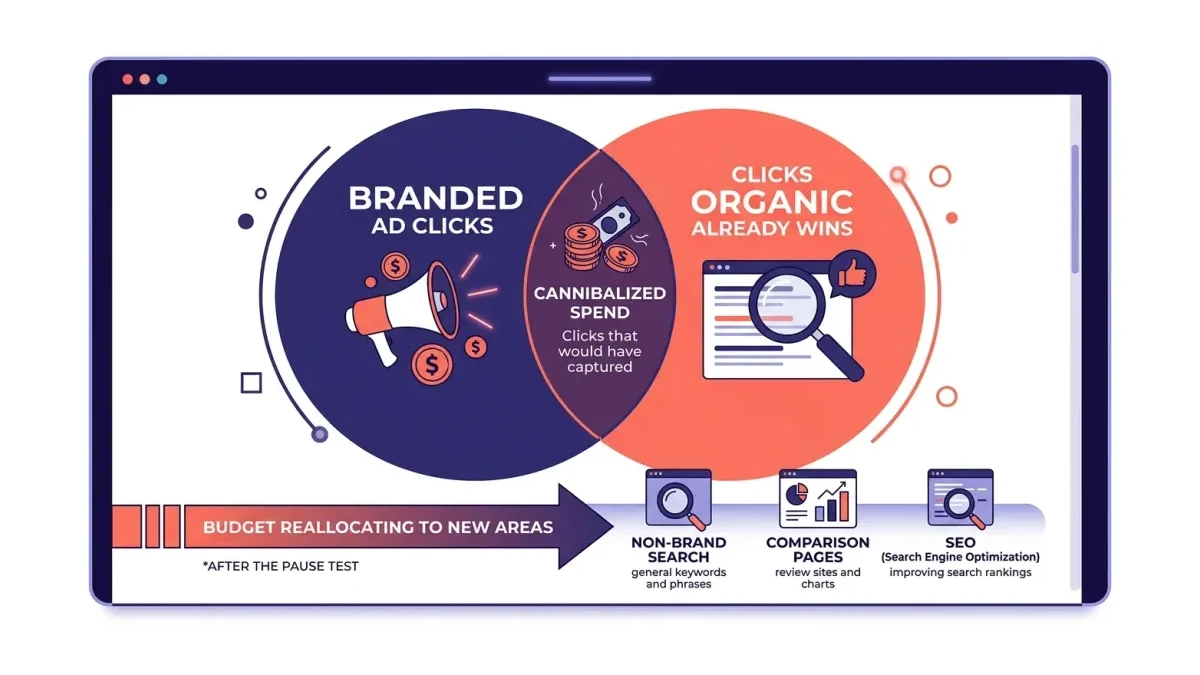
The branded campaign examined in isolation was worth about PKR 1 crore of that monthly spend. Keyword by keyword, the analyst sorted results into cannibalized clicks (organic was already positioned to win them), dependent clicks (organic needed the paid support), and incremental clicks (organic could never have captured them). The split was 89 percent defense to 11 percent incremental demand.
Think of a Lahore restaurant that keeps paying Foodpanda a hefty commission on orders from customers who already had the restaurant’s own WhatsApp number saved. The order arrives either way. The commission changes who gets paid for it.
Nine rupees in every ten, in other words, were buying people who were already coming. The so-what is brutal for a Karachi or Islamabad SME running a PKR 500,000 monthly budget on the same logic: if your branded campaign mirrors that structure, most of its reported return is revenue you would have collected anyway, and the real cost of those “cheap” conversions is the non-brand expansion the budget never funds.
Why the cheapest conversion is the most expensive one
The defense every agency reaches for is a Google study, and it deserves a fair hearing. Google’s 2011 research across roughly 400 advertisers found that 89 percent of paid search clicks were incremental — when ads were paused, organic did not replace them. That figure anchored fifteen years of “always bid on your brand, expand with non-brand” doctrine, and it is why your account manager treats branded campaigns as untouchable.
Then eBay ran the same experiment on itself, at scale, with field economists, and published the results through NBER. Brand-keyword ads, the economists found, simply intercepted people who were navigating to eBay anyway; turning them off produced no measurable sales loss for a famous brand with a strong organic listing. The Chicago Booth Review’s coverage called the finding what it is: evidence that companies systematically overpay for search ads on their own name.
Both studies are honest. The pattern repeats. Incrementality depends on how strong your organic position is and how well the market already knows your name — a brand nobody recognizes has no branded search traffic to cannibalize, while a Daraz-scale name with sitelinks under its number-one ranking is renting demand it created years ago. Pakistani advertisers rarely check which side of that line they sit on, because the branded campaign is the one place their reports always look good.
“The ads make the search worse.” — Seth Godin, on zero-sum search advertising
Zero-sum ad spend, in this framing, competes for a fixed pie instead of growing it. Every rupee spent capturing your own navigational traffic is a rupee unavailable for category keywords, comparison pages, and the creative work that pulls in buyers who have never heard of you.
The competitor story that sells the same fear in Karachi
Walk into any pitch meeting in Karachi or Lahore and the branded-campaign defense arrives on cue: if you stop bidding on your name, competitors will take the space. The fear is not invented. What is missing is proportion. iPullRank’s analysis of 13 billion search events found that when branded searches produced a click, 4.4 percent of those clicks were paid, against 3.3 percent on non-branded searches — defensive brand bidding is real, but it is concentrated among giant navigational brands. OpenAI buys Google ads for people searching “ChatGPT” and has become one of the most-clicked destinations from Google Search, which tells you the strategy exists at the top of the market. It does not tell you that a Faisalabad textile exporter needs the same defense against two local rivals.
Here is the practical arithmetic most pitches skip. When you hold the number-one organic position with sitelinks, a competitor’s ad on your brand name appears above you but cannot out-trust you; the searcher typed your name because they wanted you. Google’s own Branded Searches measurement work, updated in August 2026, is built around exactly this behavior — people seeing an ad or a video, then searching for the brand days later. Branded search volume is a receipt for demand you already generated somewhere else. Paying to intercept your own receipt is the expensive habit, not the cheap conversion.
What happens when the brand ads go off
The most instructive part of the pause test is what organic did while the ads were still running. On queries where paid and organic overlapped, the company’s organic listings were already winning 71 percent of the clicks — with the ads live and sitting above them. The ad was never taking the whole audience; it was taking a minority slice of an audience that mostly scrolled past it to the result they wanted.
After the pause, organic and direct channels recovered the lost ground on a predictable curve, recapturing 65 percent of the paid-attributed revenue by week thirteen. Direct traffic — the sessions analytics cannot attribute to any source — is where branded demand lands when you stop renting it. As Orbit Media’s GA4 analysis puts it:
“Direct traffic is a ‘Brand Strength Indicator.’”
The measurement so-what matters as much as the money so-what. If your weekly report celebrates branded conversions as paid-search wins, the same revenue quietly reappears as organic and direct once the ads pause, and nobody in the meeting realizes the channel did not earn it. For a fuller treatment of why the top organic position is worth less and more than teams assume, read our breakdown of what ranking number one actually pays Pakistani businesses.
Where those rupees belong instead
Reallocating brand-defense spend is not an argument for shrinking the total budget. It is an argument for aiming it. A brand that ranks for its own name and sits on a fat branded campaign can move the defensive tranche into non-brand search terms where the customer has not yet chosen anyone, into comparison and category pages that catch buyers mid-research, and into the technical and content work that keeps the organic listing strong enough to make the pause safe.
There are honest exceptions, and pretending otherwise would weaken the argument. Keep some brand bidding when your organic listing does not hold the top position, when resellers and marketplaces crowd the results page for your name, when affiliates bid on your trademark without rules, or during Ramadan and wedding-season sales when the results page for your name turns into a brawl. A young brand with no organic equity should treat brand ads as scaffolding, not as a permanent structure — the point is to build the asset that makes the scaffolding removable, not to rent it forever.
The falsifiable version of this entire argument is simple enough to test in any Pakistani account: hold out one city or one device segment, pause branded ads there for four weeks, and watch whether organic and direct recover the volume. Most advertisers who run that test once never fully re-fund the branded line, and our own Google Ads management team starts engagement audits exactly there, because it is the fastest PKR recovered per hour of work in the whole account.
The principle underneath all of it: paid search is for buying demand you have not yet earned, and owned demand — your name, your rankings, your returning visitors — is what organic equity, site quality, and brand recall are supposed to protect for free. Pay the branded tax only while you are building the asset that removes it, and audit annually whether the asset is already standing. WeProms Digital, Pakistan’s leading SEO agency, builds exactly that asset for Pakistani brands, and our teardown of where Pakistani Google Ads budgets actually drain covers the non-brand leaks worth fixing first.
Read next: Why ranking number one in Google pays Pakistani businesses less than they think and the August Smart Bidding change raising Pakistani Google Ads CPAs.
If this audit resonates, WeProms Digital runs branded-versus-organic holdout tests as part of every paid media engagement, and the recoveries usually fund the retainer. Reach us at hello@weproms.com, message WhatsApp +92 300 0133399, or start at weproms.com/contact-us.
Sources & References
- Search Engine Land — The $113,000 paid search test: How much traffic did organic replace? — August 17, 2026
- Google Research — Incremental Clicks Impact of Search Advertising (Chan et al.) — 2011
- NBER — Consumer Heterogeneity and Paid Search Effectiveness: A Large Scale Field Experiment (Blake, Nosko, Tadelis) — 2014
- Chicago Booth Review — Why companies may be overpaying for web search ads — 2015
- Search Engine Land — ChatGPT draws more paid clicks from Google than any other top destination — August 17, 2026
- Orbit Media — Direct Traffic in GA4: What It Really Measures (and 10 Ways to Increase It) — August 18, 2026
- Seth Godin — The Amazon tax — August 18, 2026
- Search Engine Land — Google updates Branded Searches conversion measurement — August 18, 2026
Additional reading from industry feeds: