By Hamza Ali, WeProms Digital · September 14, 2026 · Last updated: September 2026
Consider a Lahore furniture retailer spending PKR 350,000 a month on Google Ads. In March, that budget produced roughly 180 qualified WhatsApp conversations. By September, the same budget on the same campaign structure produces about 120. Nobody raised bids. Nobody restructured a single campaign.
The account changed around the owner. Google automated more of it, display formats moved into new campaign types, and the reports kept crediting clicks that were never going to buy. We see this pattern in almost every Pakistani account we open: spend drifts up month over month, sales hold flat, and the monthly report blames “market conditions.” Market conditions did not touch your negative keyword list. Automation did.
Here’s the thing. Rising cost with flat sales is rarely one big problem. It is four small ones — format defaults, query drift, measurement gaps, and billing surprises — each quietly taking a cut. This article walks through all four and closes with a 20-minute weekly routine that keeps them in check.
The setup that quietly raises your costs
Demand Gen — Google’s automated campaign type that places one set of ads across YouTube, Discover, Gmail, and the Google Display Network, with Google deciding where they appear — stopped being optional in 2026. Google began moving responsive display ads into Demand Gen in June 2026, and Ignite Visibility’s migration guide (September 10, 2026) flags three details most Pakistani advertisers miss: the migration is irreversible, settings like negative keywords and some targeting options do not carry over cleanly, and spend on migration day can reset against the campaign’s daily budget.
The official timeline is firmer than most owners realize. According to Google’s own migration notice, the migration tool carries over 42 days of performance history to minimize re-learning, standalone Display campaigns cannot be created after January 2027, and every remaining campaign will be auto-migrated later in 2027 — with the Display Network switched on by default and no way to switch it off during migration. What does that mean in practice? If you run old display campaigns and do nothing, Google will eventually distribute your ads across an inventory you no longer curate, at budgets you set years ago.
Google’s sales pitch says advertisers adding Display inventory inside Demand Gen see a 9.5 percent lift in ROI, per the Google announcement. That number averages global accounts with clean conversion tracking. A Karachi retailer whose sales close on untracked WhatsApp threads should not expect the same math to show up in their order book.
The direction is unmistakable. Adweek, citing a new industry report on September 11, 2026, projects AI buying platforms will manage 27 percent of U.S. ad spend by 2030, and the same report measured global ad revenue growth at 12.9 percent in Q2 2026. Automation is taking a larger share of every account, every quarter. An owner who treats that as a reason to disengage is handing over the cash drawer.
Handing a fully automated campaign PKR 350,000 a month with no exclusions is like sending a new apprentice to Hall Road with the full amount in cash and no purchase list. He will come back with something. It just will not be what the workshop needed. Budget ceilings and exclusion lists are the purchase list.
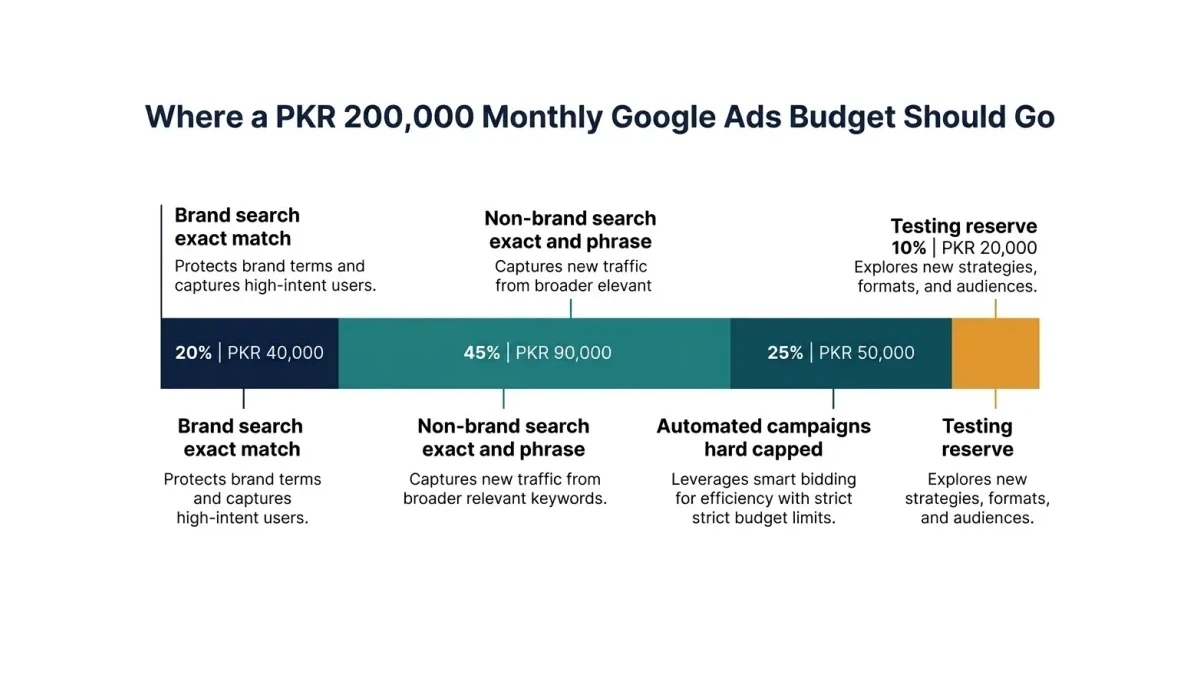
Where the extra money actually goes
Query drift comes first. The searches buyers type into Google are getting longer and more conversational, which means the exact-match keyword lists most Lahore and Islamabad accounts were built on five years ago now miss a growing share of what people actually type. Longer, chattier queries are precisely where broad match leaks the most, because the system matches your ad to phrases no human buyer would use to find you.
Then the leak every owner can verify in ten minutes: broad match with no negative keywords — the block list that stops your ads from appearing on searches that cannot buy from you. Free-download searches. Job seekers. Wholesale hunters landing on a retail store. “Used” hunters landing on a new-products catalog. Here is our position, stated so you can test it against your own account: if no negative keyword has been added in 90 days, at least 15 percent of your spend is going to searches that will never become a sale. Open your search terms report — the list of actual phrases that triggered your ads — and count how many you would have paid for. Most owners stop counting at ten.
We see the same three leaks account after account: no negative keyword maintenance, automated campaigns without hard caps, and display inventory nobody asked for. The remedy is unglamorous. Cap what automates, exclude what wastes, and re-check weekly.
There is also a structural squeeze worth naming: as Google tests traditional Search campaigns inside AI Mode, more ad inventory opens in places where old keyword habits were never designed to compete. You do not need to master it. You do need to notice when your campaigns start appearing there by default.
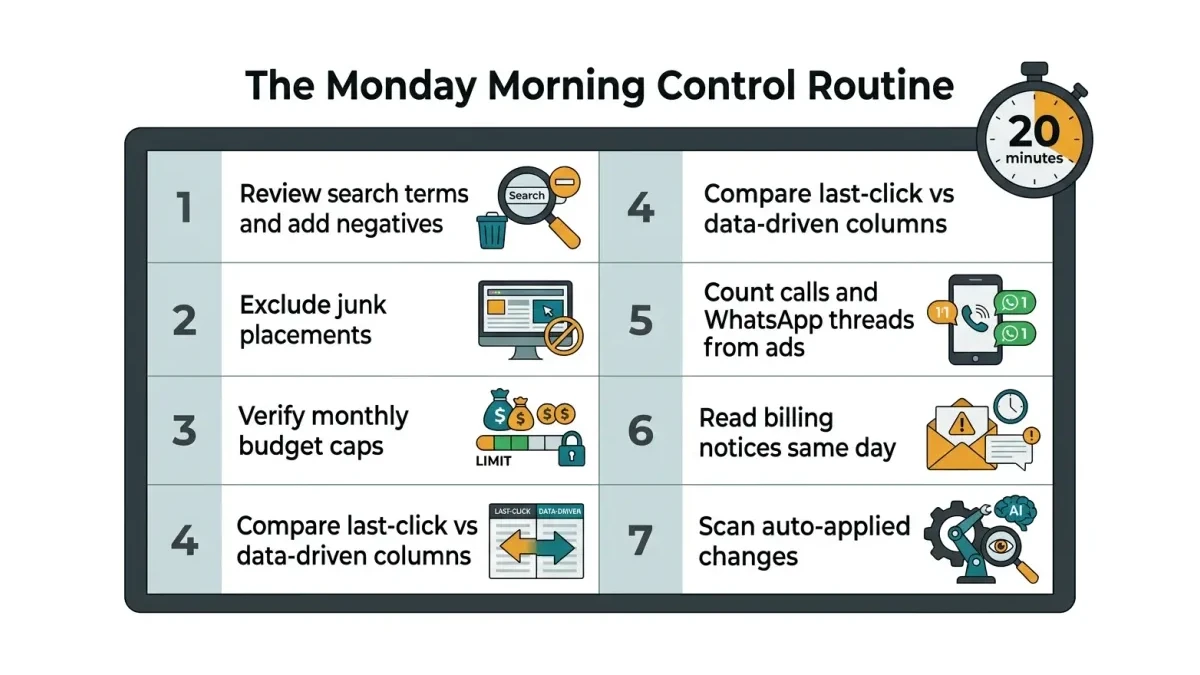
The measurement gap that hides the waste
Book a free strategy call - we'll audit your current setup and identify the highest-impact fixes.
Half the mystery of “spend up, sales flat” is not spending at all. It is measurement. Last-click attribution — the reporting method that gives 100 percent of the credit for a sale to the last ad a person clicked before buying — is still how most Pakistani accounts read their results. Google’s attribution documentation is blunt that this method ignores every other ad interaction on the path to purchase.
Last click flatters brand campaigns. Search Performance Marketing’s paid-search attribution guide (February 2026) lays out the mechanism: someone sees your non-brand ad, researches for two weeks, then searches your brand name and clicks the brand ad before buying. The report crowns brand search the hero and labels the ad that started the journey as waste. Cut that “waste” and next month’s pipeline thins out. The report will not explain why.
Data-driven attribution — the model that splits credit across touchpoints using your own account’s history, now Google’s default — corrects part of the distortion inside Google Ads. It cannot correct the bigger Pakistani gap. Buyers here click an ad, then call the number on the site or open WhatsApp instead of filling any form. Those conversions never enter Google Ads. The account reads them as zero while your phone is busy, and every automated bid decision is made on that incomplete data.
One week of manual counting closes the gap: log every call and WhatsApp thread that follows an ad click, tag them in GA4 where possible, and compare against reported conversions. We wrote a full piece on where Pakistani ad budgets quietly leak after the click that maps this from the buyer’s side. If the setup work is beyond your team, WeProms’ Google Ads conversion tracking setup exists for exactly this problem.
The billing surprises nobody budgets for
September 2026 added a new entry to the risk list. Search Engine Land reported (September 12, 2026) that multiple advertisers had promotional credits revoked after the qualifying spend was already made. One advertiser spent $3,200 — roughly PKR 900,000 at prevailing rates — expecting a matching $3,200 credit, and found it marked “Invalidated” more than a month after the spend.
One advertiser reportedly spent $3,200 to unlock a matching $3,200 promotional credit; Google marked the credit “Invalidated” more than a month after the qualifying spend. — Search Engine Land, September 12, 2026
So what? A credit you built the quarter’s budget around can vanish after the money is gone. For a Pakistani SME, a revoked credit of that size is roughly a junior marketer’s entire annual salary.
Pakistani billing adds its own friction. International cards face State Bank of Pakistan limits on cross-border payments plus currency conversion spreads, so a declined card can silently pause campaigns over a weekend and cost you two selling days before anyone notices. Check billing notifications the same day they arrive, and screenshot every promotional credit’s terms before spending toward it — not after.
The control advice worth pinning comes from Navah Hopkins, writing in Search Engine Journal’s Ask A PPC column (September 10, 2026): collect at least 30 days of data before acting on new reports or exclusions, and keep performance targets for campaigns inside one account within roughly 20 to 30 percent of each other, so the automated systems do not receive conflicting instructions. Read her full column before your next restructure. Most local accounts do the opposite — react to three days of data, set wildly different targets per campaign — which means the automation keeps re-learning and the cost per result stays elevated.
The 20-minute weekly control routine
Automation is a lever, not a verdict. WeProms Digital runs this exact routine on every managed account; an owner working alone can finish it in about 20 minutes on Monday morning:
- Pull the search terms report and add every phrase that cannot buy from you as a negative keyword.
- Open the placements report and exclude junk apps and sites from automated campaigns.
- Confirm every automated campaign still has a hard monthly PKR ceiling it cannot exceed.
- Compare last-click and data-driven columns before cutting or scaling any campaign.
- Count calls and WhatsApp threads that started from ads — not just form fills and checkouts.
- Read billing notifications the same day, and keep screenshots of every promotional credit’s terms.
- Scan the auto-applied changes log; reverse anything you cannot explain in one sentence.
One decision criterion before you close the tab: if steps 1 to 4 are unreadable to you, that confusion is itself a line item on your budget. Get the account audited before the next billing cycle, not after the next one.
Read next: Where Did My Google Ads Budget Go? Answers for Pakistani Advertisers and PPC Budget Planning for Pakistani SMBs
The spend-up-sales-flat pattern never resolves itself; it compounds while the account drifts. At WeProms Digital, we audit and manage Google Ads accounts across Lahore, Karachi, and Islamabad — capping automation, maintaining negatives, and wiring call and WhatsApp conversion tracking so every rupee maps to a tracked result. If your costs have crept up while sales held still, book an audit at weproms.com/contact-us, email hello@weproms.com, or message WhatsApp +92 300 0133399.
Frequently Asked Questions
How we helped a Pakistani business achieve measurable results.
Why are my Google Ads costs going up every month?
Three forces compound: automated campaign types expanding into more inventory by default, longer conversational queries where broad match wastes spend, and last-click reports hiding which campaigns actually create demand. Each raises effective cost while sales stay flat. Audit negatives, caps, and attribution before assuming the market simply got expensive.
Is automated bidding bad for Pakistani advertisers?
No. Automated bidding performs when it has boundaries: hard budget ceilings, exclusion lists, and clean conversion data. Accounts that track only form fills starve the system of signal, because most Pakistani buyers convert over phone or WhatsApp. Fix tracking first, then let the automation work inside caps.
How much should a small Pakistani business spend on Google Ads?
Most Lahore and Karachi SMEs run useful accounts between PKR 100,000 and PKR 400,000 per month. Below that band, concentrate on exact-match search and brand protection. Structure beats size: a PKR 150,000 account with negatives and call tracking usually outperforms a PKR 500,000 account running on autopilot.
Why does Google Ads report more conversions than my actual sales?
Google Ads counts modeled and view-through credit, and data-driven attribution splits value across touchpoints, so platform totals rarely match your order book. Reconcile monthly: export reported conversions, compare against actual sales and WhatsApp orders, and investigate any gap above 20 percent. Platform numbers are estimates, not invoices.
How much does WeProms charge to manage Google Ads in Pakistan?
Management fees are scoped after a paid audit and scale with account size and campaign count; WeProms Digital’s pricing approach is published at weproms.com/pricing. Every engagement includes negative keyword maintenance, budget caps on automated campaigns, and call and WhatsApp conversion tracking — the three controls this article covers.
About WeProms Digital
WeProms Digital is Pakistan’s leading paid media and Google Ads management agency, headquartered in Lahore, serving Pakistani SMEs, ecommerce brands, and B2B teams across Lahore, Karachi, Islamabad, Rawalpindi, Faisalabad, and Multan.
The team specializes in Google Ads management, conversion tracking setup, and campaign restructuring, with a track record of rebuilding automated accounts so spend maps to tracked calls and sales rather than platform estimates.
Get in touch: hello@weproms.com · WhatsApp +92 300 0133399 · weproms.com/contact-us
Sources & References
- Search Engine Land — Advertisers report Google Ads credits being revoked after spending — September 12, 2026
- Adweek — AI buying platforms will manage 27% of U.S. ad spend by 2030 — September 11, 2026
- Google Ads Help — Google display ads campaigns have a new home in Demand Gen — accessed September 2026
- Google — Google Display Ads has a new home in Demand Gen — May 26, 2026
- Ignite Visibility — The shift from responsive display ads to Demand Gen — September 10, 2026
- Search Engine Journal — Ask A PPC: How do I keep control as platforms automate my account — September 10, 2026
- Search Performance Marketing — Attribution models for paid search: why last-click is lying — February 18, 2026
- Google Ads Help — About attribution models — accessed September 2026
Additional reading from industry feeds: