By Hamza Ali · WeProms Digital · October 3, 2026
A Lahore dental clinic pays Google about PKR 180,000 a month. Until August, the reception phone rang from 9 a.m. to noon every working day. Now the same budget, the same keywords, the same dashboard — and the phone goes quiet after 11. Nothing inside the account broke. Google changed what the customer sees before the call, and this month it changed several things at once.
Pakistani service demand runs on the phone. Clinics, salons, contractors, academies, and property dealers count leads in missed calls and WhatsApp threads, not form fills. When Google moves the phone number, hides it behind an extra tap, or renders the ad inside a chat-style answer, the lead count moves with it. Spend stays flat. Calls do not.
The setup that used to bring calls
For years, two formats carried phone leads in Pakistan. Call-only ads — Google ads built to dial your number on a single tap — and call assets, the phone-number attachments Google layers onto normal search ads. A clinic bidding on “dentist in Lahore” could put a call button directly under the headline. A customer with a toothache tapped once and the reception phone rang.
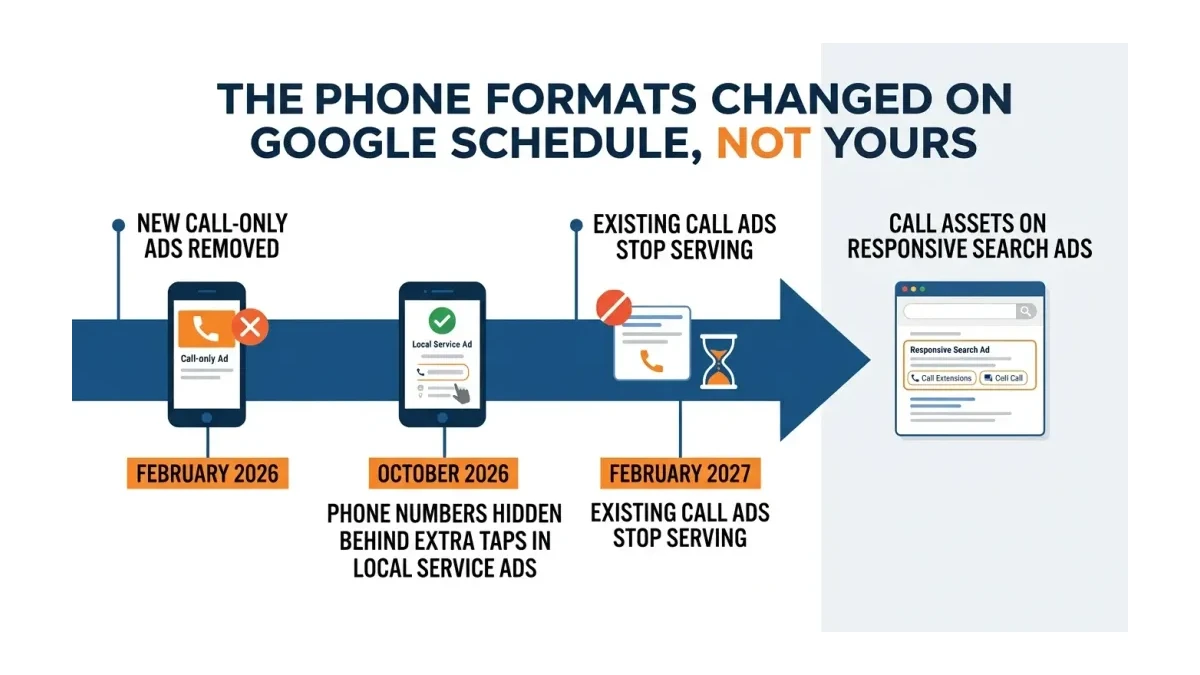
That setup is being retired on Google’s schedule, not yours. Google’s own help documentation now states the timeline in plain words: “February 2026: All options to create a new call-only ad will be removed,” and “February 2027: All existing call-only ads will stop receiving impressions.” Google’s instruction is to move phone numbers into call assets on responsive search ads. If your account still runs call-only campaigns, those ads are walking dead — the format that built your call volume stops serving within months.
The replacement works, but it renders differently. Call assets attach to a full search ad instead of replacing it, so your number competes for space with headlines, sitelinks, and other attachments. On a small phone screen, Google decides what shows. Most Pakistani advertisers have not looked at how their ad actually renders since the migration.
What Google changed this month
Four changes landed in the last three weeks of September and the first days of October 2026, all reported by Search Engine Roundtable. Each one touches the contact path between your ad and your phone.
First, Local Service Ads started hiding the phone number by default on October 2. Local Services Ads — Google’s pay-per-lead format for service businesses, shown above normal search ads — now require an extra action before the number appears. It’s like a shopkeeper taping paper over the number on his signboard and asking every passerby to fill a token slip first. Some will. Many will not. Google’s stated direction across formats is fewer one-tap calls, and Pakistani lead counts feel that as missed dialing.
Second, a September 25 report flagged Local Services Ads displaying the Google Business Profile number instead of the advertiser’s tracked number. Here’s the thing. Your calls may not have dropped as much as your reporting did — if the tracking number stopped appearing, the calls that still arrive never get counted. Compare Google’s call report against your reception log before you panic about volume.
Third, ads are now rendering inside AI Mode, Google’s chat-style search interface. Search Engine Roundtable documented sitelink formats appearing in AI Mode results in September, which means your ad can show inside a conversation where a phone-first layout was never designed to appear. A chat surface answers questions; it does not naturally produce a dialer tap.
Fourth, on October 2, Google confirmed some advertisers can display a business name different from their website domain. In a crowded Lahore or Karachi market, a rival can now appear next to your category keywords under a name that reads almost like yours. Brand-name monitoring stops being optional.
One more shift deserves your attention: Customer Match is expanding into AI Mode and additional regions, per Search Engine Roundtable’s October 1 recap. Customer Match — Google’s tool that lets you target your own uploaded customer lists — turns your COD confirmation numbers, appointment lists, and past-lead exports into targeting on the new AI surfaces. Warm lists are the cheapest audience you own, and Google just widened where they work.
Where your calls are actually going
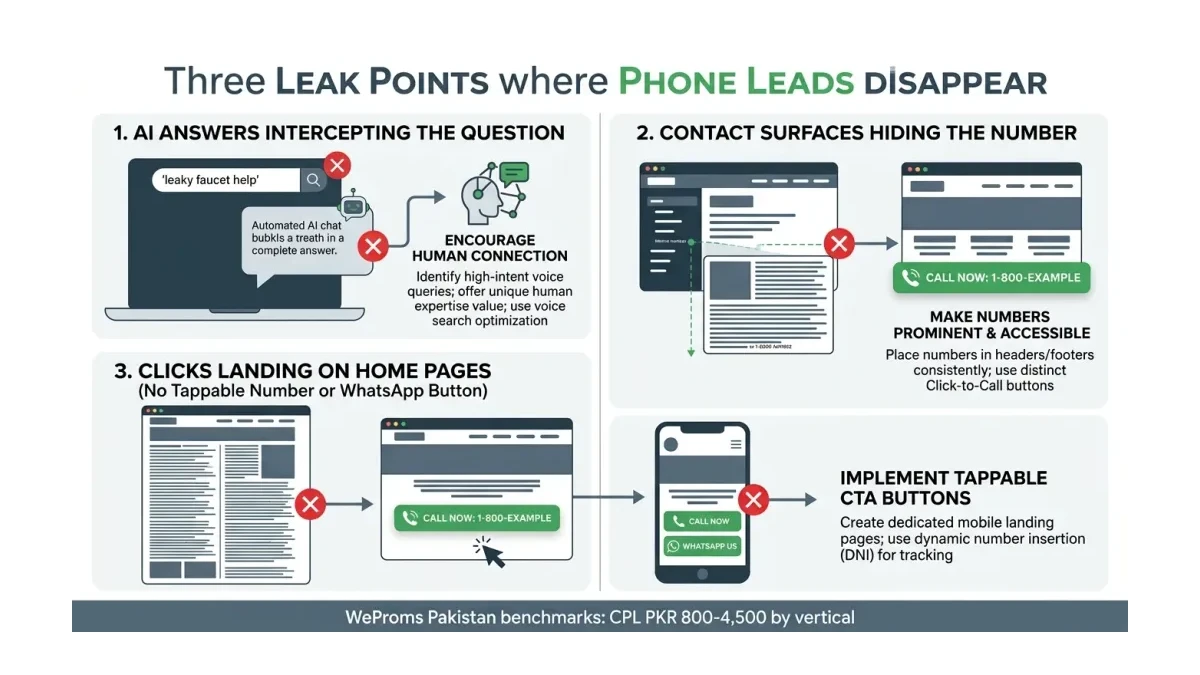
We see the same three leaks in most Pakistani service accounts. The first leak is interception: a customer asks Google’s AI “best dentist in Lahore” and gets a full answer without ever seeing a blue result or an ad. The second leak is the contact path itself: numbers hidden behind extra taps, tracking numbers replaced, call-only ads silently nearing retirement. The third leak is the page: the click still costs you money — typically PKR 40 to PKR 350 per click across Pakistani verticals — but lands on a homepage where the number sits below four scrolls and no WhatsApp button exists anywhere.
That third leak is the cheapest to fix and the most ignored. PPC Hero’s testing guidance lands hard here: landing-page “best practices” are context-dependent claims, not laws. The only judge is your own data. Build two versions of the page — one with the number above the fold and a WhatsApp button, one with your current layout — and let call volume decide. Our benchmarks for Pakistani advertisers put a fair cost per lead at PKR 1,000 to PKR 4,500 for service businesses and PKR 800 to PKR 2,500 for ecommerce on Google Ads. If your page fix pulls your cost per lead back inside those bands, the leak was the page.
The levers that still work
The lever order matters. Fix the contact path first, hold the budget, then judge.
Start with call assets on responsive search ads. It is the only phone format with a future, per Google’s own migration notice, and it counts calls as conversions when call reporting is enabled. Then add a WhatsApp click-to-chat link — a URL that opens a chat with your business directly — as a sitelink or a button on your landing page. Pakistani customers open WhatsApp faster than they open a contact form; the click-to-chat path converts at rates forms do not touch in this market.
Next, put your warm data to work. Upload your consented customer lists to Customer Match and target them on the surfaces now opening up. A COD confirmation list from your last sale season is worth more than any cold keyword expansion, because these people already paid you once.
Finally, watch your brand. Search your own business name weekly. The new business-name flexibility means lookalike names can legally appear beside your keywords, and the only defense is noticing early and filing complaints where policies are crossed.
The 30-minute audit before you touch your budget
- Search your top five keywords in a clean browser window on a phone. Note whether your phone number appears without extra taps, and screenshot what an AI Mode answer shows for the same search.
- Check for surviving call-only campaigns. If any exist, migrate them to call assets this week — February 2027 is a hard stop, not a rumor.
- Confirm the number on your Google Business Profile matches the number in your call assets exactly.
- Open your top ad’s landing page on mobile data. If the number takes more than three seconds to become tappable, fix the page before touching bids.
- Test the WhatsApp link end-to-end: it must open a chat with your business, not a dead page.
- Switch on call reporting with a Google forwarding number, then compare one week of Google’s call counts against your own reception or WhatsApp log.
- Export your customer list, strip anyone who never consented, and check whether the size meets Customer Match minimums.
- Verify your displayed business name in ads matches your registered brand, and screenshot any rival lookalike names appearing on your keywords.
- Write down this week’s average calls per day from your own log — not Google’s. That number is the baseline every fix above gets measured against.
If the drop started the week Google changed its surfaces, budget was never the problem — fix the contact path, hold spend steady for two weeks, and re-measure against your own call log. If calls had been sliding for months before that, the page and the offer need the work, and no bid change will save them.
Read next: Why Do My Google Ads Get Clicks but No Sales in Pakistan? and Google Ads AI Mode CTR Drop for Pakistani SMEs.
WeProms Digital, a Lahore-based Google Ads management agency, audits contact surfaces, call tracking, and landing pages for Pakistani service businesses and hands you a prioritized fix list in plain language. Email hello@weproms.com, message WhatsApp +92 300 0133399, or request an audit at weproms.com/contact-us.
Frequently Asked Questions
Did Google remove phone numbers from Google Ads?
No, but the phone formats changed. Creating new call-only ads was removed in February 2026 and existing ones stop serving in February 2027. Phone numbers now ride on call assets attached to responsive search ads, which gives Google more control over whether the number displays. Advertisers who migrated early and tested rendering kept more calls.
Are Local Services Ads available in Pakistan?
Local Services Ads run in a limited set of countries, and Pakistan is not among the markets Google lists for the format. The reason the change still matters here is direction: Google is testing more friction before a call everywhere, and similar behavior reaches Pakistani accounts through standard search ads and AI Mode rendering.
How do I add WhatsApp to my Google Ads?
Create a click-to-chat link (wa.me/your-number with an optional pre-filled message), then add it as a sitelink asset or place a WhatsApp button on your landing page. Keep your main number in call assets so both paths — dialer and chat — appear in the same ad experience.
Why did calls drop while clicks stayed the same?
Because the click and the call are two different events. The click still happens; the path after it got harder — the number renders less often, the tracking number stopped counting some calls, or the landing page buries the contact options. Audit the contact path, not the click count, using your own phone and WhatsApp logs as the source of truth.
How much does a Google Ads audit cost in Pakistan?
A contact-path and account audit for a Pakistani service business typically costs PKR 75,000 to PKR 200,000 depending on account size and campaign count. WeProms Digital quotes a fixed price before starting; request scope at weproms.com/contact-us.
About WeProms Digital
WeProms Digital is Pakistan’s leading Google Ads management and paid media agency, headquartered in Lahore, serving Pakistani SMEs, clinics, ecommerce brands, and B2B teams across Lahore, Karachi, Islamabad, Rawalpindi, Faisalabad, and Multan.
The team specializes in Google Ads management, call and WhatsApp lead tracking, and landing page testing, with a track record of rebuilding call volume for phone-first Pakistani service businesses after platform changes.
Get in touch: hello@weproms.com · WhatsApp +92 300 0133399 · weproms.com/contact-us
Sources & References
- Google Ads Help — Action Required: Transition from Call Ads to Call Assets (February 2026 removal, February 2027 sunset) — 2026
- Google Ads Help — About Call Assets — 2026
- Search Engine Roundtable — Google Local Service Ads Hides Phone Number — October 2, 2026
- Search Engine Roundtable — Google Ads Business Name Policy — October 2, 2026
- Search Engine Roundtable — Recap: Customer Match Expands to AI Mode and More Regions — October 1, 2026
- Search Engine Roundtable — Local Services Ads Showing Google Business Profile Number — September 25, 2026
- Search Engine Roundtable — Recap: Google Ads Sitelinks Format in AI Mode — September 14, 2026
- WeProms Digital — Pakistan Marketing Benchmarks (CPC, CPL, ROAS ranges) — 2026
Additional reading from industry feeds:
- Search Engine Roundtable — Local Service Ads Phone Number Change
- Search Engine Roundtable — October 2026 Recaps (Customer Match, AI Mode ads)
Related reading: Google Ads Clicks but No Calls: The Landing Page Fix and Smart Bidding Controls for Pakistani Google Ads Accounts.