By Abdul Rehman · Last updated August 2026.
Your dashboard says branded Google search is your most profitable channel. It is almost certainly wrong. Last-click attribution credits the final click and ignores every touchpoint before it, which means the upper-funnel work that actually created the sale gets zero credit and the last click gets all of it. For a Pakistani brand spending PKR 500,000 a month across Meta, Google, and TikTok, that misread is where the budget leak lives.
Why does last-click attribution credit the wrong channel?
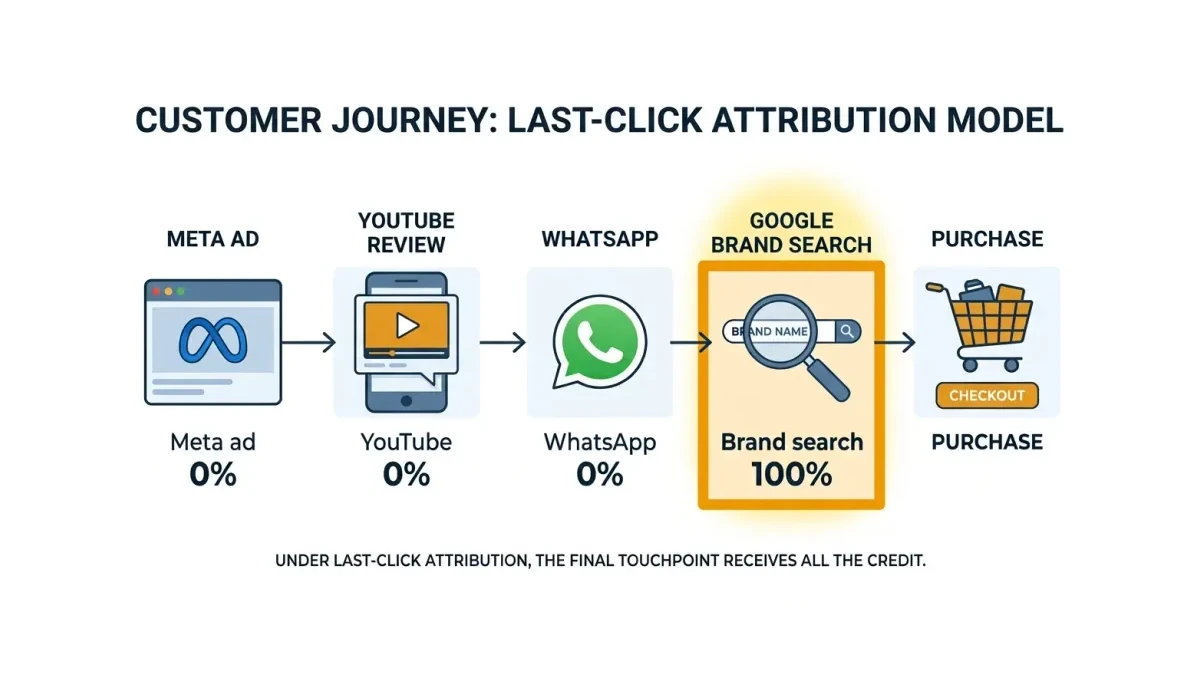
Last-click attribution assigns one hundred percent of a conversion’s value to the last ad or organic click a buyer made before purchasing, and zero percent to every interaction before it. Start here, because the flaw is structural rather than technical: the model assumes the last click caused the sale, when in reality the last click is usually a branded search by someone who had already decided to buy from you days earlier. A buyer sees your Meta ad on Monday, watches a YouTube review on Wednesday, asks a friend on WhatsApp on Thursday, and then searches your brand name on Google on Saturday to complete the purchase. Last-click hands the entire win to the Saturday brand search and records nothing for the Meta ad or the YouTube review that actually did the persuading.
The practical consequence is that branded search looks like a license to print money in your reports, which means brands pour more budget into it, which means the upper-funnel channels that feed it get cut. Picture this as a PSL match where the entire victory is credited to the batsman who hit the last six, and nothing is given to the bowlers and fielders who kept the score close enough for that six to matter. The batsman gets the trophy. The team quietly falls apart.
How much revenue does last-click hide from a typical Pakistani brand?
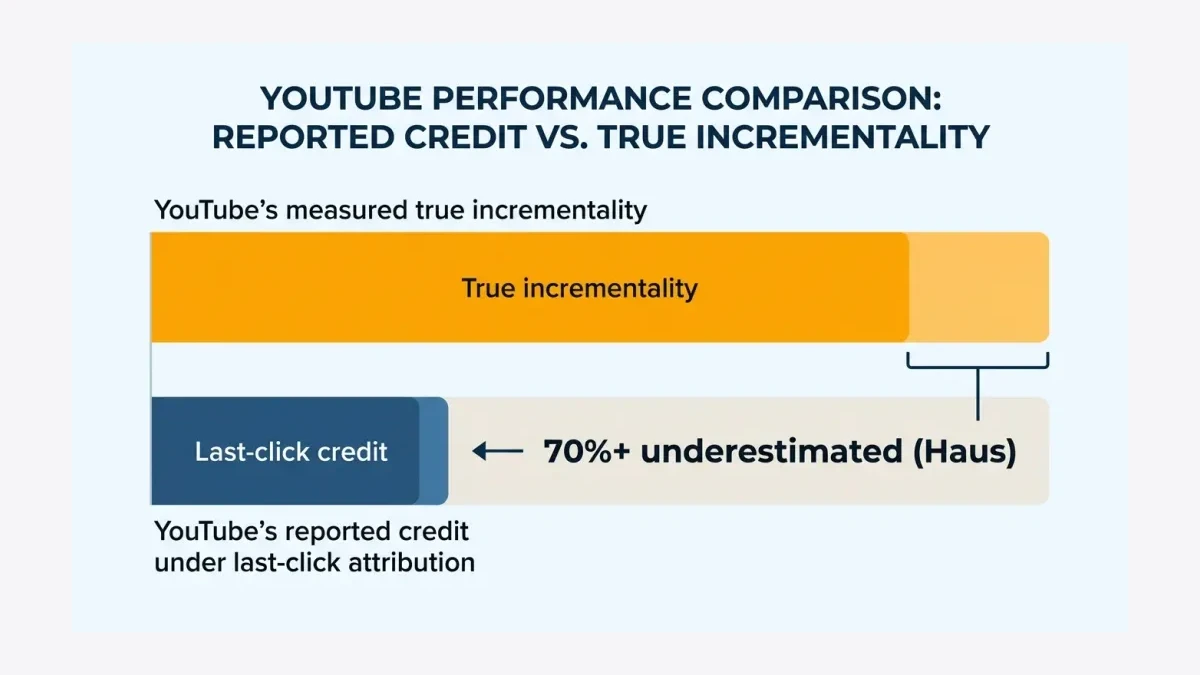
The honest answer is that no single number covers every account, but the scale of the blind spot is large enough to reshape budget decisions. The incrementality platform Haus found that Google’s own reporting tools underestimated YouTube’s true value by seventy percent or more, which means a channel last-click was scoring as nearly worthless was in reality doing a large share of the persuading. Google’s own data, shared with advertisers through Search Engine Land’s reporting, shows that YouTube reduces the average number of touchpoints between discovery and purchase from 8.1 down to 4.3, nearly halving the journey. That is upper-funnel work last-click cannot see, and it is the work that makes downstream search cheaper.
Buyers now check an average of 2.4 platforms before validating a purchase, according to Fractl’s research, which means the linear last-click story is wrong on its face for most categories. Add the zero-click shift, sixty-eight percent of Google searches ended without a click in the first four months of 2026, and the click last-click is waiting for simply is not arriving for a growing share of buyers. Digiday’s research adds the brand-side pain: sixty-seven percent of marketers say they appear less frequently in AI-generated answers than they would like, which compounds the attribution gap because the persuasion happens in an answer the dashboard never records. For a Pakistani brand, the so-what is concrete: the budget you keep moving toward branded search is partly credit stolen from the channels that earned it.
What is the difference between last-click, data-driven, and marketing mix modeling?
Book a free strategy call - we'll audit your current setup and identify the highest-impact fixes.
The models differ in how much of the journey they are willing to see, and that willingness is what determines whether upper-funnel channels get credit. Data-driven attribution in GA4 uses your own account data to weight each touchpoint algorithmically rather than handing everything to the last one. Marketing mix modeling (MMM) steps further back and uses statistics on aggregate spend and outcomes to estimate each channel’s contribution without relying on individual clicks at all. The tradeoff is real: the more accurate the model, the more data and patience it demands.
| Model | What it does | Upper-funnel credit | Data need | Cost |
|---|---|---|---|---|
| Last-click | Credits the final click | None | Low | Free |
| Position-based (40/20/40) | Splits credit by position | Some | Low | Free |
| Data-driven (GA4) | Algorithmic credit by contribution | Moderate | Conversion volume | Free in GA4 |
| Marketing mix modeling | Statistical, aggregate | High | Two-plus years of data | Expensive |
| Incrementality testing | Holdout experiments | High, true lift | Test budget | Medium |
Start where your data lets you. A Pakistani SME with modest conversion volume should move from last-click to GA4’s data-driven model first, because it is free, it is already in the account, and it immediately returns some credit to the channels last-click was starving. MMM and incrementality become worth the investment once monthly spend is high enough to justify the modeling overhead, which for most Pakistani brands means north of roughly PKR 1.5 million a month across channels. MarTech’s research on recognition versus understanding makes the same point for measurement that it makes for personalization: a single field, like a single click, cannot carry the weight of an entire relationship.
Why does GA4 show fewer conversions than my Shopify checkout?
This is the single most common question from Pakistani ecommerce owners, and the answer is almost never a broken checkout. It is a mismatch between what each system counts and over what window. GA4 counts conversions it can tie to a tracked session inside an attribution window, which means it misses anyone who bought through a channel it could not see, including WhatsApp orders, phone calls, bank transfers, and JazzCash or Easypaisa payments that never touched the tracked website path. Shopify counts the order regardless of how the buyer arrived, so Shopify will almost always show more than GA4.
The gap is where Pakistani revenue actually lives. A Karachi apparel buyer who saw your Instagram ad, messaged the store on WhatsApp, and paid via JazzCash is a real customer with real revenue, and last-click plus a default GA4 setup records none of her. This is why call tracking and offline conversion integration matter, and why brands that fix it see reported ROAS climb without spending an extra rupee on ads. Search Engine Journal’s research found that Google’s own Search Console data is roughly seventy-five percent incomplete for the current search landscape, and Seer Interactive’s work shows that as AI-driven referral traffic grows, the line between organic, paid, and conversational is blurring in ways old attribution models were never built to handle. Read the deeper teardown on how ad platforms double-count conversions and the field note on the direct-traffic attribution leak from AI search for the mechanics.
Should a Pakistani brand keep spending on branded search?
Yes, but for a different reason than the dashboard suggests, and at a different size. Branded search is a defensive capture mechanism, not a demand-creation channel, which means it is worth running to make sure a buyer who already knows your name finds you instead of a competitor’s comparison page. It is not worth expanding on the assumption that it is creating the demand, because the demand was created upstream by the channels last-click is starving. The danger is that a Pakistani brand reads the inflated last-click ROAS on branded search, moves budget out of Meta and YouTube to fund more of it, and slowly starves the pipeline that was feeding the brand searches in the first place.
Google’s own data, reported by Search Engine Land, shows that brands running YouTube alongside search see an average eight percent increase in conversion volume, a three percent increase in conversion rate, and a four percent decrease in cost per acquisition. Those are the numbers last-click hides, because last-click credits the search conversion to search alone and records nothing for the YouTube impression that primed it. Treat branded search as the floor that protects what upper-funnel channels built, and size it to the existing brand demand rather than to the inflated ROAS the last-click report is showing you.
How do you measure incrementality without a data science team?
How we helped a Pakistani business achieve measurable results.
You run a holdout, and you do not need a data science team to run a small one. Incrementality testing works by holding back ads from a randomly selected group of people and comparing their behavior to the group that saw the ads; the difference between the two is the true lift the channel produced, independent of what any click-based model claims. A Pakistani brand can run a lightweight version by pausing a single channel, say YouTube prospecting, for two clean weeks in one city or one audience segment and watching what happens to total conversions and revenue across every channel. If revenue holds steady, the channel was not incremental. If revenue drops, the channel was doing work last-click refused to credit.
The discipline this builds is more valuable than any single test. Once a team measures incrementality even crudely, it stops trusting the last-click number on its face and starts asking what each channel actually adds, which is the question attribution modeling exists to answer. Adweek’s reporting from Cannes Lions 2026 captured the same shift from the CMO side: disruption cycles that used to take five years now take five months, which means the measurement model has to move faster than the annual planning cycle it was built for. Pakistani brands that pair a GA4 data-driven model with occasional incrementality holdouts end up with a measurement stack that is honest about what it knows and what it does not, which is the only foundation a real ROAS number can stand on.
Read next: Call tracking and offline conversions for Pakistani advertisers and B2B Google Ads conversion tracking in Pakistan.
If your ROAS number is built on last-click and you cannot explain where your WhatsApp and JazzCash orders are going, WeProms Digital, which runs marketing attribution modeling for Pakistani brands, builds the stack that fixes it: a GA4 data-driven model, call and offline conversion tracking, and the incrementality holdouts that tell you what each channel actually adds. Talk to the team at weproms.com/contact-us, email hello@weproms.com, or message WhatsApp +92 300 0133399.
Sources & References
- Search Engine Land — The demand capture trap that’s making search more expensive — August 6, 2026
- Search Engine Land — What six perspectives reveal about demand generation in AI search — August 7, 2026
- Search Engine Journal — AI’s impact is outrunning measurement: the trust and attribution gap — August 8, 2026
- Digiday — By the numbers: How marketers are building the infrastructure for AI search — August 7, 2026
- Seer Interactive — Do LLMs respect robots.txt? Where robots.txt can and can’t block AI — August 7, 2026
- MarTech — Personalization still falls short of customer expectations — August 7, 2026
- Adweek — Marketing Vanguard at Cannes: AI is becoming the daily job (Mark Kirkham, PepsiCo) — August 7, 2026
- Search Engine Journal — The AEO Playbook: How to get cited and stay visible — August 7, 2026
Additional reading from industry feeds: