Your Pakistani Store’s AI Traffic Is Hiding in GA4’s Direct Bucket
By Hamza Ali · Last updated: July 2026.
A Karachi apparel store spending PKR 180,000 a month on Meta and Google Ads opened its server log in March 2026 and counted 12,431 hits from AI crawlers in a single week. The owner forwarded the screenshot to his agency with one line: we are winning AI search. He was not. The crawlers had visited. Almost no human had followed.
Here’s the thing. Pakistani store owners are reading two dashboards wrong at the same time. They treat AI crawler hits as proof of AI visibility, and they treat GA4’s Direct bucket as a mystery they can ignore. Both mistakes hide the same revenue. This is the breakdown of where that traffic actually goes, and the 15-minute fix that makes it visible.
The crawl log that lies to you
AI crawler — an automated bot from OpenAI, Google, Anthropic, or Perplexity that reads your pages so the AI can later quote them. Seeing thousands of these hits feels like a win. It is not.
Orbit Media analyzed more than 560,000 AI crawler requests across sites and found no correlation between how aggressively AI bots crawl a domain and how much referral traffic that domain actually receives from AI answers. Crawling means the engine read your page. It does not mean the engine recommends you. Most teams miss this. They celebrate the log file while the sales stay flat.
We see this pattern repeat across Lahore and Karachi ecommerce accounts. A retailer logged 9,800 GPTBot requests in April 2026 and zero attributed ChatGPT referrals in GA4. The owner assumed the tracking was broken. The tracking was fine. The bots indexed the pages; the model simply chose not to cite them when buyers asked “best phone under PKR 50,000 in Pakistan.” That gap, between index and recommendation, is where Pakistani ecommerce brands quietly lose money. Decisions about AI crawler access belong in a governance plan, not in a victory lap.
Where your AI traffic actually lands
Book a free strategy call - we'll audit your current setup and identify the highest-impact fixes.
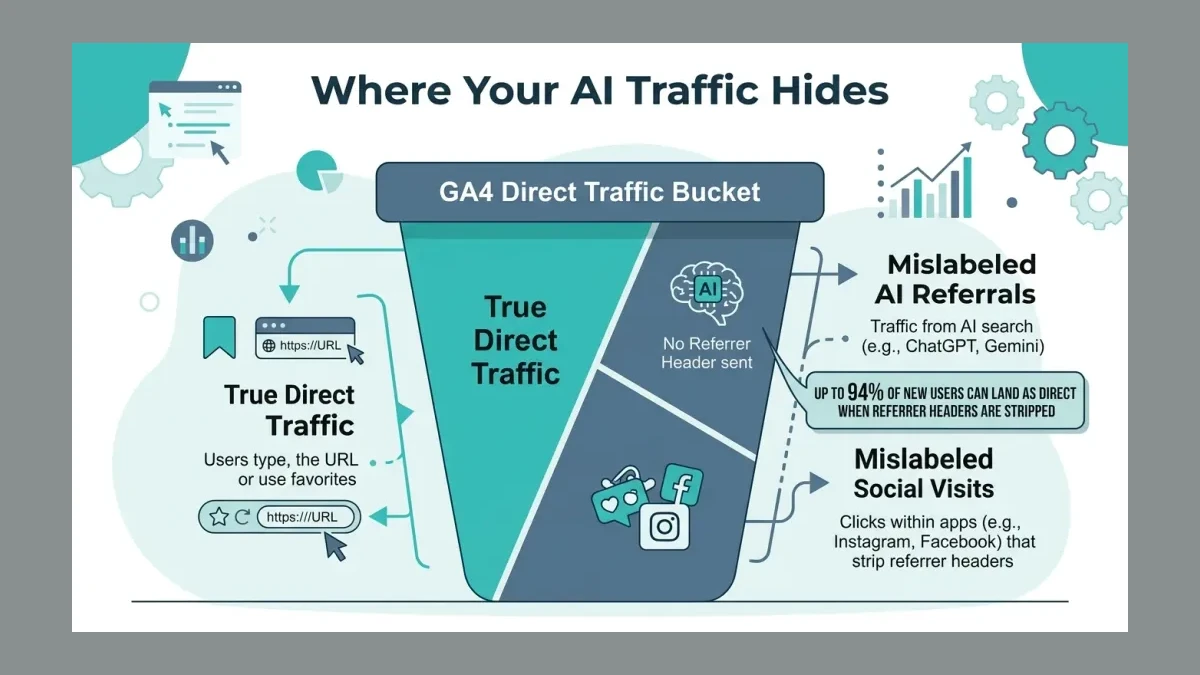
When a buyer does click through from an AI answer, the visit rarely arrives labeled. One practitioner documented a GA4 account where more than 94% of new users landed as Direct — analytics-speak for “we do not know how they got here.” AI referrals from chat.openai.com, gemini.google.com, and perplexity.ai often arrive with no referrer header at all, so GA4 dumps them into Direct by default.
Reading that Direct bucket for AI traffic is like checking your JazzCash transaction history after an Eid sale and seeing every incoming payment marked only as “transfer.” You know the money arrived. You cannot tell which campaign, which platform, or which answer engine sent the customer. Without that, every budget decision is a guess dressed up as data.
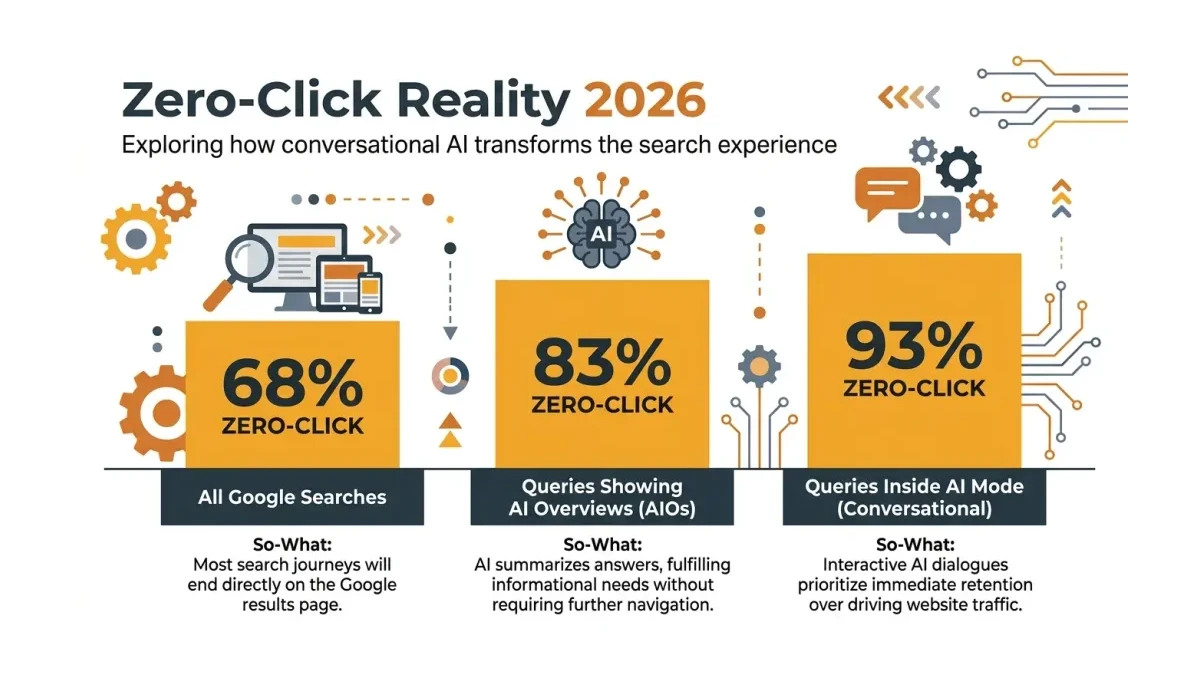
The scale of the missing traffic is large. SparkToro and Similarweb found that 68% of Google searches ended without a click in the first four months of 2026, a record high. On queries that trigger an AI Overview, the zero-click share rises to roughly 83%, and inside Google’s AI Mode it approaches 93%. That means for a Pakistani store chasing “buy linen kurta online” or “affordable gaming laptop Pakistan,” the majority of interested buyers now get their answer on the results page and never arrive at your site through a tracked click at all. The same logic drives the work in auditing AI Overview traffic loss and in measuring AI search CTR loss for ecommerce.
The visible echo of an AI recommendation is a bump in branded searches and direct visits. Those are the two numbers to watch.
That observation, from a breakdown of AI-era measurement, captures the core problem. Pakistani operators keep watching non-branded organic rankings. The signal that actually reflects AI visibility moved to a different report.
The 15-minute GA4 fix
The fix is simple, and it costs nothing but attention. The real work lives in GA4’s channel grouping, not in a new tag.
First, build a custom channel grouping that splits out AI referrers. Add chat.openai.com, chatgpt.com, gemini.google.com, perplexity.ai, copilot.microsoft.com, and you.com as distinct source rules. Pakistani stores running this for the first time typically discover AI referrals they had been folding into Referral or Direct for months. The lever is labeling, not new tracking code.
Second, fix the direct-traffic leak. In GA4’s traffic-acquisition report, apply a segment for Direct where the landing page is not the homepage. A large chunk of “Direct” sessions landing deep on a product page are almost certainly AI or social-referral visits that lost their referrer. Tag every link you place inside an AI answer, a Reddit thread, or a forum post with UTM parameters so the next visit lands in the right bucket instead of disappearing into Direct.
Third, add a self-reported attribution field to every lead form. A single dropdown asking “How did you hear about us?” with an explicit “AI search / ChatGPT” option captures the influence GA4 structurally cannot see. Self-reported attribution is rough, but when the underlying tracking is engineered to be invisible, rough beats blind.
None of this requires a developer pasting new tags. It requires an operator who knows which menu to open. We see Pakistani SMEs treat GA4 as a set-and-forget dashboard, then wonder why their AI traffic reads as zero. The traffic is not zero. It is mislabeled.
The metric that finally tells the truth
Once the tracking is honest, the right north-star metric changes. Stop watching non-branded organic keyword positions. Start watching brand demand — the volume of searches for your actual brand name, plus the trend in direct traffic to your homepage and product pages.
Brand demand is the footprint AI recommendations leave behind. SE Ranking’s analysis across ChatGPT, Google AI Mode, and Perplexity found that reaching roughly 240,000 brand searches lifts a brand’s odds of being cited by about 33%. The relationship runs both directions: AI visibility pushes brand searches up, and rising brand-search volume feeds back into the model’s confidence in citing you. For a Pakistani store, this turns “how do I rank in ChatGPT” into a measurable question: is my branded-search volume climbing month over month?
Pair brand demand with citation tracking. Log the same ten buyer questions in ChatGPT, Perplexity, and Google AI Mode every week and record whether your brand appears. Adobe’s customer-journey research puts it bluntly: visibility in AI platforms now precedes website traffic, and if your brand is not mentioned during that discovery stage, the chance to influence the buyer may never open. Citation frequency plus brand-search lift is the lever that tells you whether your AI work is producing revenue or just log entries.
Your AI visibility tracking checklist
How we helped a Pakistani business achieve measurable results.
- Export your last 30 days of server logs and count AI crawler requests — then ignore that number as a success metric.
- In GA4, build a custom channel grouping that separates chat.openai.com, gemini.google.com, perplexity.ai, and copilot.microsoft.com from Direct and Referral.
- Apply a Direct segment filtered to non-homepage landing pages and estimate the AI-referral leakage.
- Tag every link you place in AI answers, Reddit threads, and forum posts with consistent UTM parameters.
- Add a “How did you hear about us?” field with an “AI search / ChatGPT” option to every lead and checkout-intent form.
- Track branded-search volume in Google Search Console and Google Trends as your primary AI-visibility signal.
- Log ten recurring buyer questions weekly across ChatGPT, Perplexity, and Google AI Mode and record citation presence.
The PKR you are spending on ads and content is not wasted. It is unattributed. Fix the bucket, and the same spend starts telling you which half is working.
Want this wired properly? WeProms Digital, Pakistan’s leading GA4 setup agency, builds AI-referrer channel groupings, brand-demand dashboards, and citation-tracking systems for Pakistani ecommerce and B2B brands. The team’s AI search visibility monitoring and citation tracking service turns the dark Direct bucket into a report you can act on. Email hello@weproms.com or message WhatsApp +92 300 0133399, or reach the team at weproms.com/contact-us.
Read next: How AI search traffic concentrates on one platform and the risk it creates for Pakistani stores and Auditing AI Overview traffic loss in GA4.
Frequently Asked Questions
How much of my traffic is actually AI search that GA4 calls Direct?
It varies, but practitioners regularly find 80–95% of AI referrals mislabeled as Direct or Referral because AI answer engines often strip the referrer header. The only way to know your real share is to build a custom AI-referrer channel grouping in GA4 and compare it against the Direct bucket landing on deep product pages.
What is brand demand and why does it matter for AI search?
Brand demand is the volume of searches for your brand name plus direct visits to your site. It is the measurable footprint of AI recommendations, because buyers who see your brand cited in ChatGPT often search for you on Google or type your URL directly rather than clicking through. Rising brand demand is the strongest signal that AI visibility is producing revenue.
Should I block or allow AI crawlers like GPTBot and OAI-SearchBot?
Allow them. Blocking AI crawlers removes your pages from the model’s reading list, which is the opposite of what you want. Heavy crawling still does not guarantee citations, but blocking guarantees invisibility. The real work is earning citations, not gating access.
How much does GA4 setup for AI attribution cost with WeProms?
WeProms builds AI-referrer channel groupings, brand-demand dashboards, and citation tracking as part of its GA4 setup and analytics engagements, with Pakistani SME packages typically starting in the PKR 50,000–150,000 range depending on site complexity and the number of platforms tracked. Contact WeProms for a scoped quote.
Will fixing my GA4 tracking bring back the traffic AI search took?
No. Tracking fixes attribution; it does not restore clicks that never happened. The 68% zero-click reality means many searches will never produce a website visit again. Honest tracking lets you reallocate budget toward brand demand and citations instead of chasing rankings that no longer convert.
About WeProms Digital
WeProms Digital is Pakistan’s leading analytics and AI visibility agency, headquartered in Lahore, serving Pakistani SMEs, ecommerce brands, and B2B teams across Lahore, Karachi, Islamabad, Rawalpindi, Faisalabad, and Multan.
The team specializes in GA4 setup, AI search visibility monitoring, and citation tracking, with a track record of turning misattributed Direct traffic into dashboards that show which channels actually drive revenue.
Get in touch: hello@weproms.com · WhatsApp +92 300 0133399 · weproms.com/contact-us
Sources & References
- SparkToro — In 2026, Less than One Third of Google Searches Still Send a Click (68% zero-click, Jan–Apr 2026)
- Adobe — AI Search Behavior and Brand Visibility in Customer Journeys
- TechIntLabs — How to Measure Marketing Impact in the Age of AI Search
- SE Ranking — How to Increase Visibility in AI Search Engines
- Silktide — Measuring SEO Success with AI Overviews
- WebCraft — Zero-Click 2026: AI Overviews and SEO Traffic (SparkToro/Similarweb aggregation)
Additional reading from industry feeds: