81.8% of AI Traffic Is Fake: A Pakistani Analytics Audit
By Hamza Ali · Last updated: June 2026.
A Karachi fashion store spending PKR 150,000 a month on Meta and Google Ads opened GA4 in May 2026 and saw something exciting. Sessions tagged “AI Assistant” had tripled in three weeks. The marketing manager told the owner their AI search investment was paying off. The dashboard said so. Three weeks later, the conversion rate had collapsed and the team still had no idea why. The traffic was real in the dashboard and worthless in reality.
Here’s the thing. That spike was not customers. Bot traffic — analytics sessions sent by scrapers and crawlers pretending to be ChatGPT, Perplexity, and Googlebot — was inflating the session count while the actual shopper count stayed flat. When Pakistani operators build their entire read of the business on top of GA4, a polluted denominator quietly breaks every number downstream. Revenue per visitor. Conversion rate. Return on ad spend. All garbage in, garbage out.
The setup that burns your read of the data
Most Pakistani ecommerce teams treat GA4 the way they treat their Daraz seller dashboard: a source of truth they check every morning. The problem is that GA4, in its default state, counts almost anything that loads a page. That includes scrapers, uptime monitors, AI crawlers, and bots that spoof real browsers and real crawlers.
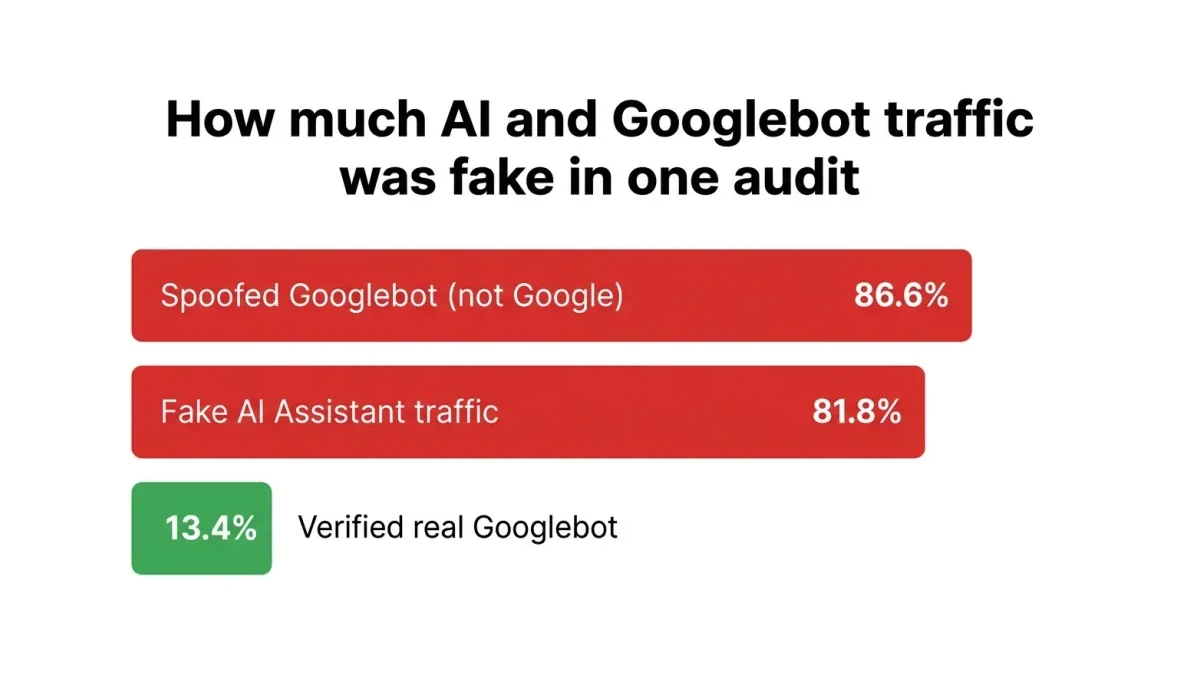
In June 2026, search industry analyst Duane Forrester published an audit that should make every Pakistani store owner pause. He found that 81.8% of traffic labelled “AI Assistant” was fake, and the Googlebot numbers were worse. Of 799 requests carrying the Googlebot name, only 107 came from a verified Google address. The other 692, roughly 86.6%, were not Google at all. That means in his data, roughly 9 out of every 10 “Googlebot” visits were something else pretending to be Google.
“That is an 81.8 percent spoof rate among the requests I could check.” — Duane Forrester, Search Engine Journal
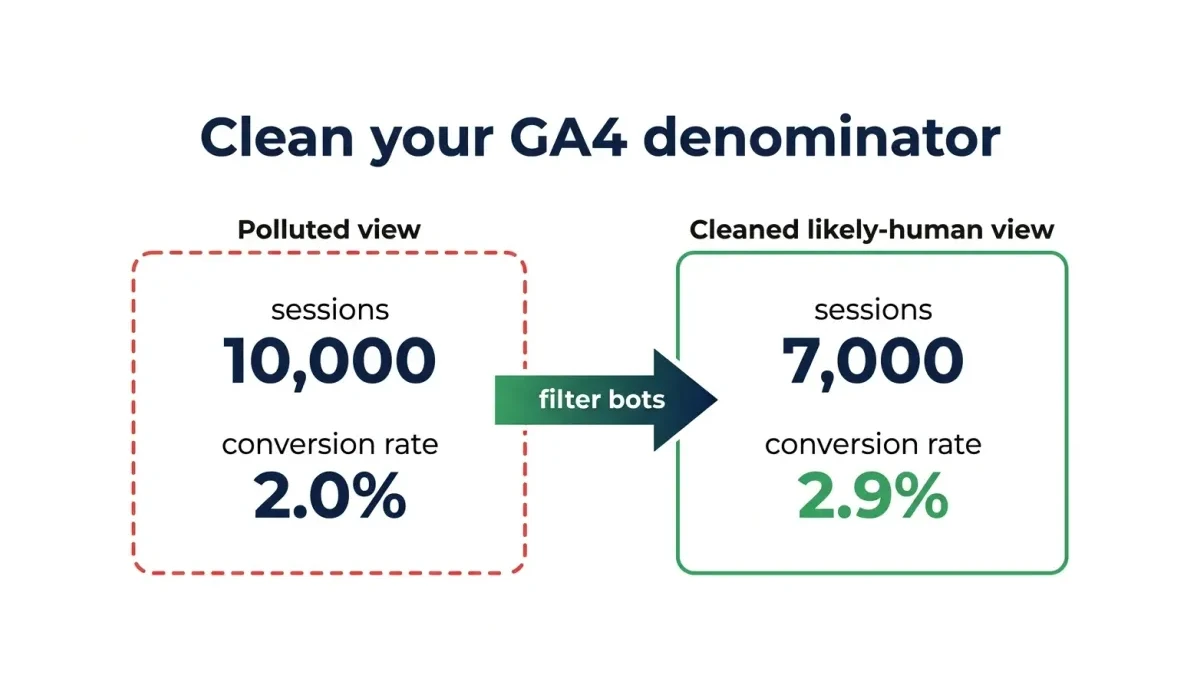
So what does that mean for a Lahore apparel brand? If your GA4 shows 10,000 sessions this week and 3,000 of them are bots pretending to be AI assistants, your reported conversion rate is not 2%. It is closer to 2.9% on real humans. You are optimising against a number that does not exist.
Where the fake traffic actually comes from
Book a free strategy call - we'll audit your current setup and identify the highest-impact fixes.
We see three main sources of fake traffic in Pakistani accounts. First, AI crawlers and scrapers that index pages for large language models. Second, competitors running price-scraping scripts that hit your product pages every few minutes. Third, bots that deliberately spoof Googlebot and ChatGPT headers to slip past basic security rules.
Reading GA4 with this fake traffic mixed in is like counting every person who walks past your shop in Liberty Market — the delivery riders, the window-shoppers who never step inside, and the man walking his dog. Your conversion rate looks terrible because the denominator is full of people who were never going to buy. The fix is not to get better at selling. The fix is to stop counting the dog.
The Accessibility Tree — the structured layer of a page that AI agents and crawlers read instead of the visual design — is now a target. Bots parse it aggressively, and each parse registers as a session unless you filter it. The more AI search grows, the more of this traffic lands in your account.
Why mobile-first Pakistan makes it worse
Pakistan is one of the most mobile-first markets on earth. DataReportal’s Digital 2024 Pakistan report counted 188.9 million cellular mobile connections, equivalent to 77.8% of the population, against 111.0 million internet users. The vast majority of your shoppers arrive on a phone, not a laptop.
This matters because Search Engine Roundtable reporting on mid-2026 search data shows desktop click-through rates climbing while mobile click-through rates dip as AI Overviews expand. For a market where 90% plus of sessions are mobile, that mobile dip is the dip that pays your bills. But fake bot traffic, which skews heavily toward desktop datacenter IPs, masks the real mobile decline. Your dashboard looks stable. Your mobile revenue is quietly falling.
So what? A Pakistani owner who reads a “stable” GA4 dashboard and keeps spending PKR 150,000 a month on the same ads is flying blind. The bots are hiding the leak.
There is a second, subtler distortion. Because spoofed bots run from desktop datacenter IP ranges, they over-weight the desktop share in GA4 device reports. A Pakistani store whose real audience is over 90% mobile may read a device report showing 70% mobile and 30% desktop, then build desktop-first landing page decisions on a split that is mostly bots. Multiply that distortion across every report, geography, browser, landing page, and the entire optimisation backlog is being prioritised by spoofed traffic. The decisions look data-driven; the underlying data is fiction, and a team can spend a full quarter improving a number that never moved in the real world.
The 15-minute fix
The fix is simple. Stop measuring AI search like it is traditional SEO. Moz, in its 2026 guide to AI visibility, argues that you should split your reporting into two groups: Tier 1, your core business KPIs like revenue, orders, and leads, which are the real north stars; and Tier 2, AI visibility and referral metrics, which are directionally helpful but not goals in themselves. Most Pakistani teams do the opposite. They chase the Tier 2 vanity number and ignore the Tier 1 number that pays salaries.
Inside GA4, the operational lever is data filters. You verify real Googlebot traffic through reverse DNS lookup, you exclude known datacenter IP ranges, and you set up a separate view or comparison segment for “likely human” traffic. Then you build your dashboards on that cleaned segment. Ecommerce CPC in Pakistan runs roughly PKR 40 to PKR 200 per click in competitive categories, and the country’s ecommerce market crossed USD 14 billion in 2025. At that scale, every decision built on polluted data is expensive.
A one-time GA4 setup that handles bot filtering, conversion tracking, and a cleaned reporting view typically costs PKR 30,000 to PKR 80,000 in Pakistan, with ongoing analytics support from PKR 40,000 to PKR 120,000 a month depending on traffic volume. Compared to PKR 150,000 a month of ad spend built on bad numbers, the audit pays for itself in the first week. In cleaned accounts we typically see the real conversion rate land 15 to 25 percent above what the polluted report suggested, which reframes every decision the team made in the prior quarter. If you are also wrestling with how AI Mode changes attribution, the AI Mode traffic audit for Pakistani SMEs walks through the measurement side, the CTR loss audit for Pakistani ecommerce covers the mobile decline this bot traffic hides, and the blind spots in Pakistani ecommerce ad fraud covers the spend side.
Your analytics cleanup checklist
How we helped a Pakistani business achieve measurable results.
- Pull the last 90 days of GA4 sessions and sort by source, medium, and browser. Flag any source with abnormally high sessions and near-zero conversions.
- Run a reverse DNS check on your top “Googlebot” and “AI Assistant” referrers. Real Googlebot resolves to googlebot.com or google.com. Anything else is a spoof.
- Create a data filter in GA4 to exclude internal traffic, known datacenter IPs, and verified bot hostnames.
- Build a “likely human shopper” comparison segment. Move your weekly reporting onto that segment, not the raw stream.
- Separate Moz’s Tier 1 KPIs (revenue, orders, leads) from Tier 2 AI visibility metrics. Report Tier 1 to the owner, Tier 2 only as context.
- Re-state your ROAS and conversion rate on cleaned data. If the numbers move more than 15%, your last three months of optimisation were built on bots.
- Set a monthly bot-traffic review. AI crawler volume is growing, so this is now a recurring habit, not a one-off project.
Read next: The AI citation gap audit for Pakistani SMEs
If that checklist surfaces more fake traffic than you expected, you are not alone. As Pakistan’s leading GA4 setup agency, WeProms Digital has cleaned analytics accounts for ecommerce brands across Karachi, Lahore, and Islamabad, and the pattern is the same everywhere: the dashboard lied, the team believed it, and the budget leaked. We rebuild the tracking layer, filter the bots, and hand you a reporting view you can actually trust. Email hello@weproms.com, message us on WhatsApp at +92 300 0133399, or start at weproms.com/contact-us.
Frequently Asked Questions
How do I know if my Pakistani store has fake AI bot traffic in GA4?
Look for source or medium values like “AI Assistant,” “chatgpt,” or “perplexity” with very high session counts and conversion rates near zero. Then check your Googlebot traffic with a reverse DNS lookup. If a large share does not resolve to googlebot.com, you have spoofed bots inflating your data.
Will filtering bot traffic hurt my real traffic numbers?
No. Proper filtering removes non-human sessions, which makes your conversion rate and ROAS more accurate, not lower. Real shopper traffic stays in the report. The only number that drops is the inflated session count that was never going to convert anyway.
How much does a GA4 bot-filtering audit cost in Pakistan?
A one-time GA4 setup with bot filtering and cleaned reporting typically costs PKR 30,000 to PKR 80,000, with ongoing analytics support from PKR 40,000 to PKR 120,000 a month depending on traffic and reporting complexity.
Does fake AI traffic affect my Google Ads spend?
It can. If you use automated bidding that reads GA4 or Google Ads conversion data polluted by bots, the algorithm optimises toward fake signals. Cleaning the data often improves real-cost-per-acquisition within the first billing cycle.
Should a Pakistani SME do this in-house or hire an agency?
Basic internal-traffic filtering is possible in-house. Reverse DNS verification, datacenter IP exclusion, and a defensible cleaned reporting view are faster and more reliable through a specialist setup, because the cost of getting it wrong is months of decisions built on bad data.
About WeProms Digital
WeProms Digital is Pakistan’s leading analytics and tracking agency, headquartered in Lahore, serving Pakistani SMEs, ecommerce brands, and B2B teams across Lahore, Karachi, Islamabad, Rawalpindi, Faisalabad, and Multan.
The team specializes in GA4 setup and custom configuration, server-side tracking, and analytics audits, with a track record of rebuilding polluted reporting layers so Pakistani owners can make budget decisions on data they can trust.
Get in touch: hello@weproms.com · WhatsApp +92 300 0133399 · weproms.com/contact-us
Sources & References
- Duane Forrester / Search Engine Journal — “81.8% of My ‘AI Assistant’ Traffic Was Fake. The Googlebot Number Was Worse” — June 2026
- Moz — “How to Optimize for AI Visibility and Prepare for Agentic Search” — 2026
- Search Engine Roundtable — Daily Search Recap (desktop CTR up, mobile CTR down) — June 2026
- Google Analytics Help — Manage Data and Filter Internal and Bot Traffic — 2026
- Yotpo — “AI Visibility for Ecommerce” — 2026
- Shopify Pakistan — “AI Business Ideas and Ecommerce Trends” — 2026
- Capacity Interactive — “Google’s AI Search Shift: The Current State of SEM” — 2026
Additional reading from industry feeds: