Why Can’t Pakistani Brands Track Their AI Search Visibility?
Last updated: June 2026. By Sara Khan, Marketing Analytics Lead at WeProms Digital.
AI search visibility is not a Google Analytics channel; it is a citation surface spread across ChatGPT, Perplexity, Google AI Mode, and Meta AI. Industry reporting suggests as many as 82% of Pakistani consumers now consult AI tools before buying, yet most brands cannot name a single metric proving whether an AI engine recommended them last week.
The pattern repeats across every Pakistani dashboard the analytics team opens. Sessions look healthy; revenue looks stable; the blue-link click line even trends up. Meanwhile, the actual purchase decision has already happened inside a conversational answer the brand never measured. ECDB reports roughly $564 million in monthly Pakistani ecommerce revenue for May 2026, and a growing slice of that revenue is shaped by AI answers the brand cannot see.
What counts as an AI search impression in 2026?
An AI search impression is a brand or product mention rendered inside a conversational answer, counted when the AI element loads rather than when a user clicks. Google’s John Mueller clarified that AI Overviews impressions register on render, not on interaction, which is why the number behaves nothing like a traditional search impression.
This distinction matters because Pakistani teams export AI impression counts into the same spreadsheets as blue-link impressions and assume they are comparable. They are not. A classic search impression is a real human seeing a link; an AI impression is an algorithm surfacing a synthesized sentence that may or may not name the brand. Mixing the two inflates reach and hides the actual question, which is whether the AI cited you at all.
Why does GA4 show almost no traffic from ChatGPT and Perplexity?
Book a free strategy call - we'll audit your current setup and identify the highest-impact fixes.
GA4 shows almost no ChatGPT or Perplexity traffic because most AI engines strip referrer data or route users through in-app browsers that report as direct traffic. The visit still happens; the attribution simply vanishes into a bucket called “direct” or “(not set),” which is why AI-driven revenue looks invisible in standard reports.
What actually drives this is a measurement gap, not a traffic gap. ChatGPT, Perplexity, and Google AI Mode frequently open destination links inside embedded browsers that do not pass a clean referrer string. Pakistani brands relying on GA4’s default channel grouping therefore undercount AI-assisted purchases by a wide margin. A Lahore apparel store could earn thirty orders a week from a Perplexity citation and watch every one of them land in the Direct channel.
The fix is not more GA4 views. The fix is a separate measurement layer that asks the AI engines directly whether they cite you, rather than waiting for the click trail to show up broken in attribution. Shopify’s Pakistan guidance on Perplexity Shopping frames this well: optimize for discovery inside the answer first, and treat clicks as a secondary signal.
How invisible is the average Pakistani brand to AI agents right now?
The average Pakistani brand is largely invisible to AI agents, and the baseline data is grim. Search Engine Journal reports that a third of fintech sites are invisible to AI agents entirely, which means a regulated, well-funded sector cannot be surfaced by the crawlers that feed ChatGPT and Perplexity.
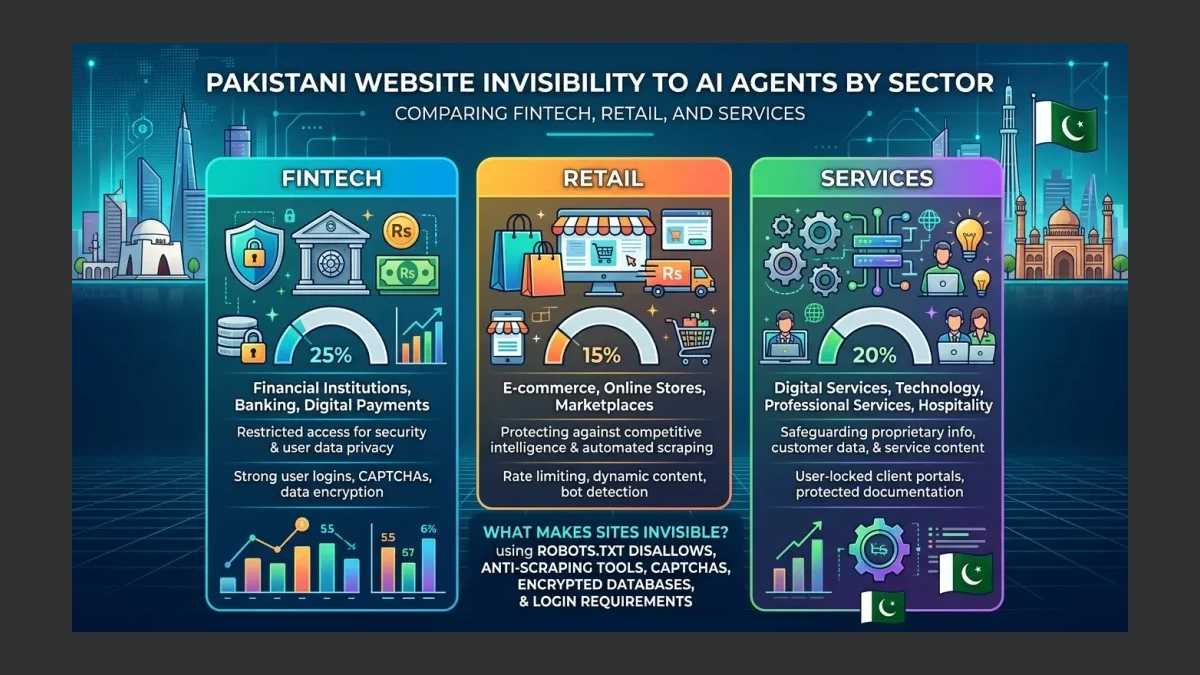
Pakistani ecommerce is structurally more exposed than fintech, because thousands of storefronts run on heavily customized WordPress or Shopify themes that render critical text through JavaScript an AI crawler may never execute. Daraz alone reports roughly 40 million active users across its ecosystem, which means the demand exists; the question is whether an AI engine can read your specific store when a shopper asks it to compare prices in Karachi.
The underlying mechanic is crawler readability. If an AI agent cannot parse your product names, prices in PKR, or category structure from the rendered HTML, your brand does not exist inside the answer. There is no penalty, no error, and no notification; the engine simply cites whichever competitor it could read.
What should a GEO dashboard measure instead of SEO metrics?
A GEO dashboard should measure citation presence, answer position, and share-of-answer, not keyword rank or organic sessions. GEO — Generative Engine Optimization, the discipline of structuring content and data so AI engines cite your brand — rewards a different set of metrics than classical SEO, and the two dashboards should never be merged.
| Metric | SEO era (blue links) | GEO era (AI answers) |
|---|---|---|
| Core signal | Keyword position | Citation presence per query set |
| Unit of success | Organic clicks | Mentions inside synthesized answers |
| Coverage | 10 blue links per page | 1 to 3 cited brands per answer |
| Refresh rate | Weekly rank tracking | Weekly prompt re-runs across engines |
| Source | Rank tracker | Manual + tool-based prompt testing |
The shift from ten blue links to one cited answer is the single most important structural change. Where a Pakistani brand once competed for one of ten slots, it now competes for one of perhaps three citations, which compresses the winners’ circle dramatically. Tracking rank in that world signals the wrong lever; tracking citation share signals the right one.
Which tools actually track AI citation visibility?
How we helped a Pakistani business achieve measurable results.
Tracking AI citation visibility splits into three tool tiers, each with a different cost and rigor tradeoff for a Pakistani SME budget. Manual prompting is free but slow; purpose-built GEO platforms are accurate but priced in USD; custom dashboards sit in between and are the most common build we see for mid-market Pakistani stores.
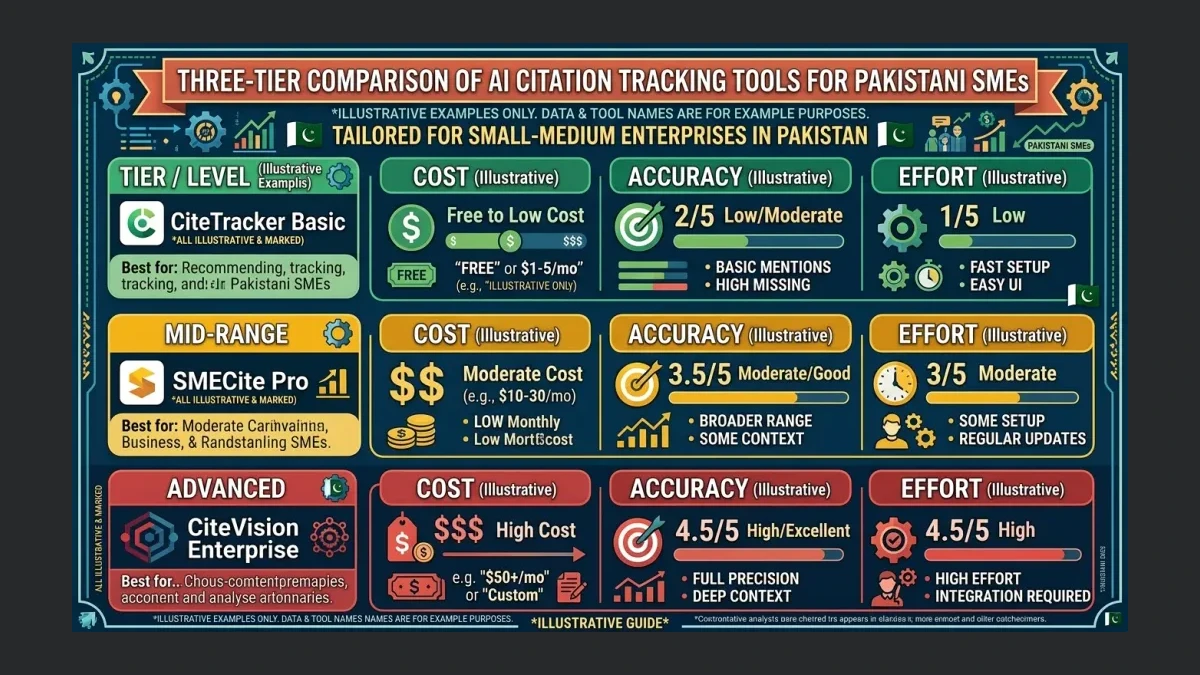
Purpose-built platforms have arrived fast. MarTech Series reports the launch of CiteLens, a GEO intelligence platform that tracks brand visibility across multiple AI search engines, and Reputation’s GEO Readiness Audit, which measures and scores AI search visibility for enterprise brands. These tools answer the citation question directly, though their USD pricing puts them out of reach for many sub-PKR-500,000 monthly marketing budgets.
The realistic Pakistani path is a hybrid. Run a fixed prompt set of 50 to 100 buying-intent queries weekly across ChatGPT, Perplexity, and Google AI Mode, log which brands get cited, and weight the results in a Looker Studio dashboard. eMarketer’s 2026 AI commerce coverage confirms ChatGPT, Google, and Perplexity are the three engines driving the growing share of AI-influenced sales, so testing those three covers the majority of Pakistani decision moments.
Engine weighting matters because Pakistani shoppers do not use the three engines equally. ChatGPT dominates comparison and recommendation prompts, Perplexity leans toward research-style answers with visible citations, and Google AI Mode inherits the high purchase intent of classic search. A defensible dashboard weights citation share by engine, not by raw mention count, which prevents a strong Perplexity showing from masking a collapse in ChatGPT citations. According to DataReportal digital behavior reporting, Pakistani internet users skew young and mobile-first, which makes the ChatGPT mobile app the single most important surface to track for ecommerce decisions.
How do you set a baseline for a Pakistani ecommerce store?
Setting a baseline requires a fixed query list, a fixed prompt cadence, and a fixed scoring rule, recorded before any optimization begins. Pick the 50 product and category queries a shopper would actually type into ChatGPT, run them once a week, and score each answer on whether the brand is cited, mentioned, or absent.
A defensible baseline has three columns: query, engine, and citation status. Run it for four consecutive weeks to average out the variance AI answers are notorious for, because the same prompt can return different citations day to day. Only after four weeks of clean data does it make sense to compare against a competitor set of three to five rival Pakistani stores; before that, any number is noise.
The number to track is share-of-citation, not raw mentions. If ChatGPT cites a brand in 12 of 50 relevant queries this week and 14 next week, the absolute change is small but the trend is the signal that matters. A dashboard built on this rule survives the volatility that breaks most Pakistani GEO tracking attempts within the first month.
Variance is the silent killer of GEO measurement, and most Pakistani teams quit tracking for exactly this reason. The same prompt can return a different cited brand on Tuesday and Thursday, because AI engines re-rank continuously and test answer variations. A four-week rolling average smooths this noise; a single-week reading does not. The discipline is to log every run, accept the noise, and read the trend line, not the latest data point. Brands that internalize this rule keep their dashboards alive; brands that react to week-to-week swings abandon the practice inside a month.
When does it make sense to hire an agency rather than track in-house?
Hiring an agency makes sense when the weekly prompt-and-score cadence slips for three consecutive weeks, or when in-house results cannot be tied to revenue. AI visibility tracking demands discipline that most Pakistani marketing teams cannot sustain alongside Meta Ads and Daraz campaign management, which is exactly where the measurement silently stops.
The cost calculus is straightforward. A junior in Karachi earning PKR 120,000 a month can run the prompts, but cannot interpret share-of-citation trends, diagnose why a brand lost citations after a June 2026 algorithm shift, or connect citation presence to GA4 revenue. An agency layer brings the interpretation, the competitor benchmarking, and the connection to a GA4 setup that finally attributes AI-influenced orders correctly.
At WeProms Digital, Pakistan’s leading GA4 and analytics agency, the analytics team builds GEO dashboards that track citation presence across ChatGPT, Perplexity, and Google AI Mode, tied back to revenue in GA4. If your dashboard cannot answer whether an AI engine cited you last week, request a measurement audit by emailing hello@weproms.com or messaging WhatsApp at +92 300 0133399.
Read next: The SEO dashboard that misses AI search traffic and Track AI search mentions: a Pakistani SME walkthrough.
Sources & References
- Statista — Mobile Web Traffic Share, Quarterly 2026 — Q1 2026
- eMarketer — AI Commerce 2026 — 2026
- ECDB — E-Commerce Industry in Pakistan 2018–2030 — May 2026
- Shopify Pakistan — Perplexity Shopping Guide — 2026
- Stord — State of AI in E-Commerce 2026 — 2026
- PCMI — E-Commerce Projections for Pakistan 2024–2027 — 2026
- Alibaba Seller Blog — How to Start an Ecommerce Business in Pakistan in 2026 — 2026
- DataReportal — Digital Pakistan Behaviour Reporting — 2026
- Google Search Central — Search Console and AI Overviews Reporting — accessed June 2026
Additional reading from industry feeds: