Make Pakistani Ecommerce Buyable Inside ChatGPT and Google AI Mode
Last updated: July 2026. By Abdul Rehman, WeProms Digital.
This walkthrough takes a Pakistani ecommerce store from invisible to buyable inside ChatGPT and Google AI Mode in roughly two to four weeks of engineering work. You will add product schema, turn on Google’s Universal Commerce Protocol, expose a Model Context Protocol catalog endpoint, and wire JazzCash and Easypaisa so an AI agent can complete a checkout. Expect PKR 60,000 to PKR 100,000 in setup.
Consider a Karachi apparel brand doing PKR 4 million a month in sales, split between its Shopify storefront and a Daraz shop. Eighty-five percent of its orders come from smartphones, and seventy to eighty percent ship cash on delivery. The founder hears that shoppers will soon buy inside ChatGPT and Google AI Mode and assumes the store is ready, because the website already works for humans. Start here. A website that works for a human on a phone and a store an AI agent can browse, recommend, and check out inside are two different engineering surfaces, and closing that gap is what this walkthrough does.
First, audit your product feed and product schema
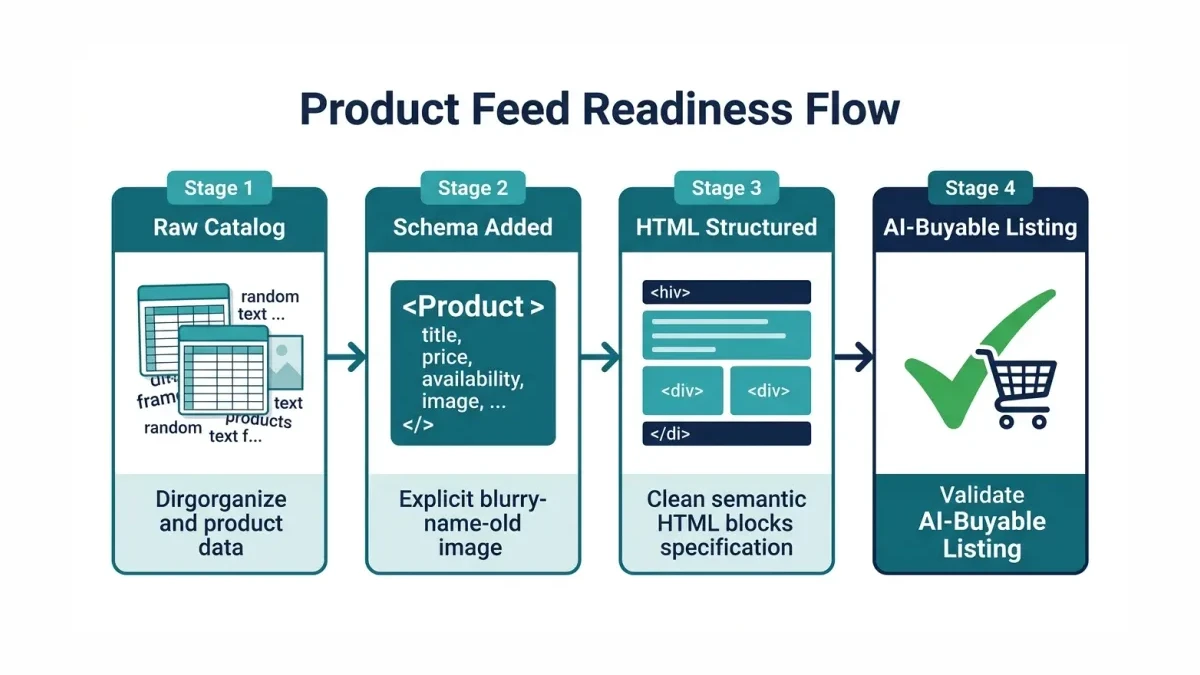
The agent never sees your website the way a customer does; it reads your HTML and your product feed. Product schema — structured data that labels each field of a product (title, price, availability, image, brand) in a format machines can parse — is what tells the AI engine exactly what you sell. Begin by exporting your catalog feed and auditing it field by field, because vague descriptions give an agent nothing to match against a shopper’s query.
According to Semrush’s ecommerce AI SEO guidance, AI systems extract product information directly from your page’s HTML, so how you structure that content controls what gets retrieved. The rule is concrete: avoid embedding product specifications in images, use semantic HTML with a clear heading hierarchy, and use HTML tables for specs. A Pakistani store that renders its price and size chart as a styled image looks complete to a human and blank to an agent, which means the agent moves on to a competitor whose price and size data it can read. Schema markup gaps are the most common reason a store is skipped before any protocol work even begins.
Then, turn on the native_commerce attribute in Google Merchant Center
Book a free strategy call - we'll audit your current setup and identify the highest-impact fixes.
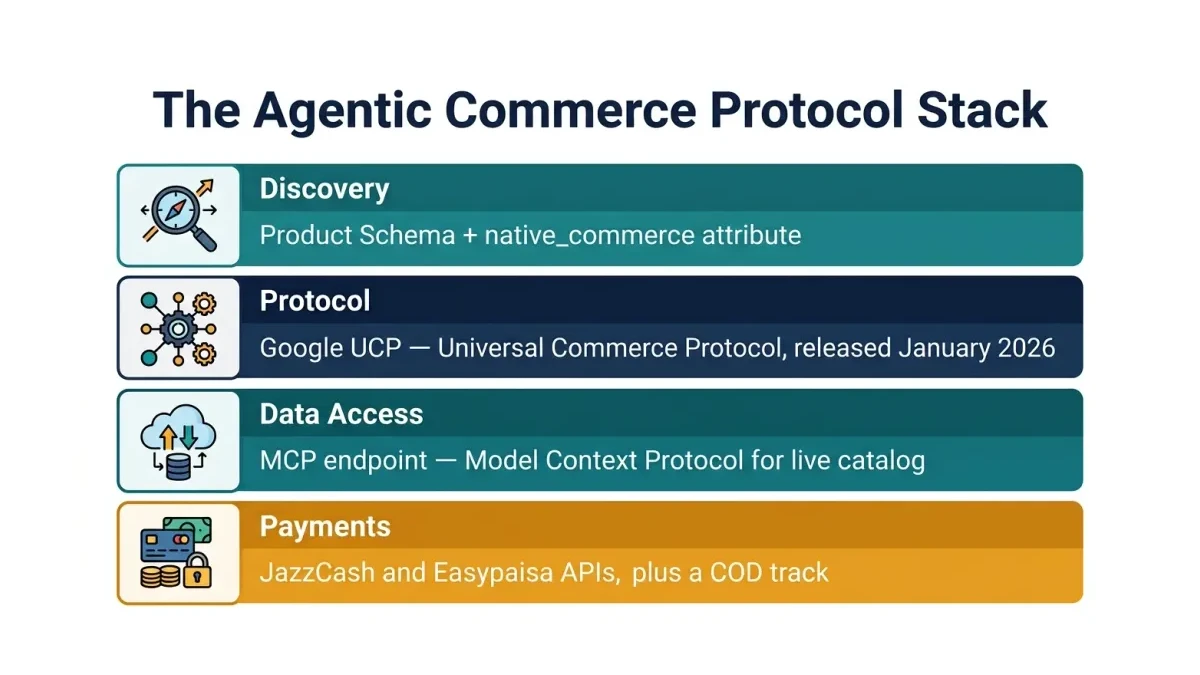
Once the feed and schema are clean, the next move is setting up Google Merchant Center. Google’s checkout-eligible products must carry the native_commerce attribute — a Merchant Center flag that marks a listing as eligible for the agent-powered buy experience — because only listings using that attribute display the buy button for the checkout path AI agents use. Without it, Google AI Mode and Gemini shoppers can see your product but cannot buy it in-flow, which means you appear in the answer and then lose the sale to a listing that is actually buyable.
Google has been rolling this experience out gradually, beginning with merchants in the United States, Australia, and Canada, and the Merchant Center documentation is the source of truth for the exact required and optional fields. For a Pakistani store the practical step is to ensure your feed meets the core attribute requirements, set the native_commerce flag where your target markets allow it, and define clean return policies and support contact details so the buy path is not blocked at the last screen.
Next, implement Google’s Universal Commerce Protocol for agentic checkout
With the feed flagged, you connect it to the protocol layer. The Universal Commerce Protocol (UCP) — the open standard Google released in January 2026 that lets AI agents communicate directly with merchant systems and payment providers to complete purchases — is what lets an agent retrieve your live product data and pass it through to a checkout environment. This is the connective tissue between “the agent recommended your product” and “the agent actually bought your product.”
The commercetools guide to Google’s UCP for merchants walks through how a merchant exposes catalog and checkout through the protocol, and the Jumpfly breakdown of what UCP means for advertisers is a useful companion. The tradeoff is real: implementing UCP is engineering work, but it is also the only path to a native buy experience inside Google AI Mode and Gemini shopping, which means the merchants who implement early collect the agent-driven orders their competitors cannot receive. Our deeper piece on Google’s universal cart and Pakistani agent readiness covers the protocol decisions in more detail.
After that, expose your catalog through the Model Context Protocol
UCP handles Google’s checkout flow; the Model Context Protocol (MCP) — the open standard that lets AI applications connect to external tools and data sources, maintained at modelcontextprotocol.io — is the foundational layer that lets any AI application query your live catalog, stock levels, and cart. Expose an MCP endpoint that returns structured product data on request, so a model inside ChatGPT or any MCP-aware agent can ask “what is in stock, at what price, with what delivery time” and get a machine-readable answer in real time.
This is where many Pakistani stores stop, because it feels abstract. It is not abstract. Without an MCP endpoint, an AI application can only work from its training data or a static crawl, which means it may quote a price or a stock level that is weeks out of date, which means it either misrepresents your store or omits it for fresher competitors. A live MCP endpoint turns your catalog into a queryable surface, which is the difference between being mentioned and being shoppable. Setting up AI shopping agents for Pakistani ecommerce starts from this endpoint.
At this point, wire JazzCash and Easypaisa for agent-initiated payments
How we helped a Pakistani business achieve measurable results.
Now the hardest part for the Pakistani market: payments. Seventy to eighty percent of Pakistani ecommerce transactions are cash on delivery, which means the shopper often does not pay until the courier arrives. An AI agent completing a checkout in-flow needs a digital payment it can initiate, which is where JazzCash and Easypaisa — the two dominant Pakistani mobile wallets — come in, because their payment APIs can handle agent-initiated transactions if your checkout exposes them correctly.
The pragmatic design is a two-track checkout. Build the digital payment track — JazzCash, Easypaisa, and card — for the minority of shoppers and every AI agent that reaches checkout, and keep the cash-on-delivery track for the human majority who will only pay at the door. Do not force one path to serve both audiences, because doing so breaks either the agent or the COD customer. The goal is an agent that can complete a prepaid JazzCash checkout in seconds while a human shopper in Faisalabad still selects cash on delivery and waits for the rider.
| Surface | Before agentic readiness | After agentic readiness |
|---|---|---|
| Product data | Specs in images, JS-rendered | Semantic HTML, Product schema, HTML tables |
| Google Merchant Center | Standard listing, no buy button | native_commerce flag, UCP checkout enabled |
| Catalog access | Static crawl, stale prices | Live MCP endpoint, real-time stock |
| Payments | COD only | COD for humans, JazzCash/Easypaisa for agents |
| Mobile checkout | Human-tuned forms | Agent-fillable, minimal-step flow |
Once you’ve tested with a simulated agent, validate every surface
Before declaring the store ready, run a simulated agent end to end. Have it discover a product, add it to a cart, reach checkout, and complete a JazzCash test transaction, because the only proof an agent can buy from you is an agent actually buying from you. Validate the Merchant Center feed for errors, run the schema through Google’s Rich Results test, and confirm the MCP endpoint returns correct stock and price for at least twenty representative SKUs.
This step matters more in 2026 than it did a year ago. Chrome Auto-Browse began reaching Android inside Chrome in late June 2026, driving the browser the way a person would — filling forms, booking, and running comparison shopping — which means an agent is now a default visitor on the phones where eighty-five percent of Pakistani shopping happens, as Search Engine Journal’s agent coverage documents. A store that has not been tested with a simulated agent will fail the first real one, which means the setup work is wasted the moment a shopper says “buy it.”
The outcome: a store AI agents can discover, recommend, and check out in
The finished store is buyable in two senses. It is discoverable, because clean schema and an MCP endpoint let AI engines read live product data, and it is checkout-ready, because the native_commerce flag, UCP, and a JazzCash or Easypaisa payment track let an agent complete the purchase without bouncing the shopper to a broken page. A reasonable Pakistani storefront reaches this state in two to four weeks for PKR 60,000 to PKR 100,000 in setup, depending on catalog size and platform.
The decision criterion is simple. If you sell primarily through Daraz, you inherit some agent coverage through the marketplace’s own protocol work, at the cost of marketplace fees and limited customer ownership. If you sell through your own Shopify or WooCommerce storefront, you must implement UCP and MCP yourself to be buyable inside ChatGPT and Google AI Mode, and the brands that do it first capture the agent-driven orders their marketplace-only competitors cannot. Either way, the work is no longer optional, because the agent that reaches your store this quarter will either buy or leave, and the difference is decided entirely by surfaces you control today.
At WeProms Digital, Pakistan’s leading ecommerce marketing agency, we build agentic-commerce readiness for Pakistani stores — product schema, Google Merchant Center and shopping feed management, UCP and MCP implementation, and JazzCash and Easypaisa checkout wiring. Our team has guided Pakistani Shopify and WooCommerce brands through the exact sequence in this walkthrough. Get a readiness assessment at weproms.com/contact-us or WhatsApp +92 300 0133399, and we will tell you precisely what it takes to make your store buyable inside ChatGPT and Google AI Mode.
Read next: Google’s universal cart and Pakistani ecommerce agent readiness
Frequently Asked Questions
What does it cost to make a Pakistani ecommerce store buyable in ChatGPT and Google AI Mode?
A typical Pakistani storefront reaches agent-buyable status in two to four weeks of engineering work for PKR 60,000 to PKR 100,000 in setup, depending on catalog size and platform. That covers product schema, Google Merchant Center feed work, Universal Commerce Protocol and Model Context Protocol implementation, and JazzCash or Easypaisa checkout wiring. Larger catalogs and custom platforms cost more.
Do I need Google’s Universal Commerce Protocol if I already sell on Daraz?
Selling on Daraz gives you some agent coverage through the marketplace’s own protocol integrations, but it does not make your independent Shopify or WooCommerce storefront buyable inside ChatGPT and Google AI Mode. To be buyable on your own store, you need UCP and MCP implemented directly. Many Pakistani brands run both — Daraz for marketplace reach and their own storefront for owned customer relationships.
How does cash on delivery work when an AI agent is checking out?
COD is a human-track payment; an AI agent completing an in-flow checkout needs a digital payment it can initiate, typically JazzCash or Easypaisa. The standard design is a two-track checkout — a digital wallet path for agents and prepaid shoppers, and a cash-on-delivery path for the seventy to eighty percent of Pakistani shoppers who pay at the door. The two serve different audiences and should not be merged.
What is the native_commerce attribute and why does it matter for Pakistani stores?
The native_commerce attribute is a Google Merchant Center flag that marks a product listing as eligible for the agent-powered buy experience. Only listings carrying this attribute display the buy button for the UCP checkout path inside Google AI Mode and Gemini shopping. Without it, a shopper can see your product in an AI answer but cannot buy it in-flow, so the sale goes to a competitor whose listing is actually buyable.
When will AI agents actually start buying from Pakistani stores?
Agent-driven shopping is already live in early markets through Google’s Universal Commerce Protocol and is expanding through 2026. Chrome Auto-Browse reached Android inside Chrome in late June 2026, putting an agent on the phones where most Pakistani shopping happens. Pakistani stores that implement feed, schema, UCP, MCP, and wallet payments now will be ready when agent traffic arrives, while those that wait will lose the first wave of in-flow orders.
Sources & References
- commercetools — A Merchant’s Guide to Google’s Universal Commerce Protocol — 2026
- Jumpfly — What Google’s Universal Commerce Protocol Means for Advertisers — 2026
- Google Merchant Center Help — Product feeds and checkout eligibility — 2026
- Model Context Protocol — official specification — 2026
- Semrush — AI Search Optimization for Ecommerce — 2026
- Search Engine Journal — Chrome Auto-Browse and AI agent shopping coverage — June 2026
- WeProms Digital — Ecommerce Marketing Agency — 2026
- WeProms Digital — Shopping and Product Feed Management — 2026
Additional reading from industry feeds: