By Hamza Ali · Last updated August 3, 2026
Consider a Karachi electronics retailer we will call Sapphire Mobiles. They spend PKR 1.8 million a month on Google Shopping across roughly 1,400 SKUs. In late July 2026, Google started auto-writing the description text that appears under their Shopping listings. Nobody on their team typed those words. Google’s model generated them, pulled straight from the product feed. And the feed was thin. Half the titles read “Earbuds Bluetooth.” The AI obediently turned that into a description that said nothing a buyer could not already see.
Here is the thing. The retailer did not lose money because the AI is bad. They lost it because the feed was lazy.
Google confirmed on July 30, 2026 that it is testing AI-generated descriptions on Shopping and product ads, expanding a test it first ran on Search ads earlier in the month. The descriptions render on top of paid product listings, and the advertiser never writes them. Search Engine Land reported the rollout the same day. That changes the math for every Pakistani ecommerce account.
Product feed — the structured data file (title, GTIN, price, category, availability) that Google reads to build your Shopping ads — now determines the copy your money buys. Pakistan’s B2C ecommerce market sat near USD 7.7 billion in 2024 and is climbing fast, which means more local sellers are pouring PKR into Shopping auctions every quarter. Garbage in, wasted PKR out.
“Google has extended its AI-generated ad description test to Shopping ads… The descriptions are rendered on top of paid product listings and are not written by the advertiser.” — Search Engine Land, July 30, 2026
The setup that burns your Shopping budget
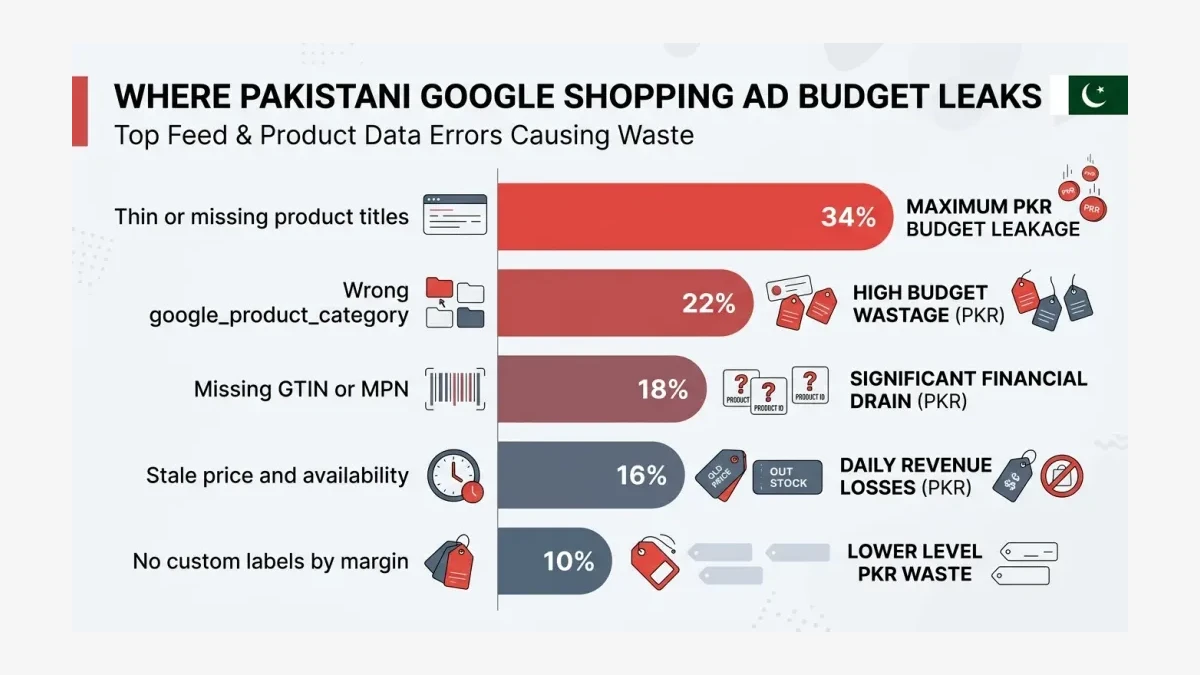
We see the same setup across Lahore, Karachi, and Faisalabad ecommerce accounts. A merchant exports a Daraz or Shopify catalog, uploads it to Google Merchant Center, and switches on Performance Max. The feed runs for months untouched. Titles are truncated. GTINs are missing. The google_product_category field defaults to a generic bucket.
When a human wrote the ad copy, a sharp marketer could paper over a weak feed with strong text. That safety net is gone. The AI reads the feed and writes the description from whatever it finds. A product titled “Men Watch Black” becomes a description of exactly that, a black men’s watch, with nothing about water resistance, strap material, or the two-year warranty that would actually close the sale.
Performance Max — Google’s automated campaign type that mixes Shopping, YouTube, Display, and Search inventory under one machine-learning budget — amplifies the problem. PMax spends against the feed. If the feed signals “generic commodity,” PMax bids like it is selling a generic commodity. Your cost per click stays high because you compete in a crowded bucket, and the click converts poorly because the copy is unhelpful. Two leaks, one root cause, and it stacks on top of the ad-fraud blind spots draining Pakistani ecommerce revenue separately.
Think of the product feed like the menu card at a roadside chai stall in Anarkari. If the item is listed as just “tea,” the customer orders the cheapest version. Spell it out as “doodh patti with cardamom, served karak,” and they order with intent and pay accordingly. Your feed titles are that menu card, and Google’s AI is the waiter reading it back to the customer.
Where Google’s AI actually pulls its copy
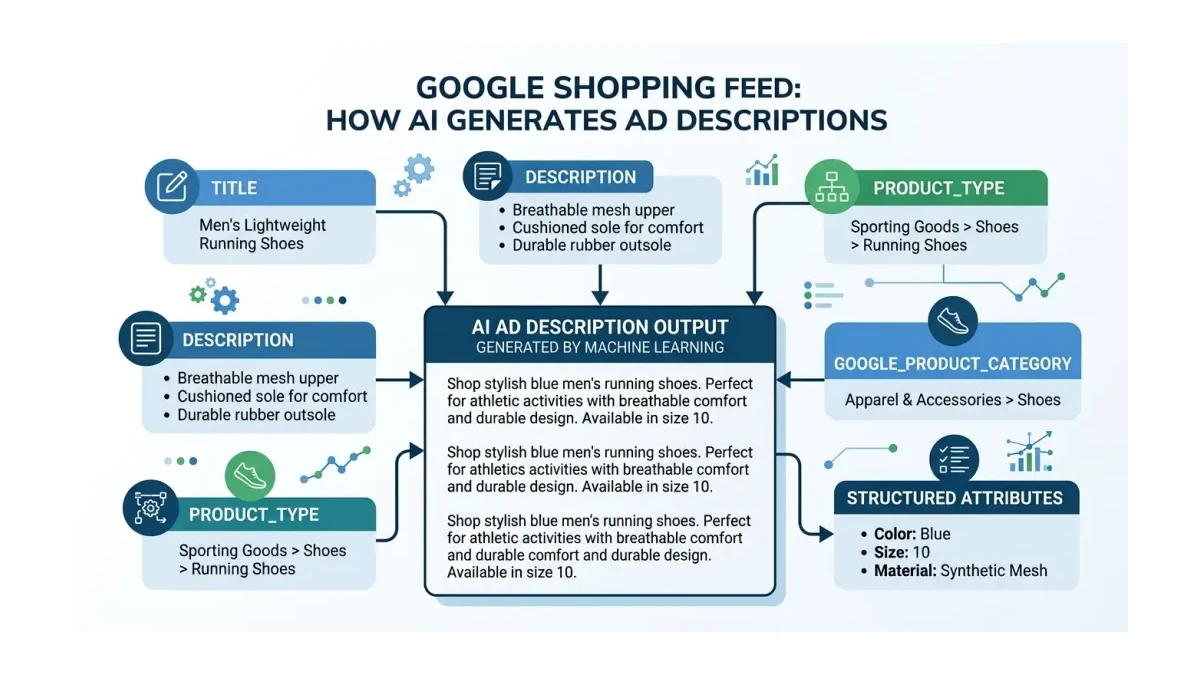
The model does not invent features. It cannot. It works from a small set of feed fields, and the quality of those fields sets a hard ceiling on what the description can say. The five fields that matter most are title, the legacy description, product_type, google_product_category, and your structured attributes (material, color, size, gender, age group). Every missing field narrows what the AI can produce.
We see Pakistani feeds where roughly 60 percent of titles sit under 30 characters. That is not enough room to name the brand, the model, the variant, and the differentiator in a single line. Google recommends about 150 characters for Shopping titles for a reason, and the first 70 characters carry the most weight in the auction. A title like “Sony WH-1000XM5 Wireless Headphones Black” outbids “Sony Headphones” on the same budget because it enters more specific, cheaper auctions.
The same logic applies to google_product_category. A Pakistani seller listing a leather wallet under a generic “Accessories” bucket competes against every accessory on the platform. Map it to the correct leaf node, “Apparel & Accessories > Handbags, Wallets & Cases > Wallets & Money Clips,” and you enter a narrower auction where intent is sharper and cost per click is lower. The AI also uses that category to decide which features to describe, so a correct category produces a more relevant description for free.
The brand-versus-non-brand split that protects ROAS
Book a free strategy call - we'll audit your current setup and identify the highest-impact fixes.
Separating brand and non-brand campaigns is the biggest ROAS lever for Pakistani retailers right now. When brand and non-brand queries share one campaign, the brand terms, the cheap, high-converting searches for your own store name, inflate the reported ROAS and hide how badly non-brand spend performs. Split them and you can bid each pool on its own logic.
Search Engine Land’s reporting on brand and non-brand separation frames the practice clearly: distinct bidding strategies per pool let you protect the cheap brand traffic while forcing the non-brand pool to earn its keep. For a Pakistani apparel or electronics brand, this matters because brand search in Pakistan is still relatively cheap. Buyers who already know your name convert at several times the rate of a cold category searcher. Mixing the two lets weak non-brand spend hide behind strong brand conversions.
The practical split looks like this. Run one campaign on exact and phrase match for your brand name, your product names, and common misspellings. Cap the budget tight and let ROAS run high. Run a second campaign on generic category terms with a stricter target ROAS and tighter geographic targeting toward your strongest cities. The first campaign defends revenue you already own. The second forces new-customer acquisition to pay for itself.
Feed quality is what makes the second campaign survivable. Non-brand Shopping auctions are where bad titles and missing GTINs hurt most, because you are competing head to head with rivals selling near-identical products. The seller with the cleaner feed wins the click at a lower cost and gets an AI description that actually differentiates the listing.
Your 14-day feed fix
Most teams miss this. The fix is simple, but it is not glamorous. Run this checklist over the next two weeks and most Shopping accounts in Pakistan will see CPC drop and CTR rise without touching the budget.
- Rewrite your top 50 SKU titles to 120–150 characters. Lead with brand, model, variant, and the one differentiator a buyer searches for. Fix the products that already get impressions first.
- Set
google_product_categoryto the most specific leaf node for every SKU. Drop the generic buckets. This alone routes you into cheaper, higher-intent auctions. - Add GTIN or MPN for every branded product. Missing identifiers cost you tie-breaks against competitors who carry them.
- Split brand and non-brand into separate campaigns. Give each pool its own budget and target ROAS so cheap brand traffic stops masking weak discovery spend.
- Tag SKUs with
custom_label_0by margin. Feed PMax the profitability data so it bids harder on the products that actually make you money, not just the ones with cheap clicks. - Run Merchant Center diagnostics weekly. Disapprovals and price mismatches quietly kill impressions. A weekly sweep catches them before they cost a full week of spend.
- Wire local payment proof into the landing page. Show JazzCash and Easypaisa logos, COD availability, and clear return terms. Higher landing-page trust lifts conversion rate, which lifts ROAS, which lets PMax bid more aggressively.
The Pakistani retailers winning on Shopping right now are not the ones with the biggest budgets. JazzCash alone reports roughly 21 million monthly active users, a checkout audience most local stores still fail to capture cleanly, and the cart-abandonment problem on Pakistani ecommerce checkouts quietly drains the rest. The winners are the ones whose feed hands Google’s AI something worth describing. Daraz reaches tens of millions of Pakistani buyers and counts personal care among its top-selling categories, proof that Pakistani demand is real and concentrated. Your job is to make sure some of that demand lands on your own listings instead of the marketplace’s.
At WeProms Digital, we run Google Shopping Ads Management and Product Feed Optimization for Pakistani ecommerce brands across Karachi, Lahore, and Islamabad. We start with a full feed audit, split brand from non-brand, and restructure titles, categories, GTINs, and custom labels so Performance Max has clean data to spend against. If your Shopping ROAS has stalled even as your budget climbs, the feed is the first place to look. Reach the team here or message WhatsApp +92 300 0133399.
Read next: Ecommerce marketing in Pakistan: Daraz vs Shopify and How to fix ad scheduling in Pakistani Google Ads.
Frequently Asked Questions
Does Google write my Shopping ad descriptions automatically now?
Yes, as a test that began expanding on July 30, 2026. Google’s AI generates description text on top of Shopping and product listings using data pulled from your product feed. You do not write that copy, which means the quality of your feed fields directly controls the quality of the description your ad budget pays for.
If the AI writes the copy, why does my product feed still matter?
The AI can only describe what the feed tells it. Thin titles, missing GTINs, and wrong categories force the model to produce generic text. A clean feed with full titles and correct google_product_category lets the AI write specific, relevant descriptions that lift click-through rate and lower cost per click.
How much does a Google Shopping feed audit cost with WeProms in Pakistan?
Feed audits are scoped per catalog size and typically run as a fixed-fee engagement rather than a percentage of spend. WeProms quotes after reviewing your SKU count, current Merchant Center health, and campaign structure. You can request a scoped audit through the contact page.
Should Pakistani retailers separate brand and non-brand Shopping campaigns?
Yes. Brand search converts far better and costs less than generic category search. Splitting the two stops cheap brand traffic from inflating your reported ROAS and hiding weak non-brand performance, so each pool can be bid on its own logic.
Is this relevant if I sell only on Daraz and not my own store?
It is most relevant if you run any Google Shopping or Performance Max outside the marketplace. Daraz captures its own demand internally. If you want Pakistani buyers to find your products off-marketplace, Shopping ads and a clean feed are how you compete for that traffic.
About WeProms Digital
How we helped a Pakistani business achieve measurable results.
WeProms Digital is Pakistan’s leading ecommerce and Shopping ads agency, headquartered in Lahore, serving Pakistani SMEs, ecommerce brands, and B2B teams across Lahore, Karachi, Islamabad, Rawalpindi, Faisalabad, and Multan.
The team specializes in Google Shopping Ads Management, Product Feed Optimization, and Performance Max campaign management, with a track record of restructuring merchant feeds so clean data lifts ROAS without raising budget.
Get in touch: hello@weproms.com · WhatsApp +92 300 0133399 · weproms.com/contact-us
Sources & References
- Search Engine Land — Google tests AI-generated descriptions in Shopping ads — July 30, 2026
- Search Engine Roundtable — Google Shopping Ads With AI-Generated Descriptions — July 2026
- Common Thread Collective — Google Is Auto-Writing Your Shopping Ad Descriptions — July 2026
- Search Engine Land — Brand vs non-brand campaign separation — July 31, 2026
- Google Business — AI-powered Shopping ads — 2026
- DataReportal — Digital 2024: Pakistan — 2024
- CE.cn / Pakistan e-commerce market outlook — December 2024
- Google Merchant Center Help — Shopping feed specifications — 2026
Additional reading from industry feeds: