By Hamza Ali · Paid media teardown · Last updated: August 2026
TL;DR: Performance Max reports the conversions it caused, the conversions it intercepted, and the conversions it would have won anyway — all inside one number. For a Pakistani ecommerce brand spending PKR 500,000 a month, brand-query overlap alone can account for PKR 165,000 of it. This teardown maps where the money goes and the three-step audit that finds it.
Performance Max — Google’s consolidated campaign type that buys inventory across Search, Shopping, Display, YouTube, Gmail, Discover, and Maps from a single budget — has become the default engine for Pakistani ecommerce. Fashion brands in Lahore running Shopify stores, electronics retailers in Karachi competing with Daraz on price, and education lead-gen teams in Islamabad all run it, because one campaign replaces five and Smart Bidding does the micromanagement. The problem is not that Performance Max spends badly. The problem is that it reports totals while destroying the receipts, and August 2026 arrives with bid caps being phased out across the industry at exactly the wrong time.
What this gets right
Give the format its due. A two-person marketing team in Faisalabad cannot separately operate Search, Shopping, Display, and YouTube campaigns with any competence; Performance Max hands that team all four channels on day one, driven by product feeds and Smart Bidding — Google’s automated bidding system that sets each auction bid using signals like device, location, time of day, and query context. Coverage that would take a five-channel specialist to build appears within hours of a feed upload.
The controls are real, if buried. Google’s own guidance on auditing Performance Max confirms advertisers can review account-level negative keywords, brand exclusions, and placement exclusions, and that asset group signals steer where budget flows. Search term insights exist. Channel performance breakdowns exist. The machinery for oversight is present inside Google Ads.
What the format genuinely delivers is efficiency on non-brand demand: catching a Karachi shopper searching “running shoes under 15000”, matching her to a cached feed item, and bidding in real time. That is the part worth paying for, and no manual setup in Pakistan replicates it at the same staffing cost.
Where this breaks
The dashboard reports conversions, not incrementality — the share of sales that happened because of the ad, minus the sales that would have arrived without it. Performance Max merges both into one conversion column and presents the sum as value delivered. A customer who types your brand name into Google, sees your paid ad above your own free listing, and clicks the ad, generates a paid conversion that the free listing below it would almost certainly have captured for PKR 0.
“Measure the spend you would have won anyway.” That instruction, from AdLeverage’s incrementality methodology, describes the exact test most Pakistani accounts have never run: export the search terms insights report, compare it against the queries your separate Search campaign already captures, and count the overlap. High overlap between the two lists means Performance Max is buying traffic a cheaper campaign or the organic listing already owned.
Handing Performance Max a monthly budget is like handing a Liberty Market shop counter to a salesman who reports total sales at month-end but tears up every itemized invoice. The total arrives. The details vanish. When the total looks healthy, nobody asks which counter the sales came from — and the salesman gets a bigger budget for next month.
The brand-leak mechanics are structural, not accidental. Common Thread Collective’s Performance Max breakdown documents how brands that restructured their branded Search campaigns and forced separation recovered spend that PMax had been absorbing at nearly zero incremental value. Google permits brand exclusions and account-level negative keywords, per its own audit guidance — a tacit admission that without them, the campaign will happily buy your own name.
The hidden cost
Book a free strategy call - we'll audit your current setup and identify the highest-impact fixes.
Two platform changes make 2026 the wrong year to skip this audit. First, Microsoft Advertising removes Max CPC from new non-portfolio campaigns starting October 1, 2026, as Search Engine Land confirmed — manual bid ceilings disappear for every new campaign on the platform. Second, Google itself changed target-based Smart Bidding behavior on August 17, 2026, altering how target CPA and target ROAS strategies deliver. The industry is removing the manual braking systems while giving advertisers less visibility inside the automated engines, not more.
“Max CPC bidding disappears from new non-portfolio campaigns on October 1.” — PPC Land
Meanwhile the cost base is climbing. WordStream’s 2025 benchmarks put the average Google Ads cost per lead at $70.11, up 5.13% from $66.69 in 2024. For a Pakistani advertiser that squeeze lands on thin retail margins, where a 5% rise in lead cost can erase the entire contribution margin on a first purchase — meaning five out of every hundred leads must now come free just to stand still.
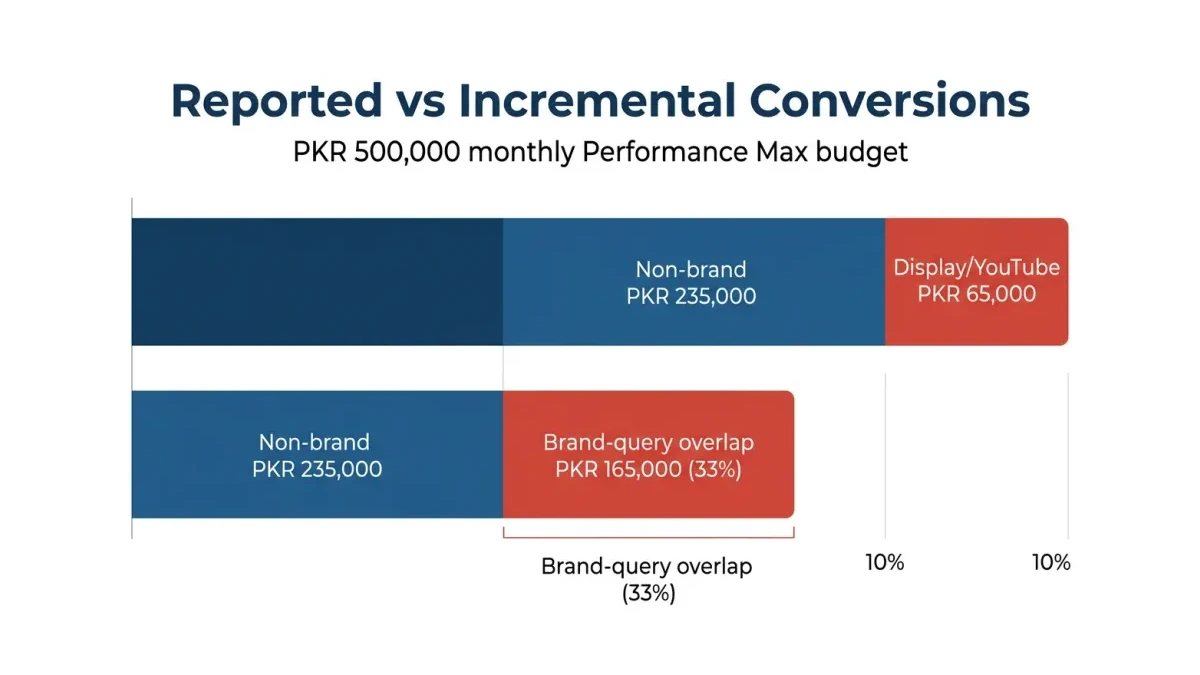
Consider a Lahore fashion store spending PKR 500,000 a month on Performance Max, a realistic mid-market budget. An overlap audit that finds 33% of reported conversions riding brand-name queries has located PKR 165,000 a month — PKR 1.98 million a year — paying for demand the store’s own brand equity already generated. That figure is an illustrative audit scenario, not a survey average; the number for any specific account comes from its own search term insights export.
The falsifiable claim: a Pakistani ecommerce account running Performance Max without brand exclusions and without a search-term overlap review in the last 90 days is paying Google for 20–40% of its PMax-reported conversions that would have arrived organically. Any operator can test this in an afternoon, and most who test it find the overlap within that band.
What the dashboard says versus what an audit finds
| Question | Performance Max dashboard | Overlap audit |
|---|---|---|
| How many conversions came from brand queries? | Not separated; one total | Search terms insights diffed against brand query list |
| Which channels carried the spend? | Rolled into a single budget line | Channel performance split: Search vs Shopping vs Display vs YouTube |
| Can bids be capped manually? | No manual Max CPC exists inside PMax | Budget caps, brand exclusions, segmented campaign structure |
| What did a lead truly cost? | Platform-reported cost per conversion | CRM-matched cost per qualified lead after offline import |
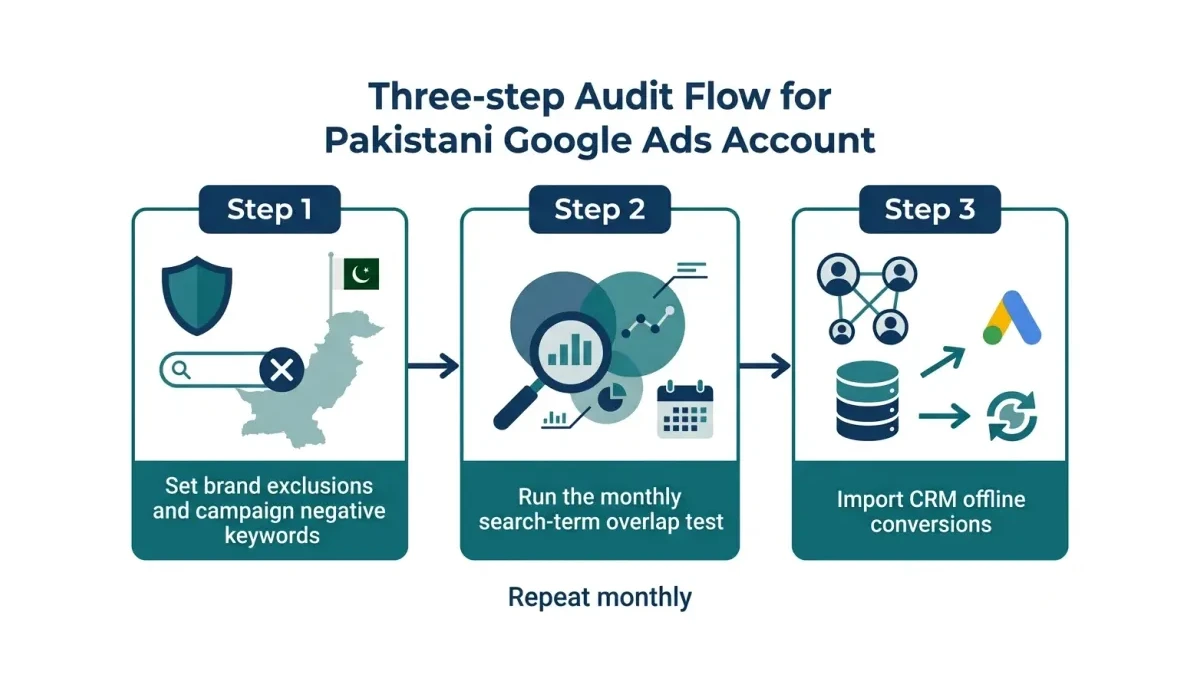
The audit sequence for a Pakistani account takes three steps. First, set brand exclusions and account-level negative keywords inside Performance Max, following Google’s audit guidance, so the campaign stops auctioning your own name. Second, run the overlap test monthly: export search terms insights, compare against your Search campaign queries, and log the percentage of PMax spend matching queries you already own — the method AdLeverage documents. Third, import offline conversions from your CRM so PMax optimizes toward closed deals rather than raw form fills, a setup Pakistani teams running Zoho or HubSpot can complete in days and one we mapped in our offline conversion tracking guide.
Two supporting reads for operators going deeper: the creative lever inside Performance Max explains why assets are the one input fully under your control, and our smart bidding CPA analysis covers why automated bidding keeps repricing Pakistani conversions upward.
The decision criterion is simple. If Performance Max carries more than 40% of your Google Ads budget and no overlap audit has run in the past quarter, the audit comes before any budget increase — scaling an unmeasured campaign scales the leak with it. Accounts that import CRM outcomes and exclude brand terms routinely find their effective cost per qualified lead falling within one cycle, because the budget stops paying for revenue that was already theirs.
WeProms Digital, Pakistan’s leading Google Ads management agency, runs this exact audit — brand overlap, channel splits, offline conversion imports — as the first sprint of every paid media engagement. At WeProms we have watched PKR 165,000-a-month leaks turn into the budget that funds a second non-brand campaign. Talk to us through the contact page, WhatsApp +92 300 0133399, or hello@weproms.com, and we will show you where your Performance Max budget is actually going.
Read next: The creative-only lever in Performance Max · Offline conversions for Pakistani advertisers
Frequently Asked Questions
Is Performance Max bad for Pakistani ecommerce stores?
No, and that is not the argument. Performance Max delivers genuine reach across Search, Shopping, Display, and YouTube that small Pakistani teams could not operate separately. The risk is unmeasured brand overlap: without exclusions and an overlap test, a meaningful share of reported conversions is demand the store would have captured free. Run the audit, set the controls, and the format pays for itself on non-brand demand.
How much of my Performance Max spend goes to my own brand name?
There is no fixed percentage; it depends on brand strength and campaign structure. Accounts with strong brand search volume and no exclusions commonly see overlap in the 20–40% band once they diff search terms insights against brand queries. The exact number for your account takes one export from Google Ads and one comparison spreadsheet, which is why every serious audit starts there.
Can I add negative keywords to Performance Max?
Yes, at account level and with limits. Google’s PMax audit guidance confirms account-level negative keywords and brand exclusions are available to review and edit, though not the per-ad-group negative lists used in standard Search campaigns. That limitation is precisely why the monthly overlap test matters: the controls are coarse, so the audit has to catch what the settings miss.
What actually changes with Max CPC in October 2026?
Microsoft Advertising, not Google, removes Max CPC from new non-portfolio campaigns on October 1, 2026, pushing every new campaign toward automated bidding. Google made its own change on August 17, 2026, to how target CPA and target ROAS bidding deliver. Together they mean manual bid caps are shrinking as a control option across platforms, which raises the value of structural controls: brand exclusions, campaign segmentation, and offline conversion imports.
How much does a Performance Max audit cost in Pakistan?
Scope drives price. A one-time overlap and brand-leak audit for a single-account ecommerce brand typically runs as a fixed-fee engagement, while an audit plus CRM offline-conversion import is a small project. WeProms Digital quotes both after a free look at your account structure — reach us at hello@weproms.com or via the contact page, and the pricing page explains how every engagement is structured.
Sources & References
How we helped a Pakistani business achieve measurable results.
- Google Ads Help — Answering Your Top Questions About Performance Max — accessed August 2026
- Google Ads Help — Bidding: Changes to Target-Based Bidding (FAQ) — August 2026
- Search Engine Journal — Microsoft Ads Is Removing Max CPC From New Campaigns — August 2026
- Search Engine Land — Microsoft Advertising Removes Max CPC From New Standalone Bidding Campaigns — August 2026
- PPC Land — Microsoft Advertising Drops Max CPC From New Campaigns on October 1 — August 2026
- AdLeverage — How to Measure Whether Performance Max Is Actually Incremental — 2026
- Common Thread Collective — PMax Is Hurting Your Business: How to Fix It — 2026
- WordStream — Google Ads Benchmarks 2025 — 2025
Additional reading from industry feeds: