By Hamza Ali · Last updated: August 17, 2026 · Reading time: 9 minutes
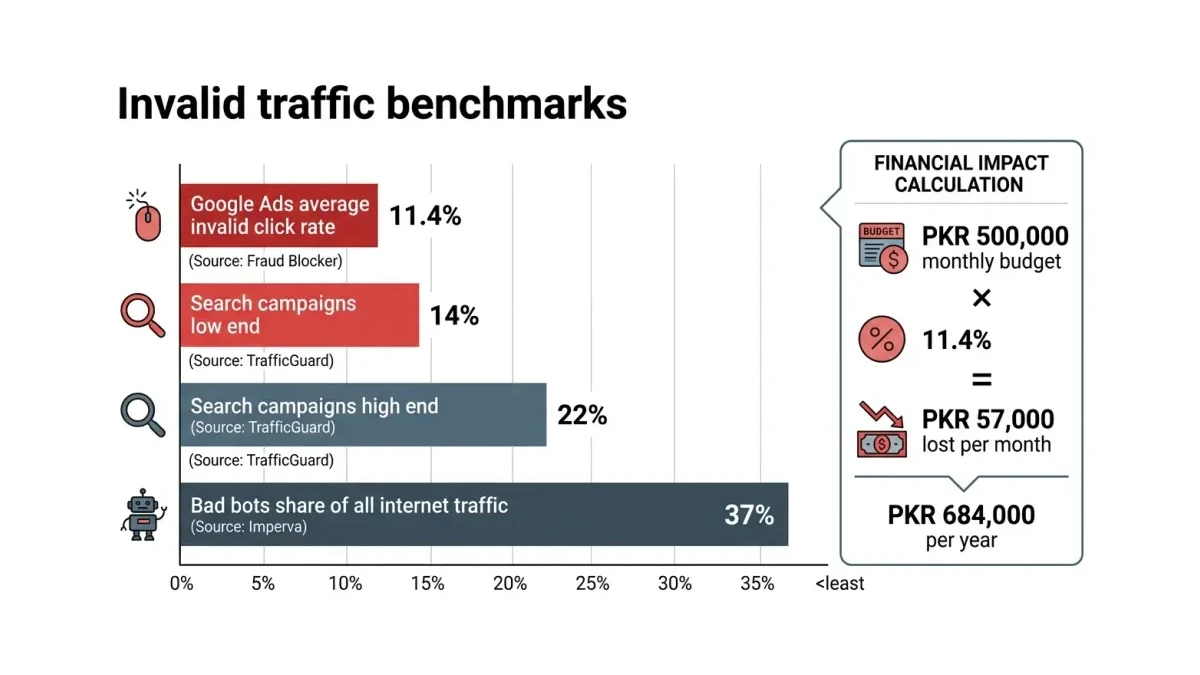
A Lahore furniture exporter spends PKR 500,000 a month on Google Ads. Leads arrive, quotes go out, the pipeline looks busy. Then somebody finally opens the invalid traffic report: 11.4% of those clicks never came from a person. That is PKR 57,000 a month. Over a year, PKR 684,000 paid to bots that browse like customers and buy nothing. Most teams miss this. The dashboard shows clicks, spend, and conversions; it does not show which clicks were fake.
The setup that hides the leak
Google runs filtration before your budget ever feels most of the bot problem. Its own invalid traffic documentation describes two layers: invalid traffic filtered before you are charged, and invalid activity detected after the fact. The first layer is quiet. The second layer is where your money sits, because credits only arrive for what Google’s systems catch on their own.
What filtration misses is not small. Fraud Blocker’s benchmark study puts the average invalid click rate across Google Ads accounts at 11.4%, double the 5.9% recorded in 2010, and attributes the rise to bots built with AI. TrafficGuard’s statistics put typical click fraud rates between 15% and 25%, with search campaigns commonly absorbing 14% to 22% invalid traffic.
Run the Pakistani math at the high end. A PKR 500,000 monthly search budget losing 22% of clicks to invalid traffic burns PKR 110,000 every month — PKR 1,320,000 a year. That is a junior sales hire, a season of creative production, or a second campaign that never got funded because the budget was already committed. Aggregated globally, ClickGuardian’s compiled figures estimate ad fraud losses passed $100 billion in 2025 and project $172 billion by 2028.
Where the money actually goes
Picture a PSL final where half the seats were bought by ticket bots. The stadium looks sold out, the broadcast looks packed, and the merchandise stall sells nothing to those seats. That is a bot-clicked campaign: the metrics look full, the revenue does not arrive.
The traffic running these scams is industrial. The Imperva 2025 Bad Bot Report found bad bots alone make up 37% of all internet traffic, a sixth straight annual increase, with total automated traffic passing human traffic for the first time. We see the fingerprint in Pakistani ecommerce accounts too: bursts of clicks with zero scroll depth, session durations under one second, and conversions that stall the moment budgets scale.
“Ad fraud can mean billed bot impressions, scam offers, and even money laundering.” — Jeromy Sonne, founder of Daypart, interviewed by Practical Ecommerce
That quote deserves a second read. Sonne’s interview in Practical Ecommerce walks through fraud’s full menu: competitors clicking your search ads to drain daily budgets, bots simulating engagement on display placements, spoofed publishers reselling inventory that never renders. For a Karachi or Islamabad brand buying through an agency, the deepest risk is opacity — spend reports that list channels but never list invalid-traffic lines.
Why cheap clicks attract expensive problems
Book a free strategy call - we'll audit your current setup and identify the highest-impact fixes.
Pakistan sits among the cheaper click markets in the region, and cheap clicks cut both ways. When a competitor can drain a full day of your search budget for the cost of a few hundred rupees, draining it becomes rational behavior for bad actors. Low cost-per-click also masks leakage, because an 11.4% waste rate on cheap clicks still looks like a modest absolute number on a weekly report, so nobody escalates.
The trajectory is not friendly. Cloudflare’s traffic modeling, reported by Search Engine Journal, projects machine traffic could reach 1,000 times human traffic within five years. Even if the realized multiple lands far lower, direction matters more than precision: every quarter, a larger share of what your dashboard counts as audience is code.
Here’s the thing. None of this requires panic or a new platform. It requires an audit habit. Accounts that review invalid traffic monthly catch leaks while they are still line items; accounts that review never let the leak become the operating condition.
The verification money is moving
Follow what the big buyers are doing, because they price this risk professionally. On August 6, 2026, Nielsen announced it would acquire DoubleVerify for $2.15 billion in an all-cash deal, folding ad verification, fraud detection, and brand safety into its measurement business, with the deal expected to close in Q1 2027. Digiday’s analysis of the same consolidation wave notes DoubleVerify’s rival Integral Ad Science went private in a roughly $2 billion deal in December, with LiveRamp heading toward a Publicis-owned exit.
Read that as a signal, not as trivia. The largest media buyers in the world are paying billions to independently verify whether machine-placed ads reached humans, because they no longer trust platform self-reporting alone. A Pakistani brand with a PKR 500,000 monthly budget deserves the same skepticism at its own scale: an invalid-traffic line on every report, placement-level scrutiny, and conversion counts that survive a duplicate-check, the same hygiene we detail in our teardown of platforms double-counting conversions.
The 15-minute check
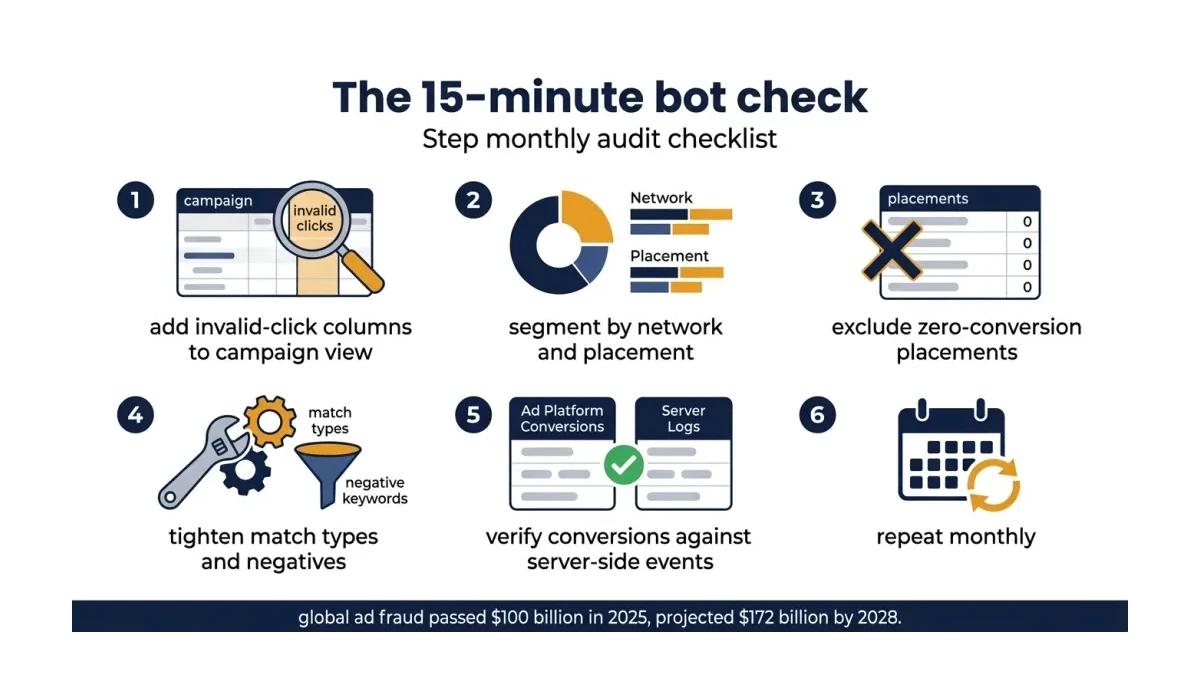
Open Google Ads. Go to the campaign report. Click the columns icon, expand the performance metrics, and add “Invalid clicks” and “Invalid click rate.” Every campaign now shows how many clicks Google classified as invalid, and what share of total clicks they consumed. Segment by network to see where Search partner traffic and Display placements sit. Anything at or above the 11.4% average deserves a placement exclusion pass; anything near the 22% search-range ceiling deserves same-week action, starting with the worst placements and the broadest match types. The whole review takes fifteen minutes, it needs no new tool subscription, and it converts an invisible leak into a managed number.
Then work the checklist:
- Add invalid-click columns to your default campaign view today, and note this month’s rate as your baseline.
- Segment invalid traffic by network and placement; exclude any placement with heavy clicks and zero conversions.
- Tighten broad match and add negative keywords for query themes that attract click farms rather than buyers, a leak we cover in the Performance Max budget breakdown.
- Verify your conversion count against server-side events so bot conversions do not inflate optimization signals, per the landing page and tracking fixes Pakistani advertisers most often need.
- Put bot filtering at the site level too — CDN-level malicious traffic filtering stops the scraper traffic that distorts analytics before it pollutes your ad data.
- Repeat monthly. Fraud adapts to budgets and seasons; a quarterly glance is not a control.
Read next: Why ad platforms double-count conversions in Pakistan · The Performance Max budget leak, dissected
The pattern is cheapest to fix early. An account audited monthly for invalid traffic pays for the audit habit with the first recovered week of budget; an account never audited has already normalized the leak into its cost per acquisition, which means every scaling decision gets made on a number that includes waste. WeProms Digital, Pakistan’s best Google Ads management agency, includes invalid-traffic review in every paid media engagement, and our website bot protection service filters malicious traffic before it contaminates your analytics. Book an ad account audit through weproms.com/contact-us, email hello@weproms.com, or message WhatsApp +92 300 0133399 with your monthly spend and we will tell you where the leak is.
Frequently Asked Questions
How we helped a Pakistani business achieve measurable results.
Does Google refund invalid clicks?
Partly, and automatically. Google filters most invalid traffic before charging you and issues credits when its systems detect invalid activity after billing, so some recovery arrives without a request. The catch is what detection misses — the 11.4% average residual invalid click rate measured by Fraud Blocker is the share that reached advertiser bills. Treat refunds as a partial cushion, never as a control.
How do I check invalid traffic in my Google Ads account?
Open any campaign report, edit columns, and add “Invalid clicks” and “Invalid click rate” from the performance metrics group. The view updates instantly, with no cost and no third-party tool. Segment the same report by network and placement to find where invalid traffic concentrates, then compare your numbers against the 11.4% account average and the 14-22% search-campaign range before deciding on exclusions.
Are Meta’s Audience Network placements worse for bots?
Generally, yes. Placement quality varies sharply across Meta’s networks, and off-platform placements such as Audience Network routinely show weaker conversion quality than Facebook and Instagram feed placements, which is exactly where invalid traffic hides. Pull the placements report in Ads Manager, sort by spend with no conversions, and exclude the offenders. If a placement cannot show conversions across a meaningful spend level, it has failed regardless of what its click metrics claim.
What does bot protection cost for a Pakistani website?
It depends on scope. CDN-level filtering that blocks known malicious traffic and scraper floods is a monthly service tier, not a capital expense, while a full audit covering ad-account hygiene, conversion verification, and site-level filtering is scoped to your traffic volume. WeProms Digital quotes both after a short review of your current spend and traffic profile, and the pricing conversation starts on WhatsApp at +92 300 0133399.
Can WeProms audit my ad account for fraud?
Yes. The audit covers invalid-traffic rates by campaign and network, placement exclusions, match-type exposure, conversion double-counting, and site-level bot filtering, ending in a prioritized fix list with the recoverable spend estimated. Audits are run by WeProms Digital, Pakistan’s leading paid media audit team, for Google Ads and Meta accounts of any size. Request one through weproms.com/contact-us.
About WeProms Digital
WeProms Digital is Pakistan’s leading paid media audit and bot protection agency, headquartered in Lahore, serving Pakistani SMEs, ecommerce brands, and B2B teams across Lahore, Karachi, Islamabad, Rawalpindi, Faisalabad, and Multan.
The team specializes in Google Ads and Meta account audits, invalid-traffic analysis, and malicious traffic filtering, with a track record of turning wasted ad spend into recoverable, re-deployable budget.
Get in touch: hello@weproms.com · WhatsApp +92 300 0133399 · weproms.com/contact-us
Sources & References
- Google Ads Help — Invalid traffic — accessed August 2026
- Fraud Blocker — Invalid click rate benchmarks for Google Ads — accessed August 2026
- TrafficGuard — Click fraud statistics — accessed August 2026
- Imperva — 2025 Bad Bot Report — 2025
- ClickGuardian — Click fraud statistics — accessed August 2026
- Nielsen — Nielsen to Acquire DoubleVerify, Creating a Leading, Independent Media Intelligence Platform — August 6, 2026
- Digiday — Future of Marketing Briefing: The public ad tech era is over — August 14, 2026
- Practical Ecommerce — Ad Fraud Expert on Scams, Bots, Spoofs — August 14, 2026
- Search Engine Journal — Cloudflare: Machine Traffic Could Hit 1,000x Human Traffic In 5 Years — August 14, 2026
Additional reading from industry feeds: