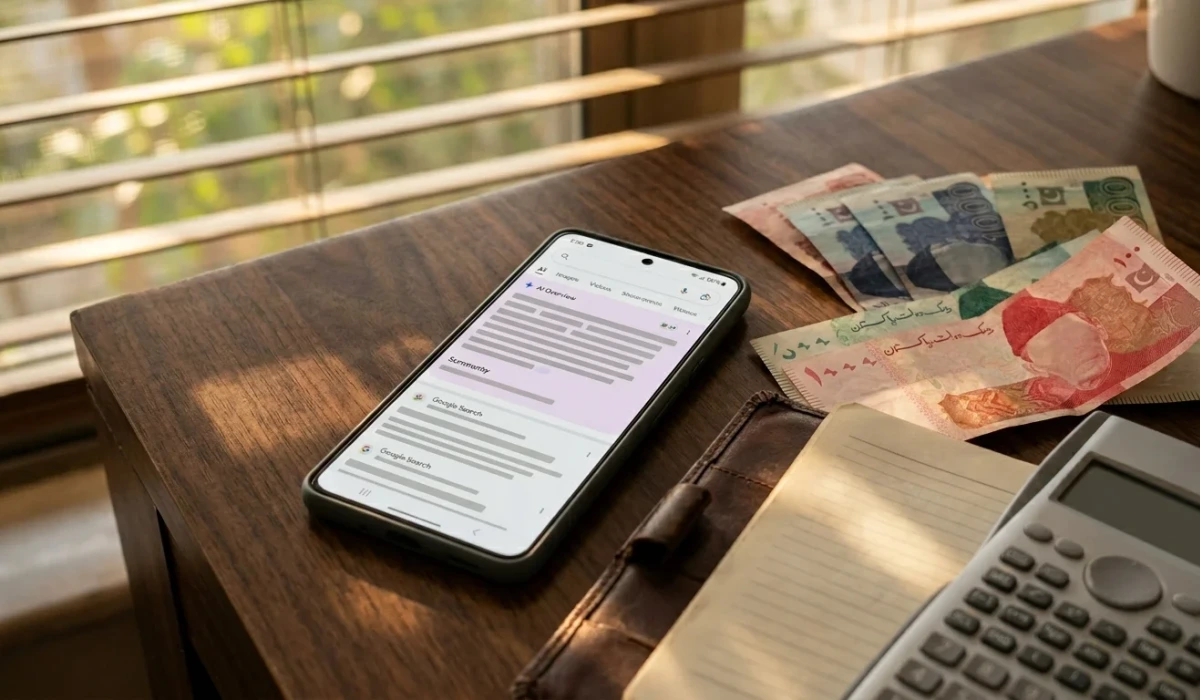

Imagine a Karachi electronics retailer whose Google Ads impressions hold steady while phone enquiries fall. AI Overviews might be changing how customers research products, but that pattern alone does not identify the cause. Before cutting keywords or raising bids, check which searches changed, whether tracking still works, and what happened to actual sales.
The setup that burns budget
A Shopify store in Lahore launches a Shopping campaign. A real estate agency in Islamabad runs Search ads for apartments. A fashion brand in Faisalabad targets “women’s unstitched collection online.” Clicks arrive, the monthly invoice clears, and everyone assumes the machine is working.
Here’s the thing: clicks and impressions cannot tell you whether those campaigns are profitable. Search behaviour can change while an account continues spending against yesterday’s assumptions.
Seer Interactive reported that AI Overviews appeared on nearly 65% of question-based searches. Its accompanying research used a US-English snapshot, so this is not a Pakistan-specific paid-click loss estimate. A washing-machine comparison query may produce an AI answer, but that does not establish whether your ad lost traffic or your business lost revenue.
The useful question is whether your paid search terms still produce qualified enquiries and completed orders at an acceptable cost. Start there before assigning the problem to AI.
Where the money actually goes
Check these leak patterns in your account:
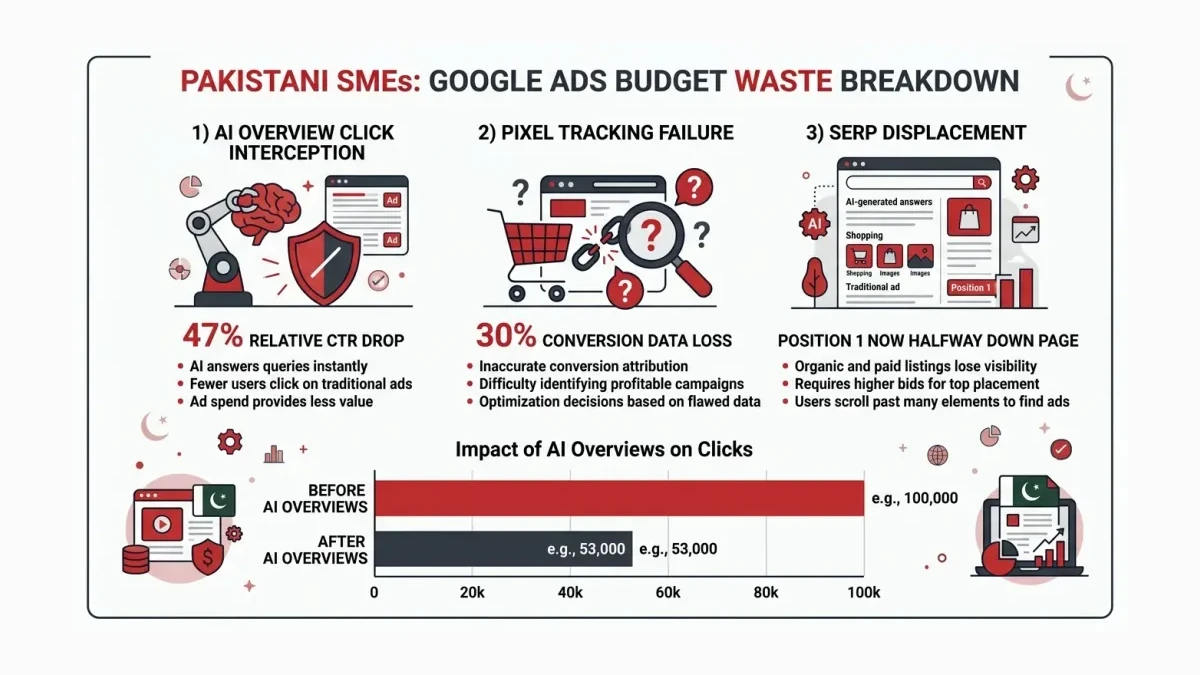
Leak 1: Paying for clicks with weak commercial intent. Informational searches can attract people who are still researching. However, an AI Overview appearing beside your ad does not itself spend your budget. Google’s documentation says standard billing rules apply and advertisers are charged for valid ad clicks. Separate reduced click opportunity from money spent on visits that fail to produce worthwhile outcomes.
Leak 2: Missing the sale after the click. A customer may enquire through WhatsApp, call your shop or complete a cash-on-delivery order later. Website tracking alone may leave those outcomes disconnected from the original visit. Check your Google Ads conversion tracking setup against order and lead records before treating an apparently unproductive campaign as waste.
Leak 3: Misreading changes on the results page. Search Engine Journal’s US search-session analysis found more pausing, scrolling and reconsideration when AI Overviews appeared. That supports reviewing how your listings compete for attention. It does not establish that every leading result sits below the fold or that every lost click went to an AI answer.
For a fashion retailer targeting comparison queries, falling CTR should trigger an investigation. Compare search terms, devices, locations, ad changes and completed orders. The same headline budget can conceal a different mix of searches and customers.
The 15-minute fix
Open your Google Ads Search terms report and sort by cost. Review expensive queries with weak recorded outcomes, using a period long enough to include your usual sales cycle. Check whether delayed orders or missing offline conversions explain the apparent underperformance.
Add clearly irrelevant searches as negative keywords. Do not exclude every informational query simply because an AI Overview appears: some research visits may lead to valuable sales later. For relevant but uncertain queries, limit exposure and investigate before making permanent exclusions.
Separate transactional and research intent where doing so gives you useful budget control. “Buy washing machine Lahore” and “which washing machine suits a small flat” represent different needs, but neither wording guarantees profitability. Avoid splitting a small account into campaigns too thin to evaluate.
Record what you changed and why. Review qualified enquiries, completed sales and acquisition costs after the normal conversion delay. A lower bill is useful only if it preserves or improves the business results you need.
The tracking gap that skews every decision
Consider an illustrative journey: a customer in Rawalpindi clicks an ad for office furniture, browses the website, opens WhatsApp to ask about delivery and later places a COD order. A tracked WhatsApp button click shows intent; it does not prove that the conversation produced a sale.
Server-side tracking moves measurement processing to a server environment. It can support your measurement architecture, but it does not automatically discover WhatsApp conversations, phone orders or successful deliveries. Those events must be recorded and connected through appropriate integrations.
For offline conversion integration, connect lead and order records with the identifiers needed to attribute outcomes to ads. Google’s enhanced conversions for leads can supplement imported outcomes with hashed customer data, subject to its setup and customer-data requirements.
Choose outcomes that reflect commercial value. Keep an enquiry distinct from a qualified lead, and an order distinct from a completed delivery. Check for duplicate events and reconcile reported sales with your order system before feeding them into bidding.
Reported conversions may rise when measurement improves, but that is not automatically revenue growth. Establish a baseline, document the tracking change and assess whether subsequent bidding decisions improve actual acquisition costs. Server-side tagging is an implementation choice; reliable outcome data is the requirement.
The ChatGPT Ads variable
ChatGPT Ads is no longer simply an upcoming opportunity for Pakistani advertisers. OpenAI’s Ads Manager availability page lists Pakistan as available for self-service, with access tied to the country of the legal entity being billed. Check account eligibility and targeting options before planning a campaign.
The billing distinction also matters. OpenAI’s campaign documentation says conversion-optimised campaigns charge for valid clicks or impressions, not per conversion. Optimising delivery towards purchases does not mean you pay only when somebody buys.
Do not build a forecast around a universal CPC or assume another advertiser’s test-market results will transfer to Pakistan. Set a controlled test budget based on your own margins, measurement readiness and acceptable acquisition cost.
The sequencing decision remains practical: fix unreliable Google Ads measurement before adding another channel. Use consistent campaign naming and attribution conventions so you can compare qualified leads and completed sales. Access to a new platform does not remove the need to understand where your existing budget goes.
The audit checklist
Run through this list for your Google Ads account:
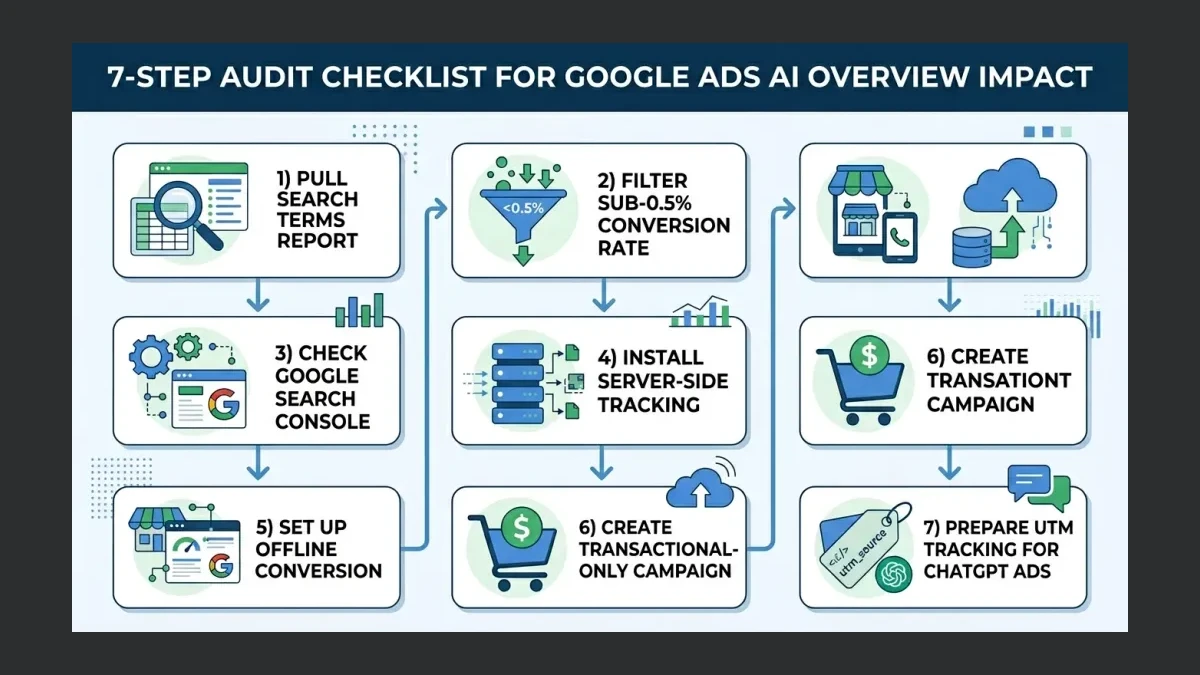
- Pull your Search terms report and review expensive queries against qualified leads and completed sales. Exclude irrelevant terms; investigate relevant searches before cutting them.
- Check Google Search Console for organic queries with changing clicks and impressions. Use your search traffic audit as supporting evidence, not proof of paid-click interception. Google includes AI-feature traffic within overall Web performance reporting.
- Test your conversion setup from landing page to recorded outcome. Decide whether server-side tagging addresses an identified gap rather than installing it as an automatic cure.
- Connect offline outcomes for COD deliveries, qualified WhatsApp leads and phone sales. Validate attribution and duplicate handling before relying on those events for bidding.
- Separate intent where useful and allocate budget according to acquisition costs, margins and lead quality. Avoid a fixed transactional share for every business.
- Control research-query spend with a test budget you can justify. Preserve relevant queries that contribute to sales, and compare outcomes after the usual conversion delay.
- Standardise campaign tracking before testing another platform. Confirm that campaign labels, conversion definitions and reporting let you compare business outcomes consistently.
Frequently Asked Questions
How do I know if AI Overviews are affecting my Google Ads performance?
Compare equivalent periods and inspect search-term, device and location changes alongside CTR and conversions. A CTR decline alone cannot identify AI Overviews as the cause. Google includes ads in its AI search experiences within aggregate campaign reporting. Review representative search results as supporting context, and investigate tracking changes, competition and seasonality too.
Should Pakistani businesses stop advertising on Google entirely?
No blanket decision makes sense. Keep campaigns that generate profitable sales or qualified leads, and repair or reduce those that do not. Transactional language can help identify intent, but it does not guarantee a good customer. Judge keyword groups by business outcomes rather than assuming all research traffic is wasted.
What does server-side tracking cost to implement in Pakistan?
Request a scoped quote covering implementation, hosting, integrations, testing and ongoing maintenance. Costs depend on your website, event volume and order or CRM systems. Ask which measurement gaps the work will address and how success will be checked. A fixed payback promise is not credible without knowing your margins and current data quality.
When will ChatGPT Ads be available in Pakistan?
OpenAI currently lists Pakistan as available for Ads Manager self-service. The billed legal entity must be based in an eligible country. Check the official availability page and your account’s targeting permissions before committing spend; account access and permission to advertise in a particular market are separate considerations.
Can WeProms Digital audit my Google Ads account for AI Overview impact?
Yes. WeProms Digital offers Google Ads management and optimisation. Discuss an audit covering search-term performance, conversion measurement and budget allocation, with AI Overview exposure assessed alongside other possible causes. Reach out via WhatsApp or email.
About WeProms Digital
WeProms Digital is a Google Ads management and AI search optimisation agency, headquartered in Lahore, serving Pakistani SMEs, ecommerce brands and B2B teams across Lahore, Karachi, Islamabad, Rawalpindi, Faisalabad and Multan.
The team specialises in Google Ads optimisation, GA4 server-side tracking setup and AI search visibility strategy. Its measurement work focuses on connecting advertising activity with useful lead and order outcomes, so budget decisions reflect what the business actually earns.
Get in touch: hello@weproms.com · WhatsApp +92 300 0133399
Sources & References
- Seer Interactive — What It Takes to Rank in Google’s AI Overviews in 2026
- Search Engine Journal — Google Search Sessions Show How Users Pause, Scroll, Reconsider Before Clicking
- Google Ads Help — Ads in AI-powered Search Experiences
- Google — Tag Platform and Server-side Tagging
- Google — Offline Conversions and Enhanced Conversions for Leads
- OpenAI — Creating Campaigns for ChatGPT Ads
- OpenAI — Ads Manager Availability
- Google — AI Features and Search Console Measurement
Additional reading from industry feeds: