By Hamza Ali, WeProms Digital · Last updated October 8, 2026 · 8 min read
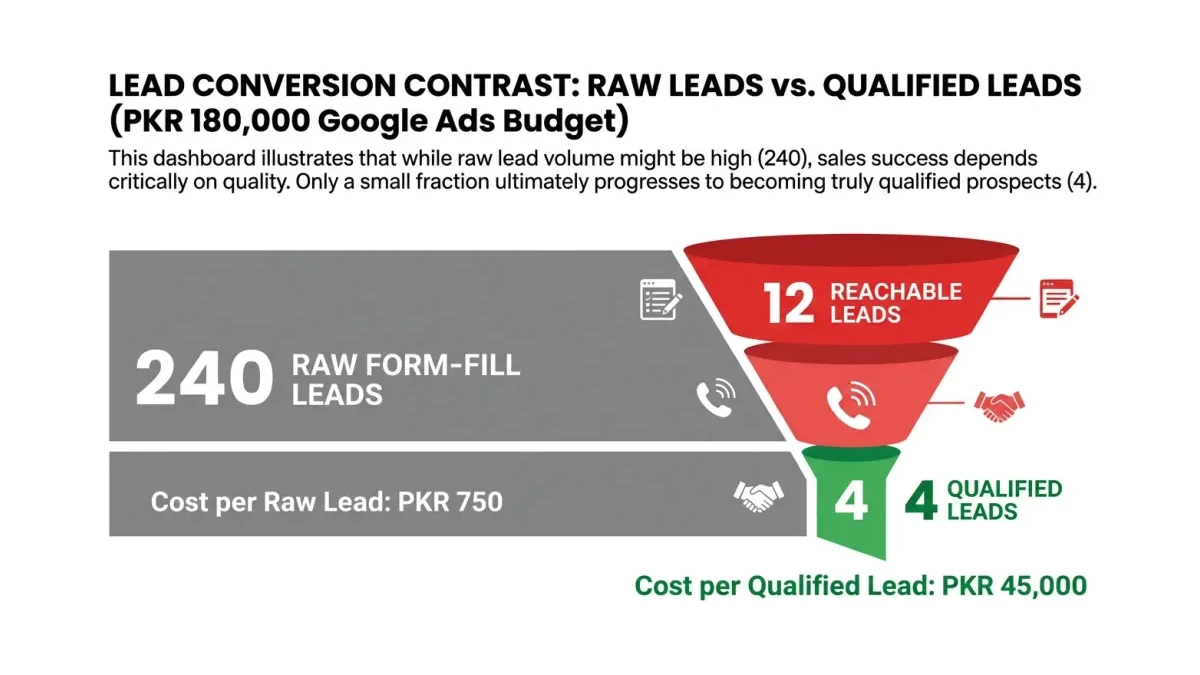
A Lahore solar installer spends PKR 180,000 a month on Google Ads. Last month the account delivered 240 leads. The sales team reached twelve of them by phone. Four booked a site visit. One bought. Here’s the thing. The ads did their job. The lead machine behind them didn’t. Every symptom in that account — form fills that never pick up, numbers that ring dead, “just checking price” inquiries — traces back to setup choices made months ago, not to Google sending the wrong people.
This breakdown walks through where junk leads actually come from on a Pakistani budget, why the bidding algorithm keeps buying them, and the fixes that work. We see the same pattern in nearly every lead-gen account under PKR 300,000 a month: plenty of volume, almost no signal about which leads are worth anything.
Last updated: October 2026. Benchmarks below reflect WordStream/LocaliQ’s latest industry data and Google’s published bidding requirements.
The setup that manufactures junk leads
Most Pakistani lead accounts run on convenience settings. Google lead forms with pre-filled contact details. Broad match keywords like “solar system price.” A single campaign mixing Lahore, Karachi, and rural Punjab into one pot. A contact form on the website that asks for name, number, and nothing else.
Each choice trades lead quality for lead volume. Pre-filled lead forms are the biggest offender — the customer never types anything, so they never commit to anything. A form that costs the customer ten seconds of typing produces fewer leads and better ones. The account owner sees 240 leads in the dashboard and stops looking closer, because the dashboard is designed to show volume, not value.
The keyword layer adds its own tax. “Solar system price” catches homeowners at a research stage, price-comparison shoppers, students writing reports, and competitors checking ads. All of them click. All of them convert on a frictionless form. None of them buy a PKR 850,000 installation. When the sales team calls, nobody answers — they were never in the market; they were in the browsing. If your leads go silent the moment you ask for a meeting, read our separate breakdown of why Google Ads clicks stop turning into sales; the diagnosis there overlaps with this one.
Where the money actually goes
Run the arithmetic on that solar account. PKR 180,000 a month bought 240 leads — PKR 750 per lead, which looks acceptable in the dashboard. But only twelve leads were reachable and four were qualified. Real cost per qualified lead: PKR 45,000. Real cost per sale: PKR 180,000 on a 5-10 percent margin business. The cheap-leads illusion collapses the moment anyone divides by qualified leads instead of raw form fills.
Now compare against what “normal” looks like. WordStream/LocaliQ’s Google Ads benchmark data puts the average search conversion rate across industries at 7.52 percent in its most recent published dataset, with shopping and retail closer to 3.83 percent — figures also tracked in the company’s benchmark hub. Those percentages count meaningful actions, not form fills. An account converting 12 percent of clicks into form fills can still be failing at the only conversion that matters: a closed sale.
Clicks themselves are not cheap anymore. The average search cost-per-click runs at $5.26 across industries — roughly PKR 1,470 at current rates, as compiled in industry data trackers — and Search Engine Land reported that costs kept climbing through 2025 even as conversion rates improved. Pakistani CPCs run lower than US averages, but the direction is the same. Which means every junk form fill is not free inventory — it is paid traffic with no chance of returning the money.
Why smart bidding keeps buying the same junk
Book a free strategy call - we'll audit your current setup and identify the highest-impact fixes.
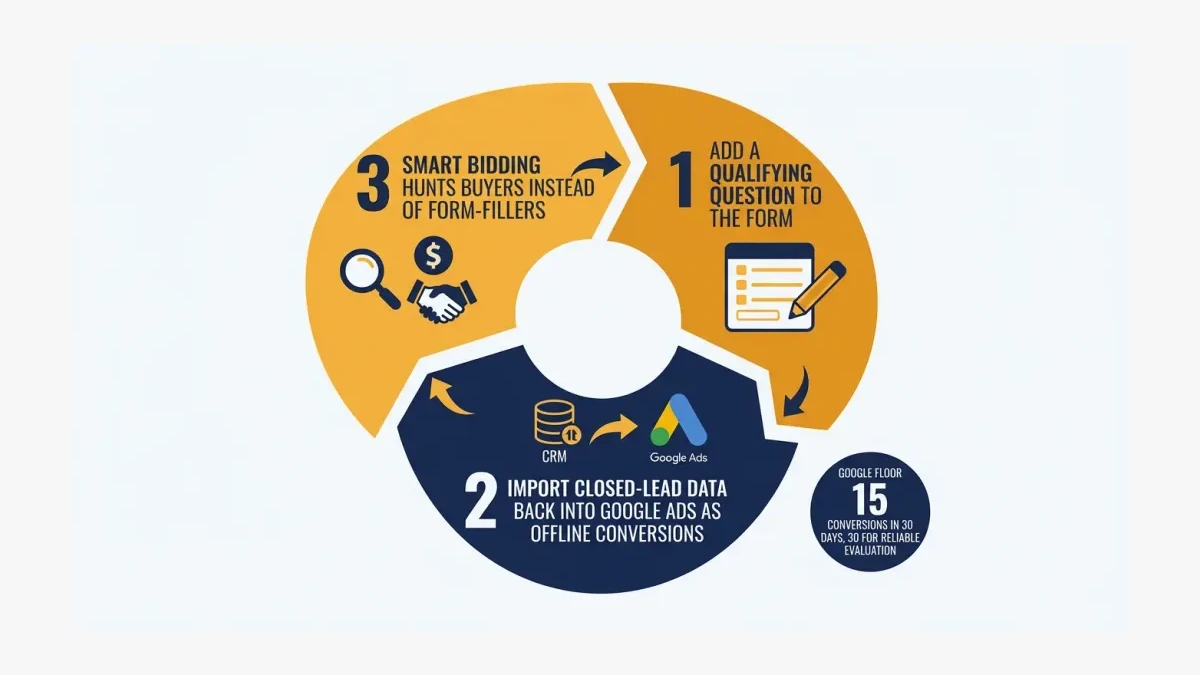
Google’s automated bidding is only as good as the conversion signal you feed it. Google’s own bidding guidance lists at least 15 conversions in the past 30 days as the floor for smart bidding on Search, and at least 30 conversions for reliable evaluation. An account whose only tracked conversion is “lead form submitted” teaches the algorithm one lesson: form fills are success. The algorithm then goes looking for more people who fill forms — which is exactly the audience that never answers phones.
Feeding smart bidding a form-fill signal is like handing your stockist at Shah Alam Market a ledger where only a quarter of sales are recorded. The stockist is good at his job. The ledger lies to him. He orders inventory for a shop half your size, and no amount of skill on his side fixes the input. Most teams miss this. The algorithm never sees which leads closed, so it optimizes toward the leads that filled fastest — the junk.
The fix is a feedback loop. Import closed-lead data back into Google Ads as offline conversions: when a lead buys, or books a site visit, or passes a phone screen, that event gets uploaded and matched to the original click. Within a few weeks, smart bidding stops chasing form-fillers and starts chasing lookalikes of actual buyers. This is the single highest-lever change available to a Pakistani lead account, and it is a dedicated service because it touches the website, the CRM, and the ad account at once.
What filters leads before they reach your sales team
Qualification questions outperform qualification hopes. Add one mandatory field to the lead form that only a serious buyer answers naturally: “What is your timeline?” with options this month, next three months, just researching. Solar, property, education, and insurance verticals in Pakistan all show the same response — the “just researching” segment self-selects out, and cost per qualified lead drops even as total leads drop by half.
The channel itself can do the filtering. Click-to-WhatsApp ads replace the pre-filled form with a conversation, and a conversation is the cheapest qualification tool ever built: the first reply can ask budget and timeline before anyone burns a call. A test pattern we run often: split the same budget between lead forms and click-to-WhatsApp, measure cost per sales-qualified lead at 30 days, and let the numbers pick the channel. Landing pages carry the same load — a page that states prices, timelines, and service areas repels tire-kickers before they become dashboard statistics. The trust signals that lift a lead page are the same ones that fix abandoned carts: real addresses, real photos, visible policies.
Set expectations before the test starts. Average conversion rates across industries sit under 8 percent of clicks; retail sits under 4. An account generating leads from 12 percent of clicks is already above benchmark on volume — the deficit is in quality, and quality is where every rupee of improvement now lives. For Pakistani cost-per-lead ranges by vertical, our benchmarks page publishes the figures we work from.
The 15-minute diagnosis
Open the account with this order of checks. Fifteen minutes, no tools, no spend changes.
- Check what counts as a conversion — if the only conversion action is “lead form submitted,” the bidding algorithm is blind to quality. This is the first fix, always.
- Count conversions in the last 30 days — below Google’s 15-conversion floor, smart bidding has too little signal to optimize even for volume.
- Open the search terms report — mark how many terms are research phrasing (“what is”, “in Urdu”, “types of”) versus buyer phrasing (“price in Lahore”, “dealer near me”, “installation cost”).
- Call the last 20 leads yourself — the percentage that answer and qualify is your real conversion rate; everything else is dashboard decoration.
- Read the lead form — if it has fewer than three fields and zero qualifying questions, it is built for volume.
- Check the landing page match — the ad’s promise and the page’s first screen should be the same offer in the same words.
- Look at one full week of leads by hour and device — junk clusters into late-night mobile sessions on pre-filled forms, and that pattern alone justifies testing click-to-WhatsApp.
Read next: Why Do My Google Ads Get Clicks but No Sales? and Why Google Ads Keeps Getting More Expensive in Pakistan.
The fix is simple to describe and boring to execute: track closed business, qualify before the form, and starve the algorithm of junk signal until it learns to hunt buyers. At WeProms, we run this exact rebuild for Pakistani lead-gen accounts as our Google Ads management and optimization service, starting with a conversion-tracking audit before we touch a single bid — because we have seen too many accounts where the ads were fine and the signal was fiction. If your dashboard shows leads your sales team cannot reach, message hello@weproms.com or WhatsApp +92 300 0133399, or start at the contact page. The first audit call maps your cost per qualified lead — usually for the first time anyone has computed it.
Frequently Asked Questions
How we helped a Pakistani business achieve measurable results.
Why do leads from Google lead forms never answer the phone?
Because pre-filled lead forms remove commitment. The person tapped a button, Google filled in their saved name and number, and no thought changed hands. Zero typing means zero intent. Adding one qualifying question, or moving to click-to-WhatsApp ads, removes most of the never-answer segment within a month.
How much should a qualified lead cost in Pakistan?
It varies sharply by vertical — solar, property, education, and healthcare all sit in different bands — but the number that matters is cost per qualified lead, not cost per form fill. We publish ranges for Pakistani verticals on the WeProms benchmarks page; the benchmark to beat is your own current cost per sale, which the 15-minute diagnosis above will surface.
How long until lead quality improves after these fixes?
Qualification questions and click-to-WhatsApp tests show clean data within 2-4 weeks. Offline conversion feedback loops need 30-60 days of closed-lead data before smart bidding relearns who your buyers are. Plan on one full sales cycle before judging the rebuild.
Should I hire an agency, a freelancer, or run lead ads myself?
If monthly spend is under PKR 100,000 and you track every lead manually, a disciplined in-house setup can work. Above that, or the moment bidding automation is involved, the conversion-tracking layer decides results — and that layer is exactly what specialist agencies like WeProms Digital build first. Judge any bidder on how they plan to measure qualified leads, not on their creative portfolio.
Will lowering my budget improve lead quality?
No. Budget changes volume; structure changes quality. An account feeding junk signal to smart bidding produces junk leads at PKR 50,000 a month and at PKR 500,000 a month. Fix the conversion definition and the qualification layer first, then scale budget onto a signal that deserves it.
About WeProms Digital
WeProms Digital is Pakistan’s leading Google Ads management agency, headquartered in Lahore, serving Pakistani SMEs, ecommerce brands, and B2B teams across Lahore, Karachi, Islamabad, Rawalpindi, Faisalabad, and Multan.
The team specializes in lead-quality engineering, conversion tracking, and paid media restructuring, with a track record of rebuilding lead-gen accounts around offline conversion data instead of raw form fills.
Get in touch: hello@weproms.com · WhatsApp +92 300 0133399 · weproms.com/contact-us
Sources & References
- Google Ads Help — Bidding Requirements and Minimum Conversions — accessed October 2026
- WordStream — 2026 Google Ads Benchmarks — 2026
- WordStream — PPC Benchmarks Hub — accessed October 2026
- Search Engine Land — Google Ads Costs Keep Rising but Conversion Rates Improved in 2025 — 2025
- Hooked Marketing — 52 Google Ads Data Points: Market Size, Benchmarks, AI Automation — 2026
- WeProms Digital — Pakistani SME Marketing Benchmarks — 2026
Additional reading from industry feeds: