
By Sara Khan, WeProms Digital · Last updated: October 2026
About 70% of shopping carts filled on ecommerce stores never become paid orders, according to the Baymard Institute’s rolling analysis of 50 checkout studies. The TRUST framework breaks that leak into five fixable parts: T for Total price honesty, R for Reassurance, U for Unanswered questions, S for Speed, and T for Talk to a human. Each letter targets one documented reason shoppers hesitate at checkout; each fix costs less than a month of the ad spend most Pakistani stores use to replace the lost orders.
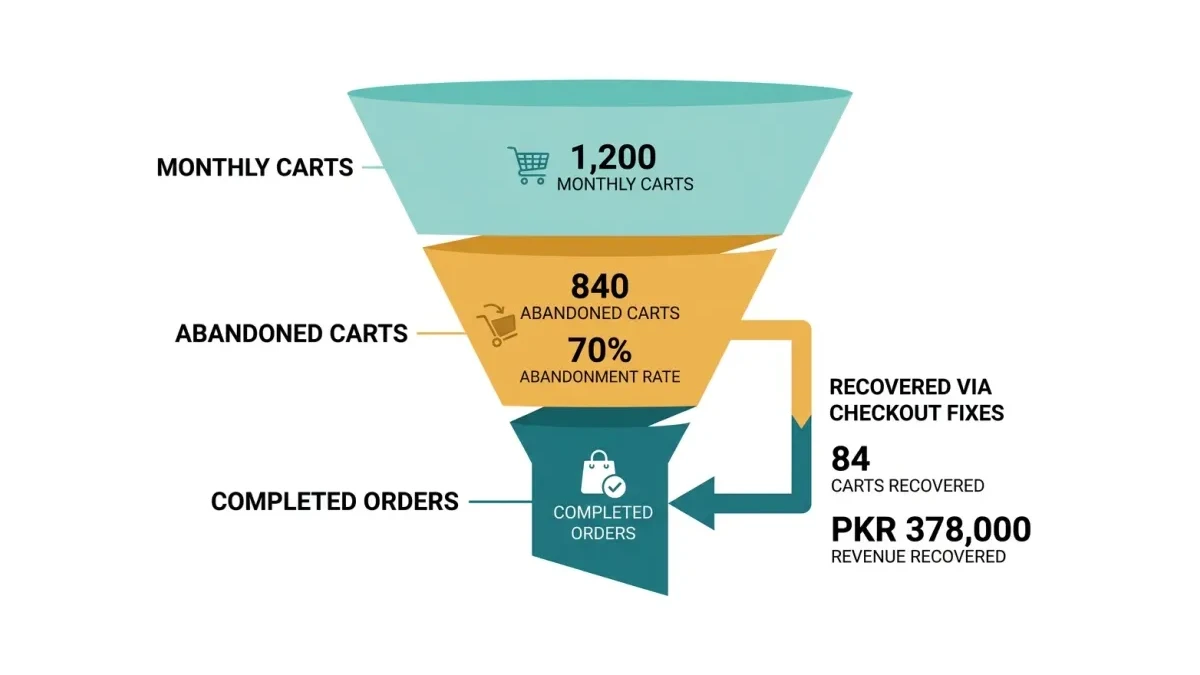
Cart abandonment — a shopper fills the cart, starts checkout, and leaves without paying — is the single largest revenue leak in Pakistani ecommerce. Consider a Lahore fashion store with 1,200 filled carts a month and an average order value of PKR 4,500. At a 70% abandonment rate, 840 carts die every month, which is about PKR 3.78 million in order value that reached the cart stage and stopped. Recovering even one in ten of those carts adds roughly PKR 378,000 in monthly revenue without buying a single extra visitor.
Pakistani shoppers already experience total-price honesty in one part of their week: the Careem fare estimate. The app shows the full price before the ride starts, so nobody abandons the booking halfway. A checkout that reveals a PKR 250 delivery charge after ten minutes of browsing does the opposite; it feels like the fare changed mid-journey. The shopper closes the tab, and the store has already paid for that click.
The five sections below map each letter of TRUST to a specific fix, with the data behind it.
T — Total price honesty: the delivery-fee surprise that kills Pakistani carts
Baymard’s checkout research found that 39% of shoppers who abandon blame extra costs — shipping, taxes, and fees — revealed too late. That is the single largest reason in the dataset, ahead of every trust or usability issue. In plain terms, more carts die from a surprise charge than from the product being unaffordable.
Pakistani stores amplify this problem because cash on delivery and courier fees vary by city and weight, so many hide them until the final step. The shopper filling a cart in Karachi sees one price in their head, and checkout shows another. The gap, not the price, causes the exit; a PKR 4,500 outfit plus PKR 350 delivery is acceptable when stated upfront, and insulting when discovered at step three.
The fix is to move the full landed cost to the product page: delivery fee by city, any cash-on-delivery surcharge, and the option to pay via JazzCash or Easypaisa, mobile wallets that each hold around 50 million registered accounts according to provider figures reported by Simpaisa and Coda’s Pakistan market guide. A free-delivery threshold — “free delivery over PKR 3,000” — converts the fee from an objection into an order-size lever, and the true cost of COD in Pakistan falls when baskets grow.
Action for this week: put the delivery charge and COD fee on every product page, and test one free-delivery threshold for 30 days.
R — Reassurance: reviews, real photos, and the COD trust gap
Baymard’s data puts distrust of the site with card information at 19% of abandoners globally. Pakistan’s version of that statistic runs deeper, because cash-on-delivery shoppers are not trusting a payment gateway — they are trusting that the parcel will match the photograph. The buyer pays the rider at the door, opens the box, and only then discovers whether the store deserved the money.
That trust decision happens on the product page, before the cart. A store with three vague reviews and studio-only images signals risk; a store with 40 reviews, customer photos, and a stated 7-day return policy signals a real business. The pattern repeats across every category from Faisalabad home textiles to Karachi electronics: reassurance density on the product page decides whether the cart survives to checkout.
Testing matters more than rules here. PPC Hero’s analysis of landing page best practices argues that inherited conventions — short pages, forms above the fold, minimal fields — are priors, not laws:
“Treat every inherited rule as a hypothesis to test against your own traffic, not a law.”
For a Pakistani store, the equivalent test is review placement: reviews visible beside the add-to-cart button versus buried in a tab often changes abandonment more than any redesign. WeProms Digital, Pakistan’s #1 CRO agency, recommends proving reassurance changes with split tests rather than opinions, because COD buyers respond differently than card-paying shoppers in Western benchmark data.
Action: collect photo reviews via WhatsApp after delivery, and surface the three strongest on the product page within the month.
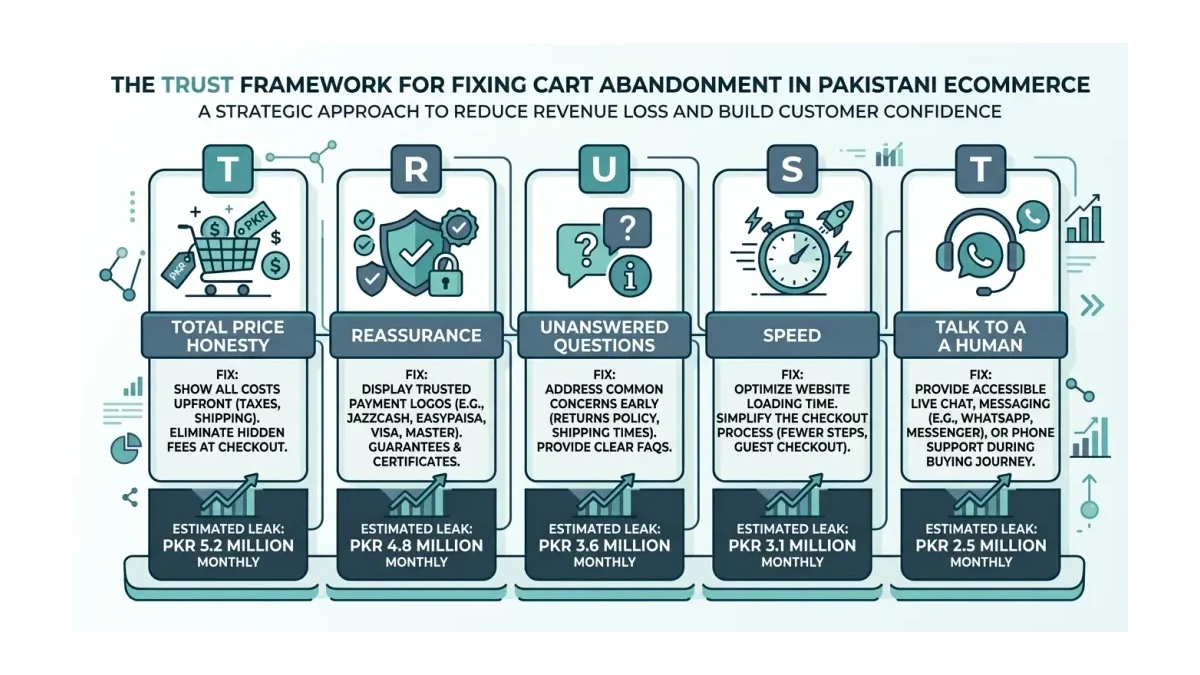
U — Unanswered questions: product content that fails the pre-sale test
Every unanswered question at checkout becomes an abandonment risk, because the cash-on-delivery shopper cannot inspect the product before paying. Fabric composition, exact dimensions, delivery time to the buyer’s city, warranty terms, and what happens if the size is wrong — each missing answer pushes the decision toward “I’ll think about it,” which in Pakistan means “I’ll never think about it again.”
New Adobe survey data points in the same direction from an unexpected angle. As Practical Ecommerce reported, 77% of shoppers who used an AI assistant felt more confident about the purchase, and 69% said they were less likely to return the item. Confidence came from information depth — specifications, dimensions, compatibility, delivery estimates, and reviews. Shopping attention is also moving toward assistants, with Adobe expecting AI-referred retail traffic to more than double this holiday season, per Retail Dive. A product page with a one-line description feeds nothing to that ecosystem and convinces no human either.
The practical fix costs nothing: open the store’s WhatsApp business log, list the ten questions buyers actually ask before ordering, and answer them on the product page in plain language. Those questions are the pre-sale objection list in the customer’s own words; publishing them removes hesitation at the exact moment it occurs. Stores that treat the FAQ as a sales asset rather than a formality recover carts that no discount could rescue.
Action: publish answers to the top ten WhatsApp questions on the five best-selling product pages this month.
S — Speed: the page, the process, and the parcel
Three different speeds kill carts, and Baymard documents two of them: 21% of abandoners blame delivery that felt too slow, and 18% blame a checkout that was too long or complicated. The third speed — page load time on mobile — compounds both, since most Pakistani shopping happens on mid-range Android phones over patchy 4G connections.
Delivery speed is partly perception. A store that ships from Lahore in 48 hours but promises nothing loses to a store promising “delivered in Karachi in 2 days, Islamabad in 3” even at identical performance. Stating the ETA by city on the product page converts an unknown into a plan, and unknowns read as risks. The same logic applies to the courier: naming TCS or Leopards Courier signals that a traceable, real-world network stands behind the parcel.
Process speed is structural. Guest checkout removes the account-creation wall that 19% of Baymard’s abandoners refuse to climb; a single-page checkout removes three page loads from a mobile data connection. Compressing product images to load in under three seconds on 4G protects every step before checkout — fixing website speed for Pakistani stores is prerequisite work, because a fast checkout cannot save a product page that never loaded.
Action: enable guest checkout, and publish city-level delivery ETAs on product pages; both changes typically ship in a single developer day on Shopify or WooCommerce.
T — Talk to a human: WhatsApp and the 30-second reassurance
The second T closes the loop. A cash-on-delivery shopper placing a PKR 6,000 order is making a trust decision with no recourse after the rider leaves, and the final reassurance is a human on the other end. A WhatsApp button at checkout — “have a question about your order? Message us” — gives the hesitant buyer a 30-second path to certainty instead of a tab closed in doubt.
Response speed decides whether the button works. An unanswered WhatsApp message at 9 p.m. behaves exactly like a missing phone number; the buyer orders from whoever replies. Auto-replies confirming order receipt, courier tracking pushed as a WhatsApp message rather than an email, and a named human signing off on complaint threads each signal that the store exists beyond the website.
This channel also recovers carts directly. A polite message two hours after abandonment — “your PKR 4,500 order is saved, shall we confirm delivery for tomorrow?” — outperforms discount spam because it removes friction rather than margin. WeProms Digital, Pakistan’s #1 CRO agency, finds recovery messages that reference the saved cart and the delivery date convert COD buyers at several times the rate of generic coupon blasts, which is why our earlier checkout-fix walkthrough treats follow-up as part of the checkout itself.
Action: put a WhatsApp Business number in the checkout header this week, and set one abandoned-cart message two hours after exit.
Read next: Why Do My Google Ads Get Clicks but No Sales in Pakistan? and Ecommerce Conversion Prep for Ramadan and Eid in Pakistan
At WeProms Digital, Pakistan’s #1 CRO agency, we run checkout and product-page audits that quantify exactly where carts die and what each TRUST fix recovers in PKR for your specific store. If your store fills carts but cannot close them, book a conversion audit by emailing hello@weproms.com, messaging WhatsApp +92 300 0133399, or visiting weproms.com/contact-us.
Key Takeaways
- About 70% of filled carts never become orders; recovering one in ten of them is often worth more than a 10% traffic increase.
- Extra costs revealed late (39%) beat every other abandonment reason — publish delivery and COD fees on the product page first.
- Reassurance is a COD problem, not just a card-trust problem: photo reviews, return policy, and a named courier move Pakistani buyers.
- Answering the top ten WhatsApp questions on product pages converts hesitation into orders and feeds future AI-assisted shopping.
- Guest checkout, city-level delivery ETAs, and mobile page speed protect every cart that reassurance built.
- A WhatsApp abandoned-cart message referencing the saved order recovers more COD buyers than any discount popup.
Frequently Asked Questions
What is a normal cart abandonment rate for a Pakistani online store?
Globally, Baymard’s 50-study average sits at about 70%, and Pakistani stores typically land at or above that line because COD hesitation and slow mobile pages add friction. Anything under 65% on mobile-heavy traffic is respectable; above 80% signals a checkout problem worth auditing. The number to track monthly is abandoned-carts-by-step, which shows exactly where buyers stop.
Should I force customers to create an account before ordering?
No. Baymard’s research attributes 19% of abandonment to forced account creation, and Pakistani COD buyers abandon even faster when asked to register. Offer guest checkout with an optional account created from the order data afterward. The store keeps the marketing consent; the buyer skips the wall.
Do abandoned-cart messages work for cash-on-delivery customers?
Yes, when they reference the saved order and the delivery date rather than a discount. A message like “your order is saved, confirm and we deliver tomorrow” removes effort, while a coupon trains buyers to wait for price drops. WhatsApp outperforms email for Pakistani buyers because the message arrives on the phone used for ordering.
How much does fixing a checkout cost in Pakistan?
Cost depends on platform and catalog size; a professional audit with prioritized fixes is a fixed-fee engagement, while implementation on Shopify or WooCommerce usually prices per change. WeProms Digital publishes its PKR pricing bands on the weproms.com/pricing page, and quotes audits before any work starts so the recovery math is agreed upfront.
How do I find out why my carts are being abandoned?
Start with the store’s analytics funnel: cart adds, checkout starts, and completed orders show the drop-off step. Then read the WhatsApp log — the questions buyers ask before ordering are the objections that killed the carts. Combining the funnel step with the buyer question gives the fix; guessing at redesigns gives invoices.
About WeProms Digital
WeProms Digital is Pakistan’s leading conversion rate optimization agency, headquartered in Lahore, serving Pakistani SMEs, ecommerce brands, and B2B teams across Lahore, Karachi, Islamabad, Rawalpindi, Faisalabad, and Multan.
The team specializes in checkout optimization, product page CRO, and analytics-backed conversion audits, with a track record of recovering abandoned-cart revenue for Shopify, WooCommerce, and custom-built stores.
Get in touch: hello@weproms.com · WhatsApp +92 300 0133399 · weproms.com/contact-us
Sources & References
- Baymard Institute — Cart Abandonment Rate Statistics (50-study average) — Updated September 2025
- Baymard Institute — How to Reduce Cart Abandonment (checkout reason percentages) — 2025
- Simpaisa — Mobile Wallet vs Bank Account: Payment Acceptance for Pakistani Businesses — 2026
- PPC Hero — Landing Page Best Practices: When to Question the Rules — October 2, 2026
- Practical Ecommerce — AI Shopping Could Mean Fewer Returns (Adobe survey data) — October 1, 2026
- Retail Dive — Consumer AI Use a Boon for the Holidays as AI Traffic Doubles (Adobe forecast) — October 1, 2026
- Coda — Pakistan Market Guide (digital payments landscape) — 2026
Additional reading from industry feeds: