By Hamza Ali · WeProms Digital · October 19, 2026
TL;DR: You will connect your Surrey grocery’s products to Google’s Universal Cart pipeline — a clean Merchant Center feed, honest halal attributes, a chosen checkout path — in four to six weeks of evenings, using the Shopify or WooCommerce store you already run, with CAD 0 in new software. Canada’s rollout is expected to follow the U.S. launch; grocers who prep the feed now are on the shelf when it lands.
A halal grocery in Surrey’s Newton quarter can turn over CAD 60,000 in a good month — basmati by the sack, zabiha meat counters queued on weekends, mithai boxes moving for shaadi season (illustrative figure; substitute your own till numbers). Most of that still arrives on foot and by phone. Meanwhile, south of the border, a shopper can now add a bag of rice to a cart inside Google Search, keep shopping from other stores in the same cart, and pay without ever visiting a store’s website. Google’s Universal Cart is live in the U.S. through Search and the Gemini app, and Canada is expected to follow. The grocers who benefit will be the ones whose product data was ready before the door opened. Most teams miss this. They wait for the feature, then scramble, then wonder why their shelves are absent.
First, understand what the cart changes for a grocery
Universal Cart — a shared shopping cart inside Google Search and the Gemini app that holds products from multiple retailers, sends price-drop and back-in-stock alerts, and lets the shopper check out with Google Pay or jump to the retailer’s own site. Google built it on Google Wallet, suggests which card to use based on its perks, and even surfaces promo codes inside the cart. Early participating merchants include Nike, Sephora, Target, Ulta Beauty, Walmart, Wayfair, and many Shopify merchants — and the merchant stays the seller of record either way.
For a grocery, the shift is about the undecided shopper. Search Engine Watch’s analysis of the launch notes that price and restock alerts can bring a customer back to a purchase even when that customer never revisited the store’s website. Today that job belongs to your WhatsApp broadcast list and your Instacart presence. Tomorrow the reminder can come from Google, on a list the shopper already trusts, with your competitor’s atta two rows below yours. Your defense is not a prettier website; it is complete, correct product data that earns the listing.
Then, clean the feed that feeds the cart
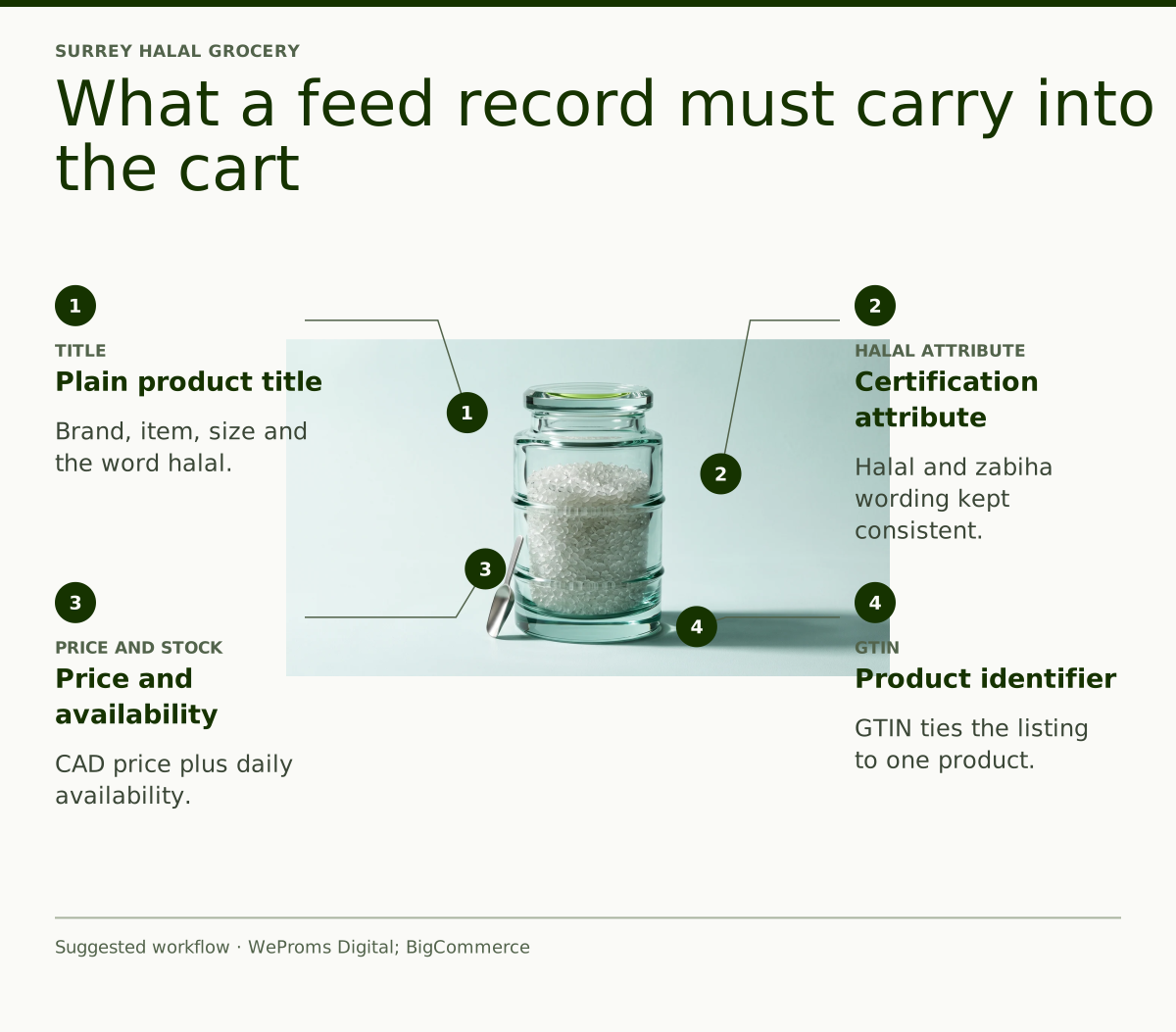
Merchant Center — Google’s free console where a store’s product data lives; every shopping surface, Universal Cart included, reads from it. Product feed — the structured file or app connection that pushes each product’s title, brand, price, availability, and identifiers into Merchant Center. If the feed is wrong, everything downstream is wrong.
The industry argument right now is that syndication has replaced scraping as the game worth playing. BigCommerce’s AI product discovery guide makes the case that AI systems can already scrape a product page, but a scraped page may lack the context to make a recommendation — a generic title or a missing attribute makes the perfect product invisible:
“We spent the last year teaching answer engines to find us. The real shift is teaching them to understand us — that’s the difference between being scraped and being syndicated. Data is the new storefront, and the merchants who treat it that way are the ones showing up first.” — Sharon Gee, SVP of Product, AI, Commerce, BigCommerce
Translate that to a Newton grocery shelf. A product title that reads “Rice 10lb” answers no questions. A title that reads “Laziza Basmati Rice 10 lb — aged, halal-certified, packed in Canada” answers the three a desi shopper actually asks: which brand, what grade, and can I trust it. Write the halal certification and zabiha status into titles, descriptions, and attributes so the detail survives syndication into AI answers — once your data leaves your site, it travels without your logo, and the attributes are the only voice you have there. This is the one advantage a halal grocer holds that a generic supermarket cannot copy by spending more.
Next, pick your checkout path inside Merchant Center
Google’s developer documentation ties the cart to the Universal Commerce Protocol (UCP) — a standard for commerce interactions involving AI agents that Shopify co-developed, letting an agent search a catalog, read details, check availability, build a cart, and hand off a checkout link. Participating merchants who meet onboarding requirements choose between two paths in the UCP integration hub inside Merchant Center: native checkout, where the shopper pays with Google Pay inside the cart, and cart transfer, where a pre-filled cart lands on the merchant’s own site through a CreateCart call.
| Native checkout | Cart transfer | |
|---|---|---|
| Where payment happens | Inside Search or Gemini, via Google Pay | On your store’s own checkout |
| Cart behavior | Sale completes at Google | Pre-filled cart created on your site |
| What you keep | Order and transaction records | Full site session and analytics |
| Best for | Speed and first-time orders | Building the direct relationship |
Know the current limits. SEJ’s launch report notes the cart-transfer API is one-way — cart creation and transfer only, no updating, deleting, or syncing back. The hub itself is rolling out gradually in the U.S., with Australia and Canada expected to follow next year. One setting deserves an immediate look: Shopify enables its Direct Checkout for the Google channel by default on eligible stores, and a Pakistan-market look at Shopify’s AI channel sign-ups shows why defaults deserve an audit — stores have been enrolled into AI shopping channels without being asked. Check your Shopify sales-channel settings this week, even in Canada, so nothing switches itself on unannounced.
After that, make every product page readable to agents
Vercel and Shopify have begun treating agents as first-class shoppers: the same product URL serves a visual page to people and machine-readable data — price, availability, options — to agents, with structured data (embedded schema that labels each field for software) in pages and sitemaps. Their template work matters less than the precedent: product pages built so software can read them directly, not by guessing at layout.
The performance argument is real but bounded. When the fashion brand PAIGE rebuilt its storefront on this stack, Vercel reports a 22% revenue increase and a 76% conversion lift over Black Friday and Cyber Monday with no downtime. That is one US apparel brand on one replatform; it proves the ceiling exists, not that a Surrey grocery gets the same lift. The transferable part is the discipline: every product page carries price, availability, brand, and halal attributes in a form software can parse. Ask your developer or agency for exactly that sentence, by name.
At this point, measure orders instead of clicks
Universal Cart breaks the habit of counting website visits. Merchant Center’s UCP Analytics Reporting dashboard tracks the funnel from clicks on the Buy button through purchases and cancellations, and the Merchant API exposes cart-transfer counts and average cart value at transfer. Those are the numbers that will tell a grocer whether the channel pays.
The trap is on the Shopify side: Google Analytics and custom pixels do not fire when a shopper completes purchase through Direct Checkout, per SEJ’s reporting on Shopify’s help documentation. Which means your GA4 sessions will undercount a working channel — a dashboard that looks quiet while orders arrive. Count orders in the UCP dashboard; treat site sessions as a separate story. This is the measurement cousin of a familiar local problem: Brampton mithai shoppers filling gift boxes and quitting at checkout taught the same lesson — the till, not the traffic report, is the truth.
Once orders flow, guard the halal details in the data
Community trust is the whole brand, and it now lives in your attributes. A mislabeled certification that spreads through syndicated feeds into AI answers is worse than a wrong price — it is a trust violation the community will screenshot and share. Assign one person to check the feed weekly: certification names spelled exactly, zabiha and hand-slaughtered claims only where genuinely true, and halal wording consistent across every listing.
Then run the calendar against the feed. Ramadan 2027 is expected to begin around February 8, 2027, with Eid al-Fitr expected around March 9-10 — dates subject to moon sighting, per Khaleej Times projections and Gulf News’ 2027 holiday calendar — and the pantry-stocking rush starts weeks before the fasting does. Deadline that matters: complete feed work before the pre-Ramadan stocking window, because that is when comparison shopping peaks in this community. Work the margin math now (illustrative): a 10-lb basmati bag at CAD 22.99 with a landed cost of CAD 15.20 contributes CAD 7.79 per bag; a feed-management app at CAD 60 a month breaks even at 8 extra bags. This is a small-numbers game that compounds — and if the seasonal plan feels bigger than the feed, the Mississauga halal grocery holiday-season plan covers the full Ramadan-to-Eid trading calendar.
The outcome: shelves where the shopper already stands
Practical Ecommerce, citing McKinsey estimates, puts the retail sales AI shopping is expected to touch by 2030 at $900 billion to $1 trillion in the U.S. and $3 trillion to $5 trillion worldwide. Those are influence estimates, not guaranteed revenue, and they say nothing about basmati demand in Surrey — what they mark is where the shelf is moving. Payment rails from Stripe, Visa, and Mastercard for agent transactions are being built around the same protocols. The grocers who win this will not be the ones with the biggest ad budget; they will be the ones whose product data answered the shopper’s question before the shopper arrived. Gulf-region sellers walking the same road — getting Eid products into AI shopping answers — are proof the approach travels across markets.
Read next: How Can a Halal Grocery in Mississauga Win Black Friday and Shaadi Season? and Get Your Riyadh Eid Gift Boxes Into ChatGPT’s Shopping Answers
The decision criterion is one line. If your products are already in Merchant Center with clean titles and honest attributes, you are months ahead and should finish the checkout-path choice now; if the grocery has no feed at all, that is the first four weeks, and every week of delay is a week of the pre-Ramadan window spent invisible.
WeProms Digital is an AI shopping channel and ecommerce feed agency for overseas Pakistani businesses. Based on our experience working with grocers, sweet shops, and marketplace sellers across Canada, the UK, and the Gulf, we build Merchant Center feeds that carry halal trust signals intact, choose the right checkout path, and report orders — not clicks. Message hello@weproms.com or WhatsApp +92 300 0133399 (we reply in UK and Gulf business hours), or through weproms.com/contact-us.
Frequently Asked Questions
Is Universal Cart available in Canada yet?
Not yet. Google’s Universal Cart and the UCP integration hub are rolling out gradually in the United States, with Australia and Canada expected to follow next year, per SEJ’s launch reporting. Canadian grocers can and should prepare the Merchant Center feed now; the prep work is identical, and it already improves free product listings and Shopping visibility.
Does checkout inside Google take away my customer relationship?
No. Google’s UCP documentation says retailers remain the merchant of record, retain customer data, and own the post-purchase relationship — confirmations and support come from the store. Google has also described an explicit marketing opt-in during checkout as a planned feature, so ask for consent at handoff rather than assuming it.
My grocery only sells in-store right now. Where do I start?
Start with Google Merchant Center and free product listings: list the shelf products with clean titles and halal attributes even without online checkout. That builds the feed muscle now, feeds Search visibility immediately, and makes the Universal Cart connection a configuration change rather than a construction project when Canada access arrives.
Will Universal Cart replace my Shopify or WooCommerce store?
No. Shopify co-developed the Universal Commerce Protocol, and the store remains the catalog, fulfillment, and (with cart transfer) the checkout of record. Think of the cart as another storefront frontage pointing at the same inventory — the store stays; the shelf multiplies.
How much does WeProms charge to set up a grocery feed for AI shopping?
Pricing depends on catalog size and whether the store already runs Shopify or WooCommerce; a 300-SKU grocery feed with halal attributes is a different job from a 3,000-SKU build. WeProms Digital quotes after a free look at the current product data — message hello@weproms.com or WhatsApp +92 300 0133399.
Sources & References
- Search Engine Journal — Google’s Universal Cart Is Live: How Carts Get To Your Store — October 15, 2026
- Search Engine Watch — Google’s Universal Cart gives shoppers fewer reasons to leave Search — October 15, 2026
- BigCommerce — From Scraping to Syndication: What It Takes to Win at AI Product Discovery in 2026 — October 16, 2026
- Vercel — Vercel and Shopify make agents first-class shoppers — October 16, 2026
- Practical Ecommerce — AI Platforms Attract a Growing Ecosystem — October 16, 2026
- Khaleej Times — Ramadan, Eid al-Fitr and Eid al-Adha 2027 likely dates
- Gulf News — UAE public holidays 2027
Additional reading from industry feeds: