By Abdul Rehman · WeProms Digital · October 13, 2026
TL;DR: When ChatGPT shops, it goes to brand websites first: 75.9% of its single-site searches target a brand’s own site, and “price” is one of the fastest-growing words in those searches. A Riyadh gift-box store whose product facts live only on noon or WhatsApp is invisible at that exact moment. The fix is first-party product pages, clean feeds, and tracking that proves the traffic.
It is the last week before Eid, and the family WhatsApp group is arguing about what to gift the in-laws, the office, and the doorman. A Pakistani-owned dates and gift-box business in Riyadh now sells into that same argument — except the group has a new member. Shoppers increasingly ask ChatGPT what to buy, where to buy it, and what it costs, and the assistant answers from whatever it can find. Most Saudi gift stores cannot be found. The questions below cover why that happens and what to do about it before the next Ramadan rush.
When a Riyadh shopper asks ChatGPT for Eid gift ideas, what happens behind the answer?
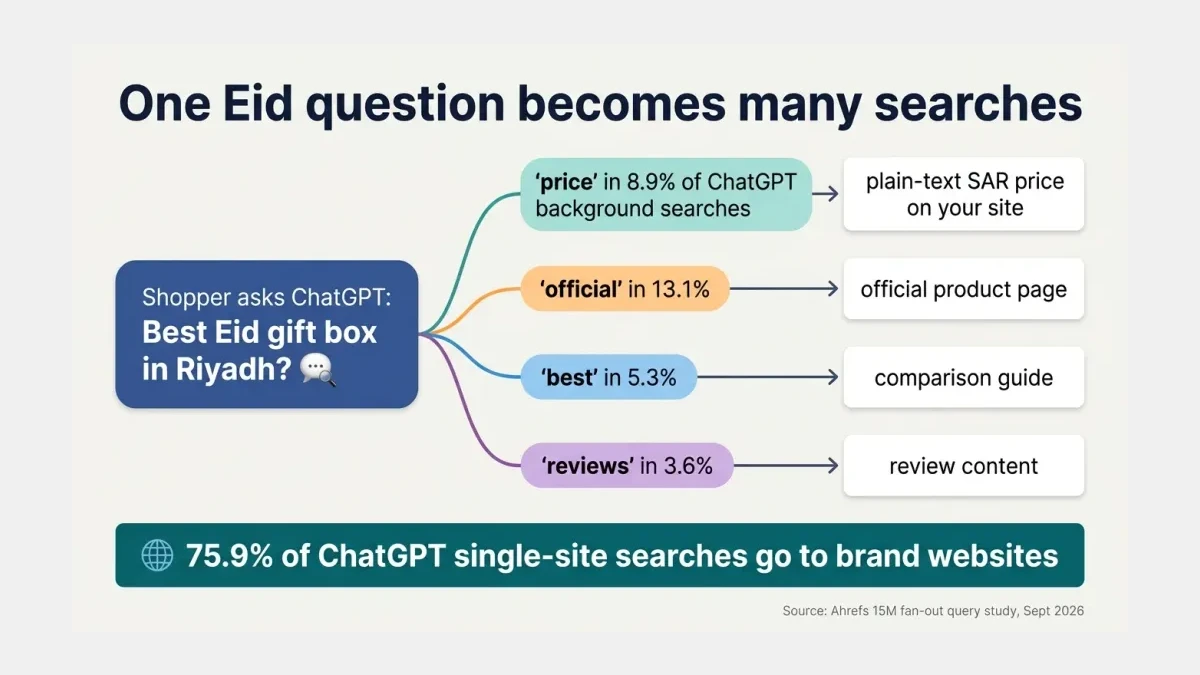
ChatGPT first decides whether to search the web at all: only 14.4% of the tens of millions of free responses Ahrefs tracked between August and September 2026 triggered a search, which means for many questions the assistant answers from what it already knows about your brand. When it does search, it runs an average of about 1.6 background queries per response — a behavior called fan-out, where one shopper question becomes several parallel searches before an answer is assembled.
That has a practical consequence for a store owner. If ChatGPT can answer “where do I buy premium dates in Riyadh?” from memory, your visibility depends on what it has already learned about you; if it searches, your visibility depends on what your pages say in plain text. Both paths require the same foundation: facts about your products, written on pages you control. And the words inside those background searches tell you exactly which facts matter — Ahrefs’ study of 15 million fan-out queries shows “price” appearing in 8.9% of them and climbing month over month, alongside “official” and “best”. A gift-box store with no plain-text SAR prices anywhere is absent from every one of those searches.
Why doesn’t ChatGPT use my noon or Amazon.sa listing?
Because marketplaces summarize, and ChatGPT increasingly cites the summarized less. In Search Engine Journal’s coverage of the same Ahrefs data, PubMed climbed from 64th to 4th among the most-cited domains in US answers between March and September, while health-and-finance explainer sites slid down the rankings — because, as Ahrefs puts it, ChatGPT:
“seems to be prioritizing original sources over sites that summarize them.” — Ahrefs, via Search Engine Journal
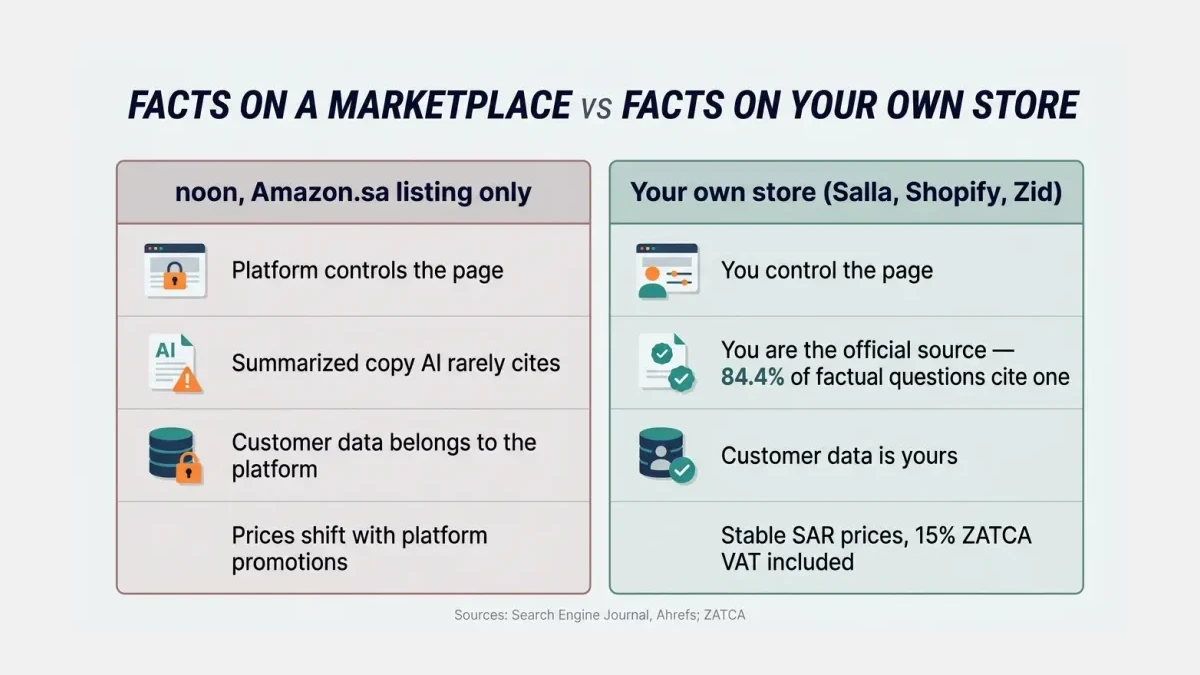
Your noon listing is a summary: near-identical copy to dozens of other date sellers, priced in a format the platform controls, on a page the platform owns. The strongest structural signal is this: among the roughly 160 domains ChatGPT most often searches directly, 75.9% of those single-site searches went to brand websites like apple.com and ikea.com — the seller’s own site, not a reseller’s marketplace page. Which means a Riyadh trader selling Khairpur dates sourced through family back in Sindh, with everything listed on noon and Amazon.sa but nothing on a store of their own, is structurally invisible at the moment the assistant goes looking for an official source.
One honest caveat belongs here. The Ahrefs dataset is drawn from US answers; treat the direction as universal and the exact percentages as local to that sample. Saudi shoppers also search in Arabic, and an Arabic product page on your own domain serves both languages better than a marketplace listing either way.
Which product facts belong on my own website?
Book a free strategy call - we'll audit your current setup and identify the highest-impact fixes.
Start here: one page per product, written like the answer to a customer’s question, with the price visible in plain text. Kristina Pototska, Director of Product Management at Commerce, said it plainly in BigCommerce’s ecommerce outlook:
“Your catalog is the new SEO.” — Kristina Pototska, BigCommerce
For a dates and gift-box catalog, the facts that earn citations and orders are concrete. Name the date varieties and their origins — Ajwa, Khairpur, Sukkari — because comparison questions name them. List box contents and weight, shelf life, delivery windows within Riyadh, corporate-gifting terms for bulk orders, and the price in SAR including ZATCA’s 15% VAT, since goods sold online and delivered inside the Kingdom carry the standard rate. Ahrefs found 84.4% of factual questions about pricing, features, or company details cited at least one official source — a store page is an official source; a WhatsApp photo of a price list is not.
| noon / Amazon.sa listing only | Your own store (Salla, Shopify, Zid) | |
|---|---|---|
| Who controls the page | The marketplace | You |
| Can AI cite it | Rarely — summarized, duplicated copy | Yes — you are the official source |
| Customer data | The platform’s | Yours |
| Price display | Shifts with platform promotions | Stable SAR, 15% VAT included |
| Ramadan flexibility | Campaign windows set by the platform | Deposits and pre-orders on your calendar |
Run the money before rebuilding anything, using this illustrative worked example — substitute your own costs. A 1kg premium Khairpur gift box sells at SAR 145. Dates cost SAR 60, gift packaging SAR 25, and Riyadh delivery SAR 15, leaving SAR 45 contribution per box. A corporate Eid order of 50 boxes at SAR 130 each still contributes SAR 30 per box — SAR 1,500 on the order. Your budget rule follows from those numbers: spend on catalog pages and feeds only while tracked orders from AI-assisted and organic sessions exceed that monthly spend, and stop scaling the work in any month the tracked contribution falls under it.
How do I cover every way a customer words the request?
Fan-out means one question becomes several, so one page cannot carry the whole season. “Best dates gift box for Eid”, “corporate Eid gifts Riyadh”, “Ajwa or Khairpur for gifting”, and “premium dates delivery Riyadh” are four different searches wearing the same intent. Ahrefs found the pattern splits by question type: 84.4% of factual questions cited at least one official source, against 68.3% of comparison questions like “which is better” — and only 46.4% of comparison-question citations went to official sites, so the assistant leans on third parties to weigh options. Which means your own pages should answer the factual queries, and a comparison page you publish (“Khairpur vs Ajwa: which gift box suits which budget”) is how you appear inside the comparison searches too.
Complete product data pays off even when AI is not involved. Dutch fashion brand Studio Anneloes, after replatforming to BigCommerce, reported a 24% lift in conversion rate — the case study credits the faster, more reliable storefront, with clearer product data coming as part of the same rebuild. For feed hygiene on the Google side, our guide to products disappearing from Shopping is written for Pakistani sellers, but the feed discipline transfers line for line to a Saudi store; and if you sell premium fragrance alongside dates, how a Dubai oud shop got recommended by ChatGPT covers the same first-party groundwork from a Gulf neighbor’s angle.
How do I check whether AI actually sends me buyers?
In GA4, open Reports, then Acquisition, then Traffic acquisition, and filter Session source/medium with a regex matching chatgpt.com and the other AI referrers — Practical Ecommerce walks through the setup. Watch that channel monthly alongside your ordinary organic traffic, and note which product pages the sessions land on, because those are the pages the assistants actually cite. Semrush’s prompt-tracking approach adds the other half: an AI visibility dashboard built around a stable set of buyer-phrased prompts, refreshed weekly, shows whether your brand appears in answers even when no click follows.
A product feed — the structured file of your products, prices, and images sent to shopping platforms — and Merchant Center, Google’s tool that validates that feed, both need a monthly look, because feed rules change quietly and Google’s Merchant Center announcements page is where those changes are published. Gift boxes live and die on presentation: the packaging is the product, so the feed image is your shop window, and missing or low-quality images cost you the click even when the listing appears.
When should all of this be live before Ramadan?
How we helped a Pakistani business achieve measurable results.
Ramadan is expected to begin around February 8, 2027, subject to moon sighting, with Eid al-Fitr expected around March 9 or 10. Corporate buyers — the 50-box orders that carry the season — shortlist vendors in December and January, which places the real deadline in mid-December 2026: product pages live, feed clean, prices in plain SAR, and a pre-order page collecting deposits six weeks out from the expected start. Work backward from that date and October becomes the build window, not the thinking window.
Read next: selling inside Google’s AI search (written for Pakistani stores; the setup sequence transfers) and how Google now writes Shopping ad copy from your feed (a PKR example of why feed quality decides paid performance too).
WeProms Digital, an AI shopping channel optimization agency for UK, Gulf, and North American sellers, builds exactly this stack: first-party catalog pages, product feed optimization, Merchant Center management, and GA4 tracking that shows whether AI sends you buyers. We have worked with ecommerce sellers across Riyadh, Dubai, and Toronto, and we reply in Gulf and UK business hours. Email hello@weproms.com, message WhatsApp +92 300 0133399, or use weproms.com/contact-us — bring your top five products and we will show you what ChatGPT finds today.
Sources & References
- Ahrefs — How ChatGPT Does Query Fan-Out (15 Million Queries Studied) — October 12, 2026
- Search Engine Journal — ChatGPT’s Most-Cited Sites Tilt Toward Primary Sources — October 12, 2026
- BigCommerce — Unfiltered Views on Ecommerce: Product Discovery and Checkout — October 12, 2026
- Semrush — How to Build an AI Visibility Dashboard — October 12, 2026
- Practical Ecommerce — New GA4 Channel Tracks AI Traffic — October 2026
- ZATCA — Guideline for the Retail Sector under VAT Provisions — accessed October 2026
- Google — Merchant Center announcements — accessed October 2026
- Gulf News — When will Ramadan 2027 begin? Moon sighting forecasts — October 10, 2026