By Abdul Rehman · WeProms Digital · Last updated: September 24, 2026
TL;DR: In September 2026, Google switched on buying inside its AI search and enrolled eligible stores automatically. This walkthrough shows a Pakistani online store, step by step, how to get platform, product feed, online payments, ratings, and a small live test ready — roughly two to four weeks of focused work, and far less than a season of Shopping ads spend.
If you run a Lahore womenswear brand doing PKR 2.5 million a month online, or a Karachi cosmetics label shipping nationwide, your next customer may soon pay you without ever loading your website. Google has started letting shoppers complete purchases directly inside AI Mode on Google Search and inside the Gemini app, using payment details already saved in their Google Wallet. The feature, called Native Checkout, moved from a limited pilot to a much wider rollout during the third week of September 2026, and Google enrolled eligible merchants by default rather than asking permission.
Start here. That sentence — enrolled by default — is the reason this guide exists.
First, understand what Google actually switched on
On September 22, 2026, merchants on Shopify began receiving emails from Google Merchant Center with an unusual opening line: “Your products are now eligible for native checkout.” The email explained that the merchant’s Shopify store had been matched to its Merchant Center account, and that customers could now buy the store’s products inside AI Mode on Google Search, inside Gemini, and on other Google surfaces. Search Engine Roundtable, which broke the story, reported that the checkout technology had existed since February 2026 and that Google widened the rollout on September 19 before the emails went out three days later.
Native Checkout — Google’s feature that lets a shopper pay for a product directly inside a Google surface such as AI Mode or Gemini, instead of visiting the seller’s website. The plumbing underneath is the Universal Commerce Protocol (UCP), an open standard that connects a store’s ecommerce platform to Google Pay and carries the product, payment, and shipping details between them. Merchant Center — Google’s free tool where a store uploads its product catalog so products can appear across Google Shopping, Search, and now AI surfaces.
The detail Pakistani store owners should not miss is the direction of the default. Google did not ask merchants to opt in. Eligible products were enrolled automatically, and a store that prefers buyers to finish the purchase on its own website must actively switch the feature off in Shopify admin, under Sales channels > Agentic. Google’s email stated this in the plainest possible terms: “Eligible products are automatically included. There’s nothing for you to set up.”
“Your Shopify store was matched to your Merchant Center, enabling native checkout on Google AI Mode and Gemini. Customers can now buy your products in AI Mode on Google Search, Gemini, and more.” — Google’s merchant email, September 22, 2026, via Search Engine Roundtable
Check your Merchant Center notifications and your platform’s admin panel this week. Knowing whether your store has been matched is free, takes ten minutes, and decides every step that follows.
Then, check whether your store is in the game yet
Honesty first: as of late September 2026, Google’s published eligibility rules require merchants based in the United States selling to US customers, on a platform that supports UCP — Shopify is the confirmed one, through its Agentic Storefronts integration. Google has publicly named the retailers already live in AI checkout, including Nike, Sephora, Target, Ulta Beauty, Walmart, and Wayfair, plus Shopify brands such as Fenty and Steve Madden. Google has also stated it plans to expand UCP checkout to Canada, Australia, and the United Kingdom in the coming months, then to YouTube in the US, with hotel booking and local food delivery verticals to follow.
That expansion path has two practical meanings for a Pakistani business. A Karachi or Islamabad exporter already selling to US customers through Shopify could qualify today, and that store is leaving orders on the table by ignoring the settings. A domestic-only Pakistani store is not on the published list yet — but the eligibility checklist is effectively the preparation roadmap, and Google’s southward expansion is visible in its other shopping tools. Merchant Center’s AI performance insights, which report how a brand performs on conversational shopping queries in AI Mode and AI Overviews, already cover Australia, Canada, India, New Zealand, and the United States. India’s inclusion signals that South Asian catalogs are being wired into Google’s AI shopping layer now; Pakistan’s absence is a timing gap, not a wall.
The tradeoff is really a sequencing decision. Stores that fix feeds and payments before the feature reaches Pakistan will switch it on in days when it arrives; stores that start then will spend a quarter catching up while competitors collect the early orders.
Next, fix the product feed Google reads first
Picture this: the feed is the application form, and Google’s AI is the clerk who never asks follow-up questions. Every attribute either qualifies your product or silently drops it. The attributes that decide AI checkout eligibility are the same ones that already decide Shopping ads performance:
Price comes first, in PKR, matching your website to the rupee. A stale price is the most common disapproval reason in Pakistani Merchant Center accounts, and an AI checkout cannot complete a purchase on a wrong price. Availability belongs in the same breath, updated the same day stock changes, because an AI surface that sells an out-of-stock lawn suit creates a refund, a dispute, and a lost customer in a single transaction.
GTIN — the global barcode number printed on retail packaging. Products without GTINs can still serve, but identical items with valid GTINs win placement because Google can match them to a known catalog entry. Titles and images carry the rest of the weight: a title reading “Kurti F-M” means nothing to a matching system, while “Women’s Embroidered Lawn Kurti, Size M, Blue” means everything, and watermarked or vendor-poster images fail quality checks without ever telling you why.
Pakistani catalogs fail these checks at a much higher rate than global ones, and the reasons are structural: sizes written in shorthand, barcodes missing on imported or unbranded goods, and prices that change faster than the feed syncs. Two earlier WeProms guides cover this ground in depth — why one-line product descriptions lose sales in Pakistan and why Pakistani stores need Merchant Center setup in the AI search era. Read both before touching your feed.
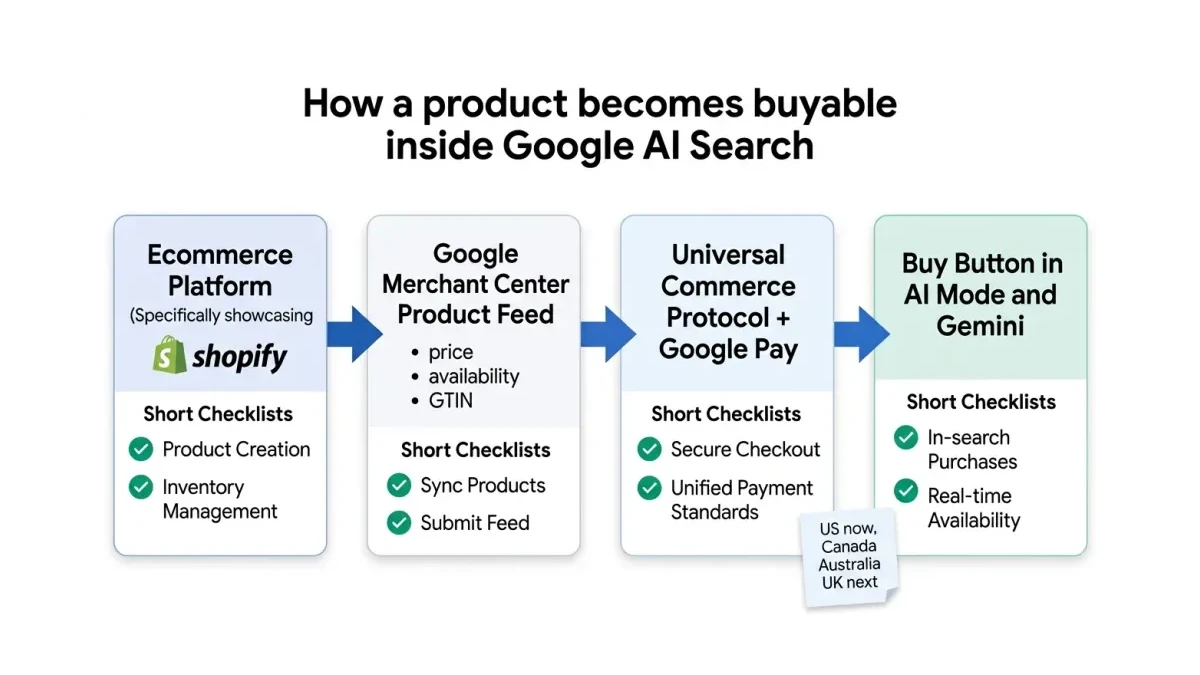
A clean feed pays for itself today, before any AI checkout reaches Pakistan, because the same attributes drive Shopping ads, free listings, and product snippets in regular Search. The work is not speculative.
After that, solve the payment problem cash on delivery creates
Here is the structural barrier, stated plainly. Published estimates put cash on delivery at 60% to 70% of all Pakistani ecommerce orders — the figure cited in the draft Ecommerce Policy 2.0 — and some industry estimates run as high as 75%. Pakistan’s ecommerce market was worth an estimated US $5.776 billion in 2025, growing 10-15% a year, according to ECDB’s market data. So roughly PKR 6 to 7 of every PKR 10 spent online in Pakistan is handed to a courier, not paid in advance. Native Checkout cannot collect that money. Google’s checkout runs on Google Pay and card rails inside UCP; there is no COD option, and there may never be one.
Within the prepaid minority, the rails are already Pakistani. State Bank of Pakistan data for FY2025 shows 93% of digitally settled ecommerce transactions were wallet- or account-based and only 7% card-based. JazzCash and Easypaisa are how Pakistani shoppers actually pay online when they prepay, and a store can accept JazzCash payments on its website through aggregator platforms in a matter of days. Raast, SBP’s instant payment system, is steadily extending the same rails.
The trust problem has a Pakistani shape too. A shopper at Liberty Market inspects the stitching before handing over cash; COD recreates that inspection privilege online, because payment happens only after the parcel is in hand. Prepaid checkout removes the inspection, so something else must carry the trust — and that something is store ratings, review counts, and a return policy Google can verify. Ratings do online what the shopkeeper’s face does at Liberty Market. A Pakistani store pushing into prepaid, AI-surfaced checkout should treat its review volume as payment infrastructure, not as vanity.
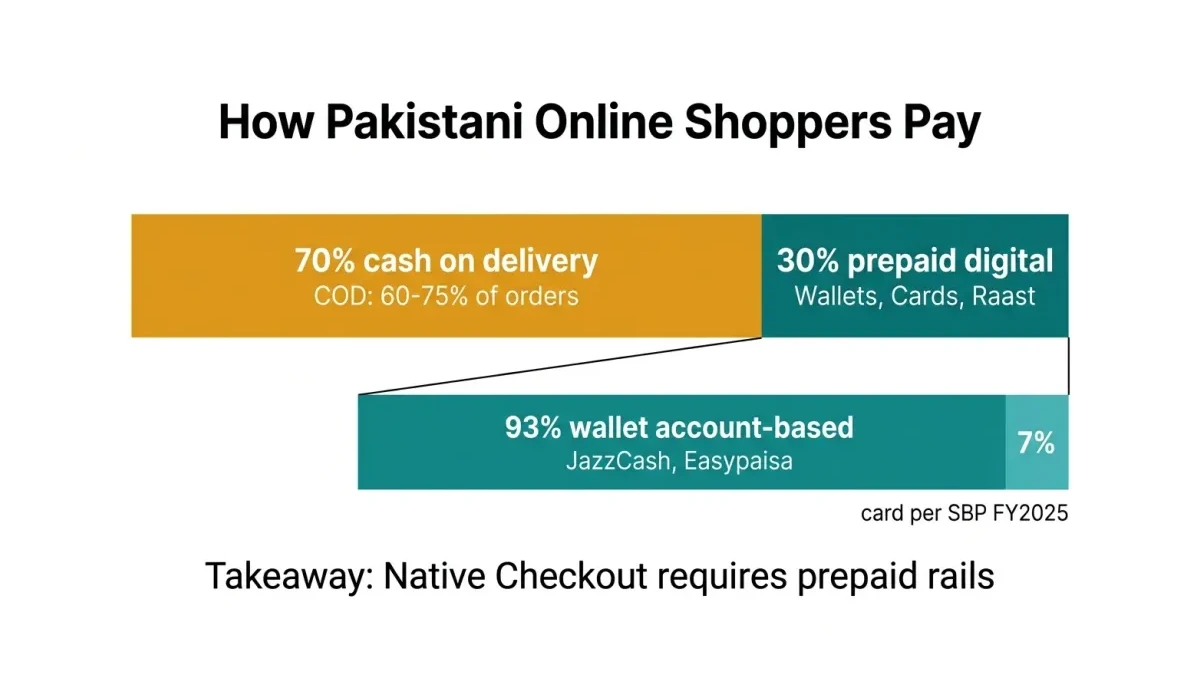
Adding JazzCash, Easypaisa, and a card gateway this month raises prepaid share on your own store immediately, regardless of when Google’s AI checkout reaches Pakistan. That alone justifies the integration cost, typically PKR 30,000-80,000 depending on the aggregator.
At this point, decide whether you actually want the buy button on Google
Being buyable inside Google’s AI is not an unmixed blessing, and Elsop’s walkthrough of Shopify’s agentic checkout settings spells out the costs. Google Analytics and custom client-side pixels do not fire inside the AI checkout — only server-to-server events for checkout started and checkout completed. Checkout blocks for consent collection, loyalty and rewards, upsells, chat, and even trust badges do not load in that flow. Your analytics will undercount AI-channel revenue unless you reconcile from platform order data, and your post-purchase upsell path disappears entirely inside Google’s surface.
That makes the decision a genuine tradeoff rather than a default. An exporter with thin brand recognition in the US gains far more from Google’s trust transfer than it loses in upsells. A Lahore brand running aggressive remarketing and a loyalty program loses the customer relationship it has spent years building the moment payment happens on Google’s page instead of its own.
From here, the rule is simple: if your margin depends on repeat purchase and upsell, keep checkout on your site; if your constraint is discovery and first orders, take Google’s checkout everywhere Google offers it.
Once the basics are clean, run a small live test
After the feed, payments, and ratings decision are settled, test with a bounded catalog rather than the whole store. Pick 20 to 50 products — bestsellers with clean images, valid GTINs, and stable PKR pricing. Watch them for two to four weeks across three places: Merchant Center diagnostics for disapprovals, your platform’s order list for AI-channel purchases, and your payment gateway’s settlement report. Reconcile revenue from the order list, never from analytics alone, because the analytics tag does not fire inside Google’s checkout. Track refunds and delivery disputes on AI-channel orders separately, because prepaid orders from new AI surfaces will behave differently from your COD baseline.
What this produces
A store that completes this sequence ends up with something rare in Pakistani ecommerce: a catalog that machines can read, a payment stack that works without a courier collecting cash, and ratings that carry trust to a customer who never sees the shop.
| Typical COD-only Pakistani store | AI-checkout-ready store | |
|---|---|---|
| Payment collected | By courier, on delivery | JazzCash, Easypaisa, card — before shipping |
| Product feed | Partial, prices drift, GTINs missing | PKR-accurate, availability synced, GTINs valid |
| Trust signal | Open-the-parcel inspection | Store ratings and verified return policy |
| Where the buyer pays | Your website, or nowhere | Your website, Google AI Search, Gemini |
| What your numbers show | Orders only | Orders plus AI-channel revenue from platform data |
Those assets win Shopping ads today, Daraz-vs-Google comparisons tomorrow, and AI checkout whenever Google switches Pakistan on. The stores that wait for the official announcement will spend the first quarter of that era fixing feeds; the stores that prepare now will spend it counting orders. As a Lahore-based ecommerce marketing agency, WeProms Digital has seen feed quality decide more ecommerce outcomes than ad budget ever does, and the AI checkout era raises that stake further.
Read next: Why Pakistani stores need Merchant Center setup in the AI search era · TikTok Shop Pakistan: an ecommerce guide for local brands
If you want this sequence run for your store — feed audit, payment gateway selection, ratings plan, and the live test — WeProms Digital handles the full pipeline as part of our ecommerce marketing services. Email hello@weproms.com, message WhatsApp +92 300 0133399, or visit weproms.com/contact-us. The first conversation costs nothing and will tell you exactly where your catalog stands.
Frequently Asked Questions
Can a store based in Pakistan sell inside Google’s AI checkout today?
Only if it sells to US customers through a US-eligible setup on a UCP-supported platform like Shopify. Google’s published rules in late September 2026 require US-based merchants selling to US buyers, with expansion planned for Canada, Australia, and the UK. A Pakistani exporter with a compliant Shopify US storefront can qualify now; a domestic-only store must prepare and wait for Pakistan’s inclusion.
Does cash on delivery work with Google’s AI checkout?
No. Native Checkout completes payment inside Google through Google Pay and card rails before anything ships, so there is no courier collection step. Stores that want AI checkout eligibility must accept prepaid online payments — in Pakistan, that practically means JazzCash, Easypaisa, a card gateway, or Raast rails behind the scenes.
How much does it cost to get a Pakistani store AI-checkout ready?
Expect PKR 30,000-80,000 for payment gateway integration, PKR 50,000-150,000 for a professional feed cleanup depending on catalog size, and ongoing effort for ratings collection. WeProms Digital scopes this as a fixed-price package after a free catalog audit, so you know the number before committing.
Will selling inside Google’s AI break my analytics?
Partly, yes. Google Analytics and custom pixels do not fire inside the AI checkout; only server-to-server events for checkout started and completed come through. Reconcile AI-channel revenue from your platform’s order data rather than analytics, and expect upsell, loyalty, and consent blocks not to load in that flow.
Is Shopify required, or can WooCommerce stores participate?
Today, Shopify is the confirmed platform because it built UCP support into its Agentic Storefronts integration. The Universal Commerce Protocol is an open standard, so other platforms including WooCommerce are expected to adopt it over time. A WooCommerce store should keep its Merchant Center feed clean now so it can move quickly when its platform connects.
Sources & References
- Search Engine Roundtable — Google Merchant Center Auto Enables Native Checkout: Buy On AI Mode & Gemini — September 22, 2026
- TechWyse — Google Opens Native AI Checkout to Shopify Merchants — September 23, 2026
- Elsop — Google AI Mode Checkout Goes Live: GA4 Doesn’t Fire — September 23, 2026
- Search Engine Roundtable — Google Expands Merchant Center AI Performance Insights — September 3, 2026
- ECDB — Pakistan Ecommerce Market Data — 2025
- Markaz — State of Ecommerce Pakistan 2026 — 2026
- Simpaisa — How to Accept JazzCash Payments on Your Website — 2026