By Abdul Rehman, WeProms Digital — September 20, 2026. Last updated: September 2026.
Rewriting your twenty best-selling listings with real specifications takes one working day and costs nothing but effort. In exchange, a Pakistani store gives shoppers the details they need to keep a cash-on-delivery parcel — and gives Google’s shopping systems clean data to read. This walkthrough covers the audit, the writing, and the measurement, in that order.
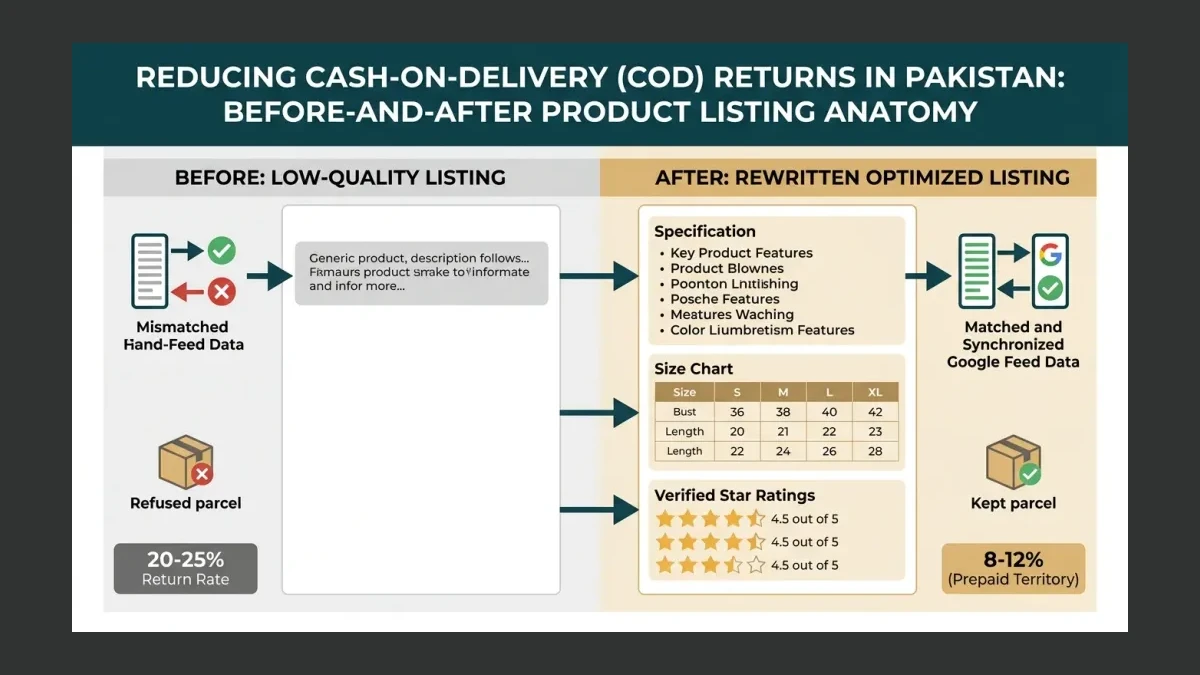
If you run a Shopify or WooCommerce store in Faisalabad turning over PKR 300,000 a month, and roughly one in five parcels comes back unopened, the courier is not your problem — the listing is. Industry figures for 2026 put cash-on-delivery return rates at 20 to 25 percent of orders, against 8 to 12 percent when customers prepay, according to the iCargoS Pakistan courier and logistics market report. The gap between those two numbers is the price of doubt. Pakistani online retail reached an estimated US$5.78 billion in 2025, per the Pakistan B2C ecommerce report, and too much of it is spent re-shipping parcels that a complete product description would have kept.
First, count what thin listings already cost you
Picture this: a shopper in Multan opens your product page, sees one sentence — “good quality shirt, available in all sizes” — a supplier photo with a watermark still visible in the corner, and no size chart anywhere. She orders anyway, because cash on delivery lets her decide at the door. The parcel arrives; the shirt is slimmer than the photo suggested; she refuses it. You pay courier charges both ways.
That is what a one-line description asks a COD customer to do: buy a sealed box. It is the equivalent of a bazaar shopkeeper showing you a suit piece through locked glass and refusing to open it until after you have paid. Some shoppers walk away before ordering, which shows up as low conversion; others order and refuse, which shows up as return charges. Either way, the same missing specifications are quietly billing you.
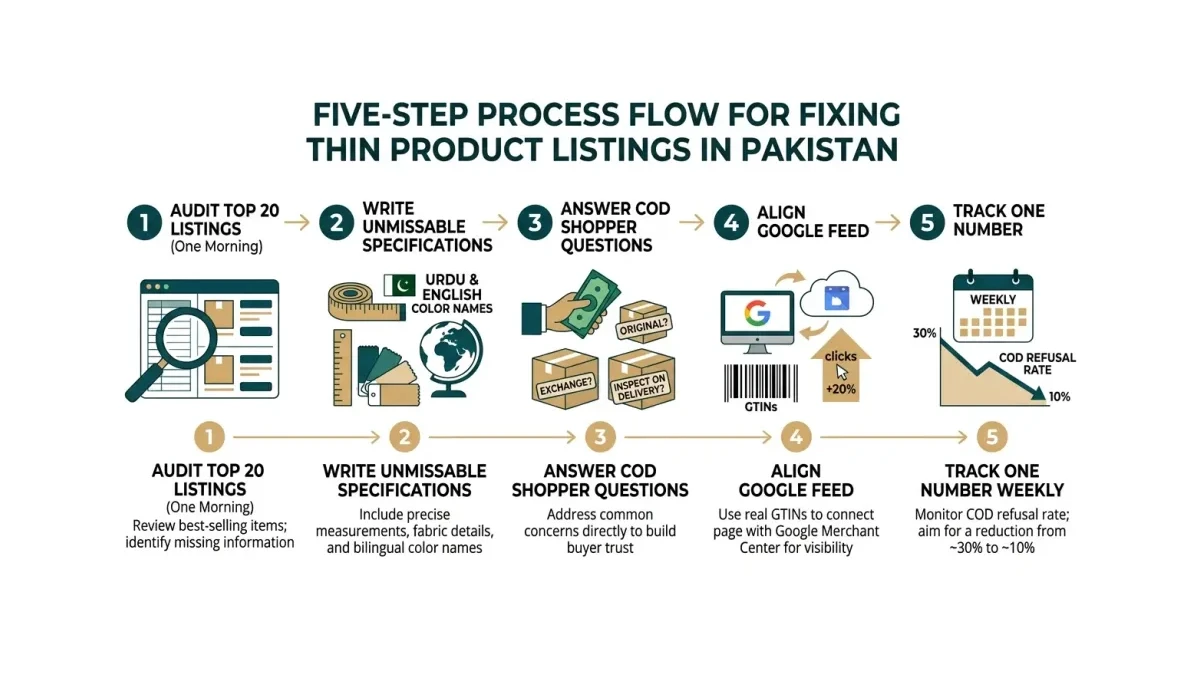
Start with an audit you can finish in one morning. Open your analytics, sort products by revenue over the last 90 days, and list your top twenty sellers. For each one, record four things: the word count of the description, whether a size or specification chart exists, whether the images are yours or the supplier’s, and the product’s return rate if your platform reports it. Most Pakistani store owners who run this exercise find that their best-selling items carry the thinnest descriptions, which means the highest-traffic pages are doing the weakest selling.
Then, write specifications a buyer cannot misread
The rewrite is not creative writing; it is engineering. For each of the twenty listings, write down every fact a shopper would need in order to say yes with confidence: fabric or material composition, exact measurements with units, color names in both English and Urdu, what is included in the box, compatibility details for electronics, and care instructions where relevant. If a measurement could be read two ways, write it the boring way — “chest 40 inches, measured flat, buttoned” beats “regular fit”.
Write for the buyer who has been burned before. Pakistani shoppers have learned to distrust stock photos and generic claims, so specificity is what reads as honesty: a Sialkot sports-goods store that states the willow grade, bat weight range, and handle type answers the three questions a shopkeeper in the bazaar would answer in person. Vague superlatives do the opposite — they signal that the seller is hiding something. One paragraph of concrete detail plus a clean specification list outperforms five paragraphs of marketing prose, every time.
Do the same for titles and image captions: the words a customer types — in Urdu, English, or both — belong in the listing, because those words are also what the platform’s search reads. “Lawn suit 3 piece unstitched, stitched option available” tells the buyer and the search engine the same story.
Next, answer the three questions every COD shopper asks
Book a free strategy call - we'll audit your current setup and identify the highest-impact fixes.
Every refusal at the door traces back to one of three unanswered questions. Is the product original and as shown? What happens if it does not fit or stops working? Can I check it before paying? Your listing should answer all three in plain sight, not in a policy page three clicks away.
State the return and exchange window next to the buy button, with the WhatsApp number a customer can message with a problem. Publish one line on what “original” means for your product — official distributor, own manufacturing, imported stock with the import detail visible. And say explicitly what can be checked at delivery: “open and inspect before paying” is a phrase that converts hesitant first-time buyers better than any discount, because it moves the risk from the shopper to the seller where it belongs. Stores that close this loop over WhatsApp recover customers marketplaces never let them reach, which is one reason setting up WhatsApp commerce matters for Pakistani ecommerce.
Here is the uncomfortable comparison with marketplace selling: Daraz gives you traffic and a returns framework, but it also owns the customer relationship and charges for the privilege — the hidden costs of selling only on Daraz accumulate exactly where your own listings are too thin to compete. A store with complete descriptions can afford to move buyers to its own channel; a store without them cannot.
After that, make your page and your Google data tell the same story
Once the human-facing copy is fixed, the second reader needs attention: Google’s shopping systems. Merchant Center — Google’s product catalogue for shops, which powers how products appear across Search, the Shopping tab, and image results — reads a product feed: the structured record of your title, price, availability, and attributes. The feed must agree with the page. If your page says PKR 2,499 and the feed says PKR 2,999, listings get suppressed silently, with no email announcing the problem.
Does the written description still matter when machines read the feed? Yes, and the reasoning is worth quoting. As Search Engine Journal’s Ask an SEO column put it in September 2026:
“Yes, your product page still matters because large language models (ChatGPT, Claude, Perplexity, etc.) are only one source of traffic and conversions, and they cannot access everything from a product feed or schema.”
Discovery runs on structured data; persuasion still runs on the copy — and thin copy loses on both fronts, because the machines quoting your product have nothing reliable to quote. Two feed habits are worth adopting this quarter. Fill in real GTINs — the global barcode numbers identifying a product — because Google’s own figures, cited in product-page SEO analysis, put correct GTINs at roughly 20 percent more clicks. And watch the feed requirements grow: Google’s Merchant Center API began accepting product reviews in September, alongside a new requirement to label adult-oriented products, per Search Engine Roundtable’s coverage — proof that feed compliance keeps expanding and that errors suppress listings without penalty notices.
One warning from abroad deserves a local hearing. Google removed free product listings from its European search results in September — trackers recorded 90 to 100 percent declines across Germany, France, and neighboring markets within two days, as PPC Land documented, with Ecommerce News EU confirming the carve-out for comparison services. Pakistan’s listings are untouched for now, which means free placements still work here; exporters serving Europe should treat compliant, complete feeds as insurance against the same retraction spreading. The full setup process is covered in why Pakistani stores need Merchant Center setup in the AI search era.
At this point, put verified proof where shoppers look
Screenshots of five-star reviews pasted on Instagram have trained Pakistani shoppers to distrust social proof. Google’s alternative is stricter and stronger: a product reviews feed — verified buyer reviews submitted through Merchant Center — which can put star ratings directly into your listings on Search and the Shopping tab. Google asks for a catalogue-wide minimum of 50 reviews before product ratings activate, with review data refreshed at least monthly, according to Google’s Product Ratings eligibility rules.
Fifty reviews sounds daunting until you count the orders you already ship. A store fulfilling ten parcels a day crosses the threshold in under a week of simply asking — a WhatsApp message two days after delivery, with a one-tap rating link, converts at rates email never will in this market. Match the review feed to your products with correct identifiers, so ratings land on the right listings.
The compounding effect is the point: the shopper deciding at the door sees specifications that match the parcel, the shopper searching Google sees star ratings beside your listing, and the systems answering product questions in AI chat read the same facts from your feed. Every reader of your product data gets the same truthful story, which is what trust is made of online.
Once the fixes are live, track one number every week
How we helped a Pakistani business achieve measurable results.
Measurement keeps the project honest. Pick a single number — the COD refusal rate on your top twenty products — and record it weekly from your courier portal or platform dashboard. Pakistani industry data suggests what is achievable: stores with weak verification and thin presentation see COD failures around 30 percent, while those combining order verification with clearer product presentation report failures below 10 percent, per Tejarify’s analysis of failed ecommerce orders.
Give each rewrite three to four weeks before judging it, because courier cycles and repeat customers muddy shorter windows. When a rewritten listing’s refusal rate drops, note which specification did the work — the size chart, the fabric detail, the inspection promise — and copy that fix across the rest of the catalogue. The audit sheet from step one becomes your measurement sheet, which means nothing new to learn; the same twenty rows, updated weekly.
| What the shopper encounters | One-line listing | Rewritten listing |
|---|---|---|
| Description | ”Good quality shirt, all sizes” | Fabric, exact measurements, color in Urdu and English |
| Proof of quality | Supplier photo with watermark | Own photos plus verified Google review ratings |
| Risk | Pay first, discover problems at the door | Inspection at delivery, stated exchange window, WhatsApp contact |
| Machine data | Missing or mismatched feed attributes | Feed matching the page, real GTINs, review data flowing |
| Typical outcome | Refusal at the door, courier cost both ways | Kept parcel, repeat orders, stronger Search placement |
The outcome: fewer refused parcels and stronger search placement
A falsifiable promise to test: a discount cannot fix a returns problem caused by vague listings. You simply pay twice — once in margin and once in reverse courier charges — while the missing specification keeps refusing parcels at the same rate. Descriptions fix what discounts cannot, and the stores that test both approaches side by side stop discounting.
The sequence compounds from the first morning. Audit the twenty listings that carry your revenue; rewrite them with facts a buyer cannot misread; answer the three COD questions in plain sight; align the page with the Google feed; collect verified reviews; then track one refusal number weekly. None of these steps requires new software, and all of them work on Daraz, Shopify, and WooCommerce alike. The cost of inaction is the arithmetic you already run every month: a fifth of your parcels travelling back across Karachi or Lahore traffic, unpaid.
WeProms Digital, an ecommerce marketing agency, handles this exact rebuild for Pakistani stores — listing rewrites, Merchant Center feed alignment, verified review collection, and COD return-rate tracking in one engagement. If your refusal rate is the number you most want down this quarter, start a conversation on WhatsApp at +92 300 0133399 or email hello@weproms.com.
Read next: Why Pakistani stores need Merchant Center setup in the AI search era and the hidden cost of selling only on Daraz.
Frequently Asked Questions
How long should a product description be for a Pakistani online store?
Long enough to state every fact a buyer needs to decide: material, exact measurements, color names in Urdu and English, what is included, and the return policy. For most products that is 100 to 200 words plus a specification list — one paragraph of concrete detail outperforms five paragraphs of marketing prose.
Will better descriptions really reduce my COD returns?
Yes, because most refusals happen when the parcel does not match what the shopper imagined. Listings with exact measurements and honest photos narrow that gap before the order is placed. Pakistani industry data shows failure rates falling from around 30 percent to below 10 percent when clearer presentation is combined with order verification.
Does this work on Daraz, or only on my own website?
Both. Daraz search reads titles and attributes the same way Google reads your feed, so specifications improve visibility on marketplaces too. The difference is ownership: on your own store, descriptions, reviews, and buyer data all build an asset you keep; on Daraz, they build Daraz’s.
How many reviews do I need for star ratings on Google?
Google requires a catalogue-wide minimum of 50 reviews before product ratings activate in Shopping surfaces, with review data refreshed at least monthly through an approved source or feed. A store shipping ten parcels a day can collect that in a week by asking buyers over WhatsApp after delivery.
Can WeProms rewrite my product listings, and what does it cost?
Yes — WeProms Digital rewrites listings, aligns Merchant Center feeds, sets up verified review collection, and tracks COD return rates for Pakistani stores. Pricing depends on catalogue size and platform; every engagement starts by auditing your top sellers so the scope is visible before you commit. Request a quote via the contact page.
Sources & References
- Search Engine Journal — Ask an SEO: Does my product page copy still matter if agents read feeds and schema? — September 17, 2026
- Search Engine Roundtable — Daily Search Forum Recap: September 18, 2026 — September 18, 2026
- PPC Land — Google drops free shopping listings across Europe in two days — September 19, 2026
- Ecommerce News EU — Google removes product carousels in Europe — September 17, 2026
- Google Merchant Center Help — Product Ratings eligibility — 2026
- UCP Radar — Product page SEO 2027: your data beats your copy — September 14, 2026
- GlobeNewswire — Pakistan B2C ecommerce report 2025: a $20 billion market by 2029 — January 29, 2026
- iCargoS — Pakistan courier and logistics market report 2026 — 2026
- Tejarify — Why ecommerce orders fail in Pakistan: the COD problem and fix — 2026
Additional reading from industry feeds: