By Hamza Ali, WeProms Digital · September 15, 2026
TL;DR: Daraz-only selling earns its keep below roughly PKR 500,000 in monthly sales. Above that line, category commissions of up to 17.2%, a 1.25% payment fee and provincial VAT on fees quietly stack up to 12-20% of every order — with zero customer data left over. This teardown shows where the model works, where it breaks, and the crossover math for your own storefront. Last updated: September 2026.
Daraz is Pakistan’s largest online marketplace, and thousands of sellers in Lahore, Karachi and Faisalabad run their entire ecommerce operation inside it. Pakistan’s online retail market was estimated at about $5.8 billion in 2025, per Research-and-Markets data reported by Markaz, and a large share of that flows through marketplace checkouts. The teardown below dissects the Daraz-only approach the way an operator would: what it earns, what it costs, and where the money leaks.
What this gets right
Traffic without a marketing budget. A new seller lists products and gets impressions on day one — no ad spend, no agency, no funnel. Daraz also runs periodic zero-commission windows for new sellers, as Pakistan Era’s August 2026 read of the seller fee page notes, which makes the first months genuinely cheap.
Cash on delivery, solved. Roughly 70% of Pakistani online orders are still settled in cash at the doorstep, per industry estimates, and Daraz’s logistics network collects, reconciles and remits that cash on the seller’s behalf. For a one-person operation in Multan, handing COD recovery to a marketplace is worth real money.
Trust, borrowed. Buyers who distrust an unknown website will order from a marketplace they already know, which shortens the decision for new brands. These three advantages are structural, and pretending otherwise helps nobody.
Where this breaks
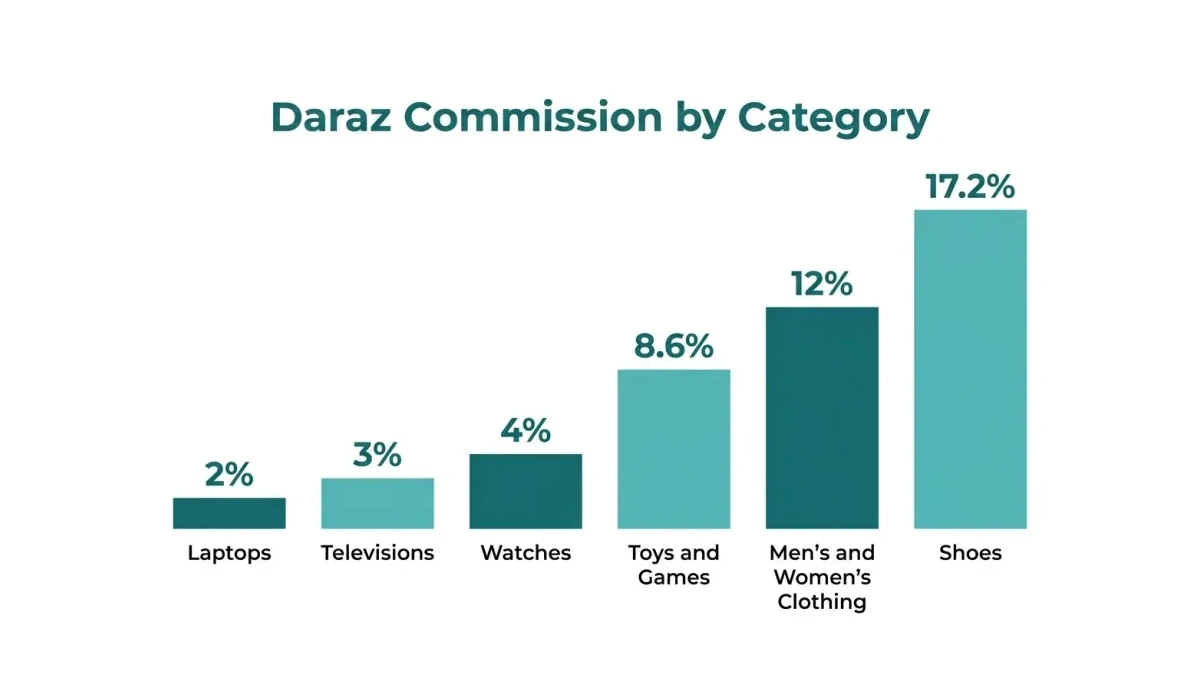
The commission schedule is where it starts. Published 2025 rate tables show shoes at 17.2% commission and men’s and women’s clothing at 12%, while electronics categories sit in low single digits. GiggBuzz’s commission guide summarizes the spread:
“Fashion items (shoes & clothing) offer the highest commissions, while electronics (laptops, cameras, TVs) generally provide lower rates.”
Fashion sellers subsidize electronics sellers. Add the 1.25% payment fee on every order and provincial VAT charged on the commission itself, and a shoes seller at 17.2% loses roughly a fifth of gross to the platform before marketing spends a rupee.
Customer data stays with the platform. The buyer’s phone number, email and purchase history belong to Daraz, not the seller. No remarketing list. No WhatsApp broadcast. No win-back flow for carts that did not convert. Every reorder depends on the customer voluntarily returning to a marketplace search bar — while the seller pays commission again for the privilege. The retention math that Pakistani stores run on owned channels, covered in customer retention strategies for Pakistani ecommerce, is simply unavailable inside the marketplace.
Visibility is rented, and increasingly auctioned. Sponsored placements inside marketplaces — retail media — eat margin, and whether they generate incremental demand or just tax existing demand is an open argument; Practical Ecommerce’s analysis of retail media value lands on “it depends on the category”, which is not a reassuring answer at 17% base commission. Meanwhile listing views are not orders, and conversion problems inside Daraz need their own fixes, as this teardown of Daraz products that are not selling shows.
The hidden cost of a rented storefront
Book a free strategy call - we'll audit your current setup and identify the highest-impact fixes.
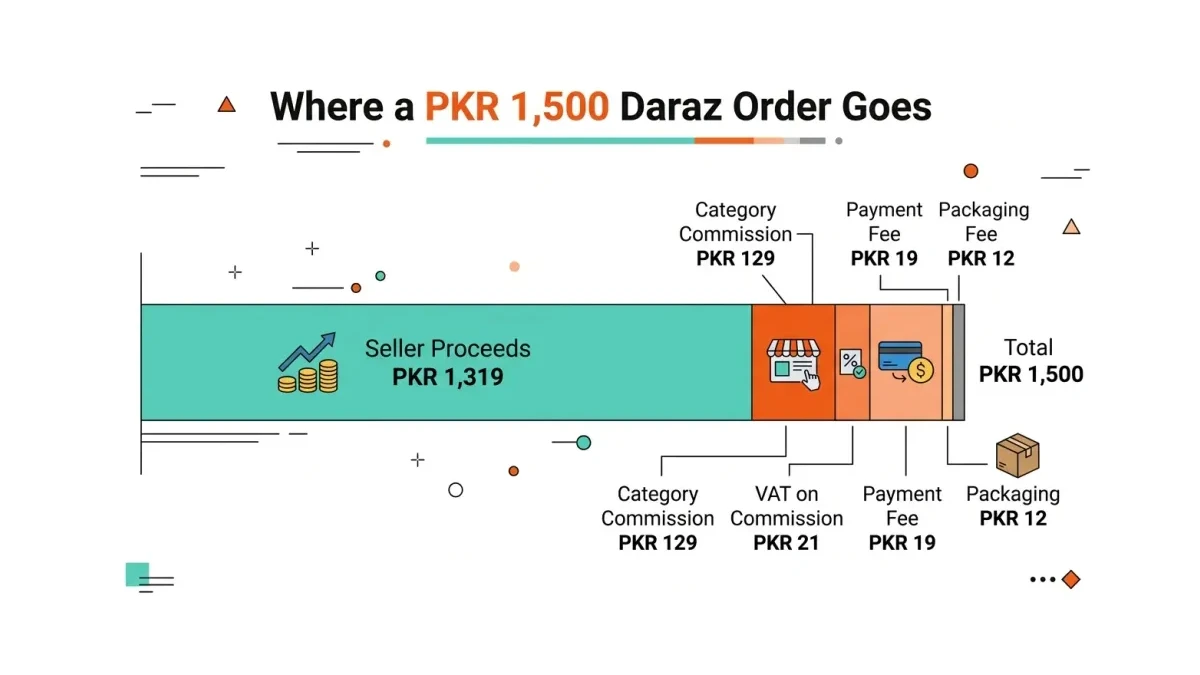
Run the worked example from the published fee tables on a single PKR 1,500 order in a mid-range category such as toys and games. Commission at the 8.6% mid-table rate costs PKR 129. Provincial VAT on that commission adds about PKR 21. The payment fee takes PKR 19, packaging PKR 12. Total deductions: PKR 180 — one rupee in eight leaves the order before stock, delivery or profit see anything. At PKR 500,000 in monthly sales, the same stack removes roughly PKR 60,000 every month.
Selling only on Daraz is like renting a stall inside Emporium Mall: the mall takes a cut of every sale, keeps the customer’s phone number at the counter, and can move your stall to the back floor whenever it reprices the floor plan. Sellers notice the cut. Most sellers never price the phone number.
The cross-border version of this leak is documented. Supply Chain Dive reported that FedEx built a Shopify app whose entire value is showing buyers a guaranteed landed cost at checkout, because 68% of merchants lose customers to surprise import charges. The lesson travels: Pakistani importers eating customs surprises on stock, and Pakistani sellers whose COD customers refuse surprise delivery adjustments, are both losing margin to unshown total costs.
The payment rails for an owned store are ready. JazzCash crossed 60 million registered customers in March 2026, per the company’s official announcement, and Easypaisa’s registered user base surpassed 50 million in its FY2024 results. Wallet-funded prepaid checkout is no longer theoretical in Pakistan, which cuts the COD handling burden that marketplace logistics currently solves — the cost side of that coin is covered in COD and digital payment costs for Pakistani ecommerce.
What Pakistani sellers should do instead
Run both, and measure net margin per order. Keep Daraz for discovery and first orders; add an owned storefront — Shopify or WooCommerce — for repeat purchases, data capture and margin recovery. Practical Ecommerce’s case for branded sites is exactly this argument: the branded store is where margin, remarketing and repeat purchase live; the marketplace is where new buyers are.
The fix is simple, but it is not free. A Basic Shopify plan at current Shopify pricing, plus a domain and a small app stack, typically lands between PKR 10,000 and PKR 15,000 a month. Against a 12% platform take on PKR 500,000 of sales, the owned store’s fixed cost is a quarter of the marketplace’s cut — before counting the repeat orders the customer list unlocks. The stack for Pakistan: COD through TCS, Leopards or Trax, JazzCash and Easypaisa wallets for prepaid checkout, and WhatsApp for support, all of which a store launch in Pakistan budgets for in more detail.
Here is the falsifiable version. For most categories the crossover sits between PKR 400,000 and PKR 600,000 in monthly Daraz sales: below it, marketplace fees beat the cost and effort of running your own store; above it, a Daraz-only setup gives away more in commissions, payment fees and lost repeat orders than an owned storefront costs to run. Sellers who disagree should run their own numbers for one month — the fee table is public, the crossover either appears or it does not.
| What you keep or give up | Selling only on Daraz | Your own store (Shopify or WooCommerce) |
|---|---|---|
| Cut of each sale | Up to 17.2% commission by category, plus 1.25% payment fee and VAT on fees | A payment gateway fee in low single digits; no commission |
| Customer phone numbers and emails | Platform keeps them | You keep them from the first order |
| Remarketing and WhatsApp retention | Not available | Available from day one |
| Delivery | Daraz logistics, COD handled | You choose: TCS, Leopards, Trax |
| Traffic | Built-in, auctioned via sponsored ads | You earn or buy it |
| Fixed monthly cost | Zero | Roughly PKR 10,000-15,000 |
WeProms Digital, Pakistan’s leading ecommerce website development agency, builds exactly these dual-track setups: Daraz kept for discovery, an owned store capturing the data and the repeat orders, with the ecommerce marketing programme feeding both. The net-margin comparison after 90 days settles the argument with numbers instead of opinions.
Read next: Black Friday Prep for Pakistani Online Stores — the one season where an owned store’s email and WhatsApp list pays for the whole year.
To get the dual-track teardown run on your own numbers — commission stack, crossover point, and the store build plan around it — email hello@weproms.com, message WhatsApp +92 300 0133399, or visit weproms.com/contact-us.
Frequently Asked Questions
How much commission does Daraz take on clothes and shoes?
Published 2025 rate tables put men’s and women’s clothing at 12% and shoes at 17.2%, before the 1.25% payment fee and provincial VAT on the commission. Electronics categories sit far lower, in low single digits. Check your exact subcategory in Daraz Seller Center before pricing, because rates change and the subcategory — not the main category — decides the rate.
Is it cheaper to sell on Daraz or on my own website?
Below roughly PKR 400,000 in monthly sales, Daraz usually wins: zero fixed cost, free traffic, COD handled. Above the PKR 400,000-600,000 band, marketplace commissions and fees typically exceed the full running cost of an owned storefront — before counting the value of the customer list an owned store builds.
Can I sell on Daraz and my own website at the same time?
Yes, and it is the recommended structure. Keep Daraz for discovery and new customers; use your own store for repeat purchases, bundles and customer data. Keep prices consistent across both to avoid channel conflict, and give the owned store reasons to be preferred — loyalty pricing, earlier drops, WhatsApp support.
How do I deliver orders from my own website in Pakistan?
Integrate a COD courier — TCS, Leopards and Trax all plug into Shopify and WooCommerce — and add JazzCash and Easypaisa as prepaid options. The courier collects cash, remits weekly, and the wallet payments settle immediately, which cuts both the COD refusal cost and the reconciliation work.
What does it cost to build an online store with an agency in Pakistan?
Scope decides the number: catalog size, integrations and design complexity. A focused Shopify or WooCommerce build from a Pakistani agency typically starts in the low hundreds of thousands of rupees; WeProms Digital scopes each build after a free consultation, and the 90-day net-margin comparison against your Daraz fees is part of the proposal.
Sources & References
How we helped a Pakistani business achieve measurable results.
- GiggBuzz — Daraz Seller Commission Rates: Complete Guide — August 2025
- Pakistan Era — Daraz Seller Fees: What You Actually Keep — August 2026
- Practical Ecommerce — Branded Sites Are Vital for Merchants — September 2026
- Practical Ecommerce — Does Retail Media Add Value? — 2026
- Supply Chain Dive — FedEx launches Shopify app to combat surprise import charges — 2026
- Markaz — State of Ecommerce in Pakistan 2026 — 2026
- GlobeNewswire — JazzCash crosses 60 million registered customers — May 2026
- BizToday — Easypaisa digital bank FY2024 results (registered base surpasses 50 million) — March 2025
- Shopify — Pricing — current
Additional reading from industry feeds: