6 Steps to Get Pakistani Store Products Into AI Shopping Search
By Abdul Rehman · Last updated June 14, 2026
Pakistani ecommerce grew 13.2% in 2025 while Daraz stayed flat and Google stopped sending clicks. This walkthrough shows the six steps to move your catalog into AI shopping engines like ChatGPT, complete a product feed, and measure real sales — in roughly four weeks and from PKR 60,000 in setup.
If you run a Shopify or Daraz-connected store in Karachi spending PKR 150,000 a month on Meta ads, your products probably appear in two places: your own website and the marketplace you sell on. A shopper who now asks an AI engine “which air fryer is best in Pakistan” never sees either. Pakistan ecommerce demand continues to grow, and ECDB reports Daraz Pakistan marketplace GMV at about US$856 million for the period it tracks. Growth is happening. It is just not flowing through the channels store owners have depended on.
The reason matters. Only 23% of Google searches now send a click to the open web, which means roughly eight in ten product searches end inside an AI answer, a marketplace, or a social app. The shopper who once browsed your category page now asks ChatGPT, Gemini, or Google AI Mode to name the best product and the best price. If your catalog is not inside that answer, you are not in the consideration set — no matter how much you spend on ads.
Start here. The shift is not a threat to fix later; it is a new shelf to stock now. This walkthrough shows a Pakistani store owner how to get products cited inside AI shopping search, step by step.
First, audit what AI engines can already see in your store
Before adding anything, find out what an AI crawler can read today. OpenAI and ecommerce technology partners have been moving product feeds into conversational commerce, while Google runs its own Merchant Center. Both depend on the same thing: a machine-readable catalog.
Run a crawl of your product pages with a structured-data testing tool. Most Pakistani Shopify and WooCommerce stores we examine return one of three problems. Product titles are written for humans, not models. Prices sit inside images or JavaScript that a crawler cannot parse. Stock status is invisible to anything except a logged-in shopper. Each gap is one product the AI engine cannot recommend.
Document what you find. A simple spreadsheet with one row per product and columns for title, price, availability, image, and category gives you the baseline. A manual audit of 200 products takes a weekend, but it surfaces every gap an AI engine would otherwise hit — time invested here buys accuracy downstream. The outcome is a clear list of what to fix before you build anything.
Then, clean and standardize your product data
Book a free strategy call - we'll audit your current setup and identify the highest-impact fixes.
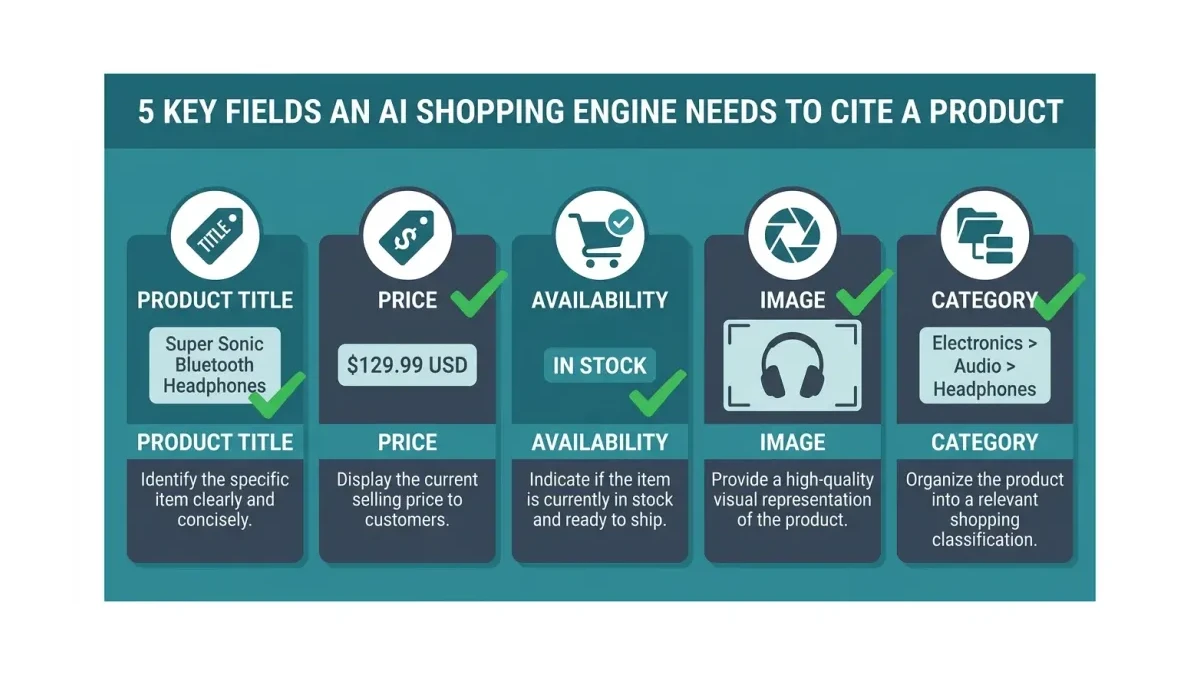
A product feed is a structured file that lists every product with fields an AI engine can read — title, price, availability, image, brand, and category. The feed is the catalog you hand the shopkeeper. Dirty data produces dirty recommendations.
Standardize titles first. “Cooker X1” tells a model nothing. “Prestige Pressure Cooker 5L Aluminium — Pakistan” tells it the brand, the capacity, the material, and the market. Add the words a shopper speaks aloud. A Karachi buyer searching in Roman Urdu types “pressure cooker 5 litre price” far more often than a model number.
Standardize prices in PKR with no symbols that break parsing. Standardize availability as a clean in-or-out-of-stock flag. Standardize images at 1000 pixels minimum on a plain background. Each standardization step removes one reason for an AI engine to skip your product and cite a competitor instead. Consistency is what lets a model trust the data enough to quote it.
Next, build a structured product feed from your catalog
With clean data, build the feed itself. The format most engines accept is a structured file — Google’s feed specification for Merchant Center, and OpenAI’s merchant portal feed for ChatGPT shopping. Both read the same underlying fields, which means one well-built feed serves multiple AI shopping surfaces.
Map your store categories to a recognized taxonomy. Google publishes a global product category list; OpenAI’s feed leans on similar structure. Mapping matters because an AI engine groups products by category when it writes an answer. An unmapped product floats; a mapped product sits in the right comparison.
Here is the difference a structured feed makes, field by field:
| Field | Before: PDF or Daraz-only | After: structured product feed |
|---|---|---|
| Product title | ”Cooker X1" | "Prestige Pressure Cooker 5L Aluminium — Pakistan” |
| Price | Inside an image | PKR 8,450, refreshed hourly |
| Availability | ”In stock” on page only | GTIN plus live stock flag in feed |
| Image | Lifestyle gallery shot | 1000px white-background product image |
| Category | None assigned | Google product taxonomy mapped |
The before-state is why most Pakistani stores are invisible to AI shopping search. The after-state is the minimum an engine needs to cite you with confidence.
After that, submit the feed to ChatGPT Merchants and Google Merchant Center
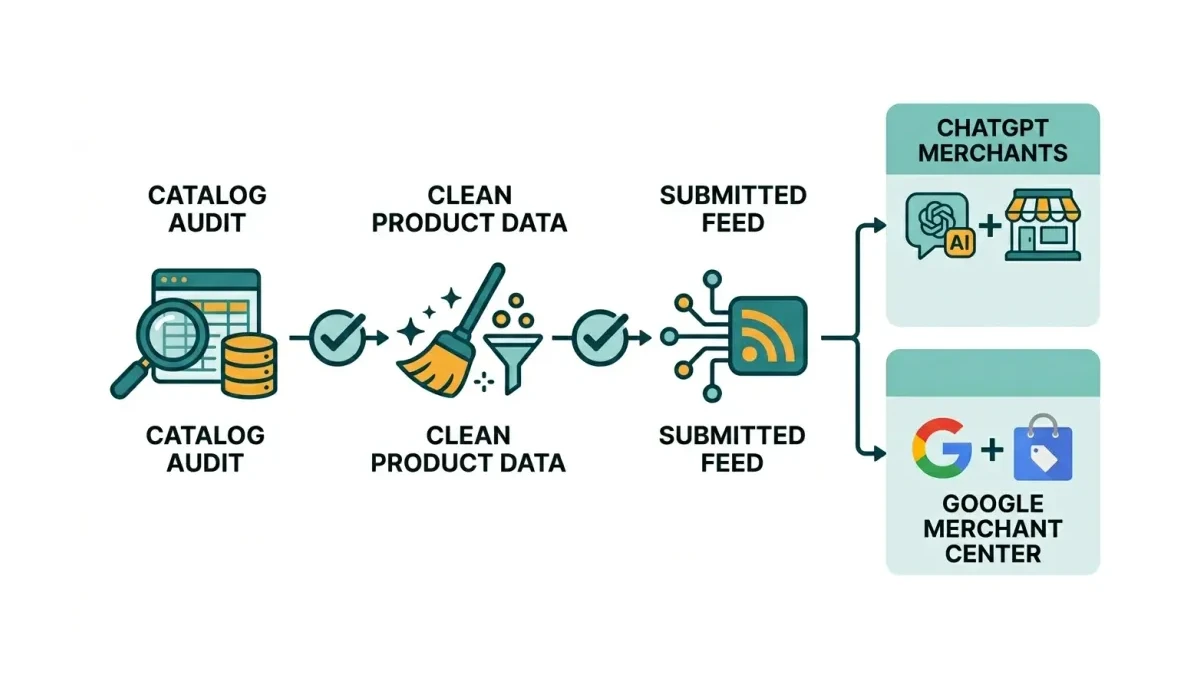
A feed sitting on your server does nothing. Submit it. Upload the completed feed to relevant merchant platforms and Google Merchant Center, then schedule a daily refresh so prices and stock stay current. Digiday reports that OpenAI has made it far easier for ecommerce brands to run shopping ads inside ChatGPT by automating product ads on top of existing catalog infrastructure, and Productsup confirms the move brings product feeds into conversational commerce.
Verify the submission. Both portals flag errors — a missing GTIN, an image that is too small, a price that fails to parse. Clear every flag. A single unresolved error can drop an entire product out of the eligible set. Treat the verification report the way you treat a payment gateway: one failed transaction is one lost sale.
For marketplaces, the same logic applies. Keep your Daraz and Shopify listings consistent with your feed so the same brand, price, and availability appear everywhere. Consistency across surfaces is what turns a scattered catalog into one recognizable product entity.
At this point, wire up conversion measurement before you scale
How we helped a Pakistani business achieve measurable results.
Visibility without measurement is guesswork. OpenAI partnered with LiveRamp to prove ChatGPT ads drive real purchases through a Conversions API (CAPI) — server-to-server tracking that ties a ChatGPT exposure to an actual sale, including offline conversions. The same pattern applies to organic AI shopping visibility: unless you measure which AI-referred sessions convert, you cannot tell which products the engines actually sell.
Set up server-side tracking so AI-referred purchases are attributed correctly. Default GA4 often mislabels AI shopping traffic as “direct” or referral, which means a sale that came from a ChatGPT answer looks like it came from nowhere. Closing that gap is covered in our guide to shopping and product feed management and in our deeper look at Daraz versus Shopify marketing in Pakistan. Measurement is not the last step; it is the step that tells you whether the previous four worked.
From here, monitor which products AI engines actually cite
With feeds submitted and conversion tracking live, watch what happens. Every two weeks, ask ChatGPT, Gemini, and Google AI Mode the questions a Pakistani shopper would ask about your category. Note which of your products appear and which do not. Cited products are working; uncited products need a stronger title, cleaner image, or better category mapping.
This monitoring loop is where most stores win or lose. Competitors who submit a feed and forget it drift out of the answers within weeks as stock changes and prices move. Stores that refresh the feed daily and audit citations monthly stay cited. The International Trade Administration’s Pakistan ecommerce guide notes the sector is projected to keep growing double digits annually, which means the AI shopping shelf will only get more crowded. The stores that maintain their feeds will own the answers; the stores that set-and-forget will be pushed out by the ones that do not. Pair this work with technical SEO for AI search visibility and a first-party data strategy that reduces dependence on any single marketplace.
Read next: To understand why organic clicks collapsed and what to do about it, see our analysis of the content problem behind Pakistani traffic loss.
WeProms Digital, Pakistan’s leading ecommerce marketing agency, builds and maintains product feeds for Shopify, WooCommerce, and Daraz-connected stores across Karachi, Lahore, and Islamabad. If your products are missing from ChatGPT and Google AI Mode answers, book a shopping and product feed management engagement and we will audit your catalog, build a structured feed, submit it to the right engines, and wire up conversion tracking. Reach us at hello@weproms.com or WhatsApp +92 300 0133399.
Frequently Asked Questions
How do I get my Pakistani products to show up in ChatGPT shopping answers?
Submit a structured product feed through the ChatGPT merchant portal at chatgpt.com/merchants. The feed needs clean titles, live PKR prices, availability flags, 1000-pixel images, and mapped categories. Once submitted and verified, OpenAI can cite your products when shoppers ask AI engines what to buy in Pakistan.
Is a ChatGPT product feed the same as a Google Merchant Center feed?
They are close but not identical. Both read the same core fields — title, price, availability, image, GTIN, and category — so one well-built feed can serve both with minor adjustments. Submitting to both Google Merchant Center and the ChatGPT merchant portal doubles your AI shopping surface with roughly one feed.
How much does product feed setup cost for a Pakistani ecommerce store?
A mid-tier ecommerce marketing engagement in Pakistan typically runs from PKR 60,000 to PKR 150,000 per month, with a one-time feed build scoped separately based on catalog size. The figure varies with the number of products and how dirty the existing data is, which is why an audit comes first.
Do I still need this if I only sell on Daraz?
Yes. Daraz keeps your products inside its own walled garden, but AI shopping search pulls from across the web. A Daraz-only store is invisible to a shopper asking ChatGPT or Google AI Mode for a recommendation. A product feed extends your reach beyond any single marketplace and reduces dependence on one platform’s flat growth.
How do I track sales that come from AI shopping search?
Use server-side tracking and a Conversions API to capture AI-referred purchases, because default GA4 often mislabels AI traffic as direct. OpenAI’s LiveRamp partnership shows the pattern: tie each AI exposure to a real purchase event on your server so you can see which products the AI engines actually sell, not just which they show.
Sources & References
- ECDB — Daraz revenue and Pakistan ecommerce market data — 2025
- International Trade Administration — Pakistan ecommerce country guide — 2025
- Search Engine Journal — Google search traffic to the open web drops to 23% — 2026
- Digiday — OpenAI makes it easier to run shopping ads in ChatGPT — 2026
- Productsup — OpenAI brings product feed ads to ChatGPT — 2026
- Adweek — OpenAI partners with LiveRamp to prove ChatGPT ads drive purchases — 2026
- Khalid Marjan — Pakistani ecommerce and SEO pricing — 2025
Additional reading from industry feeds: