By Sara Khan · WeProms Digital · October 12, 2026 · 10 min read
TL;DR: When a shopper asks ChatGPT for the best oud in Dubai, the answer is assembled from pages an engine can extract — structured product pages, Google reviews, and third-party mentions. A Deira attar shop can enter those answers by fixing its entity data, publishing extractable alcohol-free product pages, and earning real community mentions, with AED 0 in ad spend.
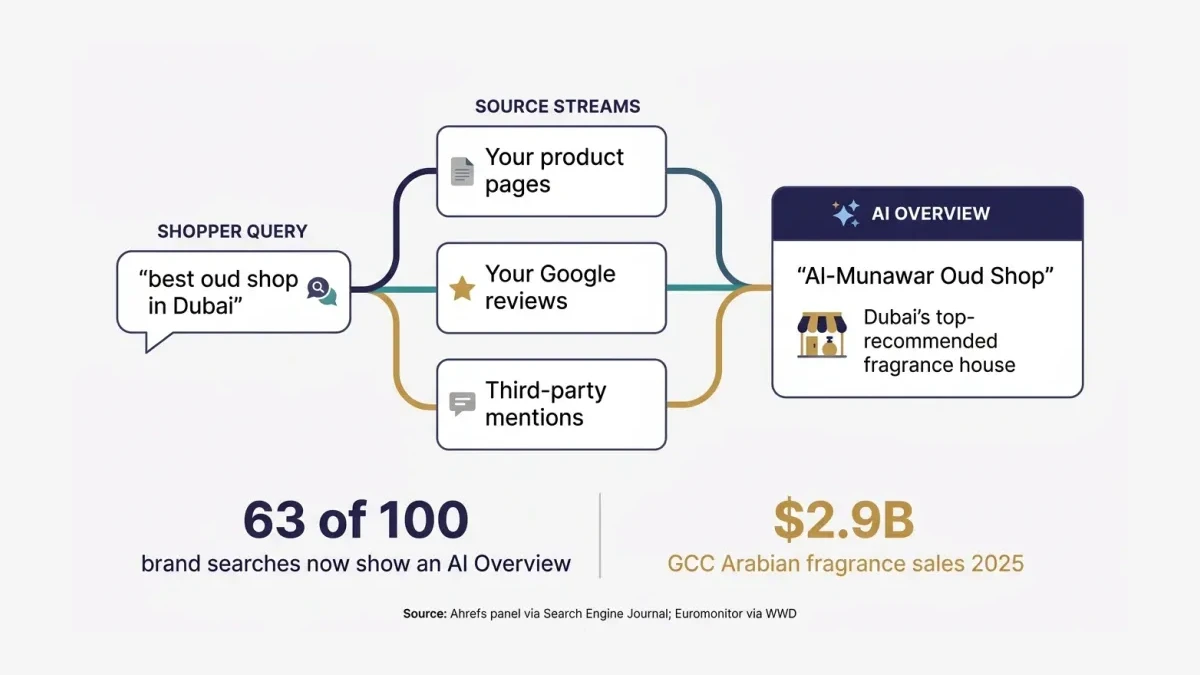
Between July 1 and September 30, 2026, the share of 100 global brand-name searches showing a Google AI Overview rose from 5 to 63 in Ahrefs’ weekly tracking panel. The same shift has reached Deira’s perfume souk: the nephew who once asked his uncle where to buy dehn al oud now asks ChatGPT, in English or Urdu, and walks toward the first three names it gives. For a Pakistani-owned attar shop in Dubai, the question is no longer whether AI answers influence the AED 300 to AED 900 a first-time gift buyer spends. The question is whose name the machine says.
Why does ChatGPT recommend my competitor’s perfume shop?
Because AI answers are assembled, not voted on. An answer engine — ChatGPT, Gemini, Perplexity, or Google’s AI Overviews — builds its response by extracting passages from your website, your Google reviews, and third-party pages about your category; when a competitor’s pages are easier to extract and more often mentioned elsewhere, the competitor gets named. Your Google ranking barely enters into it.
The numbers behind the shift are stark. Ahrefs found AI Overviews on 63 of 100 brand-name searches by September 30, up from single digits in early July, Search Engine Journal reported on October 9. Meanwhile Arabian fragrances — the oud, musk, and amber scents your shelves are full of — reached $4.9 billion in worldwide retail sales in 2025, with about $2.9 billion inside the GCC, according to Euromonitor data reported by WWD. So what? The customers asking AI assistants for oud recommendations are a real and growing slice of a growing market, not a gimmick; a shop that is absent from those answers is absent from the shopping journey.
“Earned media that appears in AI results now carries more influence than traditional coverage alone.” — HubSpot Marketing Blog, AEO for digital PR, October 2026
The pattern repeats across categories: the named shop is rarely the biggest advertiser; it is the most extractable and most mentioned. That is good news for a family counter in Deira, because extractability is a content fix, not a media budget.
How do I check what AI assistants actually say about my shop?
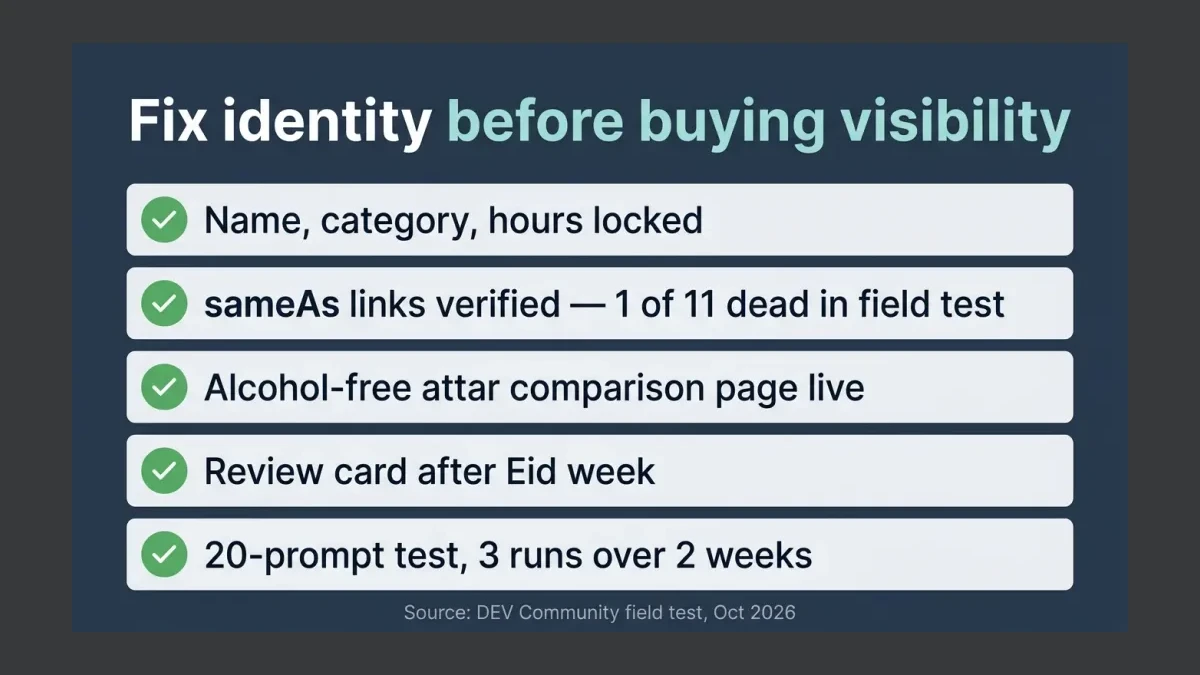
With a manual prompt test, run on a schedule, scored honestly. Write twenty questions a real buyer would ask — “best oud shop in Dubai,” “where to buy alcohol-free attar in Deira,” “oud gift under AED 500” — and run them through ChatGPT, Gemini, and Perplexity. Record which shops get named and which pages get cited. Repeat three times across two weeks before believing any movement.
Two cautions come from a practitioner who documented six ways his own AI-visibility measurement lied to him. First, echo inflation: if your shop’s name appears in the question, the model repeats it in the answer, and a naive count scores that as a mention — only a citation of your own domain counts. Second, sampling noise: two runs four minutes apart produced different answers in his field test, so a single run tells you almost nothing.
“A third to a half of the answers involve no search at all… For those questions, nothing you publish this month matters. The answer comes from training data.” — DEV Community field test, October 2026
That blockquote is the single most useful thing a Dubai shop owner can internalize this year. Between 11 and 17 of his 35 test questions were answered from training data with no live search — which means some answers about “Dubai perfume shops” will not change no matter what you publish, and chasing them wastes evenings. The fixable half is the half that searches.
| Method | What it costs | What it tells you | Where it lies |
|---|---|---|---|
| Manual 20-prompt test, 3 runs | AED 0 plus one hour | Which shops and pages get named on your money prompts | Echoes on brand questions; single runs are noise |
| Vendor AI-visibility dashboard | Monthly subscription | Trends and competitor share of voice over time | Sampling is hidden; brand-name prompts inflate scores |
| Agency audit with tracked prompts | Scoped fee | Prioritized fixes plus a prompt set run on a schedule | Varies by provider — ask which prompts are tracked and how often |
What content makes an AI answer cite an oud shop?
Book a free strategy call - we'll audit your current setup and identify the highest-impact fixes.
Extractable pages with facts on them. HubSpot’s own marketing team recorded a 642% increase in citations from comparison articles, and its AEO data shows 92% of industry-specific content pages were cited by answer engines, according to its content strategist guide. So what? A plain page titled “Alcohol-free attars under AED 200 in Deira, compared” will outperform a lifestyle photoshoot post every single time, because an engine can lift a table row out of it and cannot lift a mood.
Extraction — an answer engine copying a short, self-contained passage from your page into its reply. Every page should be built to survive being read alone. For an attar shop that means product pages carrying origin (Hindi oud, Cambodian oud), size in tola or milliliters, price in AED, alcohol-free status stated explicitly, and one defining line — “Dehn al oud — pure agarwood oil, no alcohol, no fillers” — that an engine can quote word for word.
The halal positioning belongs on the page, not in the owner’s heart. “Alcohol-free attar” is a phrase real customers search and a differentiator AI answers can repeat; a shop that never writes the phrase down is a shop AI cannot credit for it. Add one page that states plainly what the business is, where it is, its trading hours, and its Dubai Economy licence line — the boring facts engines reach for first.
Do reviews and third-party mentions get my shop into AI answers?
Yes, and they are the most durable input you have. HubSpot’s digital PR guide frames it exactly: earned media presence is what shows up in AI results, and placements in some publications generate citations at much higher rates than others. For a Dubai shop, “earned media” includes Google reviews with product names in them, gift guides in local press, and the community pages your customers actually read — not press releases nobody quotes.
The practical version costs nothing. After the Eid rush, when the shop is full, put a review card with every purchase: “Tell us which oud you bought.” A review reading “bought Cambodian oud for my father’s Eid gift, AED 450, beautiful lasting scent” feeds the exact phrases a future buyer’s question contains — in the customer’s own words, which engines weight heavily. Reviews have quietly become AI search infrastructure, not just social proof.
One hygiene task belongs here too. The same DEV field test found a dead profile link (a 404) sitting in the site’s sameAs list — the structured-data block tying your name to your official profiles across the web. One of eleven linked profiles was dead, and a broken link weakens the very identity chain that stops a namesake shop in another country from being mistaken for you. Check your own links quarterly; it is a one-hour job.
Is it safe to pay someone to guarantee AI mentions?
No — and since November 12, 2026, it is riskier than it has ever been. Anthropic’s updated usage policy prohibits seeding the sources that search engines and AI systems draw answers from with content that misrepresents its origin, authorship, or independence; violations can end a vendor’s access entirely, Search Engine Journal reported. Anthropic’s own September threat report described a network of fake local-news sites, all tied to one advertising agency, that had published at least 8,913 machine-written articles before the account was banned.
Google’s Search spam policies now name attempts to manipulate generative AI responses as spam, with the same demotion risk any spam carries. So what? A “guaranteed citations” vendor can leave your domain associated with a banned network — a cost that outlasts the contract. Real reviews, real press, and extractable pages are slower and survive enforcement; that is the entire strategy.
What should a Dubai attar shop do first — and when does it pay off?
How we helped a Pakistani business achieve measurable results.
Start with identity, then content, then measurement, in that order. First, verify the Business Profile: name, “Perfume store” category, Deira or Al Fahidi location, and Ramadan-adjusted hours. Second, run the sameAs audit from the previous section and kill dead profile links. Third, publish three extractable pages — the alcohol-free attar comparison, the dehn al oud explainer with AED prices, and the plain what-we-are page. Fourth, launch the review card after Eid week. Fifth, run the 20-prompt test every two weeks and log it — the honest version of checking what ChatGPT actually says about your business.
Timeline honesty matters here. In the same field test, Google’s sitemap fetch ran six days behind publication, eight new articles produced no movement in two days, and one “published” platform turned out to serve every article as noindex — invisible to every engine. Treat three runs moving in the same direction as the first real signal, and treat month three as the earliest honest checkpoint. The payoff, when it comes, is disproportionate: a first-time gift buyer at AED 300 to AED 900 has often already chosen your shop before walking in, because the answer did the recommending. And the prize is growing — the UAE fragrance market alone was worth $0.91 billion in 2025 and is forecast to pass $1 billion by 2030, ParfumPlus Magazine reports, citing Mordor Intelligence — so every point of AI visibility is a share of a bigger pot.
WeProms Digital, an answer engine optimization agency for halal and Pakistani-owned businesses, builds exactly this stack for Dubai retailers — entity cleanup, extractable product pages, and honest prompt tracking reported in plain language. We run the prompts on a schedule, show you the citations, and refuse to sell guarantees the engines police. If your shop is the one regulars recommend but never the one the machine names, start with a visibility audit or message +92 300 0133399.
Read next: What it costs to get your business into ChatGPT and the FETCH audit for ChatGPT citations.
Sources & References
- Search Engine Journal — AI Overviews Have Spread To Most Big-Brand Searches — October 9, 2026
- WWD — Arabian fragrance sales hit $4.9 billion (Euromonitor data) — 2026
- ParfumPlus Magazine — UAE fragrance market: $0.91B in 2025, $1.15B by 2030 (Mordor Intelligence) — 2026
- HubSpot Marketing Blog — AEO for digital PR — October 8, 2026
- HubSpot Marketing Blog — AEO for content strategists — October 8, 2026
- Search Engine Journal — Claude’s New Rules Target Fake Sources Built To Sway AI Answers — October 9, 2026
- DEV Community — Measuring whether AI search names your product: six ways the measurement lied to me — October 11, 2026
- Google — Search spam policies (generative AI responses) — accessed October 2026
Additional reading from industry feeds:
- HubSpot Marketing Blog — AEO for digital marketing teams — October 8, 2026