By Abdul Rehman, WeProms Digital · September 15, 2026
TL;DR: You can check what ChatGPT, Gemini and Google AI say about your Pakistani business in roughly 30 minutes a month, using free accounts and a simple tracking sheet. This walkthrough covers the exact prompts to type, what to record, and the fixes that hold up when your business is missing from AI answers or described wrongly. Last updated: September 2026.
Picture this: a customer in Bahria Town, Rawalpindi opens ChatGPT and types “best furniture store in Islamabad”. The assistant names three showrooms. None of them is yours, and the order that walked away was worth PKR 80,000. No dashboard flagged the loss, because AI answers are silent — they send no click, no bounce, no notification. ChatGPT alone reported 900 million weekly users in February 2026, up from 800 million in October 2025, which means the audience deciding who gets recommended is larger than most countries. You cannot fix invisibility you have never measured. The tradeoff is simple: 30 minutes a month of checking, or years of guessing.
This walkthrough shows you the full routine, step by step. No paid tools are required. If you can type a question into a phone, you can do this.
First, ask each AI the questions your customers actually ask
Start here: open a fresh chat in ChatGPT, Gemini, Perplexity and Google, and ask the exact questions a buyer would ask. Fresh chats matter, because AI assistants remember your earlier conversations and can skew answers toward businesses you have searched before.
Build a list of ten queries and reuse it every month. Good examples for a Pakistani business include:
- “best furniture store in Islamabad”
- “affordable wedding photographer Lahore”
- “top dermatologist in Karachi DHA”
- “Islamabad mein best furniture store” (Roman Urdu, which is how a large share of Pakistani buyers actually type)
- “best gym in Faisalabad with female trainers”
- “Daraz vs local electronics store in Lahore”
One prompt set, four engines, ten minutes. The point of the Roman Urdu and price-anchored queries is realism: an AI answer that names you for “cheap tailor Rawalpindi” is worth more than one that names you for a query nobody types. Write the list once in a notes app and treat it as your measurement instrument — the wording must stay identical month to month, or you are comparing different races.
Then, record exactly what each answer says
Every answer you get falls into one of four states: Named (your business is recommended), Mentioned (you appear but are not the recommendation), Absent (competitors only), or Wrong (outdated address, wrong phone number, closed branch shown as open). Make a simple sheet with columns for date, engine, query, state, which businesses were named, and which sources the answer cited.
Screenshot every answer. AI responses drift week to week, and a screenshot is the only evidence you will have when the answer changes. Google’s Gemini app reached roughly 750 million monthly users by early 2026, which makes it the second-largest answer surface your customers touch; skipping it leaves half the picture unmeasured.
| Engine | What to ask | How it shows sources | Cost to check |
|---|---|---|---|
| ChatGPT | Your ten queries, including Roman Urdu | Typically summarizes; citations vary | Free tier available |
| Gemini | The same ten queries | Often links out to sources | Free |
| Perplexity | The same ten queries | Usually lists its sources clearly | Free |
| Google (AI Overviews and AI Mode) | The same queries typed into Google | Links the sites it quotes | Free |
There is a habit worth borrowing here. Asking an AI for a recommendation works like asking a cousin in Lahore for a tailor: they only name tailors they have heard about from three or four different people. If nobody mentions your shop anywhere — no directory, no review, no article — your shop does not exist in that answer. The check you are running measures exactly that word-of-mouth layer, one engine at a time.
Next, trace where each answer’s information came from
Book a free strategy call - we'll audit your current setup and identify the highest-impact fixes.
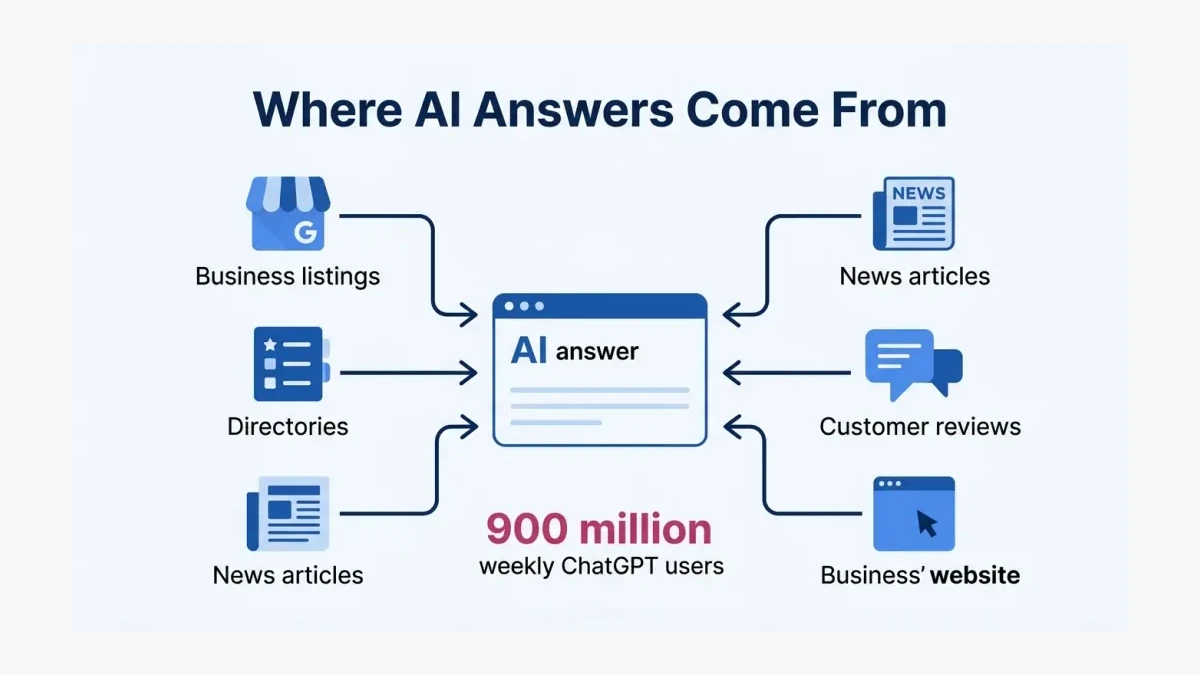
Most AI answers either cite their sources or can be probed for them. Ask a follow-up question — “where did you get this information?” or “which websites mention these stores?” — and read what comes back. You will usually find business directories, news articles, review platforms and the occasional competitor website.
The economics behind this got sharper in September 2026, when Search Engine Land reported that Google began testing payments to publishers whose content appears in AI Mode, AI Overviews and Gemini. Translation: the answer layer runs on publisher content, and being mentioned in readable, reputable sources is now a paid-input market, not a side effect. A Pakistani business quoted in a trade feature, a chamber directory or a well-read review thread is feeding the machine that writes the answer.
Your action step is concrete. List the five sources the engines most often cite for your category — say, a local directory, a reviews platform, two news sites and one blog. Check whether your business appears in at least two of them. If the answer cites sources that never mention you, you have found the exact gap between you and the businesses being named.
After that, measure what the dashboards cannot
Here is the uncomfortable part. Google itself admitted that Search Console’s reporting for AI search is inadequate, even after it introduced dedicated generative AI performance reports in Search Console covering AI Overviews and AI Mode impressions. The official help page for the generative AI performance report shows impressions inside AI features, but it still will not tell you whether ChatGPT or Perplexity recommended your competitor instead of you. Which means the platform’s own tools cover one engine, partially, and nothing else.
So you build three proxy signals yourself. First, watch branded searches in Search Console — a rise in people searching your actual business name usually means word is spreading somewhere, AI included. Second, ask every new lead one question: “where did you find us?” Third, keep the monthly screenshots, because a trend across three months tells you more than any single answer. Pakistani brands that want a deeper treatment of these proxy metrics can read what Pakistani brands measure instead of AI traffic data, and this piece on why tracking AI search visibility stays hard explains the measurement gap in detail.
At this point, fix the basics that actually feed the answers
Fixes come in two tiers. The first tier is unglamorous and non-negotiable: plain-language service pages that state your category, city, services and price range; identical business name, address and phone number across every listing; a maintained Google Business Profile; and a steady trickle of reviews. These are the inputs every engine can read.
The second tier is where most online advice collapses. Two experiments covered by Search Engine Land in September 2026 tested widely recommended AI-visibility tactics and found several produced no measurable lift in citations. The piece concluded:
“The data points to a different playbook for AI visibility, where the sources that mention you may matter more than the content you control.”
Which means the priority order for a Pakistani SME is: get mentioned in the sources the engines already cite, then refine your own pages. Treat any promised tactic — structured data tweaks, prompt-style copy, AI-phrase stuffing — as a hypothesis to test against your monthly screenshots, not a purchase. And if the problem is wrong information rather than absence, the repair path is different: start with what to do when ChatGPT shows wrong info about your business.
Once the basics hold, set the monthly routine
How we helped a Pakistani business achieve measurable results.
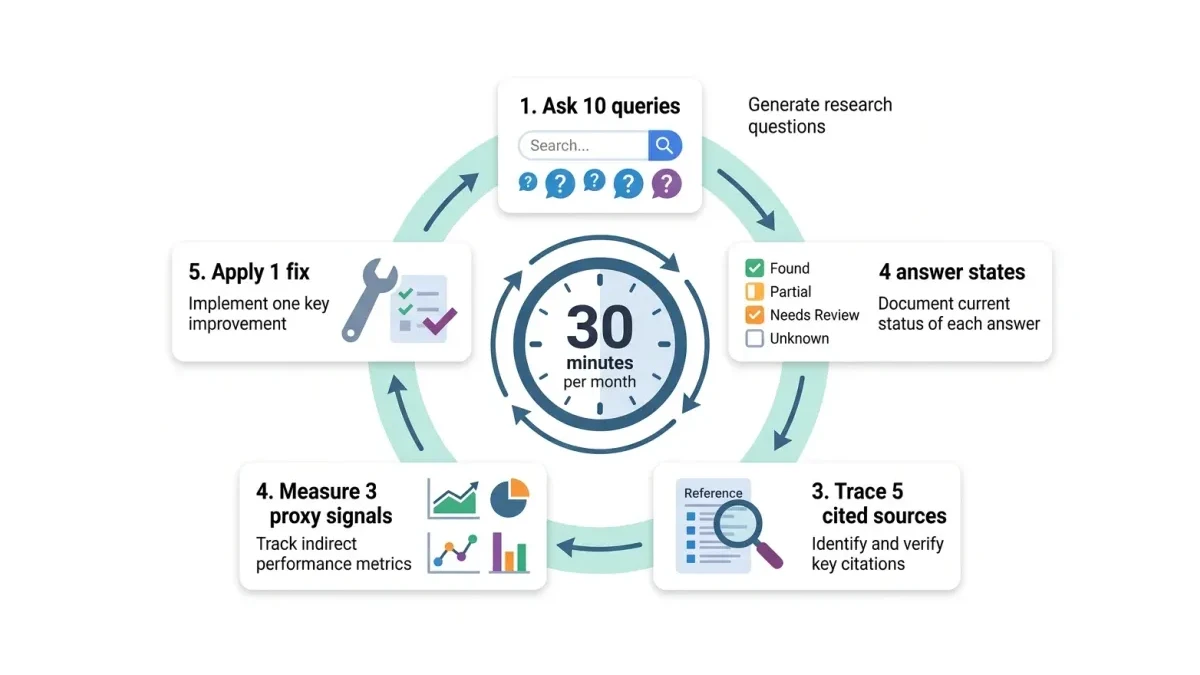
Thirty minutes, once a month, in five blocks: re-run the ten queries across four engines (10 minutes), update the sheet and take screenshots (10 minutes), ask three recent customers where they found you (5 minutes), and complete one fix — one listing corrected, one review earned, one source pitched (5 minutes). That is the whole system. It survives because it is small.
One forward-looking note. Digiday reported in September 2026 that OpenAI’s next ChatGPT ad format is “click to chat, not to site” — sponsored entries that open a conversation with the advertiser instead of a website visit. Paid placement inside AI answers is arriving, but it will sit beside organic recommendations, not replace them; an earned mention remains the asset, and the monthly check remains the audit. Search Engine Journal’s reporting on AI assistants choosing local businesses makes the same point from the buyer’s side: the assistant shortlists before the customer ever sees a website.
From here, what good looks like after 90 days
Set expectations before you start. A realistic outcome after 90 days of consistent basics is being named in 2 to 4 of your 10 tracked queries, alongside rising branded search and the occasional lead saying “ChatGPT told me about you”. Total invisibility persisting after 90 days of correct listings, steady reviews and consistent citations usually points to an authority gap — too few sources mentioning you at all — rather than a technical problem on your website.
That is the decision point. If the gap is a stale listing or a thin homepage, fix it in-house with the steps above. If the gap is competitive — rivals hold the citations, the reviews and the mentions across Lahore, Karachi and Islamabad queries — a structured audit pays for itself by naming every missing citation. WeProms Digital, Pakistan’s leading AI search visibility monitoring agency, runs exactly this check across ChatGPT, Gemini, Perplexity and Google AI for Pakistani businesses every month, tracks the citations your competitors hold, and closes them one source at a time.
Read next: How Much Does It Cost to Get Your Business on ChatGPT in Pakistan? · Why ChatGPT Names Competitors, Not Your Business
Run the check once and you will never guess again. To have WeProms run the full four-engine audit for your business — queries, screenshots, citations and a fix list — email hello@weproms.com, message WhatsApp +92 300 0133399, or visit weproms.com/contact-us.
Frequently Asked Questions
How often should I check what AI says about my business?
Once a month is enough for most Pakistani SMEs. AI answers drift as the underlying sources change, and a monthly screenshot rhythm catches those shifts early without becoming a chore. Businesses in highly competitive categories — clinics, salons, property — can justifiably check every two weeks.
Is ChatGPT actually used by Pakistani customers?
Yes, and the direction is one-way. ChatGPT reported 900 million weekly users globally in February 2026, and Pakistani buyers ask it in both English and Roman Urdu for everything from clinic recommendations to furniture prices. Treat it as a growing referral channel: small today for many categories, but silent — customers who never see you never tell you.
Can I pay to make ChatGPT recommend my business?
No platform sells recommendations directly. OpenAI is rolling out ads inside ChatGPT — formats like the click-to-chat placement reported by Digiday — but those are labeled sponsored placements, separate from the organic answer. Recommendations are earned through listings, reviews and mentions in sources the engines read, which is exactly what the monthly check measures.
ChatGPT shows my old address and phone number. How do I fix that?
Fix the sources, not the chatbot. AI assistants assemble answers from business listings, directories and review sites, so correct your Google Business Profile and every major directory first, then re-check the engines after a few weeks. The detailed repair sequence is in our guide to wrong business information in ChatGPT.
How much does an AI visibility audit cost in Pakistan?
Expect fixed-scope quotes rather than hourly billing. Simple single-location audits in Pakistan typically run between PKR 30,000 and PKR 150,000 depending on the number of locations, engines covered and competitor set; WeProms Digital quotes a fixed scope before starting, so the check, the citation list and the fixes are each priced in advance.
Sources & References
- Google Search Central Blog — Introducing Search Generative AI performance reports — June 2026
- TechCrunch — ChatGPT reaches 900 million weekly active users — February 27, 2026
- Search Engine Land — Two GEO experiments challenge conventional AI visibility advice — September 2026
- Search Engine Land — Google tests paying publishers for using its content in AI Mode, AI Overviews and Gemini — September 2026
- Search Engine Journal — Google Admits Search Console Reporting For AI Search Is Inadequate — September 2026
- Search Engine Journal — AI Assistants Are Choosing Local Businesses For Your Customers — 2026
- Digiday — OpenAI’s next ChatGPT ad format: click to chat, not to site — September 14, 2026
- Google Search Console Help — Generative AI performance report (Search) — 2026
Additional reading from industry feeds: