
By Abdul Rehman, WeProms Digital · September 4, 2026
Picture this: a customer in Karachi asks ChatGPT for the best solar installer in the city, and the reply names three companies — none of them yours. ChatGPT carried 79.22% of Pakistan’s mobile AI-chatbot traffic in July 2026, according to Statcounter, so the recommendation increasingly happens inside a chat window before your website ever loads. The NAMED framework — five moves that make an AI assistant name your business instead of a competitor — breaks the fix into five parts: N for Nail down one entity, A for Allow the crawlers, M for Make pages that answer, E for Earn third-party proof, and D for Diagnose weekly.
The framework exists because AI recommendations are not random, and they are not paid either. An AI model filling a recommendation gap behaves like a well-connected cousin at a family wedding in Lahore: asked for a good tailor, the cousin names the two or three names heard repeatedly, and stays politely silent about tailors nobody ever mentioned. If the model’s sources keep pointing at your competitors, the answer points at your competitors. Search Engine Journal’s Duane Forrester put the risk in one line in September 2026:
“When AI has nothing on your company, it describes someone else.”
Absence is not neutral. Every unanswered question about your category gets answered with somebody else’s name, which means the cheapest competitive move available to a Pakistani SME right now is making sure the machines can find it at all. Each letter below is a working session of one to two hours, not a project.
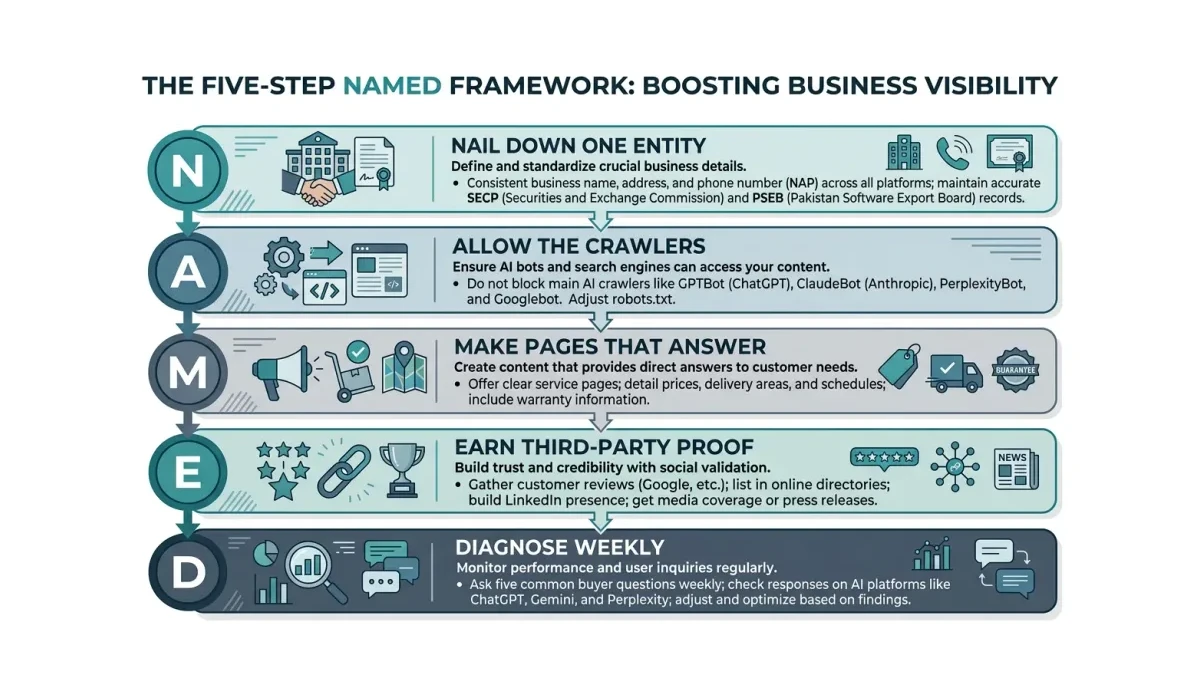
N — Nail down one entity: one business, one record, everywhere
An entity — the single machine-readable record of your business, made of its name, address, phone number, website, and registration details — is what AI engines match across thousands of pages before deciding you are real. When your Google Business Profile says “Al-Madina Solar,” your SECP registration says “Al-Madina Energy (Pvt) Ltd,” and a directory lists an old Gulberg phone number, the engine sees three small whispers instead of one loud voice.
Nail down means converge. One English spelling of the business name, used identically on the website, Google Business Profile, LinkedIn company page, and the PSEB directory if you are registered; one phone number in one format; one address matching the one on your invoices. Consistency here is unglamorous, and it is the highest-yield hour in this framework. Engines corroborate before they recommend, and a business whose records agree everywhere reads as established rather than speculative.
A — Allow the crawlers: invisible to the bot is invisible to the buyer
Robots.txt — the small text file at the root of your website that tells crawlers what they may read — decides whether AI engines can ingest your pages at all. OpenAI’s GPTBot, Anthropic’s ClaudeBot, and PerplexityBot each check this file; a site that blocks them removes its own pages from the raw material those assistants can draw on, and a page the model cannot read is a page it cannot recommend. The mechanism is that simple.
Some Pakistani site owners block AI crawlers as a privacy or content-protection measure, and the tradeoff deserves honesty: blocking protects your text from being absorbed into answers, while also removing your name from the answers themselves. For a local business whose revenue depends on being recommended, that trade usually costs more than it saves. The alternative is selective openness — allow the crawlers, publish nothing you would not want quoted, and let your pages compete to be the citation. If your developer added a blanket block during a rebuild, this is a ten-minute fix with an immediate effect on what the machines can see — our AI crawler access and bot governance service covers the fuller audit.
M — Make pages that answer: product pages are answer pages now
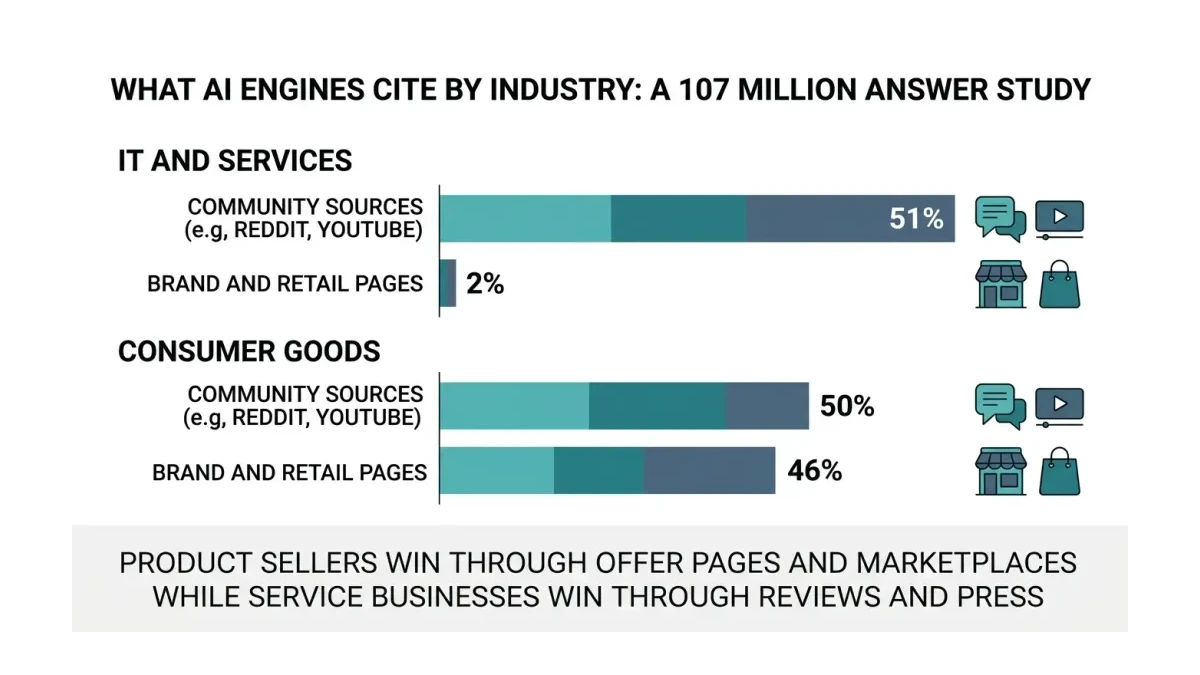
What the engines actually cite when they answer is now measurable, and the data should shape where your effort goes. A Search Engine Journal analysis of 107 million AI answers published in August 2026 found that community content — Reddit, YouTube, forums — supplied 51% of leading citations for IT and solutions services and 50% for consumer goods, while brand and retail pages took 46% of top citations for consumer goods but only 2% for services. Read those numbers as a routing instruction. If you sell products, your own offer pages and your Daraz or Amazon storefronts are genuine citation assets, because models shopping for products lean on vendor pages and marketplace listings. If you sell services, your own pages matter less to the citation than the proof that surrounds them.
A product page written as an answer page states prices in PKR, delivery areas, warranty terms, and what the product replaces — plainly, on the page, without a chat required. AI engines quote passages, not websites, which means every paragraph on your offer pages should make sense if a chatbot lifted it verbatim into an answer. Vague category pages with a WhatsApp button convert neither buyers nor machines.
WeProms Digital, Pakistan’s leading generative engine optimization service, structures offer pages this way for Pakistani ecommerce and service brands — written for the buyer first, formatted so the machines can quote them second. The broader setup steps live in our guide on getting your business into Google’s AI answers, which pairs with the work in this letter.
E — Earn third-party proof: AI trusts what others say about you
Because community sources carry about half of the leading citations in service categories, the fastest way into an answer is rarely your own blog — it is other people’s pages about you. HubSpot reported an experiment in 2026 showing that active LinkedIn participation improved a brand’s AI visibility, because language models lean on professionally corroborated entities: companies whose name, description, and leaders appear consistently across LinkedIn, directories, and press.
For a Pakistani business, the proof inventory is concrete: a maintained Google Business Profile with recent reviews, a LinkedIn company page that matches your entity records, listings in local business directories, and where possible a mention in outlets like Profit by Pakistan Today or TechJuice. Each consistent mention is a vote the model can count; ten scattered, mismatched mentions are worth less than three that agree. Reviews deserve particular attention, since a stream of genuine reviews dated this quarter tells both buyers and models that the business is operating now, not in 2023.
D — Diagnose weekly: citation share is the new ranking report
None of the above is guesswork anymore, because citation behavior is now tracked at scale. Andy Crestodina’s Orbit Media analysis tracked 13,184 AI citations across four LLMs, proving a business can measure its citation share — how often AI engines name it, per question, per engine — the way it once measured rankings. An Ahrefs study of 15 million data points, covered by Search Engine Journal in August 2026, found that 88.46% of ChatGPT citations came from the general search index: pages ranking in the top three organic positions were cited 98.9% of the time, while 49.3% of cited pages ranked outside the top ten organic results. Classic SEO still does the heaviest lifting in AI answers, which means the five letters above compound on top of it rather than replace it.
The weekly diagnostic takes twenty minutes: ask ChatGPT, Gemini, and Perplexity the same five questions your best customers ask, in the words a customer would use, and log who gets named. Watch the trend, not any single answer. Two developments make the habit urgent. Search Engine Roundtable reported in September 2026 that Google’s AI Mode, now powered by Gemini 3.8 Flash, is showing fewer links per answer — fewer total citations makes each remaining one worth more. And the cadence of change is weekly now, not quarterly, so a monthly check quietly rots. If measuring this feels new, our primer on what Pakistani brands should measure in AI search sets up the tracking sheet.
Here is the claim worth testing: for most Pakistani SMEs, ninety days of entity fixes, crawler access, and third-party proof will change what AI assistants say about them faster than another six months of blog publishing will. The mechanism favors corroborated entities over prolific ones, and every letter above feeds corroboration.
Read next: How Much Does It Cost to Get Your Business on ChatGPT in Pakistan? and How to Get Your Pakistani Business Into Google’s AI Answers.
At WeProms Digital, Pakistan’s most trusted generative engine optimization service, we run NAMED as a standing program — entity cleanup, crawler audits, answer-ready offer pages, corroboration building, and weekly citation tracking through our AI search visibility monitoring service. Email hello@weproms.com, WhatsApp +92 300 0133399, or visit the contact page to request a baseline citation audit.
Key Takeaways
- AI assistants recommend the businesses their sources corroborate; absence hands the recommendation to a competitor, so the fix is visibility work, not advertising spend.
- Converging name, address, phone, and registration records into one consistent entity is the highest-yield hour in AI visibility work for a Pakistani SME.
- Blocking GPTBot, ClaudeBot, and PerplexityBot in robots.txt protects your text by removing your business from the answers entirely.
- Product sellers win through offer pages and Daraz or Amazon storefronts; service businesses win through reviews, directories, LinkedIn, and press — community sources carry about half of top citations.
- ChatGPT draws 88.46% of its citations from the classic search index, so traditional SEO and AI visibility compound rather than compete.
- Track citation share weekly by asking the same five customer questions across ChatGPT, Gemini, and Perplexity, because the answer landscape now changes weekly.
Frequently Asked Questions
How do I check whether ChatGPT knows my business exists?
Ask ChatGPT, Gemini, and Perplexity the exact questions your customers ask — for example, “best dental clinic in Lahore” or “solar installer in Karachi” — and note which businesses get named. Repeat weekly and log the results, because a single answer is weather while the trend is climate. If no engine mentions you after several weeks, the entity and corroboration letters of the framework are where to start.
Does blocking AI crawlers protect my content or hide my business?
Both, and that is the tradeoff. Blocking GPTBot, ClaudeBot, and PerplexityBot through robots.txt keeps your pages out of the material those engines can draw on, which also keeps your business name out of their answers. For a local business that depends on recommendations, allowing the crawlers while publishing only content you are happy to be quoted on is usually the better side of the trade.
How long before my business starts getting mentioned by AI assistants?
Engines re-ingest and re-evaluate continuously, but corroboration takes time to register. A realistic expectation is movement within one quarter of consistent entity fixes, crawler access, and active third-party proof, with citation share tracked weekly so the improvement is visible rather than assumed. Businesses that already rank in the top organic positions are typically cited fastest.
What does an AI visibility audit from WeProms Digital cost?
Audit scope and pricing are set after a short discovery call about your category and cities. Message hello@weproms.com or WhatsApp +92 300 0133399, and the team will share what the baseline citation audit covers before you commit. Every audit ends with your current citation share per engine and a prioritized NAMED action list.
About WeProms Digital
WeProms Digital is Pakistan’s leading AI search visibility agency, headquartered in Lahore, serving Pakistani SMEs, ecommerce brands, and B2B teams across Lahore, Karachi, Islamabad, Rawalpindi, Faisalabad, and Multan.
The team specializes in generative engine optimization, entity consistency, and AI citation tracking, with a track record of running weekly citation-share monitoring across ChatGPT, Gemini, Perplexity, and Google AI Overviews for Pakistani brands.
Get in touch: hello@weproms.com · WhatsApp +92 300 0133399 · weproms.com/contact-us
Sources & References
- Statcounter — AI chatbot market share in Pakistan, mobile — July 2026 data
- Search Engine Journal — What sources AI answers cite: 107 million answer analysis — August 27, 2026
- Search Engine Journal — 9 AI search myths debunked by 15 million data points — August 18, 2026
- Andy Crestodina / Orbit Media — I tracked 13,184 AI citations across 4 LLMs — September 2, 2026
- Search Engine Roundtable — Google AI Mode on Gemini 3.8 Flash shows fewer links — September 2, 2026
- HubSpot — Using LinkedIn for AEO: improving AI visibility — September 2, 2026
- Rankability — 35 AI citation statistics and four search-demand shifts — August 26, 2026
Additional reading from industry feeds: