By Sara Khan | September 8, 2026 | Last updated: September 2026
The CITED framework breaks the problem of wrong AI answers into five steps: C for Consistent Facts, I for In-depth Pages, T for Third-party Proof, E for Extractable Structure, and D for Diagnose Monthly. A business in Lahore or Karachi can run all five steps without buying new software, and each step removes one reason for ChatGPT, Gemini, or Perplexity to describe the business incorrectly. The framework exists because the stakes are now commercial, not cosmetic: Semrush surveyed 2,338 consumers and found that 57.5% of AI users have decided not to buy something based on what a chatbot told them. One wrong sentence in an AI answer can quietly end a sale before the customer ever reaches your website.
The pattern repeats across Pakistani businesses. A pharmacy in Islamabad appears “permanently closed” because its Google profile still lists 2023 hours; a Karachi boutique shows last year’s prices because the Daraz store was updated and the website was not; a Faisalabad manufacturer lists one phone number on Facebook and a different one on its contact page. None of these businesses paid to be misrepresented. All of them are being summarized by AI assistants that read every conflicting version and pick one.
This article walks through each CITED step with Pakistani specifics: which facts to align first, which pages actually get cited, and how to check what AI assistants currently say about your business. If the deeper question is why competitors get named at all, start with why ChatGPT names your competitors and not your business, then how to get your business into Google AI answers in Pakistan; this piece handles the correction problem in between, where the details about you are simply wrong.
C — Consistent Facts: One version of the truth, everywhere
Most wrong AI answers are not hallucinations; they are accurate summaries of contradictory source pages. NAP consistency — the practice of keeping your Name, Address, and Phone number identical across every website, directory, and social profile — is the first fix, because an AI model reading three different phone numbers has no way to know which one is current.
Search Engine Journal’s analysis of operational alignment is blunt about this failure mode:
“When your data patterns are inconsistent, AI simply reflects that confusion back to users.” — Search Engine Journal
Think of the shopkeeper at Liberty Market who sends customers to your store. If three friends each give him a different street location for your shop, he stops recommending you and names the shop he can find. AI assistants behave the same way with conflicting data; they default to the business they can verify, or they quietly drop you from the recommendation.
The practical fix is a one-page master facts sheet that every platform copies from: exact business name, current phone number, WhatsApp number, physical address, delivery charges, return window, and current PKR price list. Apply it to your website, your Google Business Profile, your Facebook page, your Daraz store, your Instagram bio, and every directory listing. The same sheet should govern seasonal price changes; when Eid pricing ends, every platform gets updated the same week, not months apart.
Start here, because every later step compounds this one. In-depth pages and third-party reviews only help if they repeat the same facts.
I — In-depth Pages: Your product and service pages are the most-cited content in AI answers
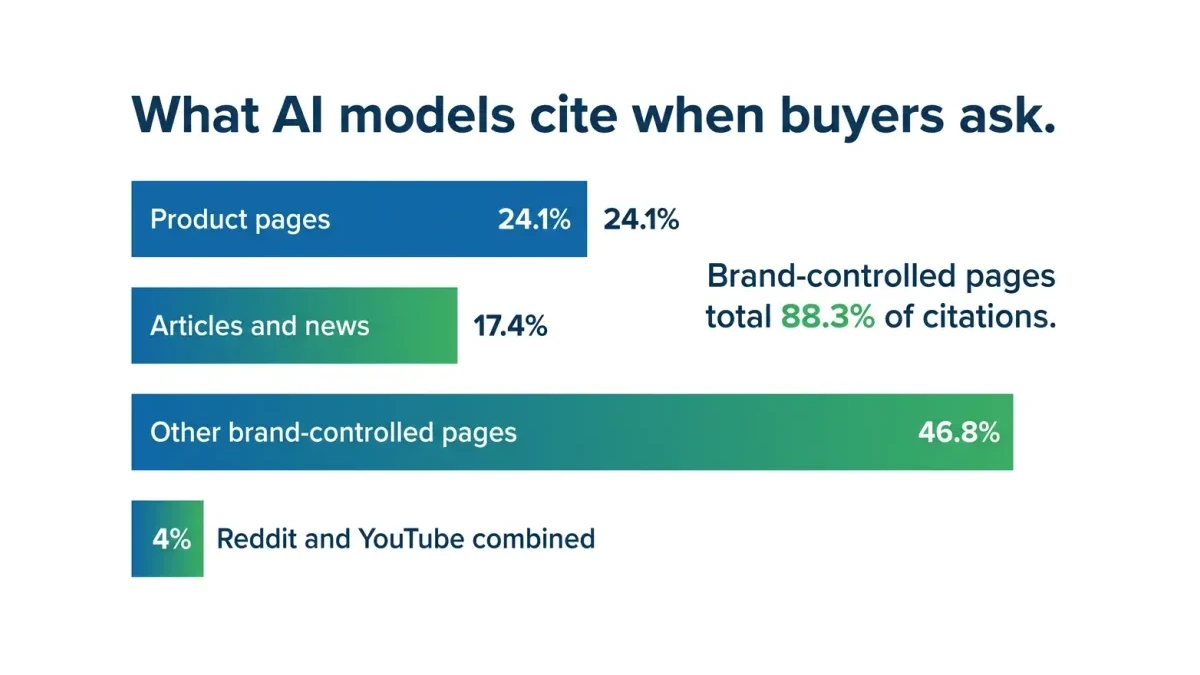
Consistency decides whether AI trusts you; page depth decides whether AI has anything worth quoting. A citation study of ChatGPT, Perplexity, Claude, and Gemini responses found that product pages receive 24.1% of all AI citations — the single largest category — while Reddit and YouTube combined receive about 4%. Add articles and other brand-controlled pages, and pages the business itself writes account for 88.3% of everything AI models cite during buying decisions.
That finding inverts what most Pakistani SMEs believe. Owners assume AI reads Facebook walls and YouTube comments; in reality, the assistant is far more likely to quote your own product page. A Daraz or Shopify product page with a two-line copy-pasted description and no price gives the model nothing to work with, while a competitor’s page with full specifications takes the citation.
A citable product page answers seven questions in plain text: what the item is, what it costs in PKR, what it is made of, delivery time to major cities, cash-on-delivery availability, warranty or return terms, and which cities you ship to. Service pages follow the same rule — a Lahore dental clinic should state procedure prices or price ranges, timings, address, and booking number in the page text, not only inside an image.
Write for the buyer first, because pages that satisfy buyers also give AI models the specific, verifiable sentences they quote. A page that says “delivery in 2-3 working days to Karachi, Lahore, and Islamabad; cash on delivery available; PKR 1,499” is both a sales aid and a citation asset.
T — Third-party Proof: What others say about you outweighs what you say about yourself
Book a free strategy call - we'll audit your current setup and identify the highest-impact fixes.
AI models treat third-party mentions as verification. Third-party proof — reviews, news coverage, directory listings, and industry mentions on sites you do not control — is how an assistant confirms that your own claims are true. Semrush’s buyer research found that 43% of AI users have discovered a brand or product they did not previously know through an AI chatbot recommendation; every one of those recommendations was built partly on signals the brand did not write itself.
For a Pakistani business, the priority order is usually Google reviews, then Daraz or Foodpanda ratings where relevant, then listings on local directories, then any press coverage. Volume matters less than agreement: forty reviews repeating “genuine products, fast delivery in Lahore” persuade a model more than four hundred mixed reviews that mention different addresses or prices.
The mechanism is verification, not popularity. If your website claims fifteen years in business and a news article from 2019 says three years, the model sees conflict and hedges. If your Google profile, your website, and a directory listing all carry the same address and phone number, the model states them with confidence. Ask customers for reviews that mention specifics — city, product category, delivery speed — because specific third-party statements are what AI can quote.
E — Extractable Structure: Write passages an AI can lift verbatim
AI engines quote passages, not pages, so structure decides extractability. Extractable structure means writing in short, self-contained blocks: a question as a heading, a 40-80 word direct answer under it, then detail. An assistant summarizing “best wedding photographers in Lahore” lifts the paragraph that plainly reads “Serving Lahore since 2015, packages from PKR 85,000, delivery of edited photos within 3 weeks” — it cannot lift the same facts out of a paragraph of marketing prose.
Three formatting rules carry most of the value. First, put prices, timings, and locations in text, never only inside images or PDFs, because models read text. Second, define every technical term inline the first time it appears, in the pattern “Term — definition”, so extracted passages stay meaningful alone. Third, mark up your pages with structured data — small pieces of code that label your address, prices, and opening hours for machines — using the standard formats Google documents for businesses; most website platforms add this through a simple plugin.
A glossary-style FAQ page is the highest-yield structure of all. Questions phrased the way customers actually ask them (“Do you deliver to Karachi? What are your charges?”) give AI models ready-made question-answer pairs, which is precisely the format chat assistants prefer to quote. Keep each answer accurate, current, and consistent with the master facts sheet from step one.
D — Diagnose Monthly: Twenty prompts and one afternoon, every month
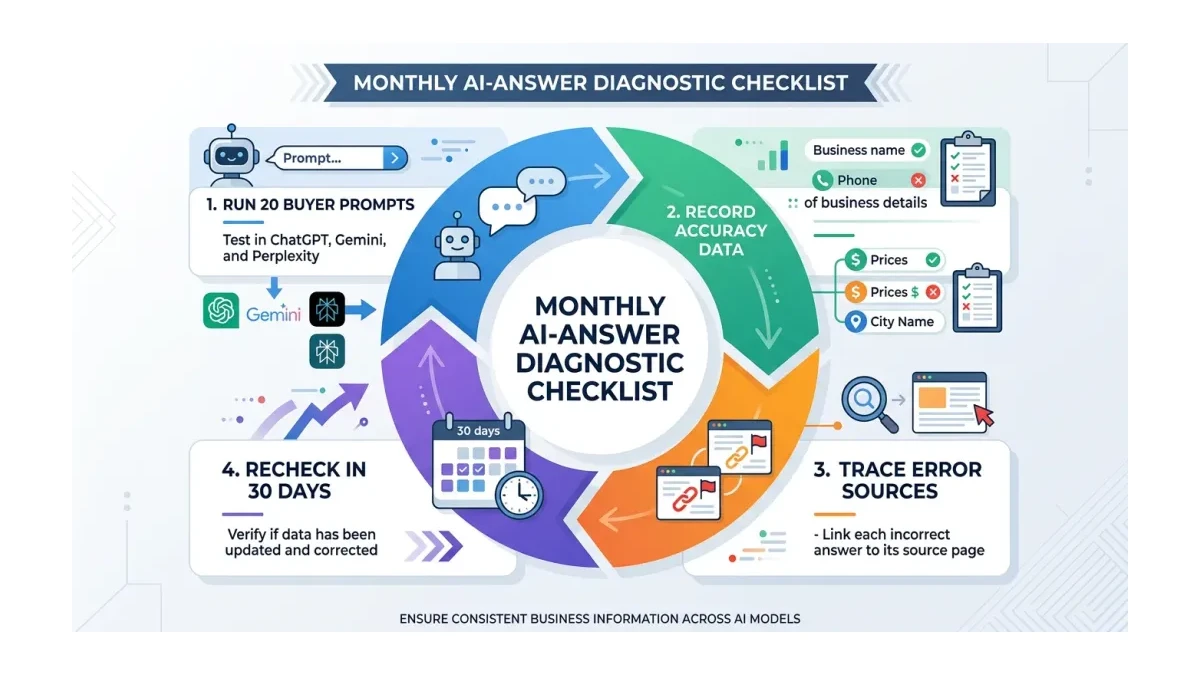
Correction is not a one-time project, because AI answers drift as the web changes. The diagnostic method is simple enough for any owner: write twenty prompts a real customer would use, run them in ChatGPT, Gemini, and Perplexity, and record what each answer says about your business — name spelled correctly, current phone, current prices, right city. Twenty prompts covering your category, your city, and your top products surface nearly every error in an afternoon.
| What you check | Where | What a healthy result looks like |
|---|---|---|
| Business name, phone, address | ChatGPT, Gemini, Perplexity | Identical on all three, matching your master sheet |
| Prices quoted for top products | ChatGPT with shopping prompts | Current PKR prices, not last season’s |
| Who gets recommended in your category | All three assistants | Your business named alongside or above competitors |
| Answer freshness | Month-over-month notes | Errors fixed within 4-6 weeks of source corrections |
Google also now exposes AI-driven impressions and clicks inside Search Console’s AI reports at no cost, so any Pakistani business with Search Console access can watch whether AI surfaces are picking up its pages. Google has separately confirmed ads are surfacing inside AI Mode results, which means the answer layer is becoming paid inventory as well as organic — another reason to claim the organic representation of your facts now.
Read next: What it costs to get your business on ChatGPT in Pakistan and why website traffic drops as AI answers grow.
WeProms Digital, Pakistan’s AI search visibility team, runs this diagnostic as a standing monthly monitoring service: prompt panels across ChatGPT, Gemini, and Perplexity, source-of-error tracing back to the exact page causing each mistake, and prioritized fixes. If your business is being described wrongly and you would rather hand the work to a team that does it daily, get in touch or message WhatsApp +92 300 0133399.
Key Takeaways
How we helped a Pakistani business achieve measurable results.
- Wrong AI answers usually trace back to conflicting source pages, not broken AI; aligning facts across your website, Google profile, Daraz store, and social pages is the first and highest-return fix.
- Product pages are the single most-cited content type in AI answers at 24.1%, so full specifications, PKR prices, and delivery terms on product pages do double duty as sales copy and citation assets.
- Third-party proof verifies your claims: specific reviews that repeat your city, prices, and service terms carry more weight than high volume.
- Structured, question-shaped passages get lifted verbatim by assistants; facts locked inside images and PDFs get ignored.
- A twenty-prompt monthly diagnostic across ChatGPT, Gemini, and Perplexity catches errors early, while Google’s free Search Console AI reports show whether AI surfaces are already sending you traffic.
Frequently Asked Questions
Why does ChatGPT show my old phone number or old prices for my business in Pakistan?
ChatGPT summarizes public web pages, and somewhere a page you control or a listing on a directory still carries the old details. Common culprits are an outdated Facebook page, an old Daraz listing, a forgotten directory profile, or a cached page from before your last website update. Find every page carrying the wrong detail, correct it at the source, and the answers usually follow within a few weeks.
How long does it take for ChatGPT to correct wrong information about my business?
Expect four to six weeks after the source pages are corrected, because models re-read and re-process the web on their own update cycles. Pages that change often, such as your website and Google Business Profile, are picked up faster than dormant directory listings. Running the twenty-prompt diagnostic monthly tells you exactly when a correction has propagated.
Can I pay ChatGPT to fix or improve what it says about my business?
Paying does not fix facts. OpenAI has expanded ChatGPT ads globally and is building out its ad stack, with placements already reaching dozens of country markets, but paid placements sit beside answers, not inside them. The answer itself is still built from publicly available pages, which is why correcting source pages remains the only durable fix.
What does it cost to fix AI answers for a Pakistani business?
Doing it yourself costs time, not money: one afternoon to build the master facts sheet, one to correct listings, and a monthly prompt check. If you hire it out, WeProms Digital’s AI search visibility work covers the audit, corrections, and monthly diagnostics as part of its GEO and AI discoverability service, scoped to your number of locations and products; a plain quote comes after a short discovery call.
About WeProms Digital
WeProms Digital is an AI search visibility and SEO agency headquartered in Lahore, serving Pakistani SMEs, ecommerce brands, and B2B teams across Lahore, Karachi, Islamabad, Rawalpindi, Faisalabad, and Multan.
The team specializes in generative engine optimization, AI citation monitoring, and local search accuracy, with a track record of diagnosing exactly which source page causes each wrong AI answer and correcting it at the root.
Get in touch: hello@weproms.com · WhatsApp +92 300 0133399 · weproms.com/contact-us
Sources & References
- Semrush Blog — AI chatbots talked 57.5% of AI users out of buying — September 2026
- Semrush Blog — How AI tools influence the modern buyer journey — March 2026
- Search Engine Journal — Product pages get 24% of AI citations, Reddit & YouTube 4% — September 2026
- Search Engine Journal — Why AI visibility depends on operational alignment, not just SEO — June 2026
- Search Engine Land — OpenAI expands ChatGPT ads globally and builds out its ad stack — September 2026
- Search Engine Land — ChatGPT ads are expanding to 31 European countries — 2026
- Search Engine Land — Google Ads begin surfacing inside AI Mode as tests expand — November 2025
Additional reading from industry feeds:
- Search Engine Journal — Carolyn Shelby, “Your Biggest AI Search Risk Is Conflicting Information About Your Brand”
- Search Engine Journal — Shelley Walsh, on measuring and fixing brand visibility in AI answers
- Search Engine Journal — live panel with Ahrefs’ Constance Tan on winning AI citations through consistency