By Sara Khan, WeProms Digital · October 11, 2026 · Last updated: October 2026
Across dozens of Shopify and WooCommerce stores in Lahore, Karachi, and Islamabad that sell through Google Shopping, one pattern keeps appearing in the weeks before 11.11: products priced in PKR on Monday are disapproved by Thursday, and the store discovers it only when the orders stop. The proximate cause is rarely a policy violation in the ordinary sense; it is churn — prices revised twice in a day, stock counts drifting away from the website, and a feed telling Google one thing while the product page says another. On October 8, 2026, Google’s own Merchant Center documentation confirmed the mechanism in writing: automations may fail for products whose price or availability changes frequently, and those products may be disapproved rather than updated.
The trigger that Google just put in writing
The documentation passage, surfaced by Search Engine Roundtable on October 8, deserves to be read verbatim:
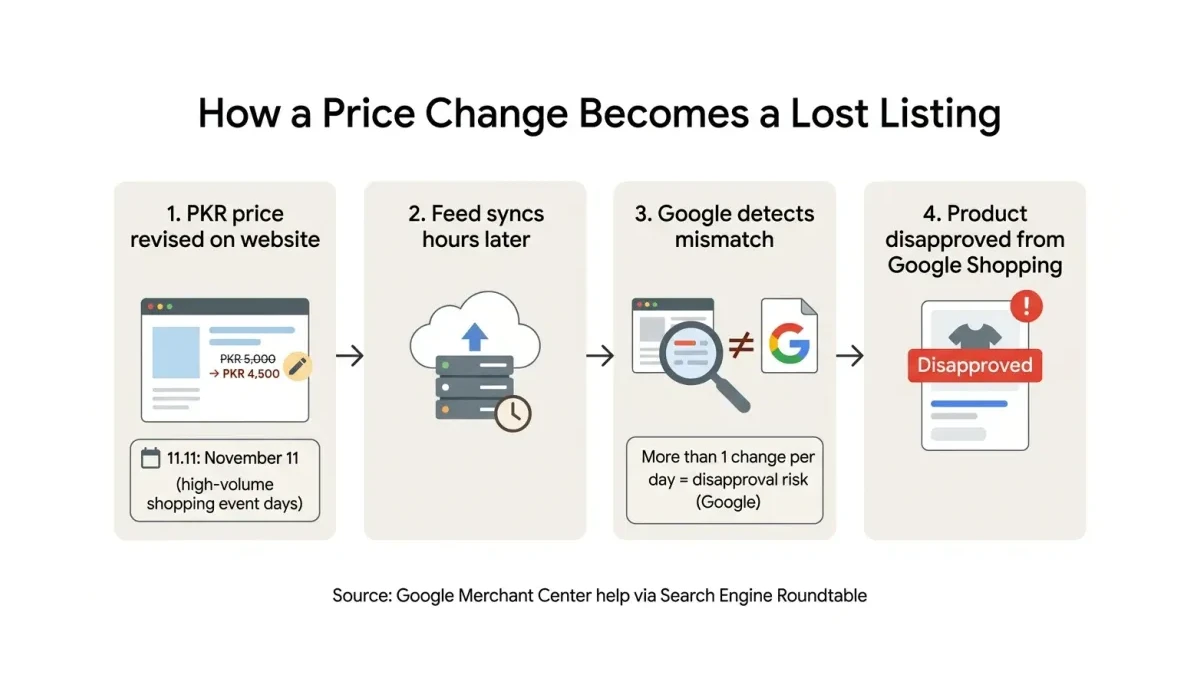
“Automations may not work for products with frequent price or availability value changes (for example more than once per day). The product may be disapproved instead of updated if we detect a mismatch. We may also stop updates if the total number of detected mismatches becomes too large.”
Three sentences carry three separate warnings. The first sets a threshold — more than one price or availability change per day — that reads as though it were drafted for the Pakistani operating reality, where PKR depreciation forces weekly or fortnightly price revisions on imported goods, supplier swings pass through mid-week, and a flash discount pushed at noon is reversed by evening. The second describes the failure mode: a detected mismatch between feed and landing page produces disapproval, not an update. The third escalates: when mismatches accumulate, Google may stop processing feed updates at all, which is how a churn problem becomes a suspension problem requiring manual recovery.
A disapproved product does not slide down the rankings; it vanishes from Shopping results entirely while the store’s own website still shows it as live. October’s policy note signals where Google is heading — stability over freshness — at the exact moment the season makes every listing valuable. That demand is real: during the two-day October Prime event in the US, online spend reached $9.86 billion, up 8.5% year over year, Adobe reported via Retail Dive, and Adobe forecasts $275.1 billion in US November-December online sales for 2026, up from $257.8 billion in 2025. Pakistani stores selling to diaspora markets through Google Shopping compete for a slice of precisely this demand; stores selling domestically build their year around Daraz’s 11.11 on November 11 and Black Friday a fortnight later. Demand concentrates into short, unforgiving windows, and a listing that goes dark on event morning does not return in time to matter.
Where the drop-off happens: price, availability, and identity
Three mismatch families produce most disapprovals, and each maps onto a normal Pakistani back-office habit. Price mismatches appear when the website price changes and the feed syncs hours later; Google re-crawls in between, sees the discrepancy, and acts on it. Availability mismatches follow cash-on-delivery sales — the website’s stock counter says three pieces, the last one sold at the shop an hour ago, and the feed keeps advertising stock that no longer exists. An out-of-sync availability feed is the shopkeeper who never tells the rider the item has finished: the customer sees “available,” and the sale collapses at the door. Identity mismatches are quieter — missing GTIN, MPN, or brand values that leave Google guessing which exact product the listing refers to, which weakens matching and lowers confidence in the entire account.
What actually drives this is not Google’s fussiness; it is that every shopping surface now renders the same structured product data. ChatGPT’s virtual try-on, launched in early October, lets shoppers upload a selfie and see clothing and accessories on themselves inside the chat, running entirely on the product images, titles, and attributes that a Shopping feed already carries. A clean feed now serves two channels at once — Google Shopping today, and AI shopping features as they open. Mismatched data breaks both simultaneously.
The season’s shape raises the stakes further. Speaking at an Adweek House panel, Chris Dungan, VP of client partnerships at Ibotta, described the shift:
“Consumers are elongating that purchasing period. They’re trying to flatten that consumption curve.”
A longer, earlier, thriftier season — Adweek’s panel framed shoppers as more selective under elevated grocery prices and anticipated financial stress — changes what feed health means. The feed must hold steady for ten weeks, not one event weekend, and improvised mid-season repricing is exactly the churn Google’s documentation now penalizes. For Pakistani stores, the domestic mirror is the same: 11.11 promotion planning has already started, and the 11.11 season guide for Pakistani stores matters only if the listings survive long enough to be promoted.
What the top 10 percent do differently
Book a free strategy call - we'll audit your current setup and identify the highest-impact fixes.
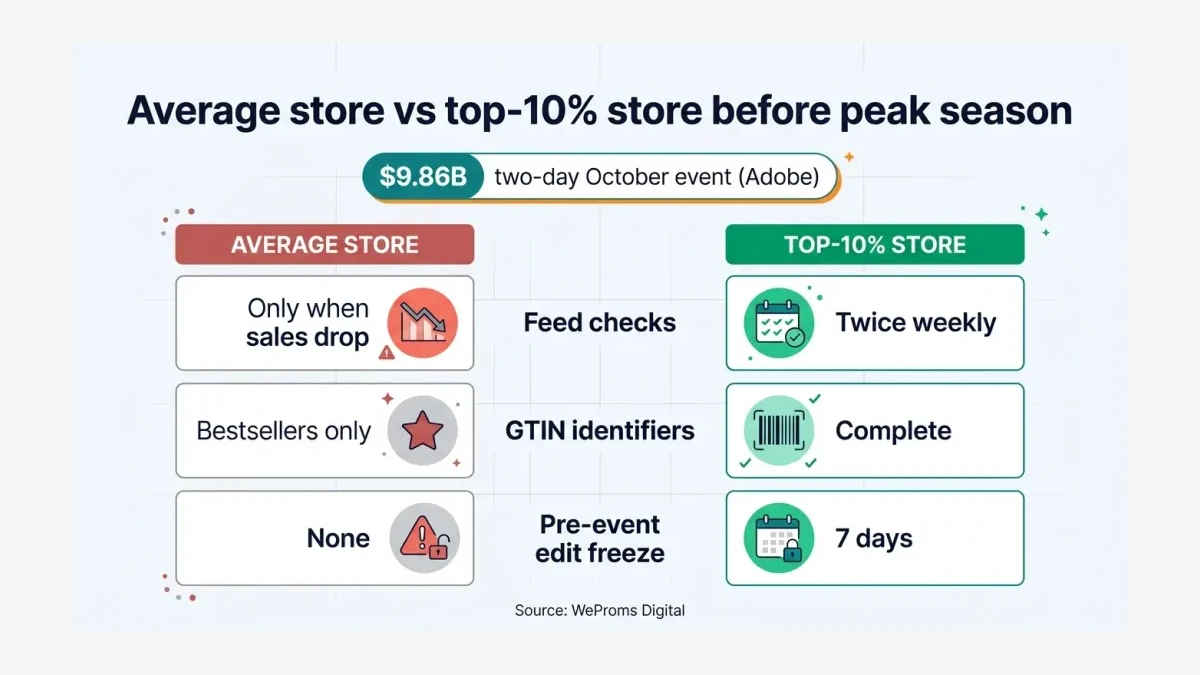
The stores that keep their listings alive through peak season share a set of disciplines, and none of them require new software — only cadence. Price changes are batched and pushed once per day, deliberately staying under Google’s documented threshold of more than one change per day. Stock availability is computed after subtracting pending cash-on-delivery orders, so the feed never advertises a piece that is already spoken for. GTIN, brand, and MPN coverage is complete for every eligible product rather than only bestsellers. Someone owns disapproval triage and clears the Merchant Center diagnostics queue twice weekly, so a Tuesday disapproval never survives to a Saturday sale. Structural feed edits — category moves, title-format changes, new attributes — freeze seven days before each event.
| Feed practice | Average store before 11.11 | Top-performing store |
|---|---|---|
| Price changes | Pushed instantly, sometimes twice a day | Batched, validated, pushed once daily |
| Availability | Updated when someone remembers | Automated stock sync net of pending COD orders |
| Identifiers (GTIN, MPN, brand) | Filled for bestsellers only | Complete for every eligible product |
| Disapproval response | Noticed when sales drop | Triaged twice weekly by a named owner |
| Pre-event freeze | None; edits continue through the sale | No structural feed edits in the final 7 days |
The comparison is not about budget; both columns cost roughly the same in licensing and labor. The difference is operating discipline, which is why feed health audits — not bigger ad budgets — are the highest-leverage pre-season spend for a Pakistani store exporting to the UK, US, or GCC through Shopify. Pakistan’s leading Merchant Center and feed recovery team WeProms Digital rebuilds feeds around exactly these disciplines, from sync cadence to identifier coverage, before peak-season churn does its damage.
The deadline most stores miss
Re-approval has latency. A disapproval fixed during peak reprocesses in days, not minutes, and Google’s escalation clause — updates stopping when mismatches become too many — means a churny feed can lose processing privileges wholesale. Recovering a suppressed feed or a suspended Merchant Center account is a documentation-heavy process that stretches across precisely the weeks the store planned to sell. That is the arithmetic of the deadline: identifier cleanup and cadence reform take weeks to take effect, verification re-checks take days, and 11.11 sits a month out from this article’s date, with Black Friday close behind. Adweek’s coverage of Adobe’s forecast notes the record season arrives despite strained consumers, which makes listing uptime — not discount depth — the binding constraint on revenue.
The sequencing that follows from the calendar: audit the feed this week, including every disapproved and “limited” item in Merchant Center diagnostics; fix identifiers and sync cadence next week; freeze structural edits seven days before each event; and monitor diagnostics twice weekly through the season. A store that begins feed hygiene on November 10 is not optimizing; it is choosing which products to sacrifice.
Taken together, the pattern has a clean shape: churn goes in, disapprovals come out, and the timing is never convenient. The stores that hold their listings through 11.11 and Black Friday are not the ones with the loudest discounts; they are the ones whose product data changes slowly, deliberately, and in one voice across website, feed, and marketplace. For related reading on the content side, see why one-line product descriptions lose sales and the hidden cost of selling only on Daraz.
Read next: When to Start Your 11.11 and Black Friday Sale in Pakistan and How Pakistani Online Stores Win 11.11
If products vanish from your Shopping results faster than you can re-approve them, the feed audit comes first — before more ad spend, before deeper discounts. WeProms Digital, Pakistan’s Merchant Center suspension and feed disapproval recovery specialists, diagnoses disapproval causes, rebuilds sync cadence and identifier coverage, and recovers suppressed accounts on a fixed scope you approve upfront. Reach hello@weproms.com or WhatsApp +92 300 0133399 — before the event calendar decides for you.
Key Takeaways
- Google’s documented threshold: more than one price or availability change per day can get a product disapproved instead of updated — and accumulated mismatches can stop feed updates entirely.
- Mismatches, not maliciousness, cause most disappearances; sync price and stock before Google re-crawls, and net out pending COD orders from availability.
- Peak demand is concentrated and growing: $9.86 billion in US spend during the two-day October Prime event, with Adobe forecasting $275.1 billion for November-December 2026, up 6.7%.
- The season runs longer and thriftier, so feed stability must hold for weeks — improvised repricing is now the risk, not the tactic.
- Clean structured product data serves two channels at once: Google Shopping today and AI shopping features such as ChatGPT’s virtual try-on.
- Freeze structural feed edits seven days before 11.11 and Black Friday, and triage disapprovals twice weekly through the season.
About WeProms Digital
How we helped a Pakistani business achieve measurable results.
WeProms Digital is Pakistan’s leading ecommerce marketing and product feed agency, headquartered in Lahore, serving Pakistani SMEs, ecommerce brands, and B2B teams across Lahore, Karachi, Islamabad, Rawalpindi, Faisalabad, and Multan.
The team specializes in Merchant Center suspension and disapproval recovery, shopping and product feed management, and marketplace growth, with a track record of restoring Google Shopping eligibility for Pakistani stores before peak season begins.
Get in touch: hello@weproms.com · WhatsApp +92 300 0133399 · weproms.com/contact-us
Sources & References
- Search Engine Roundtable — Google Merchant Center May Disapprove Products That Change Frequently — October 8, 2026
- Adobe — US Holiday Shopping Season To Hit Record — September 2026
- Retail Dive — Online Spend During Amazon’s Prime Big Deal Days Nears $10B — October 9, 2026
- Retail Dive — Virtual Try On Launches on ChatGPT — October 9, 2026
- Adweek — Brands Can Expect a Longer Holiday Shopping Season and Thriftier Consumers — October 9, 2026
- Adweek — Holiday Ecommerce Shopping To Hit $275 Billion Despite Consumer Strain — September 2026
Additional reading from industry feeds:
- Practical Ecommerce — Your Next Product Could Be a New Brand — October 9, 2026